
In my extensive experience within the manganese steel casting foundry industry, particularly in producing wear-resistant components like crusher mantles and concaves for mining applications, I have encountered persistent challenges related to internal defects. These defects, primarily porosity, pinholes, and cracking, often emerge after heat treatment and machining, leading to significant scrap rates and economic losses. The root cause was traced to specific melting practices, prompting a comprehensive investigation and process overhaul. This article details my first-hand account of identifying the issues, developing solutions, and implementing a robust metallurgical process that ensures high-integrity manganese steel castings. The insights shared here are grounded in practical foundry work and are intended to contribute to the broader knowledge base for managing hydrogen-related defects in alloy steel castings.
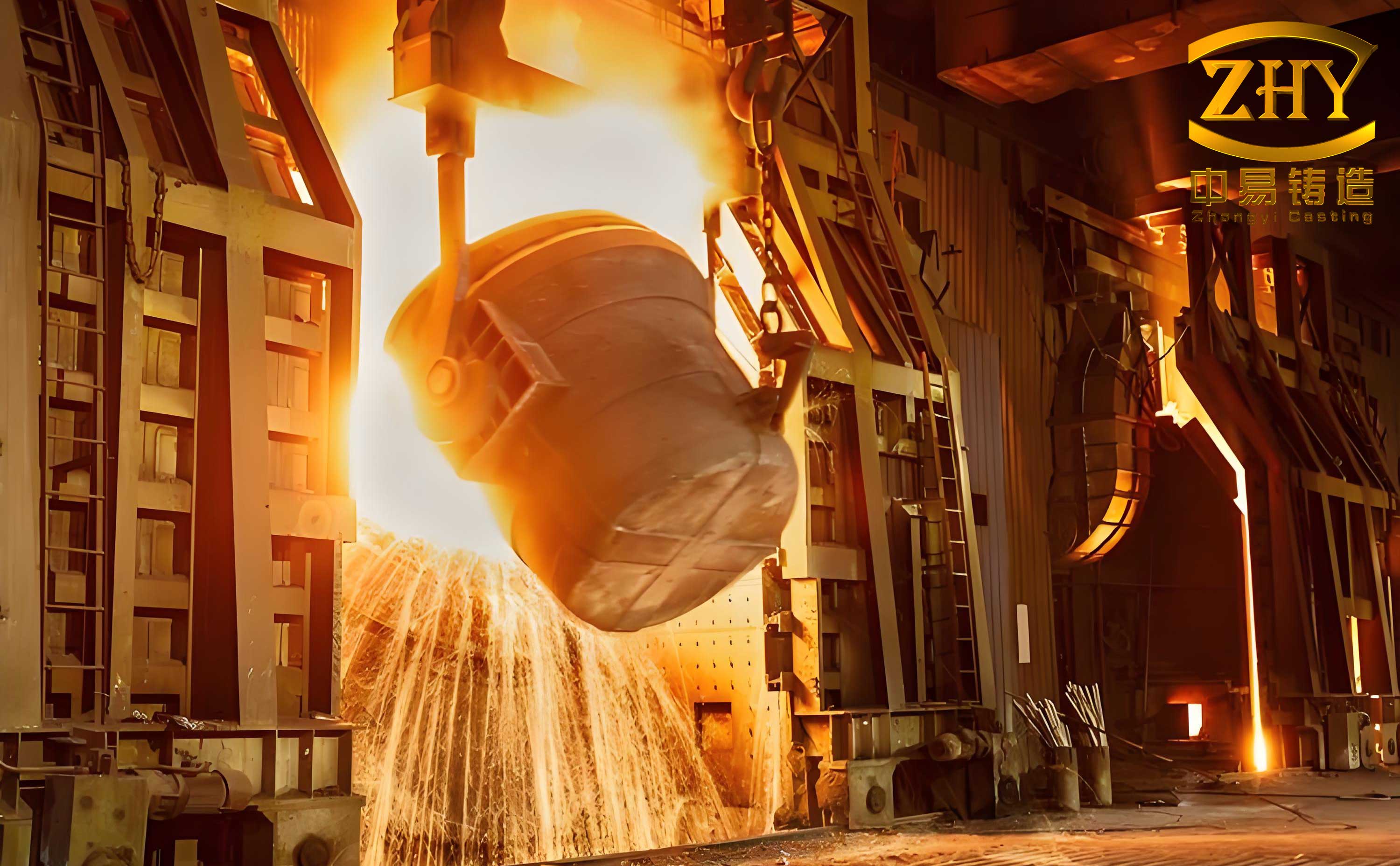
The production of high manganese steel castings, such as those used in crushing equipment, is a core activity for many specialized foundries. The standard material is often ZGMn13 or similar grades, characterized by high toughness and work-hardening capacity. However, the very alloying elements that confer these properties—primarily manganese and silicon—complicate the melting and casting process. In our manganese steel casting foundry, we historically utilized a return scrap melting method to recycle expensive alloy content from gates, risers, and scrap castings, which can constitute up to 50% of the total melt charge. This practice, while economically attractive, initially led to a severe quality issue: castings exhibited gross porosity in riser cut-off areas, fine pinholes on ground surfaces, and cracking after solution heat treatment (austenitization). These defects are visually evident and unacceptable for high-value export contracts, forcing a temporary ban on return melt practice and creating a backlog of unusable scrap. This dilemma sparked a critical analysis of our melting technology.
The fundamental problem was identified as hydrogen embrittlement and gas porosity. In a standard oxidizing melt practice for manganese steel, a deliberate carbon boil (decarburization) is performed. This vigorous CO evolution serves as a powerful purging mechanism, removing dissolved gases like hydrogen and nitrogen from the molten steel. The return melt practice, specifically a non-oxidizing method, omitted this boiling stage. The charge materials, comprising manganese steel returns supplemented with low-phosphorus mild steel scrap and turnings, inevitably introduced hydrogen sources. Rust (Fe(OH)₃) on scrap and hydrocarbons on turnings are rich in hydrogen. Without the purging action of a carbon boil, this hydrogen remains dissolved in the melt. Upon solidification and cooling, the hydrogen’s solubility drops drastically, leading to supersaturation. The hydrogen then precipitates, either forming molecular hydrogen gas pockets (causing porosity and pinholes) or accumulating at microstructural discontinuities like grain boundaries and dislocation arrays, generating immense internal pressure that induces hydrogen-assisted cracking. The governing relationship for hydrogen solubility in liquid steel can be approximated by Sieverts’ law:
$$ [H] = K_H \sqrt{P_{H_2}} $$
where $[H]$ is the dissolved hydrogen concentration, $K_H$ is the temperature-dependent equilibrium constant, and $P_{H_2}$ is the partial pressure of hydrogen gas at the melt surface. In a non-oxidizing melt under an air atmosphere, $P_{H_2}$ is negligible, but the hydrogen introduced from charge materials creates an effective internal partial pressure driving dissolution. During solidification, $K_H$ decreases, leading to supersaturation. The critical hydrogen content $[H]_{crit}$ for pore formation depends on local solidification conditions and can be modeled, but practically, any significant supersaturation is detrimental. This understanding directed our corrective actions towards forcibly removing hydrogen before casting.
To salvage the return scrap and establish a reliable process, we developed and tested a modified melting practice. The core innovation was the introduction of controlled oxygen blowing into the return melt, followed optionally by argon rinsing. We termed these methods the Oxygen Blown Return (ONR) process and the Oxygen Blown Return with Argon (ONRA) process. The key steps are outlined below, contrasting with the old non-oxidizing method:
| Process Stage | Old Non-Oxidizing Method | New ONR/ONRA Method |
|---|---|---|
| Charge Composition | 70-90% Mn steel returns, 10-30% mild steel/scrap. | 70-90% Mn steel returns, 10-30% low-P mild steel. |
| Melting & Post-Melt | Melt down, sample, preliminary slag reduction with Fe-Si/C, partial slag removal. | Melt down, then blow oxygen for 6-10 minutes at 400-700 kPa pressure. |
| Deoxidation & Alloying | Aluminum addition (0.5 kg/t), slag make-up, 4-6 kg/t of Fe-Si/C for diffuse deoxidation. | No diffuse deoxidation. Slag-off, Al addition for forced deoxidation, alloy adjustment. |
| Finishing | Final deoxidation with Al (1 kg/t) and Ca-Si (1 kg/t). | Final deoxidation with Al (1 kg/t). For ONRA, argon bubbling in ladle. |
| Key Metallurgical Goal | Alloy recovery, no intentional gas removal. | Hydrogen removal via O₂/Ar gas purging. |
The oxygen blowing serves a dual purpose. First, the high-purity oxygen bubbles create a local environment with an extremely low hydrogen partial pressure ($P_{H_2} \approx 0$). According to Sieverts’ law, this establishes a strong concentration gradient, driving dissolved hydrogen from the melt into the oxygen bubbles, which then escape to the atmosphere. Second, a minor decarburization reaction may occur, further assisting in melt agitation and purification. The reaction is:
$$ [C] + \frac{1}{2} {O_2} \rightarrow {CO_{(g)}} $$
The argon rinsing in the ONRA process provides an inert gas stream that similarly flushes out hydrogen and helps float out non-metallic inclusions. The efficiency of hydrogen removal $\eta_H$ by gas flushing can be conceptually related to the interfacial area and gas flow rate, though in practice, we monitored the outcome through casting quality and direct hydrogen sampling.
We conducted a production trial on eight heats of ZGMn14 steel (a specification for an American client). Four heats used the ONRA process, and four used the ONR process (without argon). The chemical composition requirements for this grade, along with the results from our trial heats, are summarized below. The consistent achievement of specifications across all trial heats was a significant milestone for our manganese steel casting foundry.
| Heat No. | Process | C | Mn | Si | Cr | P | S | Hardness (HB) |
|---|---|---|---|---|---|---|---|---|
| 21 | ONRA | 1.13 | 14.30 | 0.60 | 2.00 | 0.041 | 0.018 | 183 |
| 13 | ONRA | 1.15 | 14.30 | 0.58 | 1.90 | 0.039 | 0.018 | 185 |
| 18 | ONRA | 1.14 | 14.30 | 0.56 | 1.80 | 0.042 | 0.021 | 184 |
| 15 | ONRA | 1.16 | 14.04 | 0.62 | 1.70 | 0.038 | 0.020 | 182 |
| 14 | ONR | 1.17 | 13.19 | 0.53 | 1.60 | 0.040 | 0.010 | 180 |
| 23 | ONR | 1.18 | 14.43 | 0.70 | 2.10 | 0.035 | 0.010 | 187 |
| 26 | ONR | 1.15 | 14.25 | 0.64 | 1.95 | 0.037 | 0.008 | 185 |
| 97 | ONR | 1.19 | 14.14 | 0.34 | 0.50 | 0.048 | 0.010 | 181 |
A total of 54 castings (25 mantles and 29 concaves) were produced from these eight heats. Every single casting was found to be free from visual porosity, pinholes, and cracks after heat treatment and finishing, meeting all quality standards for delivery. This was a stark contrast to the previous 100% rejection rate for return-melt castings. The success validated that the controlled introduction of oxygen into the return melt was sufficient to prevent hydrogen-related defects. The role of argon, while beneficial, was not strictly necessary for defect elimination in this context, which has important implications for cost and complexity in a production manganese steel casting foundry.
The implementation of oxygen blowing into a manganese steel melt requires careful control to manage alloy burn-off, particularly manganese loss. Manganese has a high affinity for oxygen. The oxidation reaction can be represented as:
$$ [Mn] + \frac{1}{2} {O_2} \rightarrow (MnO) $$
The extent of manganese oxidation depends on oxygen potential, temperature, and melt composition. We monitored the change in carbon and manganese content before and after the oxygen blowing period for several heats. The data is consolidated below, providing practical guidelines for process control in a manganese steel casting foundry.
| Heat Ref. | O₂ Pressure (kPa) | Blow Time (min) | [C] Initial (%) | [C] Final (%) | Δ[C] (%) | [Mn] Initial (%) | [Mn] Final (%) | Δ[Mn] (%) | [P] Initial (%) | [P] Final (%) |
|---|---|---|---|---|---|---|---|---|---|---|
| A | 400-500 | 8 | 1.32 | 1.25 | -0.07 | 13.50 | 12.73 | -0.77 | 0.038 | 0.038 |
| B | 500-600 | 10 | 1.40 | 1.32 | -0.08 | 13.60 | 12.82 | -0.78 | 0.035 | 0.035 |
| C | ~800 | 8 | 1.45 | 1.29 | -0.16 | 13.70 | 12.12 | -1.58 | 0.032 | 0.032 |
From this data, key observations for a manganese steel casting foundry emerge:
- At moderate oxygen pressures (400-600 kPa) for 8-10 minutes, manganese loss is approximately 0.77-0.78%. This translates to a financial loss but is an acceptable cost for ensuring sound castings.
- At very high pressures (~800 kPa), manganese burn-off increases significantly (1.58% in 8 min). Therefore, pressure should be controlled, typically between 400-700 kPa.
- Decarburization is minimal at moderate pressures. If the melt carbon is accidentally too high and must be reduced, a higher pressure (>700 kPa) is needed to favor carbon oxidation over manganese oxidation. Approximately, at 800 kPa, decarburization rate is about 0.02% C per minute, with a concomitant Mn loss of about 0.026% per minute.
- Critically, phosphorus content remains unchanged. This is a fundamental thermodynamic constraint when melting high manganese steel returns.
The phosphorus issue is paramount for process design in a manganese steel casting foundry. In steelmaking, phosphorus removal requires oxidation to P₂O₅, which is then captured by a basic slag. However, manganese has a much stronger affinity for oxygen than phosphorus at typical melting temperatures (~1600°C). The equilibrium oxygen activity $a_O$ in equilibrium with dissolved phosphorus and manganese can be compared using the respective formation reactions and equilibrium constants. For the reaction:
$$ \frac{4}{5}[P] + {O_2} \rightleftharpoons \frac{2}{5} (P_2O_5) $$
and
$$ 2[Mn] + {O_2} \rightleftharpoons 2(MnO) $$
At 1600°C, for a melt containing 0.040% P and 10% Mn, the oxygen potential in equilibrium with phosphorus is far higher than that in equilibrium with manganese. Therefore, any oxygen introduced will preferentially oxidize manganese long before it begins to oxidize phosphorus. This is why the phosphorus level in Table 2 remains constant despite oxygen blowing. Consequently, charge design for a return melt in a manganese steel casting foundry must include a sufficient portion (we recommend 20-30%) of low-phosphorus mild steel to dilute the phosphorus inherited from the returns. If the melt phosphorus approaches or exceeds the specification limit, it becomes nearly impossible to reduce it via oxidation without first oxidizing most of the manganese to very low levels—a commercially unviable approach.
The effectiveness of argon rinsing (ONRA process) was quantitatively assessed by measuring hydrogen content before and after treatment. While both ONR and ONRA processes produced defect-free castings, argon provides an additional degassing safety margin. Typical results from our manganese steel casting foundry trials are shown below:
| Sample | Process | [H] Before Argon (ppm) | [H] After Argon (ppm) | Δ[H] (ppm) |
|---|---|---|---|---|
| 1 | ONRA | 5.2 | 3.6 | -1.6 |
| 2 | ONRA | 5.8 | 3.2 | -2.6 |
| 3 | ONRA | 6.1 | 4.3 | -1.8 |
Argon bubbling typically reduced hydrogen by about 2 ppm. Considering that the tapping process itself can introduce ~1 ppm hydrogen, this reduction is valuable for achieving very low final hydrogen levels. The hydrogen removal efficiency can be modeled considering gas-liquid mass transfer. The rate of change of hydrogen concentration $[H]$ in a well-mixed ladle with argon bubbling is often expressed as:
$$ -\frac{d[H]}{dt} = k \cdot A \cdot ([H] – [H]_{eq}) $$
where $k$ is the mass transfer coefficient, $A$ is the total gas-liquid interfacial area, and $[H]_{eq}$ is the equilibrium concentration with the argon bubble (approximately zero for pure argon). While the ONRA process is highly effective, the added complexity and cost of ladle argon systems mean that for many manganese steel casting foundries, the simpler ONR process (oxygen blowing only) is sufficient, provided the oxygen blowing parameters are correctly controlled to achieve adequate hydrogen removal.
We also analyzed the effect of argon rinsing on final composition. The data confirmed that argon bubbling has a negligible impact on the levels of carbon, manganese, silicon, phosphorus, and sulfur within the accuracy of standard analytical methods. This makes it a clean degassing operation that does not compromise compositional control, a vital consideration for any manganese steel casting foundry aiming for strict specification adherence.
The success of this technical overhaul hinges on a holistic understanding of the interplay between charge materials, melting practice, and physical metallurgy. For a manganese steel casting foundry managing return scrap, the following integrated conclusions and recommendations are drawn from my experience:
1. Charge Design is Critical: When planning a return melt, always blend the manganese steel returns with 20-30% of certified low-phosphorus carbon steel scrap. This controls the melt phosphorus level from the outset and provides some carbon adjustment flexibility. Failure to do so risks a melt with irremovably high phosphorus.
2. Oxygen Blowing is the Primary Defect Prevention Tool: A controlled oxygen blow of 6-10 minutes at 400-700 kPa pressure is essential to purge dissolved hydrogen. This step replicates the degassing function of the carbon boil in an oxidizing melt. The associated manganese loss (≈0.7-0.8% for a 8-10 min blow) is a direct operational cost that must be factored in, but it is economically justified by the drastic reduction in scrap and the ability to recycle expensive alloy content. The relationship between blow time ($t$), pressure ($P$), and manganese loss ($\Delta[Mn]$) can be empirically established for a specific furnace in a manganese steel casting foundry to optimize costs.
3. Process Simplification Yields Reliability: The ONR process eliminates the extended diffuse deoxidation period. Instead, after oxygen blowing and slag removal, a calculated aluminum addition is made for strong, rapid deoxidation, followed by final alloy trimming and tapping. This shorter process reduces total furnace time and energy consumption, enhancing overall productivity in the manganese steel casting foundry.
4. Argon Rinsing is a Beneficial Option: While not mandatory for eliminating gross defects, argon ladle treatment provides an extra degassing step, further lowering hydrogen and promoting inclusion flotation. It is recommended for critical castings or when the initial charge is suspected of being heavily contaminated with hydrogen sources. The decision to use ONRA over ONR should be based on a cost-benefit analysis specific to the manganese steel casting foundry’s product mix and quality requirements.
5. Continuous Monitoring and Adaptation: The precise oxygen blow parameters (time, pressure, lance practice) may need fine-tuning based on furnace size, charge composition, and desired manganese recovery. Regular checks of castings for defects, coupled with occasional hydrogen analysis, are prudent to maintain process health.
In summary, the challenge of porosity and cracking in high manganese steel castings produced from return scrap is fundamentally a hydrogen management problem. Through systematic investigation, we developed and proved the efficacy of the Oxygen Blown Return (ONR) melting process. This method successfully breaks the link between return scrap recycling and hydrogen-induced defects by introducing a controlled gas purging stage. It has revitalized the economic viability of using internal returns, reduced scrap piles, and ensured consistent quality for demanding applications. The principles outlined here—controlled oxidation for degassing, prudent charge design for phosphorus control, and optional inert gas rinsing—form a robust technical framework that can be adopted and adapted by any manganese steel casting foundry facing similar challenges. The journey from problem identification to solution implementation underscores the importance of applying fundamental metallurgical principles to solve practical production issues, ensuring the reliable manufacture of high-performance manganese steel components.