
In the realm of manganese steel casting foundry processes, the quenching stage is critical for achieving the desired microstructure and mechanical properties in high-manganese steel castings. As a professional engaged in metal materials application research and casting process design, I have witnessed the evolution of quenching frames used in our foundry. These frames are subjected to extreme thermal cycles, leading to issues such as deformation, cracking, oxidation, and short service life. This article details our comprehensive improvements to the quenching frames, focusing on material composition adjustments and structural redesign, which have significantly enhanced performance and efficiency in our manganese steel casting foundry.
The manganese steel casting foundry industry relies on quenching to impart high toughness and wear resistance to castings, such as those used in mining and construction equipment. Quenching frames must withstand temperatures up to 1150°C during heating and rapid cooling in water, creating severe thermal stresses. In our facility, we previously used frames made from Cr-Mo series pearlitic heat-resistant steel, but they frequently failed due to rapid oxidation and distortion. This not only increased downtime but also raised production costs. Therefore, we initiated a project to re-engineer these frames, aiming for longer lifespan and better stability. The core of our approach involved optimizing the chemical composition and reducing the frame weight, all while maintaining structural integrity under thermal loads.
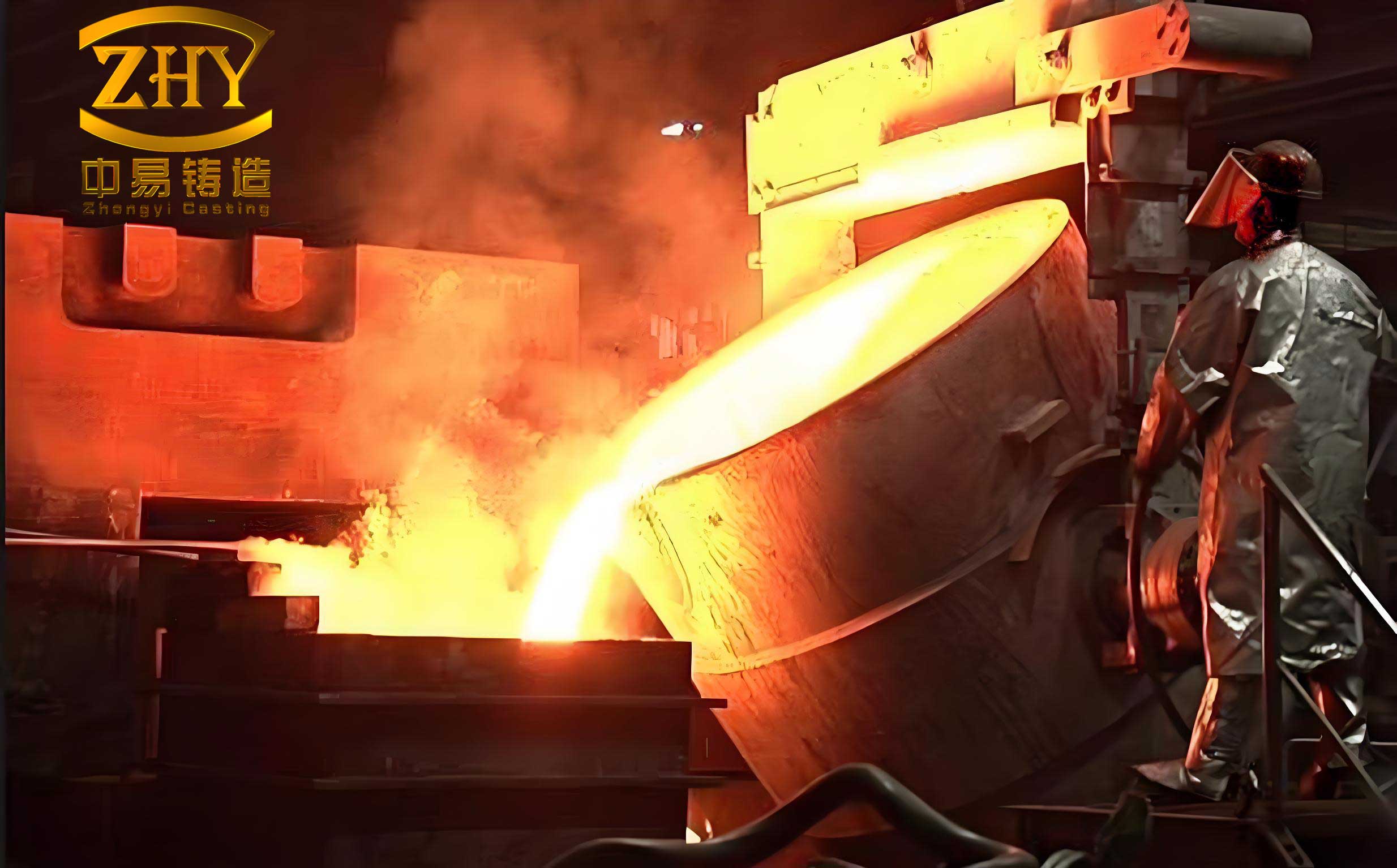
To understand the failure mechanisms, we analyzed the operating conditions of the quenching frames in our manganese steel casting foundry. The frames are loaded at room temperature, heated in a furnace to 1050–1150°C, held at temperatures above 700°C for over 10 hours and above 1050°C for 2–5 hours, then quickly transferred to a water quench. This thermal cycling induces significant thermal stresses, which can be modeled using the following formula for stress due to temperature gradient:
$$ \sigma_{thermal} = E \cdot \alpha \cdot \Delta T $$
where \( \sigma_{thermal} \) is the thermal stress, \( E \) is the Young’s modulus of the material, \( \alpha \) is the coefficient of thermal expansion, and \( \Delta T \) is the temperature difference between the surface and core. For the original Cr-Mo steel, the high \( \Delta T \) during quenching exacerbates deformation. Additionally, oxidation at elevated temperatures follows parabolic kinetics, described by:
$$ w^2 = k_p \cdot t $$
where \( w \) is the oxidation weight gain per unit area, \( k_p \) is the parabolic rate constant, and \( t \) is time. The original material’s low chromium content led to a high \( k_p \), causing rapid material loss. The frames also experienced creep deformation under load at high temperatures, which can be expressed by Norton’s law:
$$ \dot{\epsilon} = A \cdot \sigma^n \cdot e^{-Q/RT} $$
where \( \dot{\epsilon} \) is the creep strain rate, \( A \) is a material constant, \( \sigma \) is the applied stress, \( n \) is the stress exponent, \( Q \) is the activation energy, \( R \) is the gas constant, and \( T \) is the absolute temperature. The original frames showed high \( \dot{\epsilon} \) values, leading to permanent distortion. These factors collectively reduced the service life to about one month, necessitating frequent replacements and impacting the productivity of our manganese steel casting foundry.
We first addressed the material composition. The original steel had a carbon content of 0.15–0.25%, which contributed to poor weldability and increased cracking susceptibility. By lowering carbon to an ultra-low range and adding vanadium, we aimed to improve toughness and creep resistance. Vanadium forms fine carbides that pin dislocations, enhancing high-temperature strength. Chromium content was increased to boost oxidation resistance through the formation of a protective Cr2O3 layer. The revised chemical composition is detailed in Table 1, compared to the original. This optimization is crucial for components in a manganese steel casting foundry, where durability under thermal shock is paramount.
| Element | Original Frame | Improved Frame |
|---|---|---|
| C | 0.15–0.25 | 0.07–0.10 |
| Si | 0.2–0.45 | 0.15–0.35 |
| Mn | 0.5–0.8 | 0.4–0.7 |
| P | ≤0.04 | ≤0.04 |
| S | ≤0.04 | ≤0.04 |
| Cr | 0.5–0.8 | 0.8–1.2 |
| Mo | 0.4–0.6 | 0.25–0.35 |
| V | Not present | 0.15–0.30 |
The structural design was equally important. The original frame had a height of 350 mm and weighed 3.74 tons, making it prone to deformation and difficult to correct. We reduced the height to 210 mm and the weight to 2.8 tons, which lowered the thermal mass and minimized stress concentrations. The weight reduction can be quantified by the following relationship for thermal deformation energy:
$$ U = \frac{1}{2} \int_V \sigma_{ij} \epsilon_{ij} dV $$
where \( U \) is the strain energy, \( \sigma_{ij} \) is the stress tensor, and \( \epsilon_{ij} \) is the strain tensor. By reducing volume \( V \), we decreased \( U \), thus limiting distortion. Additionally, we added four Φ140 mm lifting lugs at both ends to allow frame flipping, enabling bidirectional use. This design leverages the Bauschinger effect, where reverse loading can mitigate prior deformation. The strain reversal can be modeled as:
$$ \epsilon_{reverse} = -\beta \cdot \epsilon_{prior} $$
where \( \beta \) is a material-dependent recovery factor. Diagonal stiffeners were incorporated to enhance torsional rigidity, resisting diagonal deformation during hot handling. The structural parameters are summarized in Table 2, highlighting the benefits for a manganese steel casting foundry aiming for efficiency.
| Parameter | Original Frame | Improved Frame |
|---|---|---|
| Height (mm) | 350 | 210 |
| Weight (tons) | 3.74 | 2.8 |
| Number of Lifting Lugs | Not specified | 4 |
| Diagonal Stiffeners | Absent | Present |
| Load Capacity (tons) | ~6 | ~7 |
The improved frames were tested under actual production conditions in our manganese steel casting foundry. We monitored deformation, crack formation, oxidation, and service life over several months. The results, compared in Table 3, show a dramatic improvement. Deformation was reduced due to the lower weight and better material properties. The flipping mechanism allowed self-correction, maintaining a flat usage surface. Cracking was eliminated because the vanadium addition refined the grain structure, increasing fracture toughness. The fracture toughness \( K_{IC} \) can be estimated using:
$$ K_{IC} = \sigma_f \sqrt{\pi a} $$
where \( \sigma_f \) is the fracture stress and \( a \) is the crack length. The improved material’s higher \( \sigma_f \) delays crack initiation. Oxidation slowed significantly, with the chromium-rich oxide layer reducing the parabolic rate constant \( k_p \). This extends the frame’s life in the harsh environment of a manganese steel casting foundry.
| Aspect | Original Frame | Improved Frame |
|---|---|---|
| Deformation | Significant, leading to uneven surfaces | Minimal, with self-correcting flipping |
| Crack Formation | Appeared after 2–3 uses in stress zones | None observed over 100+ uses |
| Oxidation Rate | ~50% thickness loss in one month | ~30% thickness loss in six months |
| Service Life (months) | 1 | 6 |
| Corrective Maintenance | Difficult, often requiring welding | Easy, primarily through flipping |
To further validate the improvements, we conducted thermal fatigue tests simulating the quenching cycles. The number of cycles to failure \( N_f \) can be expressed by the Coffin-Manson relation:
$$ \Delta \epsilon_p = C \cdot (N_f)^{-b} $$
where \( \Delta \epsilon_p \) is the plastic strain range, and \( C \) and \( b \) are material constants. The improved frame showed a higher \( N_f \), indicating better thermal fatigue resistance. This is vital for a manganese steel casting foundry, where equipment reliability directly impacts output. Additionally, the weight reduction allowed an increase in casting load per cycle from about 6 tons to nearly 7 tons, enhancing throughput. The economic benefit can be calculated as:
$$ Savings = (C_{original} – C_{improved}) \cdot N_{cycles} $$
where \( C_{original} \) and \( C_{improved} \) are the costs per cycle for original and improved frames, respectively, and \( N_{cycles} \) is the number of cycles per year. In our manganese steel casting foundry, this translated to a 5-fold increase in frame lifespan and a 15% reduction in quenching-related downtime.
The material science behind these enhancements is profound. The addition of vanadium promotes secondary hardening through precipitation of VC carbides, which impede dislocation motion at high temperatures. The strengthening effect can be described by the Orowan mechanism:
$$ \Delta \sigma = \frac{Gb}{L} $$
where \( \Delta \sigma \) is the increase in yield strength, \( G \) is the shear modulus, \( b \) is the Burgers vector, and \( L \) is the inter-precipitate spacing. The reduced carbon content minimizes carbide coarsening, maintaining fine precipitates. Chromium enhances oxidation resistance by forming a stable scale, with the oxidation kinetics following the Wagner theory:
$$ k_p \propto \exp\left(-\frac{E_a}{RT}\right) $$
where \( E_a \) is the activation energy. The higher chromium content raises \( E_a \), slowing oxidation. These principles are essential for developing durable equipment in a manganese steel casting foundry, where thermal stability is key.
In terms of structural mechanics, the redesigned frame leverages lightweight principles. The reduced height lowers the center of gravity, decreasing bending moments during handling. The bending stress \( \sigma_b \) can be calculated as:
$$ \sigma_b = \frac{M \cdot y}{I} $$
where \( M \) is the bending moment, \( y \) is the distance from the neutral axis, and \( I \) is the area moment of inertia. By optimizing \( I \) through diagonal stiffeners, we reduced \( \sigma_b \). The flipping feature utilizes cyclic plasticity to average out deformations, a concept akin to shake-down in structural engineering. This is particularly beneficial in a manganese steel casting foundry, where frames undergo repeated thermal shocks.
Our improvements have broader implications for the manganese steel casting foundry industry. By integrating material and design changes, we achieved a synergistic effect that boosts both performance and cost-effectiveness. Future work could explore advanced alloys like austenitic stainless steels or nickel-based superalloys for even higher temperature resistance. However, the current solution offers a practical balance for typical foundry operations. We also recommend regular monitoring of frame conditions using non-destructive testing methods, such as ultrasonic inspection for crack detection, to preempt failures.
In conclusion, the optimization of quenching frames through chemical composition adjustment and structural redesign has proven highly successful in our manganese steel casting foundry. The use of ultra-low carbon steel with vanadium and increased chromium, coupled with a lighter, flip-able design, extended service life by 5 times, reduced oxidation, and eliminated cracking. This not only lowers production costs but also enhances the reliability and efficiency of quenching processes. For any manganese steel casting foundry facing similar challenges, these improvements provide a robust framework for upgrading equipment and achieving sustainable operations. The integration of material science and engineering design principles, as demonstrated here, is crucial for advancing foundry technology and meeting the demands of modern manufacturing.