
In the realm of manganese steel casting foundry operations, the pursuit of enhanced durability and performance for critical components like railway frogs is a perpetual challenge. High manganese steel, renowned for its exceptional toughness and work-hardening characteristics under impact, is a cornerstone material in foundries specializing in heavy-duty applications. However, its relatively low yield strength and susceptibility to deformation in specific service conditions, such as the heart of a frog where wheel loads concentrate, necessitate innovative surface enhancement techniques. This research delves into the casting-penetration process, a method that integrates alloy reinforcement directly during casting, to fortify the core rail of high manganese steel frogs. As a practitioner in manganese steel casting foundry, I have explored this technique to address premature wear and crack initiation, aiming to extend service life and reliability.
The fundamental principle of casting-penetration involves the strategic incorporation of alloying elements into the surface layer of a casting during the pouring and solidification stages. This process is particularly advantageous in manganese steel casting foundry settings, as it allows for localized strengthening without compromising the bulk material’s inherent properties. For high manganese steel frogs, the core rail section, especially at the 30–40 mm cross-section, endures severe cyclic impact and rolling contact stresses, leading to accelerated wear and so-called “impact stacking” cracks. By applying a tailored alloy paste to the mold cavity prior to casting, the molten steel interacts with this layer, resulting in a metallurgically bonded, reinforced surface zone post-solidification. This approach exemplifies the synergy between traditional foundry practices and advanced material engineering.
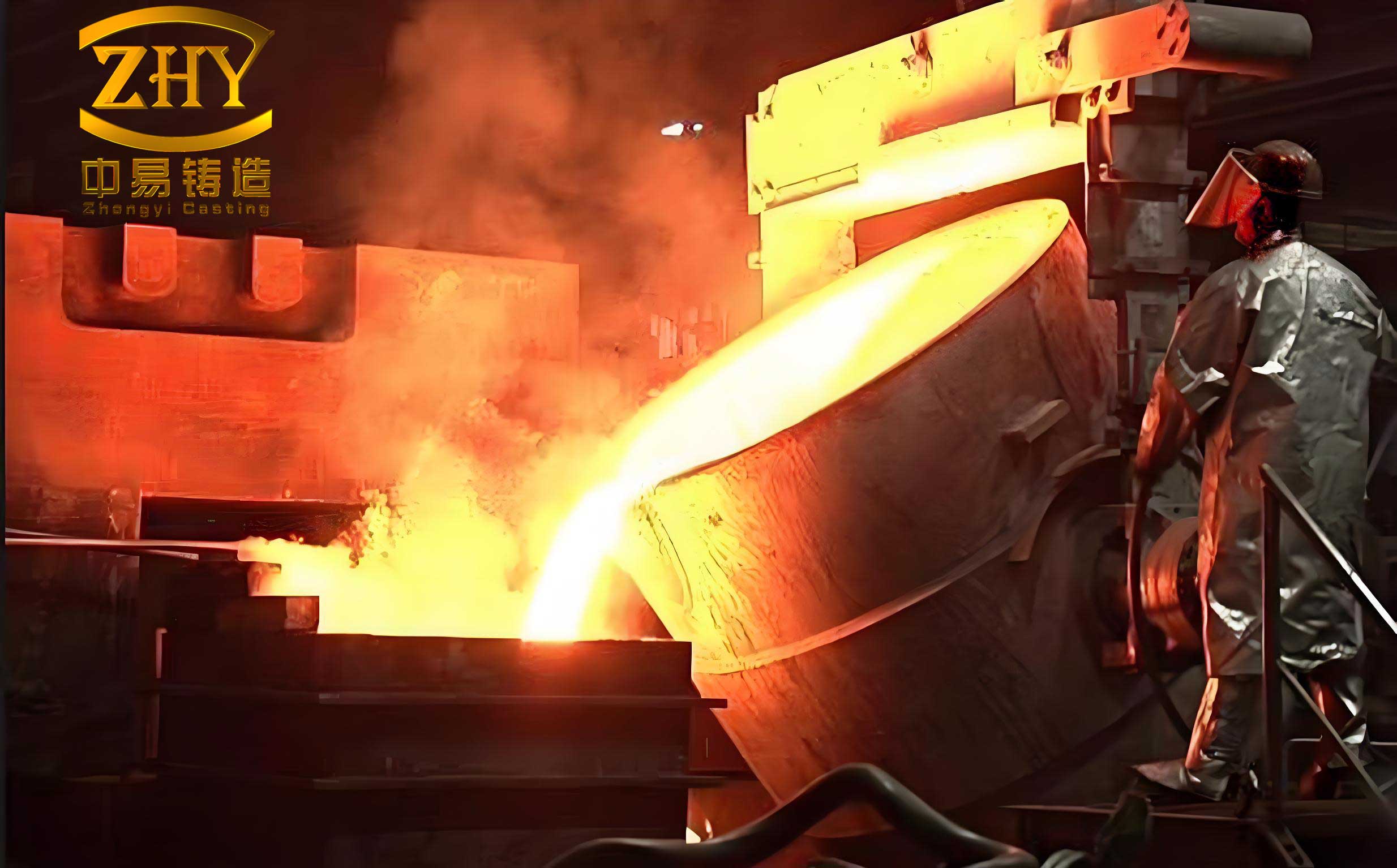
The success of casting-penetration in a manganese steel casting foundry hinges on the meticulous design of the penetrant alloy system. The chemical composition must fulfill multiple roles: it must form a hard, wear-resistant layer, exhibit good wettability and fusion with the high manganese steel melt, and withstand subsequent heat treatments without detrimental phase transformations. Based on alloying principles, key elements were selected for their contributions to microstructure and properties. Carbon is paramount for hardness and hardenability; its content governs the martensitic transformation and carbide formation. Chromium and molybdenum are strong carbide formers and provide solid solution strengthening, enhancing high-temperature stability and hardenability. Vanadium aids in grain refinement and inhibits harmful element segregation. Silicon is kept low to avoid embrittlement, while rare earth elements like yttrium with titanium serve as potent modifiers to refine grains and homogenize structure. The designed alloy system, optimized for manganese steel casting foundry processes, is summarized in Table 1.
| Element | Design Range | Selected Value | Primary Role in Manganese Steel Casting Foundry |
|---|---|---|---|
| C | 0.4–0.6 | 0.5 | Hardness, carbide formation |
| Cr | 1.5–2.0 | 1.75 | Solid solution strengthening, carbide former |
| Mo | 2–5 | 3.5 | Hardenability, high-temperature strength |
| V | 0.5–1 | 0.8 | Grain refinement, precipitation hardening |
| Si | <0.8 | 0.5 | Limited solid solution strengthening |
| RE+Ti | – | 0.2 each | Grain refinement, modification |
| Balance | Iron powder (as base for penetrant paste) | ||
The base high manganese steel used for the frog body, typical in manganese steel casting foundry production, has a standard composition as shown in Table 2. The contrast between the penetrant alloy and the base steel is intentional, aiming to create a functional gradient material.
| Grade | C | Mn | Si | P | S | Mn/C Ratio |
|---|---|---|---|---|---|---|
| Grade I | 0.95–1.35 | 11–14 | 0.3–0.8 | ≤0.045 | ≤0.030 | ≥10 |
In our manganese steel casting foundry trial, the penetrant was prepared by mixing finely ground powders (100–120 mesh) of FeCrC8, Mo, FeV50A, and the RE-Ti modifier with a binder (PVB in alcohol) and a flux (NaF). The flux plays a critical role by cleaning the alloy particles and promoting wetting by the molten steel, a common consideration in advanced manganese steel casting foundry techniques. The paste was applied to the mold cavity at the core rail’s critical section and dried. The mold, made of magnesium olivine sand using VRH (Vacuum Replacement Hardening) process, incorporated chills and a shaped feeder to ensure sound casting. Pouring was conducted at a carefully controlled temperature of 1470°C with a tilting ladle (6°–8° inclination) to enhance fluidity and interaction with the penetrant layer. This precise control is emblematic of modern manganese steel casting foundry practices aimed at quality consistency.
Following casting, the frogs underwent standard high manganese steel heat treatment: austenitization at 1050–1100°C followed by rapid water quenching. This water toughening process is fundamental in manganese steel casting foundry to dissolve carbides and obtain a single-phase austenitic microstructure. The penetrant layer, now metallurgically integrated, must also withstand this thermal cycle without deleterious effects.
Microstructural analysis revealed the efficacy of the casting-penetration process. A distinct gradient structure was observed on the cross-section of the core rail: a 4–5 mm thick casting-penetration layer, a transition zone, and the high manganese steel matrix. The transition zone exhibited an interlocking “nail” effect, ensuring robust bonding. In the as-cast state, the penetrant layer showed a microstructure of austenite with networked carbides and some pearlite, while the base steel consisted of austenite and blocky/rod-like carbides at grain boundaries. After heat treatment, significant refinement occurred. The penetrant layer transformed into a fine-grained structure with austenite and granular, spheroidized carbides, alongside some bainitic morphology. The base steel matrix displayed a typical austenitic structure with finely dispersed, isolated carbides and precipitated particles identified as complex carbides like Fe3Mo3C and (Fe,Cr)3C. The grain size was remarkably refined: ASTM 3 for the penetrant layer and ASTM 4 for the base steel, attributable to the rare earth modification—a testament to the sophistication achievable in manganese steel casting foundry processes.
The mechanical properties of both the penetrant layer and the base matrix were rigorously evaluated, underscoring the success of this manganese steel casting foundry innovation. Tensile tests, hardness measurements, and impact toughness assessments were conducted on specimens extracted from the core rail section.
Tensile strength and elongation results are consolidated in Table 3. Both the composite layer (penetrant + transition) and the base matrix far exceeded the standard requirements for high manganese steel frogs (735 MPa tensile strength, 35% elongation). The penetrant layer exhibited higher strength with slightly lower ductility compared to the base, a typical trade-off for surface-hardened components.
| Specimen | Tensile Strength (MPa) | Elongation (%) | Remark |
|---|---|---|---|
| Penetration Layer + Transition | 953, 957, 944 | 66.5, 64, 65 | Average: 951.3 MPa, 65.2% |
| High Manganese Steel Matrix | 944, 929, 928 | 74, 71, 75 | Average: 933.7 MPa, 73.3% |
The hardness profile, presented in Table 4, demonstrated a clear gradient from the surface inward. The high hardness of the penetrant layer is due to the combined effects of solid solution strengthening and fine carbide dispersion. The enhanced hardness of the base matrix compared to conventional high manganese steel is attributed to micro-alloying from element diffusion during the casting-penetration process, increasing austenite stability.
| Zone | Measurement 1 | Measurement 2 | Measurement 3 | Measurement 4 | Measurement 5 | Average |
|---|---|---|---|---|---|---|
| Casting-Penetration Layer | 322 | 318 | 313 | 322 | 331 | 321.2 |
| Transition Zone | 230 | 236 | 242 | 236 | 230 | 234.8 |
| High Manganese Steel Matrix | 200 | 205 | 196 | 200 | 196 | 199.4 |
Impact toughness, a critical property for components subject to shock loading, was evaluated using unnotched specimens. The results, shown in Table 5, indicate excellent toughness for both regions, with the penetrant layer showing marginally higher values. Fractographic analysis via SEM revealed a predominantly ductile fracture mode with dimples for both, though the penetrant layer showed some areas of quasi-cleavage and bainitic features, consistent with its complex microstructure.
| Specimen | Impact Toughness (J/cm²) | Average (J/cm²) |
|---|---|---|
| Penetration Layer + Transition | 361.0, 358.5, 360.0 | 359.8 |
| High Manganese Steel Matrix | 330.5, 338.0, 343.5 | 337.3 |
The metallurgical mechanisms behind these improvements can be partly described using fundamental strengthening equations. Solid solution strengthening, a key contributor in both the penetrant layer and the alloy-enhanced matrix, follows a relationship often approximated as:
$$ \Delta \sigma_{ss} = k \cdot c^{n} $$
where $\Delta \sigma_{ss}$ is the increase in yield strength due to solid solution, $c$ is the concentration of the solute element (e.g., Cr, Mo, Mn), and $k$ and $n$ are material constants. In the context of manganese steel casting foundry, the addition of Cr, Mo, and V increases $c$, thereby enhancing $\Delta \sigma_{ss}$. Precipitation hardening from fine carbides can be modeled with the Orowan mechanism:
$$ \Delta \sigma_{ppt} = \frac{Gb}{2\pi\sqrt{1-\nu}} \cdot \frac{\ln(2r/b)}{L} $$
where $G$ is the shear modulus, $b$ is the Burgers vector, $\nu$ is Poisson’s ratio, $r$ is the particle radius, and $L$ is the inter-particle spacing. The refined carbides in the penetrant layer and the dispersed particles in the matrix result in a small $L$, significantly increasing strength. Grain refinement, quantified by the Hall-Petch equation, also plays a major role:
$$ \sigma_y = \sigma_0 + k_{HP} \cdot d^{-1/2} $$
Here, $\sigma_y$ is the yield strength, $\sigma_0$ is the friction stress, $k_{HP}$ is the Hall-Petch constant, and $d$ is the average grain diameter. The refined grain sizes (ASTM 3 and 4) directly contribute to the enhanced strength and toughness observed, a direct outcome of the optimized manganese steel casting foundry process involving rare earth modification.
The integration of casting-penetration into standard manganese steel casting foundry workflow offers substantial benefits. It allows for targeted reinforcement of high-stress areas without the need for separate surfacing operations like welding or thermal spraying, reducing production steps and potential heat-affected zone issues. The process leverages the inherent heat of the molten metal, ensuring good metallurgical bonding. For foundries specializing in manganese steel casting, this technique can be a valuable addition to the portfolio for manufacturing high-performance, long-life components like railway frogs, crusher liners, or other impact- and abrasion-resistant parts. The ability to tailor the penetrant alloy composition provides flexibility to meet specific service conditions, pushing the boundaries of what is achievable in traditional manganese steel casting foundry practice.
However, successful implementation in a production manganese steel casting foundry requires careful control of several parameters. The particle size and uniformity of the penetrant powders, the thickness and integrity of the applied paste layer, the pouring temperature and fluidity of the steel, and the mold design all influence the final thickness, homogeneity, and bonding quality of the reinforced layer. Furthermore, the interaction between the penetrant alloy and the base steel chemistry during solidification and heat treatment must be thoroughly understood to avoid undesirable phases or brittleness. Computational modeling of fluid flow, heat transfer, and solute diffusion could further optimize this process for industrial manganese steel casting foundry applications.
In conclusion, the research demonstrates that casting-penetration is a highly effective method for surface strengthening of high manganese steel castings. It successfully creates a 4–5 mm thick, metallurgically bonded alloy layer on the core rail of frogs, with superior mechanical properties including high tensile strength, enhanced hardness, and excellent impact toughness. The base matrix also benefits from micro-alloying and grain refinement. This process aligns perfectly with the evolving needs of the modern manganese steel casting foundry, offering a route to produce components with extended service life and improved reliability under demanding conditions. The synergistic combination of alloy design, precise foundry techniques, and understanding of strengthening mechanisms paves the way for broader adoption of casting-penetration in the manufacturing of advanced high manganese steel castings.