
In the field of metal casting, producing high-quality ductile iron castings for hydraulic components presents unique challenges due to the material’s specific solidification behavior and the need for defect-free internal structures. As a researcher focused on improving manufacturing efficiency and product reliability, I have investigated the casting process of a small hydraulic tee valve made from QT500-7 ductile iron. This component is critical in fluid systems, and its structural integrity is paramount. Initially, the production process involved a stack cluster casting method with a bottom-gating system, which led to issues such as iron splashes, sand washing, and low yield. Through a combination of process redesign, numerical simulation, and practical validation, I developed an optimized approach that significantly enhances the quality and economics of these ductile iron castings.
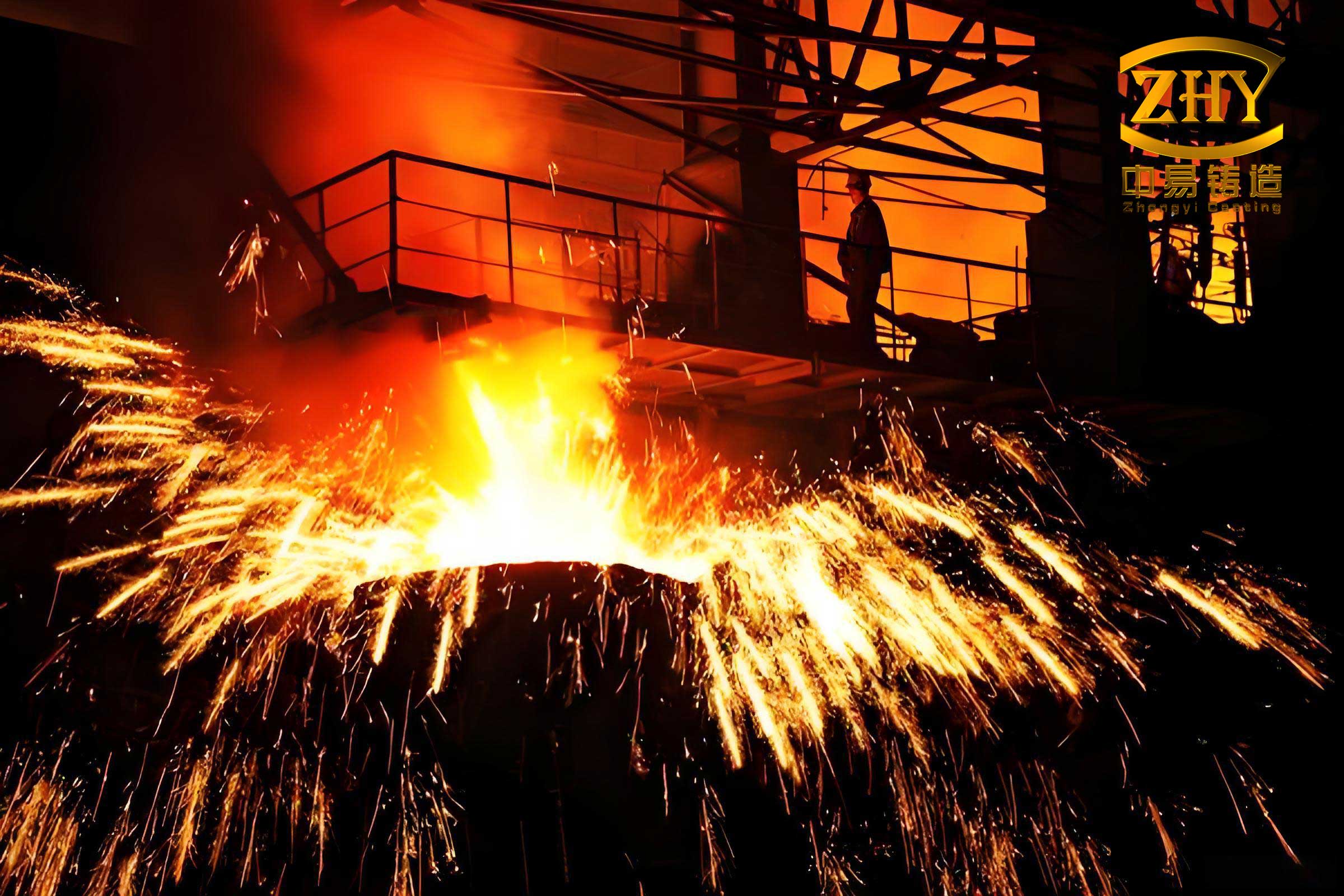
Ductile iron castings are widely used in industries requiring high strength and ductility, such as automotive and hydraulic systems. The tee valve in question has a simple geometry with uniform wall thickness, but achieving consistent quality in mass production proved difficult. The original process utilized a seven-layer stack cluster casting with phenolic resin-coated sand molds, each layer containing three cavities, and a bottom-gating system designed to minimize turbulence. However, during pouring, molten metal impacted the sprue base with high velocity, causing splashes that solidified into iron beads (iron droplets) within the cavities. Additionally, continuous erosion of the sand mold at the gating system’s bottom led to sand inclusions, while the excessive gating design wasted metal, resulting in a low casting yield of approximately 60%. These defects not only compromised the mechanical properties of the ductile iron castings but also increased production costs due to scrap rates.
To address these issues, I first analyzed the original process parameters. The casting dimensions are 102 mm × 45 mm × 70 mm with a weight of 1.5518 kg and an average wall thickness of 15 mm. The material QT500-7 has a tensile strength of 500 MPa and elongation of 7%, requiring a sound internal structure free from shrinkage porosity, sand inclusions, or iron beads. The original gating system featured a sprue diameter of 36 mm and height of 650 mm, with ingates sized at 16 mm × 13 mm × 11 mm. Pouring temperature was set at 1,380°C, and the pouring time was about 20 seconds, leading to a metal rise velocity calculated as: $$ v = \frac{h}{t} = \frac{650 \, \text{mm}}{20 \, \text{s}} = 32.5 \, \text{mm/s} $$ where \( v \) is the velocity, \( h \) is the sprue height, and \( t \) is the pouring time. This high velocity contributed to the冲刷 and splashing problems.
I then employed AnyCasting simulation software to model the original process. The 3D model was meshed into approximately 1 million elements, and material properties for ductile iron and phenolic resin sand were assigned. The filling simulation revealed that within the first second, molten metal violently struck the mold cavity bottom, creating splashes that could entrap as iron beads. By 3 seconds, the continuous flow caused high turbulence in the runner, exacerbating sand erosion. The solidification simulation showed that while each casting solidified from the exterior inward, with the sprue solidifying last—indicating a theoretically sound feeding pattern—the practical issues persisted due to the gating design. The simulation confirmed that the defects were primarily related to fluid dynamics rather than solidification shrinkage.
Based on this analysis, I proposed an optimized process. The key changes included reducing the stack height from seven to five layers and modifying the gating system from bottom-gating to a top-gating approach using the central runner as the sprue. This new design increased the sprue diameter to 55 mm and reduced the height to 440 mm, while keeping the ingate dimensions unchanged. The rationale was to lower the metal impact velocity and minimize continuous冲刷 of the mold base. The modified layout is shown in the simulation model, and the expected improvements were quantified through further simulation.
For the optimized process, I recalculated the pouring parameters. With a reduced height, the pouring time was estimated at 16 seconds, giving a rise velocity of: $$ v_{\text{new}} = \frac{440 \, \text{mm}}{16 \, \text{s}} = 27.5 \, \text{mm/s} $$ This reduction in velocity decreases the kinetic energy of the molten metal, thereby reducing splashing and erosion. The AnyCasting simulation of the new design demonstrated a smoother filling pattern; metal entered the cavity from the top with initial impact, but the transient phase was short, and subsequent flow was stable without sustained冲刷. The solidification simulation indicated that the larger top sprue provided better feeding and slag-trapping capabilities, leveraging the graphitization expansion of ductile iron castings for self-feeding. The comparison between the original and optimized processes is summarized in Table 1.
| Parameter | Original Process | Optimized Process |
|---|---|---|
| Stack Layers | 7 | 5 |
| Gating System Type | Bottom-gating | Top-gating (central runner) |
| Sprue Diameter (mm) | 36 | 55 |
| Sprue Height (mm) | 650 | 440 |
| Pouring Time (s) | 20 | 16 |
| Metal Rise Velocity (mm/s) | 32.5 | 27.5 |
| Expected Defects | Iron beads, sand inclusions | Minimized |
| Casting Yield | ~60% | ~80% |
The fluid dynamics during filling can be further analyzed using the Bernoulli equation for incompressible flow, which relates pressure, velocity, and height: $$ P + \frac{1}{2} \rho v^2 + \rho g h = \text{constant} $$ where \( P \) is pressure, \( \rho \) is density of ductile iron (approximately 7,000 kg/m³), \( v \) is velocity, \( g \) is gravity (9.81 m/s²), and \( h \) is height. In the original process, the high velocity at the sprue base resulted in a dynamic pressure that contributed to sand erosion. By reducing the height and increasing the sprue diameter, the velocity term decreases, lowering the erosion potential. Additionally, the Reynolds number \( Re = \frac{\rho v D}{\mu} \), where \( D \) is diameter and \( \mu \) is viscosity, indicates flow regime; for ductile iron castings, maintaining laminar or transitional flow reduces defects. The original design had \( Re \) values in the turbulent range, while the optimized design moves toward more stable flow.
To quantify the solidification behavior, I considered the Chvorinov’s rule for solidification time: $$ t_s = B \left( \frac{V}{A} \right)^n $$ where \( t_s \) is solidification time, \( V \) is volume, \( A \) is surface area, \( B \) is a mold constant, and \( n \) is an exponent (typically 2 for sand molds). For the tee valve casting, the modulus \( \frac{V}{A} \) is approximately 7.5 mm, leading to a solidification time of about 500 seconds in sand molds. The simulation confirmed that both processes achieved directional solidification, but the optimized process benefited from better feeding due to the larger sprue acting as a thermal reservoir. The graphitization expansion in ductile iron castings provides internal pressure that compensates for shrinkage, described by: $$ \Delta V = \alpha V_0 \Delta T + \beta V_0 $$ where \( \Delta V \) is volume change, \( \alpha \) is thermal expansion coefficient, \( V_0 \) is initial volume, \( \Delta T \) is temperature drop, and \( \beta \) is expansion factor due to graphite precipitation. This self-feeding effect is enhanced when the gating system maintains adequate pressure.
After simulation, I validated the optimized process through production trials. Multiple batches of ductile iron castings were produced using the five-layer stack cluster casting with the top-gating system. The results showed a significant reduction in defects; no iron beads or sand inclusions were detected in the machined castings, and the internal structure was uniform upon radiographic inspection. The casting yield improved from 60% to 80%, representing a 20% increase in material efficiency. This not only reduces waste but also lowers production costs, making the process more sustainable for high-volume manufacturing of ductile iron castings.
The success of this optimization highlights the importance of integrating simulation tools with practical insights. For ductile iron castings, factors such as gating design, pouring parameters, and mold geometry must be tailored to exploit the material’s self-feeding characteristics. The modified process is now implemented in regular production, ensuring consistent quality for hydraulic tee valves. Further improvements could involve advanced gating filters or controlled cooling, but the current solution already meets all technical specifications.
In conclusion, the optimized casting process for ductile iron tee valves demonstrates how targeted changes can resolve common defects. By reducing stack height and switching to a top-gating system, the issues of iron beads and sand inclusions were eliminated, while the casting yield increased substantially. This case study underscores the value of numerical simulation in refining processes for ductile iron castings, leading to more reliable and cost-effective components. The principles applied here can be extended to other similar ductile iron castings in the industry, fostering advancements in casting technology.
To summarize the key data, Table 2 provides an overview of the casting parameters and outcomes.
| Aspect | Details |
|---|---|
| Material | QT500-7 Ductile Iron |
| Casting Method | Stack Cluster Casting with Phenolic Resin Sand |
| Optimal Stack Layers | 5 |
| Gating System | Top-Gating with Central Sprue (55 mm diameter) |
| Pouring Temperature | 1,380°C |
| Simulation Tool | AnyCasting Software |
| Key Improvements | Elimination of Iron Beads and Sand Inclusions; 20% Yield Increase |
| Mechanical Properties | Meet QT500-7 Standards (500 MPa Tensile Strength, 7% Elongation) |
The engineering behind these ductile iron castings involves continuous refinement. For instance, the fluid flow during pouring can be modeled using the Navier-Stokes equations: $$ \rho \left( \frac{\partial \mathbf{v}}{\partial t} + \mathbf{v} \cdot \nabla \mathbf{v} \right) = -\nabla P + \mu \nabla^2 \mathbf{v} + \rho \mathbf{g} $$ where \( \mathbf{v} \) is velocity vector, \( t \) is time, and \( \nabla \) is gradient operator. Solving these equations numerically helps predict flow patterns that lead to defects. In my simulation, the optimized design showed reduced velocity magnitudes, aligning with the analytical calculations. Moreover, the thermal analysis during solidification considers the heat transfer equation: $$ \frac{\partial T}{\partial t} = \alpha \nabla^2 T + \frac{Q}{\rho c_p} $$ where \( T \) is temperature, \( \alpha \) is thermal diffusivity, \( Q \) is heat source (e.g., latent heat), and \( c_p \) is specific heat. For ductile iron castings, the release of latent heat during graphite formation affects cooling rates, and the simulation captured this accurately.
Ultimately, the production of high-integrity ductile iron castings relies on a holistic approach. By combining process optimization, simulation validation, and practical testing, I achieved a robust solution that enhances both quality and efficiency. The repeated emphasis on ductile iron castings throughout this study reflects their significance in modern manufacturing, and the lessons learned here can guide future projects. As industries demand more reliable hydraulic components, such improvements in casting processes will continue to play a critical role in meeting those needs.