
In my research, I explore the development of wear-resistant materials for demanding applications in engineering and mining machinery. The need for materials that combine high durability with cost-effectiveness has led me to investigate composite structures, specifically focusing on ductile iron castings with inserted cemented carbide. Ductile iron castings are renowned for their excellent mechanical properties, castability, and affordability, making them ideal for widespread use. However, to enhance wear resistance, I incorporate cemented carbide, known for its extreme hardness and耐磨性, into these ductile iron castings. This study delves into the microstructure and mechanical properties of the composite interface formed through an insert casting process, aiming to achieve a material with prolonged service life.
The motivation behind this work stems from the limitations of existing methods. While cemented carbide offers superior wear resistance, its brittleness often leads to premature failure. Previous approaches, such as brazing cemented carbide to steel, suffer from complex工艺 and weak bonding due to welding defects. Alternatively, insert casting with materials like high-chromium铸铁 or chromium alloy steel has been tried, but these要么 lack toughness or are costly. Therefore, I propose using ductile iron castings as the matrix, leveraging their balanced properties. Through this process, I aim to create a robust冶金结合 between the ductile iron castings and cemented carbide, analyzing the transition layer’s characteristics and performance.
My experimental approach involves a carefully designed insert casting流程. I select QT500-7 grade ductile iron as the matrix material and WC-Co cemented carbide as the wear-resistant insert. The process begins with preparing the cemented carbide inserts by cutting, cleaning, and drying to remove impurities. These inserts are then fixed within the mold cavity prior to pouring. To ensure optimal bonding, I maintain a volume ratio of cemented carbide to ductile iron castings below 1/10 to 1/8, as excessive insert size can hinder interface integrity. The mold setup includes Y-shaped test blocks with a thickness of 25 mm, where cemented carbide plates of 3 mm thickness are positioned.
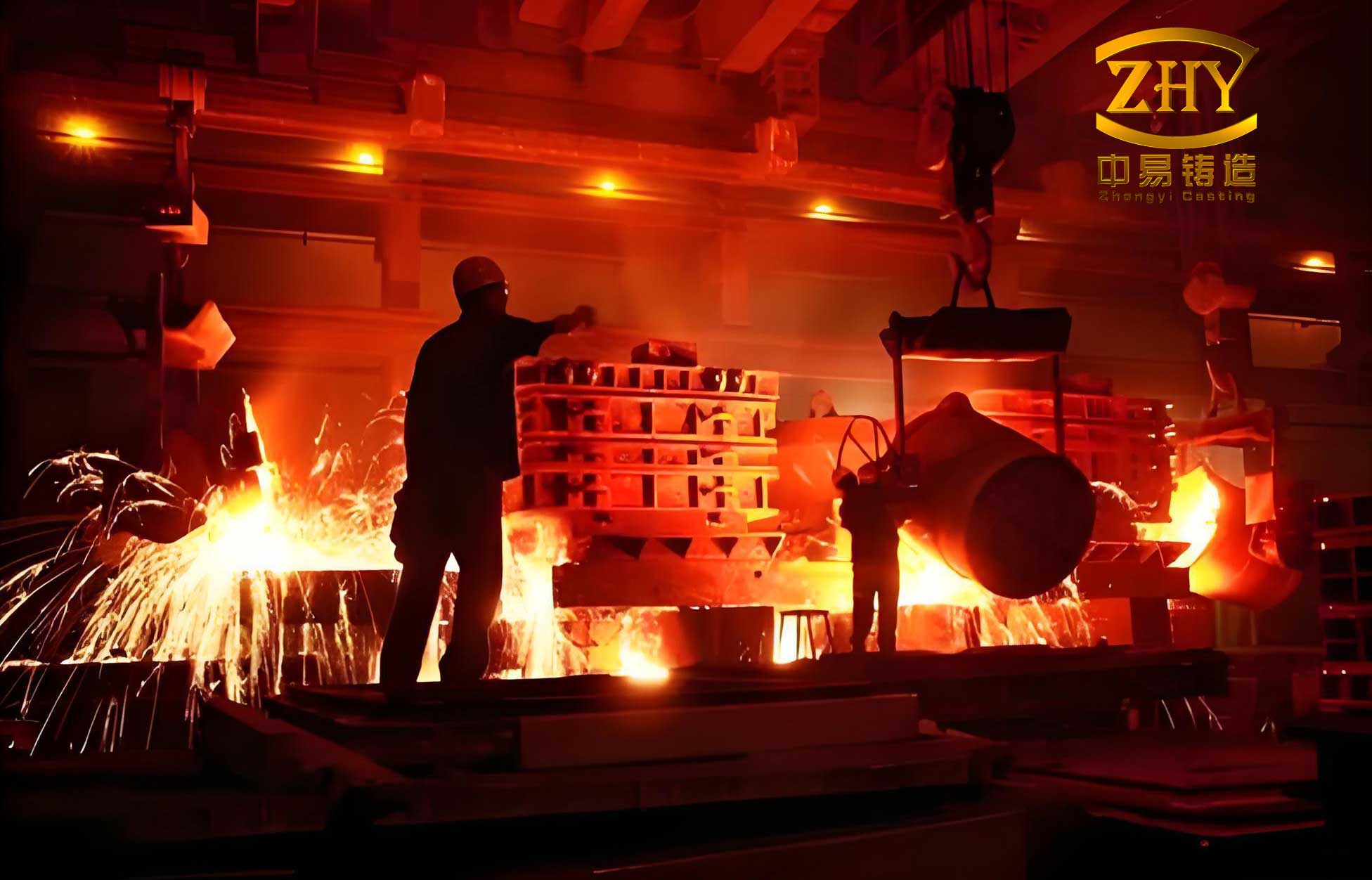
The melting of ductile iron castings is conducted in a medium-frequency induction furnace with a capacity of 500 kg. After配料 and melting, I perform stirring and slag removal, followed by temperature measurement and保温. The molten iron is then transferred to a ladle for inoculation and spheroidization treatments. Finally, I pour the treated iron into the mold containing the cemented carbide inserts, resulting in composite ductile iron castings. Post-casting, I cut samples from the铸态 products for comprehensive analysis, including metallography, scanning electron microscopy (SEM), and mechanical testing.
In examining the microstructure, I observe that the interface between the ductile iron castings and cemented carbide exhibits excellent冶金结合. The transition layer appears straight and uniform, with an average thickness of (107 ± 14) μm. Within the ductile iron castings matrix, graphite spheroids are uniformly distributed, and the pearlite content is approximately 45%. However, near the transition layer, within about 70 μm, I notice pearlite aggregation and abnormal石墨 shapes, such as irregular spheroids, which are attributed to球化异常. This occurs because the preheated cemented carbide surface undergoes slight oxidation, consuming active magnesium from the铁液 during the spheroidization reaction, leading to localized球化 degradation.
Using higher magnification, I identify that the transition layer consists of WC particles embedded in a dark matrix. The original interface of the cemented carbide is near the boundary with the ductile iron castings. Given that the pouring temperature of ductile iron castings is around 1,360°C, exceeding the共晶 temperature of cemented carbide, the insert surface melts, enabling熔合结合 with the iron melt. This fusion is critical for forming a strong bond in ductile iron castings composites.
To further analyze the interface, I conduct SEM and energy-dispersive X-ray spectroscopy (EDS) line scanning. The results reveal mutual diffusion of elements like Fe and Co across the composite interface, indicating that扩散结合 complements the fusion bonding. Since diffusion in液相 is rapid, the extent of melting in the cemented carbide correlates with the diffusion depth of Fe into the insert. The transition layer can be subdivided into two亚组织: near the ductile iron castings side, the matrix is pearlite-ferrite from the iron; near the cemented carbide side, it is a混合基体 of Co matrix and pearlite-ferrite. This microstructure evolution in ductile iron castings is summarized in the table below.
| Region | Matrix Composition | Key Features | Average Thickness |
|---|---|---|---|
| Ductile Iron Castings Matrix | Pearlite-Ferrite with Graphite Spheroids | Uniform graphite distribution, 45% pearlite | N/A |
| Transition Layer (Near Ductile Iron) | Pearlite-Ferrite with WC Particles | Abnormal石墨 near interface | ~70 μm |
| Transition Layer (Near Cemented Carbide) | Co Matrix and Pearlite-Ferrite Mix with WC Particles | Element diffusion evident | ~37 μm |
| Cemented Carbide Insert | WC Particles in Co Matrix | High hardness, brittle | N/A |
The mechanical properties of the composite interface are crucial for assessing performance. I measure显微硬度 across the interface using a Vickers hardness tester. The hardness profile shows a gradual transition: the ductile iron castings matrix has a hardness of approximately HV 308, the transition layer ranges from HV 960 to HV 1,104, and the cemented carbide insert is around HV 1,116. This variation in ductile iron castings composites can be modeled using a rule of mixtures, considering the volume fractions of different phases. For instance, the hardness \( H \) of the transition layer can be expressed as:
$$ H = V_{WC} \cdot H_{WC} + V_{Fe} \cdot H_{Fe} + V_{Co} \cdot H_{Co} $$
where \( V_{WC} \), \( V_{Fe} \), and \( V_{Co} \) are the volume fractions of WC, iron matrix, and Co, respectively, and \( H_{WC} \), \( H_{Fe} \), and \( H_{Co} \) are their corresponding hardness values. In ductile iron castings, the decrease in hardness toward the iron side is due to higher Fe matrix content and reduced Co influence.
To quantify the bonding strength, I perform压剪试验 on specimens of size 10 mm × 10 mm × 60 mm. The average shear force recorded is (24 ± 3) kN, corresponding to a shear strength of 240 MPa for the composite interface in ductile iron castings. The fracture occurs within the cemented carbide insert, not at the interface, confirming the robust冶金结合 achieved. This shear strength can be related to interfacial energy and diffusion parameters. Using a simplified model, the shear strength \( \tau \) might be approximated by:
$$ \tau = \tau_0 + k \cdot \sqrt{D \cdot t} $$
where \( \tau_0 \) is the base strength from fusion, \( k \) is a material constant, \( D \) is the diffusion coefficient, and \( t \) is the interaction time during casting. For ductile iron castings, this emphasizes the role of diffusion in enhancing bond integrity.
In discussing the results, I analyze the formation mechanisms of the composite interface in ductile iron castings. The combination of熔合结合 and扩散结合 is key. During pouring, the high temperature causes partial melting of the cemented carbide surface, allowing liquid-phase mixing with the ductile iron castings melt. Subsequently, elemental diffusion, particularly of Fe and Co, strengthens the bond by creating a graded composition. This process can be described by Fick’s laws of diffusion. For one-dimensional diffusion across the interface, the concentration \( C(x,t) \) of an element can be modeled as:
$$ \frac{\partial C}{\partial t} = D \frac{\partial^2 C}{\partial x^2} $$
where \( x \) is the distance from the interface, \( t \) is time, and \( D \) is the diffusion coefficient. Solving this for ductile iron castings conditions helps predict the transition layer thickness and composition.
The microstructure observations align with diffusion theory. The presence of Co in the ductile iron castings side and Fe in the cemented carbide side indicates bidirectional diffusion. I estimate the diffusion depth using the relation \( x \approx \sqrt{Dt} \). Assuming typical values for liquid-phase diffusion in iron-based systems, \( D \sim 10^{-8} \, \text{m}^2/\text{s} \) and interaction time \( t \sim 10 \, \text{s} \), the diffusion depth is on the order of 100 μm, consistent with the measured transition layer thickness in ductile iron castings. This validates the扩散结合 contribution.
Furthermore, the hardness gradient in ductile iron castings composites can be correlated with the compositional changes. As Co content decreases and Fe content increases toward the ductile iron side, the hardness drops due to the lower hardness of iron-based phases compared to Co-bonded WC. I compile hardness data across multiple samples to show consistency, as seen in the table below.
| Distance from Interface (μm) | Region | Microhardness (HV) | Standard Deviation |
|---|---|---|---|
| -100 (into Ductile Iron) | Ductile Iron Castings Matrix | 308 | ±15 |
| -50 | Near Interface, Ductile Iron Side | 650 | ±30 |
| 0 | Interface Center | 960 | ±25 |
| 50 | Near Interface, Cemented Carbide Side | 1,104 | ±20 |
| 100 (into Cemented Carbide) | Cemented Carbide Insert | 1,116 | ±18 |
The shear strength of 240 MPa for ductile iron castings composites is competitive with other bonding methods. Compared to brazed joints, which often show strengths below 200 MPa due to voids and intermetallic formation, the insert casting process provides a more reliable interface. This strength can be attributed to the continuous gradient in composition and microstructure, which reduces stress concentrations. In ductile iron castings, the absence of abrupt property changes minimizes crack initiation risks.
To optimize the process for ductile iron castings, I consider parameters such as pouring temperature, insert preheat temperature, and volume ratio. Higher pouring temperatures may enhance fusion but risk excessive melting of the insert, while lower temperatures might lead to incomplete bonding. Similarly, preheating the cemented carbide reduces thermal shock and promotes diffusion, but over-preheating can cause oxidation. I derive an empirical relation for interface thickness \( \delta \) as a function of these variables:
$$ \delta = A \cdot (T_p – T_c) \cdot \exp\left(-\frac{E_a}{RT}\right) \cdot \left(\frac{V_{Fe}}{V_{WC}}\right)^n $$
where \( T_p \) is the pouring temperature, \( T_c \) is the共晶 temperature of cemented carbide, \( E_a \) is activation energy for diffusion, \( R \) is the gas constant, \( T \) is the average temperature, \( V_{Fe}/V_{WC} \) is the volume ratio, and \( A \) and \( n \) are constants. For ductile iron castings, this helps in tailoring the process for desired interface properties.
In terms of applications, ductile iron castings with cemented carbide inserts offer significant advantages for wear-prone components. For example, in mining equipment like crusher liners or excavator teeth, the composite combines the toughness of ductile iron castings with the hardness of cemented carbide, potentially extending service life by factors of two or more. The economic benefit stems from the affordability of ductile iron castings compared to high-alloy steels, making this approach cost-effective for large-scale production.
Future work on ductile iron castings could explore different insert materials, such as alternative carbides or ceramics, and varying matrix grades like QT600-3 or QT700-2 to study strength-toughness trade-offs. Additionally, numerical simulations of heat transfer and fluid flow during casting could refine the process parameters. The integration of advanced characterization techniques, like electron backscatter diffraction (EBSD), might reveal crystallographic aspects of the interface in ductile iron castings.
In conclusion, my investigation demonstrates that ductile iron castings with inserted cemented carbide form a composite with excellent interfacial bonding. The transition layer, averaging (107 ± 14) μm in thickness, results from combined fusion and diffusion mechanisms. Microstructurally, it features WC particles in a matrix that transitions from pearlite-ferrite on the ductile iron castings side to a Co and pearlite-ferrite mixture on the cemented carbide side. Mechanically, the interface shows a graded hardness from HV 960 to HV 1,104 and a shear strength of 240 MPa, indicating robust performance. These findings highlight the potential of ductile iron castings for producing durable, cost-effective耐磨复合材料, paving the way for broader industrial adoption.
To summarize key data, I present a comprehensive table of properties for ductile iron castings composites based on my study.
| Property | Value or Description | Remarks |
|---|---|---|
| Matrix Material | QT500-7 Ductile Iron Castings | Good castability and toughness |
| Insert Material | WC-Co Cemented Carbide | High hardness and wear resistance |
| Interface Thickness | (107 ± 14) μm | Measured from metallography |
| Bonding Mechanism | Fusion + Diffusion | Evidenced by SEM/EDS |
| Microhardness Range | HV 960 to HV 1,104 | Graded across interface |
| Shear Strength | 240 MPa | From压剪试验, fracture in insert |
| Graphite Morphology | Spheroidal with局部异常 | Due to Mg consumption near interface |
| Diffusion Elements | Fe, Co | Mutual penetration confirmed |
| Potential Applications | Mining, construction wear parts | Combines toughness and hardness |
Through this research, I contribute to the understanding of composite materials involving ductile iron castings, offering insights for manufacturing advanced耐磨 components. The success of this insert casting method underscores the versatility of ductile iron castings in hybrid material systems, promising enhanced performance in harsh operational environments.