
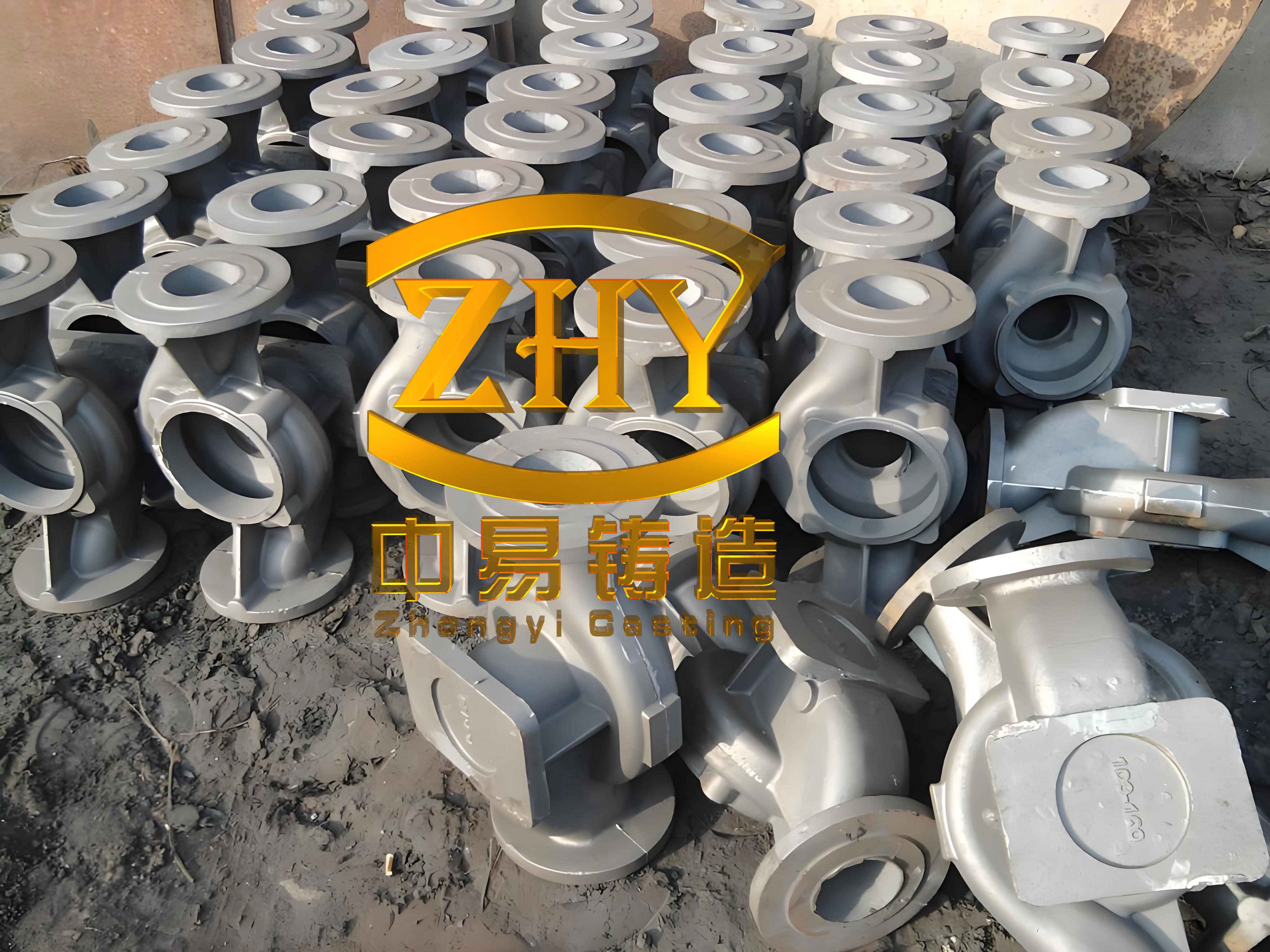
In the field of heavy machinery and automotive manufacturing, the production of engine blocks from gray cast iron remains a cornerstone. The gray cast iron family, primarily based on the Fe-C-Si system with carbon precipitating as graphite flakes, offers an excellent combination of castability, machinability, vibration damping, and good strength-to-weight ratio, making it an ideal candidate for such complex, stressed components. The design of a robust casting process is paramount to achieving dimensionally accurate, sound, and reliable castings. This process is a systematic integration of multiple disciplines, encompassing the analysis of the component’s structural castability, the formulation of the overall molding and pouring strategy, the precise definition of process parameters, the intricate design of sand cores and their assembly, the hydraulic design of the gating system for controlled filling, and the design of effective venting to eliminate gases. Based on extensive practical foundry experience, I will detail the process design principles for several representative types of gray cast iron engine blocks, illustrating the application of these principles through concrete examples, comparative tables, and fundamental formulas.
The journey of creating a gray cast iron engine block begins with a thorough structural analysis. We examine wall thickness uniformity, transition zones, potential hot spots, and geometric features that may hinder solidification or core placement. Following this, a fundamental decision is made regarding the molding and pouring orientation. The choice between horizontal (pour split) and vertical (upright) pouring is critical and depends on the block’s geometry, weight, and the desired quality characteristics. Key process parameters are then mathematically defined. The linear casting shrinkage or contraction allowance is not a universal constant but varies with the geometry and restraint during solidification. It is typically expressed as a percentage applied to the pattern dimensions. The formula governing the required pattern dimension (\(L_p\)) based on the desired final casting dimension (\(L_c\)) and the shrinkage percentage (\(S\)) is:
$$L_p = \frac{L_c}{(1 – S/100)}$$
For instance, a length direction shrinkage of 1.1% for a gray cast iron block means that for a desired casting length of 1000 mm, the pattern must be made larger: \(L_p = 1000 / (1 – 0.011) \approx 1011.12\) mm. Machining allowances (\(\Delta_m\)) are added to these pattern dimensions on specific faces, leading to the final pattern dimension for a machined surface: \(L_{p(machined)} = (L_c + \Delta_m) / (1 – S/100)\). Other parameters like draft angles, core print dimensions, and finish allowances are also specified.
The core system for an engine block is perhaps the most complex element, defining all internal cavities—water jackets, oil galleries, cylinder bores, and camshaft tunnels. Cores are manufactured using various processes: shell molding (hot-box), cold-box (e.g., with amine gas curing), or inorganic binder systems. The design focuses on core strength, accurate assembly (often using precision fixtures and robotics), gas permeability, and ease of de-coreing after casting. The gating system design is a hydraulic exercise to ensure a smooth, controlled, and non-turbulent fill. The key principle is the law of continuity and Bernoulli’s equation, simplified for practical foundry use into the concept of the “gating ratio,” which relates the cross-sectional areas of the downsprue (\(A_s\)), runner (\(A_r\)), and ingate(s) (\(A_i\)). Common systems are:
Choke-Pour (Pressurized): \(A_s < A_r < \Sigma A_i\). The smallest area is at the sprue base, maintaining a pressurised system that helps prevent slag entry but can cause turbulence.
Runner-Pour (Unpressurized): \(A_s > A_r < \Sigma A_i\). The runner is the choke, promoting a quieter fill.
Open-Pour: \(A_s < A_r > \Sigma A_i\). The ingates are the choke, often used for bottom gating heavy sections.
The filling time (\(t\)) can be approximated using the empirical formula derived from the basic flow equation:
$$t = \frac{W}{\rho \cdot A_s \cdot \sqrt{2gH}} \cdot k$$
where \(W\) is the casting weight, \(\rho\) is the metal density, \(A_s\) is the effective choke area, \(g\) is gravity, \(H\) is the effective metallostatic head, and \(k\) is a friction/ efficiency factor (typically 0.7-0.9).
Simultaneously, the venting system must be designed to allow the rapid escape of air, binder combustion gases, and core gases displaced by the advancing metal. This involves strategic placement of vents in the mold and core prints, and often the use of “blind” risers or overflow vents at the top of the mold cavity to act as both gas exits and receivers for cold, oxidized metal.
Let’s analyze three distinct gray cast iron engine blocks that highlight different approaches to these challenges.
| Feature / Block Type | WP12 Cylinder Block | 16M33 Engine Block | CW200 Engine Block |
|---|---|---|---|
| Configuration / Weight | In-line 6, ~290 kg | V-type, ~1500 kg | In-line 6/8, ~2000/2600 kg |
| Key Wall Thickness | 6 mm (thin-walled) | 9 mm | 11 mm |
| Material Grade | HT280 (Gray Iron) | HT250 (Gray Iron) | HT250 (Gray Iron) |
| Primary Molding Method | Horizontal Parting, High-Pressure Molding (KW Line) | Alkaline Phenolic Resin Self-Hardening Sand | Split-Box Molding (Cope & Drag) |
| Pouring Orientation | Mold Assembled Vertically, Poured Horizontally | Mold Assembled Horizontally, Poured Horizontally | Mold Assembled Vertically, Poured Vertically (Upright) |
| Typical Linear Shrinkage | Length: 1.1%, Width/Height: 1.0% | Cavity: 1.0%, Length: 1.1% | Length: 1.0%, Width/Height: 0.5% |
| Core Making Process | Water Jacket: Chromite Sand Hot-Box; Others: Amine Cold-Box | All Cores: Triethylamine Cold-Box | All Cores: Cold-Box |
| Core Assembly | Robotic Dip-Coating, Full Assembly before Setting | Pre-assembly of Cam Follower Cores, Full Assembly in Fixture | Assembly within Split Mold |
| Gating System Type | Semi-Pressurized, Step-Gated (Bottom + Middle) | Semi-Pressurized, Bottom-Gated | Open (Unpressurized), Bottom-Gated from Sides |
| Gating Ratio (Sprue:Runner:Ingate) | 1.12 : 1 : 1.53 | 1.13 : 1 : 1.8 | 4 : 6 : 9 (6-cyl) / 4 : 6 : 12 (8-cyl) |
| Venting Strategy | Top of Mold (Overflows), Core Vents via Prints | Top of Mold (Overflows/Shallow Risers), Core Vents on Sides | Top of Mold (Overflows/Shallow Risers), Core Vents |
Case 1: WP12 Cylinder Block – High Complexity, Thin-Wall Design
The WP12 block is an in-line six-cylinder design for heavy-duty applications, notable for its very thin primary walls of 6mm. Producing such a complex, light-weight structure in gray cast iron without defects requires exceptional process control. The strategy employed was to use high-precision, high-pressure green sand molding on a KW automated line. The molds are assembled vertically (stacked) and then rotated to a horizontal position for pouring. This “stack-pour” method is efficient and provides good mold integrity.
The core package is extensive. A critical design choice was using chromite sand for the water jacket core via the hot-box process. Chromite sand has high chilling power and superior thermal stability, which is crucial for promoting directional solidification and preventing burn-on defects in the intricate, thin water jacket passages of this gray cast iron block. All other cores, including the main block core, cam follower cores, and front/rear covers, are made with the cold-box process for dimensional accuracy. They are assembled completely, robotically dip-coated, and oven-dried before being set into the mold.
The gating system is a sophisticated step-gated design, combining bottom and middle ingates to ensure sequential filling from the bottom upwards while minimizing temperature stratification. The semi-pressurized ratio (1.12 : 1 : 1.53) indicates the runner is the choke (\(A_r < \Sigma A_i\)), promoting a quiescent flow into the cavity after an initial slight acceleration in the sprue. The venting system is dual-purpose: numerous overflow vents at the top of the mold (on bearing webs and top faces) act as exits for cold, oxidized metal and gas, while dedicated vent channels connected to core prints, especially from the water jacket core, ensure core gases are efficiently expelled.
Case 2: 16M33 Engine Block – Heavy V-Type Construction
This is a substantially larger and heavier V-type block. For such a unit, the production volume often allows for the use of resin-bonded sand molds, which provide excellent dimensional accuracy and surface finish for large castings. The process uses alkaline phenolic no-bake sand for the mold and triethylamine-cured cold-box cores exclusively. The core assembly is a two-stage process: first, the cam follower core group is mechanically fastened to the main block core, and then the entire assembly is completed in a large fixture before being lowered into the mold. This ensures precise alignment of all internal features in the final gray cast iron casting.
The gating is a simpler, robust bottom-gating system where metal enters from between cylinder banks. The semi-pressurized ratio (1.13 : 1 : 1.8) again uses the runner as a choke. For a heavy casting like this, the filling time is critical to avoid mistruns in the thin sections while preventing excessive heating of the mold. Using the filling time formula with an approximate choke area \(A_s\) of 39 cm², a weight of 1500 kg, a density for gray cast iron (\(\rho\)) of 7100 kg/m³, an effective head \(H\) of 0.4m, and a factor \(k\) of 0.8, we can estimate:
$$t \approx \frac{1500}{7100 \cdot 0.0039 \cdot \sqrt{2 \cdot 9.81 \cdot 0.4}} \cdot 0.8 \approx 31 \text{ seconds}$$
This calculated time serves as a critical benchmark for the pouring practice. Venting is achieved through three rows of vents/overflows on the cope (top) surface: one central row for core/mold gas and two outer rows along the upper faces and bearing webs to act as thermal sinks and gas exits.
Case 3: CW200 Engine Block – Massive In-Line Block with Split-Box Molding
Representing the largest category, the CW200 series blocks are produced using a classic “split-box” or “book-mold” technique, combined with vertical (upright) pouring. This is a highly specialized method for very large, box-like castings. In split-box molding, the drag and cope are further split along vertical planes, creating mold sections that open like books. This allows the block’s complex sidewalls and ends to be formed by the mold itself rather than by large, costly cores, significantly simplifying the core package for this massive gray cast iron component. The entire mold is assembled vertically and poured upright, aligning the metal’s flow direction with the block’s natural height axis, which promotes favorable thermal gradients for feeding.
The gating system is a true open system, with the ingates acting as the choke (ratio 4:6:9/12). Metal is introduced from the flywheel end and distributed along both long sides at the very bottom of the mold cavity. This bottom-filling in an upright orientation is extremely calm and minimizes oxide formation. The low height/width shrinkage of 0.5% reflects the significant mechanical constraint imposed by the massive sand mold during the solidification of this heavy gray cast iron casting. Venting is critical due to the large volume of air displaced; an array of vent pins from the main core and overflow vents at the very top of the mold (the last place to fill) ensure gases escape freely.
Fundamental Principles and Validation
Across these diverse cases, unifying principles for successful gray cast iron engine block casting emerge:
1. Process Selection Dictated by Geometry: Horizontal pouring suits complex side features and automated high-volume production. Vertical (upright) pouring is advantageous for tall, heavy sections to align thermal gradients and can be combined with split-box molding to reduce core complexity for large parts.
2. Controlled Filling is Non-Negotiable: Whether using a pressurized, unpressurized, or open system, the goal is to minimize turbulence to prevent sand erosion and air entrainment. The gating ratio and calculated filling time are essential tools.
3. Core Design is Synonymous with Internal Quality: Material selection (e.g., chromite for critical surfaces), precise assembly, and guaranteed venting paths are as important as the core’s shape.
4. Venting Must Be Proactive and Redundant: Vents must be designed for both the mold cavity and each core. Overflow vents serve a dual purpose, improving surface quality by capturing cold metal while acting as gas exits.
5. Differential Shrinkage is the Rule: Applying a single shrinkage factor is often insufficient. Factors must be adjusted for different dimensions and levels of restraint, as seen in the WP12 and CW200 specifications.
Process validation is the final, critical step. For these gray cast iron blocks, validation involved 3D scanning to verify dimensional conformance to the designed allowances and extensive sectional analysis of critical areas like main bearing webs, cylinder head bolt bosses, and transitions between thick and thin sections. The sections revealed dense, sound metal without shrinkage porosity, confirming the effectiveness of the thermal gradient management through core design, gating, and venting. The successful production of these blocks demonstrates that a scientifically grounded and meticulously executed process design can reliably translate a complex CAD model into a high-integrity gray cast iron casting, ready for machining and service.