
The production of massive, structurally complex components represents the pinnacle of foundry engineering. When tasked with manufacturing an 83-ton, 15-meter long, fully enclosed crossbeam in gray cast iron, conventional pattern-making methods become prohibitively expensive and time-consuming. This article details the first-person engineering journey of employing the full mold (or evaporative pattern) casting process to successfully produce this behemoth. We will dissect every critical stage, from pattern conception to solidification, emphasizing the unique considerations for such a large-scale gray cast iron casting.
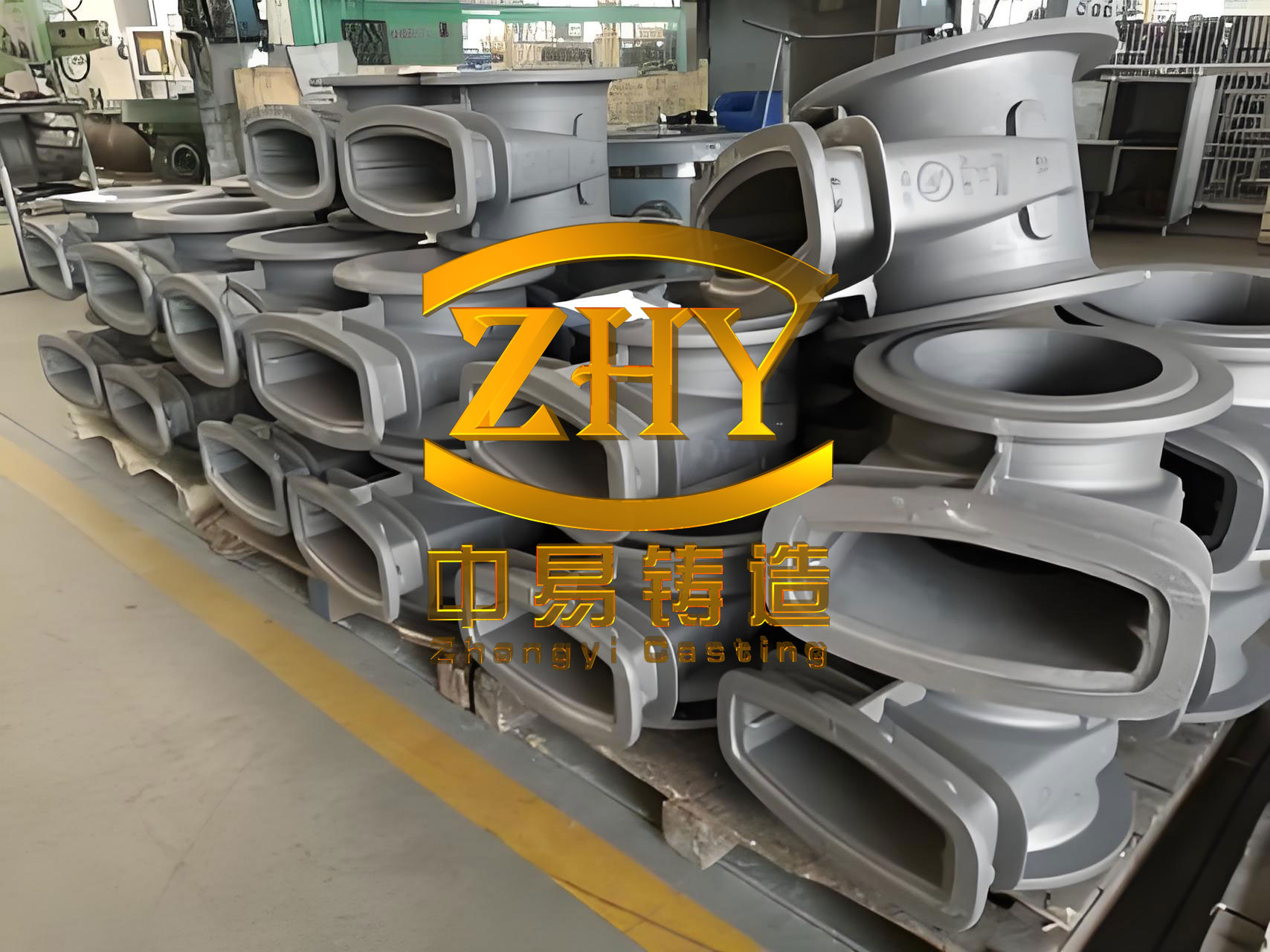
The component in question was a machine tool crossbeam with a finished machined dimension of 15,240 mm x 2,415 mm x 2,190 mm. The material specification was HT300 (a common Chinese standard for gray cast iron with a minimum tensile strength of 300 MPa), with a hardness requirement of ≥160 HB on the guideway surfaces. The geometry was essentially a long, hollow box section with internal reinforcing ribs, presenting an average wall thickness of 55-65 mm and local hot spots up to 135 mm in diameter. The most formidable challenge was its fully enclosed, six-sided design, with only a few side access holes of 300 mm diameter. This “sealed box” configuration makes traditional core assembly impossible and poses extreme difficulty for coating application and sand compaction in a full mold process.
1. Expandable Polystyrene (EPS) Pattern Engineering
The pattern is the literal and figurative foundation of the full mold process. For an 83-ton gray cast iron casting, the pattern must possess exceptional dimensional stability, strength to handle its own weight and coating, and precise geometry.
- Material Selection: Expanded Polystyrene (EPS) with a controlled density of 17-18 kg/m³ was selected. This density provides an optimal balance between sufficient strength to resist deformation during handling and coating, and a low enough density to minimize gaseous decomposition products during pouring.
- Fabrication Strategy: Given the colossal size, the pattern was built from multiple blocks cut by hot-wire machines and meticulously assembled via adhesive bonding. The total pattern mass was approximately 212 kg. Every joint and surface was finished to ensure seamless transitions, preventing potential cold laps or erosion defects in the final gray cast iron casting.
- Critical Design Modification – “Access Hatches”: To solve the insurmountable problem of coating the interior surfaces and ensuring proper sand flow and compaction within the enclosed cavity, strategic “access hatches” were incorporated into the top surface of the pattern. Twelve openings, each 500-600 mm in size, were spaced 600-700 mm apart. These hatches were later covered with separate EPS plates after internal coating and sand filling. This innovative step was crucial for process feasibility.
The dimensional integrity of the fully assembled pattern was verified against the digital model, accounting for all planned process allowances. It was then conditioned in a controlled environment to eliminate moisture and stabilize the foam.
2. Comprehensive Process Design and Parameterization
A robust process design is non-negotiable for a casting of this magnitude. The following parameters were meticulously calculated and established.
| Process Parameter | Value / Specification | Rationale |
|---|---|---|
| Pattern Shrinkage Allowance | Length: 1.2% Width & Height: 1.0% |
Accounts for the total contraction of gray cast iron from solidus temperature to room temperature, influenced by geometrical constraints and mold resistance. |
| Machining Allowance | Bottom/Upper Guides: 30 mm Sides & Ends: 25 mm |
Provides sufficient material for cleaning and finishing critical functional surfaces to final dimensions and removing any surface irregularities from the full mold process. |
| Pattern Distortion (Camber) | 0.2% of length (Appx. 30 mm) | A preemptive, opposite deformation built into the pattern to counteract sagging during sand filling and the natural deflection of the long casting under its own weight during solidification. |
The final pattern dimensions ($L_{pattern}$, $W_{pattern}$, $H_{pattern}$) are therefore derived from the finished part dimensions ($L_{part}$, $W_{part}$, $H_{part}$) as follows:
$$ L_{pattern} = L_{part} \times (1 + 0.012) + \text{Machining Allowance} $$
$$ W_{pattern} = W_{part} \times (1 + 0.01) + \text{Machining Allowance} $$
$$ H_{pattern} = H_{part} \times (1 + 0.01) + \text{Machining Allowance} + \text{Camber Profile} $$
3. Molding Media: Sand and Coating Selection
The choice of sand and coating directly governs mold stability, gas permeability, and final casting surface quality.
| Material | Specification | Function |
|---|---|---|
| Base Sand | Silica Sand, AFS GFN 20/40 | Provides the primary refractory matrix for the mold. |
| Sand System | 85% Reclaimed Sand + 15% New Sand | The new sand addition maintains system permeability and refractory performance, preventing burn-on defects in the heavy-section gray cast iron casting. |
| Coating Type | Water-based Graphite Coating | Provides a high-temperature barrier between the decomposing foam and the liquid metal, prevents sand erosion, and ensures a smooth casting surface. |
| Coating Thickness | Flat Areas: 1.5-2.0 mm Corners/Thick Sections: 2.0-3.0 mm |
Thicker coating in thermal centers resists metal penetration and absorbs more foam pyrolysis products, critical for sound gray cast iron. |
The coated pattern, now weighing over 400 kg, required extreme care during handling to prevent cracking or distortion prior to molding.
4. Pit Molding Strategy and Execution
No standard flask could contain this casting. A pit mold was the only viable option, requiring rigorous ground preparation.
- Pit Preparation & Venting: A foundation layer of dry, crushed coke was laid and traversed by a network of perforated vent pipes and rope channels. This is the critical infrastructure to evacuate the massive volume of gas generated from the vaporizing 212 kg EPS pattern. A 250-300 mm layer of bonded sand was compacted over this venting base.
- Camber Implementation: The sand bed was shaped with a reverse camber profile matching the designed 30 mm upward deflection. The heavy, coated pattern was then carefully lowered onto this bed, ensuring full contact along the camber curve.
- Sequential Sand Filling: To balance sand pressure and avoid pattern shift or distortion, filling proceeded simultaneously from both ends towards the center and from the center outwards through the access hatches. The internal cavity was filled with equal care. Sand compaction was achieved using pneumatic rammers, ensuring uniform density without deforming the fragile EPS structure.
- Mold Rigidity & Gating: Side margins (mold wall thickness) were maintained at 300-350 mm, with 400-450 mm at the ends. The cope was formed using large, reused flasks. The gating system was open and designed with ceramic sprue tubes to handle the high metal throughput, fed by a common pouring basin. The sprue placement had to align with the foundry’s crane capacity for ladle handling.
5. Metallurgy and Pouring of Gray Cast Iron
The molten metal preparation and pouring phase is where process control converges to define the casting’s metallurgical integrity.
| Aspect | Execution Details |
|---|---|
| Melting Units | Two 10-ton/hour cold blast cupola furnaces with large forehearths. |
| Ladle Logistics | Two 30-ton receiving ladles, three 15-ton transfer/pouring ladles. |
| Target Pouring Temperature | 1,420 – 1,450 °C |
| Total Melt & Pour Duration | ~4 hours melting, ~3.5 minutes pouring. |
| In-Mold Solidification Time | 8 days (controlled cooling within the sand mold). |
The chemical composition target for this high-strength gray cast iron (HT300) was carefully balanced to ensure proper graphite formation, strength, and machinability. The key is achieving a carbon equivalent (CE) that promotes gray iron formation without excessive chilling risk. The Carbon Equivalent is often calculated as:
$$ CE = \%C + \frac{1}{3}(\%Si + \%P) $$
For our target analysis, the calculated CE would be in a range conducive to a fully pearlitic matrix with type A graphite, providing the required strength and damping capacity characteristic of high-quality gray cast iron.
The pouring operation was a synchronized ballet. The high temperature was maintained to ensure fluidity for complete mold filling before foam decomposition gases could create turbulence. The large, pre-heated ladles were essential to maintain thermal mass and minimize temperature drop during the pour. The entire mold cavity was filled rapidly and continuously to establish a consistent thermal gradient.
6. Quality Evaluation and Defect Analysis
Upon shakeout and initial cleaning, the casting underwent rigorous inspection.
- Dimensional Conformance: The casting matched the predicted dimensions, including the expected camber. This validated the accuracy of the pattern shrinkage and distortion allowances.
- Chemical and Mechanical Properties: Spectrographic analysis and mechanical testing confirmed the material met specifications.
| Element | Weight % | Role in Gray Cast Iron |
|---|---|---|
| Carbon (C) | 2.90 | Primary graphite former, influences fluidity and shrinkage. |
| Silicon (Si) | 1.54 | Graphitizer, strengthens ferrite, increases fluidity. |
| Manganese (Mn) | 1.21 | Counteracts sulfur, promotes pearlite formation, increases strength. |
| Sulfur (S) | 0.12 | Controls graphite morphology in balance with Mn; excess can promote chill. |
| Phosphorus (P) | 0.10 | Increases fluidity but can form hard, brittle phosphide eutectic at higher levels. |
The measured hardness on the guideways averaged 165 HB, exceeding the 160 HB requirement. Separately cast test bars showed a tensile strength of 310 MPa, confirming the HT300 grade.
- Defect Assessment: As is common with full mold casting of thick-section gray cast iron, some localized surface anomalies were present. These included minor carbonaceous deposits (lustrous carbon films) and slag inclusions, remnants of the foam pyrolysis process. However, these defects were shallow and removed by the planned machining allowance, rendering them inconsequential to the final part’s service performance.
7. Comparative Advantage and Concluding Insights
The success of this project starkly highlights the advantages of full mold casting for oversized, complex components in gray cast iron. A traditional wooden pattern approach would have consumed 15-20 cubic meters of timber, taken over two months for pattern construction alone at a cost exceeding a quarter-million currency units, and introduced uncertainties in core assembly and dimensional accuracy.
In contrast, the full mold process completed the entire project cycle—from process design to shipment—in three months. The EPS pattern, while requiring skillful fabrication, was significantly faster and cheaper to produce. The direct translation from pattern to mold eliminated core shifts and parting line mismatches, enhancing dimensional fidelity. The process demonstrated remarkable flexibility in handling the “sealed box” geometry through intelligent pattern modification (access hatches).
This case study stands as a testament to the capability of full mold casting to push the boundaries of manufacturable size and complexity in gray cast iron. It underscores that success hinges on an integrated approach: engineering the foam pattern as a critical structural component, designing a robust and vented mold system, executing precise metallurgical control for the gray cast iron, and managing the immense thermal dynamics from pour to solidification. For foundries facing the challenge of monumental castings, mastering these interrelated elements of the full mold process is not just an option, but a necessary strategic competence.