
In the development and pilot production of a critical structural component for a newly introduced engine series—specifically, a large end cover—significant challenges were encountered. The component, a complex, thin-walled casting with an intricate internal cavity, is designated as a high-grade gray cast iron (HT300). The inherent difficulty in stabilizing the metallurgy of such high-strength gray cast iron, combined with the assembly of over twenty diverse sand cores to form its internal geometry, presented a formidable manufacturing hurdle. Initial pilot runs resulted in an unacceptably high rejection rate due to defects including cracks, gas cavities (particularly on the top surface), and dimensional deviations leading to insufficient machining stock at auxiliary core print locations. This narrative details the root cause analysis and the systematic process improvements implemented to resolve these issues and achieve stable production.
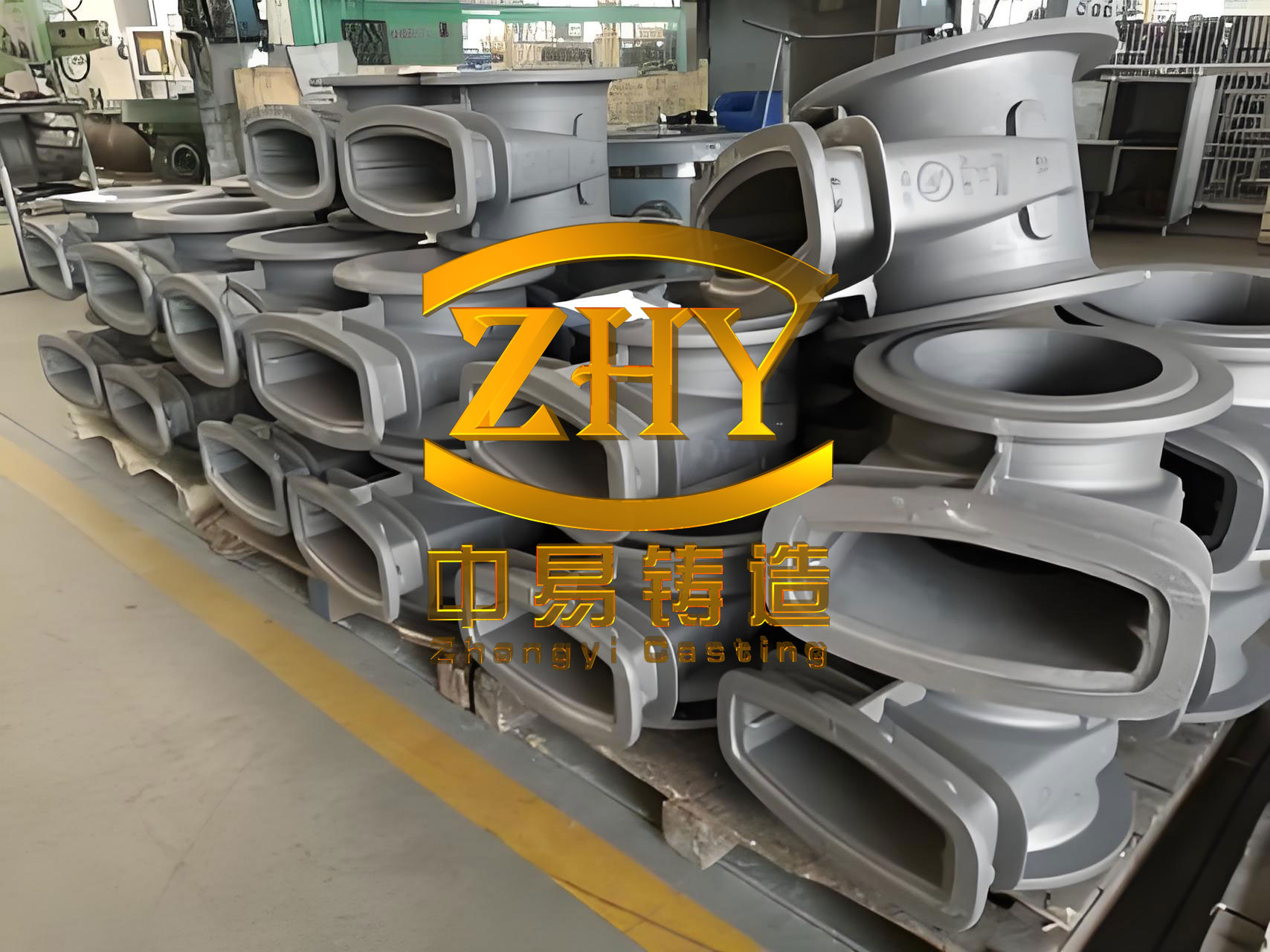
The casting in question is substantial, with rough dimensions of 1862 mm x 1422 mm x 1075 mm, a finished casting weight of approximately 1.7 metric tons, and a total poured weight of 2.4 metric tons. The production utilized alkaline phenolic resin no-bake sand for molds and hand-made cores. To address the risk of cold shuts and surface defects on the large top plane, a stepped gating system was employed. The initial bottom gating was constructed from ceramic tubes, and a 100x100x22 mm ceramic filter was placed in the runner to reduce slag inclusion. Given the presence of heavy sections in the lower regions of the casting, feeding risers were strategically placed to mitigate shrinkage porosity. The original process layout is conceptually summarized below.
Initial Process Parameters Summary:
| Process Aspect | Specification |
|---|---|
| Material | High-Strength Gray Iron HT300 |
| Molding Method | Alkaline Phenolic Resin No-Bake Sand |
| Coring Method | Hand-made Sand Cores (20+ unique cores) |
| Pouring Weight | 2400 kg |
| Gating System | Stepped Design, Ceramic Bottom Gates & Filter |
| Feeding | Risers on Heavy Sections |
The pilot production phase revealed three primary, recurring defect modes that severely impacted yield.
1. Crack Formation: Thermal tearing cracks appeared in two key areas after shakeout: on the thick upper plane sections and on internal reinforcing ribs within the cavity formed by the largest core assembly. These are classic hot tear defects, occurring in the final stages of solidification when the partially solidified casting’s contraction is restrained.
2. Dimensional Deviation (Core Shift): Machining benchmarks and subsequent CMM inspection revealed significant misalignment of auxiliary holes (core prints). This resulted in a lack of material in specified areas, rendering the casting non-conforming to machining drawings.
3. Gas Porosity/Pinholes on Upper Surface: Scattered pinhole-type defects were consistently found on the large, flat top surface of the casting, a region farthest from the ingates and a natural collection point for rising gases.
Root Cause Analysis and Targeted Countermeasures
1. Comprehensive Analysis and Resolution of Cracking
Cracking in gray cast iron castings is fundamentally a result of thermal stress exceeding the material’s hot strength. The stress $(\sigma_{thermal})$ generated during cooling can be conceptually expressed as:
$$
\sigma_{thermal} = E \cdot \alpha \cdot \Delta T \cdot \Phi
$$
where $E$ is the elastic modulus at elevated temperature, $\alpha$ is the coefficient of thermal expansion, $\Delta T$ is the temperature gradient or restrained cooling differential, and $\Phi$ is a constraint factor dictated by mold/core rigidity.
Analysis of our specific case identified multiple contributing factors:
- Geometric Stress Raisers: Small fillet radii at junctions of ribs and walls on the large core acted as initiators for stress concentration. The stress concentration factor $(K_t)$ is inversely related to the fillet radius $(r)$.
- Excessive Core Restraint: The primary 6# core assembly was massive and solid, offering poor collapsibility. This created a high constraint factor $(\Phi)$, severely hindering the natural contraction of the solidifying gray cast iron.
- Premature Shakeout: The casting was being shaken out while its temperature was well above 300°C. At this temperature, the gray cast iron still possesses significant residual stress, and rapid, non-uniform cooling in air can itself induce cracking or propagate existing micro-tears.
The implemented countermeasures were multi-faceted:
A. Design Modification: The tooling for the large 6# core was modified to increase the fillet radii at all critical rib-wall junctions, effectively reducing $K_t$.
B. Core Collapsibility Enhancement: The solid 6# core was redesigned with a hollow section or “pocket” in its central bulk area. This drastically reduced its volume and thermal mass, improving its ability to yield (collapse) under the contraction forces of the casting. The new design reduced core mass by approximately 25%.
C. Controlled Cooling Protocol: The shakeout temperature was strictly controlled. A minimum in-mold cooling time was established to ensure the casting temperature was below 200°C before shakeout commenced. This allowed stress relief through creep at elevated temperatures within the supportive mold.
| Root Cause | Countermeasure | Mechanism/Effect |
|---|---|---|
| Sharp geometry (High $K_t$) | Increased fillet radii on core tooling | Reduced stress concentration at hotspots |
| High core restraint (High $\Phi$) | Hollow-core design for largest sand core | Improved core collapsibility, reduced mechanical restraint |
| High residual stress at shakeout | Mandated shakeout temperature < 200°C | Promoted stress relief in-mold, prevented thermal shock |
2. Eliminating Dimensional Core Shift
The misalignment of features was traced directly to instability in the complex core assembly during mold closure and metal pouring. The internal cavity required a stack of multiple medium and small cores to be positioned on top of the primary 6# core. The foundational cores in this stack had only basic location pins, lacking positive locking mechanisms in rotational directions. During assembly and under the dynamic pressure of molten iron fill, these cores could rotate or shift slightly. This minute movement at the base was magnified through the stack, leading to unacceptable deviation at the top.
The solution moved from a free-hand assembly to a precision, jig-based pre-assembly process:
A. Pre-assembly Jig Fabrication: A simple but robust steel fixture was fabricated, mirroring the critical locating points of the mold.
B. Core Pre-assembly: The stack of interdependent cores (e.g., 7-1#, 7-2#, 7-3#) was assembled and mechanically locked together on this jig using pre-embedded bolts and nuts. This created a single, rigid core sub-assembly.
C. Integrated Placement: This pre-assembled block was then lowered as one unit onto the primary 6# core in the mold and securely bolted to it. Finally, any gaps, such as the hollow pocket in the 6# core, were sealed with specially fitted backup sand pieces to prevent metal intrusion.
This method transformed a chaotic, error-prone assembly into a repeatable, precision operation, eliminating the root cause of dimensional drift.
3. Mitigation of Surface Gas Defects
The pinholes on the upper cope surface are sub-surface gas defects, where gas trapped during solidification expands into pores just beneath the casting skin. The source can be mold/core gases, air entrapment, or gases evolving from the metal itself. The pressure balance is critical: a pore forms if the local gas pressure $(P_{gas})$ exceeds the metallostatic pressure $(P_{metal})$ and the capillary pressure resisting pore formation at a given solidification front. A simplified condition for pore formation is:
$$
P_{gas} > P_{metal} + \frac{2\gamma}{r}
$$
where $\gamma$ is the surface tension of the iron and $r$ is the pore radius.
Our focus was on reducing $P_{gas}$ by minimizing gas generation and maximizing gas venting. The resin-bonded sand cores, even when cured, contain residual moisture and organic compounds that pyrolyze upon contact with molten gray cast iron.
The improvements were procedural:
A. Enhanced Mold/Core Drying: After applying the refractory coating, the mold was not just flame-dried but subsequently subjected to a prolonged, controlled heat soak. A mobile hot-air dryer was used to circulate heated air (180-200°C) through the assembled mold for 2-3 hours before pouring. This drove off far more adsorbed moisture and low-temperature volatiles from the extensive core assembly.
B. Active Venting: Additional vent holes were manually drilled from all major core prints out to the mold exterior, providing direct, low-resistance escape paths for gases generated deep within the core package.
C. Tilt Pouring: The pouring practice was modified to a slight tilt angle. This creates a progressive, directional solidification front and allows gases to be swept toward the highest point (which is not the entire top surface) and out through vents or risers more efficiently, rather than being trapped under a horizontal solidifying skin.
| Action | Purpose | Targeted Variable |
|---|---|---|
| Extended hot-air drying of assembled mold | Reduce volatile content in cores/mold walls | Lower initial $P_{gas}$ from mold sources |
| Drilling auxiliary vent channels from core prints | Provide low-resistance escape paths for gas | Prevent local $P_{gas}$ buildup |
| Implementing a slight tilt during pouring | Promote directional solidification and gas evacuation | Enhances gas transport away from critical surfaces |
Production Validation and Generalized Principles
The implementation of this comprehensive set of improvements was validated through subsequent production batches. The results were decisive: cracking and core shift defects were completely eliminated. The incidence of other defects, including gas-related issues, was reduced to a manageable level, contributing to a final product yield increase from a critically low level to over 90%.
This case study underscores several universal principles in the production of complex gray cast iron castings:
1. Stress Management is Paramount for High-Strength Grades: Higher strength gray cast iron like HT300 often has lower tolerance for stress concentration and restraint due to its finer microstructure and different graphite morphology. Proactive measures—increasing fillets, improving core collapsibility, and controlling cooling—are not optional but essential.
2. Precision in Core Assembly is Non-Negotiable: For castings with multi-core internal geometries, relying on manual skill for alignment is a key risk. Investment in jigs, fixtures, and pre-assembly protocols ensures repeatable dimensional accuracy. The stability of the entire internal geometry often hinges on the secure placement of the foundational core(s).
3. Gas Evolution Must Be Actively Managed: Modern resin-bonded sands are excellent for dimensional stability but can be prolific gas generators. For large castings with extensive core surface area, standard drying practices are often insufficient. Aggressive, post-assembly drying and a philosophy of “over-venting” are critical success factors. The goal is to create a pressure gradient that always leads gas out of the mold.
The successful resolution hinged on viewing the casting process as a system of interacting variables—thermal, mechanical, and gaseous. The summary table below quantifies the key process changes.
| Defect Category | Original Condition / Parameter | Improved Condition / Parameter | Technical Impact |
|---|---|---|---|
| Cracking | Small fillet radii (e.g., ~3mm) | Increased fillet radii (e.g., ~8mm) | Reduced stress concentration factor $(K_t)$ |
| Solid, high-mass core | Hollow-core design | Increased core collapsibility, reduced restraint factor $(\Phi)$ | |
| Shakeout at ~300-350°C | Shakeout at < 200°C | Lower thermal stress $(\sigma_{thermal})$ at shakeout | |
| Core Shift | Manual, in-mold core stacking | Jig-based pre-assembly & bolting | Eliminated rotational/translational drift in core stack |
| Gas Porosity | Standard torch drying only | Torch + 2-3h hot-air drying at ~190°C | Reduced mold gas generation rate |
| Limited natural venting | Active vent drilling + tilt pouring | Enhanced venting efficiency, lowered $P_{gas}$ in cavity |
This experience reinforces that producing sound, high-integrity gray cast iron castings, especially of large size and complexity, requires a deep understanding of the material’s solidification behavior and a process design that proactively addresses the trilogy of feeding, stress, and gas management. The principles derived—enhancing geometric transition, ensuring core assembly rigidity, and aggressively managing mold atmosphere—form a robust framework applicable to a wide range of challenging gray cast iron casting projects.