
In the foundry industry, the production of wear-resistant balls and segments is a critical sector, driven by demand from mining, cement, power generation, and other material processing fields. As a researcher focused on casting process engineering, I have extensively studied various molding techniques to optimize efficiency, cost, and environmental impact. This article presents a first-person perspective analysis comparing two predominant molding processes: the sand coated iron mold casting method and the DISA molding line. The emphasis is on economic viability, operational characteristics, and future trends, with repeated reference to the sand coated iron mold casting approach to underscore its role in current practices.
The global market for wear-resistant balls has grown steadily, with consumption accounting for approximately 55% of all wear-resistant castings. Advances in materials, such as low-chromium, medium-chromium, and high-chromium alloy series, have enhanced product performance. By 2015, demand in China alone was projected to reach 2.0874 million tons, reflecting a 44% increase from 2010. This growth necessitates efficient production methods, making process selection crucial for competitiveness. In my evaluation, I consider factors like production scale, investment capacity, and sustainability, often contrasting the sand coated iron mold casting technique with automated alternatives.
Domestically, the primary molding processes for wear-resistant balls include sand molding and metal mold methods. For balls with diameters ranging from φ60mm to φ120mm, the sand coated iron mold casting process is widely adopted, while smaller balls (φ20mm to φ40mm) often use domestic vertical parting squeeze molding. Over the past decade, the sand coated iron mold casting line has evolved into a relatively complete system, though it faces limitations. Below, I detail its composition and workflow.
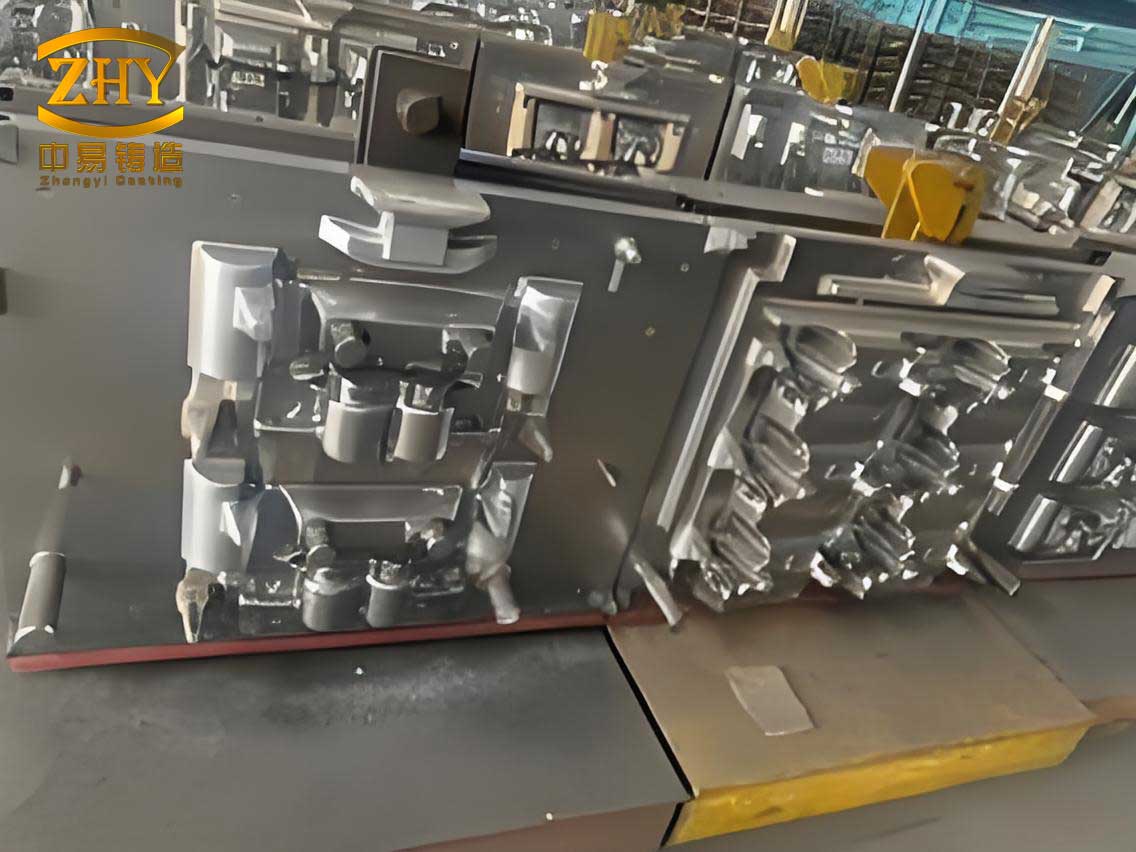
The sand coated iron mold casting production line typically consists of a roller conveyor, mold pusher mechanism, single-ring mold turnover device, high-pressure core shooter, sand coating plate with preheating device, mold turnover unit, suspended mold closing and opening device, insulated pouring ladle, automatic pouring system, mold cleaning device, mold preheating unit, mold clamping device, and instrumentation with automated control systems. This configuration highlights the complexity of the sand coated iron mold casting method, which relies on multiple interconnected components.
The process flow for sand coated iron mold casting involves several steps, as outlined in a typical flowchart: mold preparation, sand coating, mold closing, pouring, cooling, mold opening, and product extraction. Manual operations are required in key stages, such as mold setup and cleaning, while automated controls handle conveying and pouring. This hybrid approach in sand coated iron mold casting lines often leads to inefficiencies. Key parameters include a maximum mold size of 800mm (L) × 600mm (W) and a production rate of 40–60 molds per hour. The molds are designed for multi-ball production, with cavities cast directly without machining, and interconnected through gates and risers in a series-parallel arrangement. Vent holes with specialized plugs ensure proper gas escape.
The process yield for sand coated iron mold casting varies by ball diameter, as shown in Table 1. This yield impacts overall economics, especially when compared to more automated systems. The advantages of sand coated iron mold casting include precise product dimensions, good surface finish, and relatively low initial investment—approximately $400,000 to $500,000 per line. However, the drawbacks are significant: low productivity due to the 60 mold/hour cap, high thermal radiation from molds operating at 200°C, which affects worker comfort, and sensitivity to equipment precision, where minor errors can compromise quality. Additionally, harmful fumes from sand hardening and pouring pose environmental and health risks, requiring costly purification. The sand coated iron mold casting process involves many control points and human factors, necessitating 6–7 operators per line, driving up labor costs. Other issues include poor compatibility, severe sand spillage, difficulty in ball extraction, long changeover times, and high maintenance workloads.
| Ball Diameter (mm) | Process Yield (%) |
|---|---|
| 30 | 88 |
| 40 | 84 |
| 50 | 44 |
| 70 | 60 |
| 100 | 70 |
In contrast, international leaders like Belgium’s Magotteaux utilize DISA molding lines for wear-resistant ball production, with global output exceeding 600,000 tons annually. The DISA line comprises a molding host, automatic mold conveyor (AMC), and synchronous belt conveyor (SBC), often enhanced with quick pattern change devices, automatic core setters, and shuttle systems for extended cooling. Computer-integrated production modules and remote monitoring ensure stability and efficiency. The working principle involves six steps: sand shooting, squeezing, mold opening, mold conveying, positive plate return, and mold closing. This automation reduces labor to button-controlled operations, with noise levels minimized due to no shock vibrations.
The DISA line offers high productivity, often exceeding 450 molds per hour, and superior dimensional accuracy with mechanical mismatch as low as 0.15mm. It requires fewer auxiliary devices, leading to lower maintenance and simpler配套. However, drawbacks include limitations for complex sand molds and a 5–10% lower metal utilization compared to horizontal parting methods. Despite this, the DISA line represents a advanced alternative to the sand coated iron mold casting approach.
To economically compare these processes, I analyze equipment investment and per-ton casting costs. For a production scale of 3,000 tons annually, the sand coated iron mold casting line requires an investment of approximately $464,000, while the DISA line demands about $232,000, as detailed in Table 2. This stark difference arises from the DISA’s higher automation and reduced need for peripheral equipment. In terms of operational costs, the sand coated iron mold casting method incurs higher expenses due to labor, energy, and maintenance. Table 3 breaks down the per-ton cost: for sand coated iron mold casting, it totals $129.2, whereas for DISA, it is $99.6. These figures derive from factors like labor ($100/ton for sand coated iron mold casting vs. $35/ton for DISA), energy consumption (742 kWh/ton at 70% yield for sand coated iron mold casting vs. 866 kWh/ton at 60% yield for DISA), and maintenance ($150/ton vs. $70/ton). The cost advantage of DISA becomes evident, especially when scaling production.
| Component | Sand Coated Iron Mold Casting Line Cost ($) | DISA Molding Line Cost ($) |
|---|---|---|
| Molding Host | 150,000 | 600,000 |
| Auxiliary Equipment | 350,000 | 50,000 |
| Sand System | 840–1,200 per ton capacity | 70–1,200 per ton capacity |
| Melting Furnace | 300,000 | 100,000 |
| Total Investment | 464,000 | 232,000 |
| Cost Factor | Sand Coated Iron Mold Casting ($/ton) | DISA Molding Line ($/ton) |
|---|---|---|
| Labor | 100 | 35 |
| Energy (at respective yields) | 742 (70% yield) | 866 (60% yield) |
| Maintenance | 150 | 70 |
| Other Overheads | 300 | 50 |
| Total Cost | 129.2 | 99.6 |
The economic superiority of the DISA line can be quantified using return on investment (ROI) formulas. For instance, the net present value (NPV) for each process over a 5-year period can be calculated as:
$$ NPV = \sum_{t=1}^{n} \frac{C_t}{(1 + r)^t} – I_0 $$
where \( C_t \) is the net cash flow in year \( t \), \( r \) is the discount rate, and \( I_0 \) is the initial investment. Assuming annual revenue of $500,000 from 3,000 tons at $166.67/ton, the cash flows for sand coated iron mold casting would be reduced by higher operational costs. Let \( O_c \) be the annual operating cost, which for sand coated iron mold casting is \( 3000 \times 129.2 = 387,600 \), and for DISA is \( 3000 \times 99.6 = 298,800 \). The net cash flow \( C_t \) is revenue minus \( O_c \). With \( r = 10\% \), the NPV for sand coated iron mold casting is:
$$ NPV_{\text{sand coated}} = \sum_{t=1}^{5} \frac{500,000 – 387,600}{(1 + 0.1)^t} – 464,000 = \frac{112,400}{1.1} + \frac{112,400}{1.1^2} + \frac{112,400}{1.1^3} + \frac{112,400}{1.1^4} + \frac{112,400}{1.1^5} – 464,000 $$
Calculating this yields a negative NPV, indicating lower profitability. For DISA:
$$ NPV_{\text{DISA}} = \sum_{t=1}^{5} \frac{500,000 – 298,800}{(1 + 0.1)^t} – 232,000 = \frac{201,200}{1.1} + \frac{201,200}{1.1^2} + \frac{201,200}{1.1^3} + \frac{201,200}{1.1^4} + \frac{201,200}{1.1^5} – 232,000 $$
This results in a positive NPV, underscoring the economic advantage. Furthermore, the break-even point can be derived from the cost function \( C(x) = I_0 + O_c \cdot x \), where \( x \) is production volume. For sand coated iron mold casting, \( C(x) = 464,000 + 129.2x \), and for DISA, \( C(x) = 232,000 + 99.6x \). Setting these equal to revenue \( R(x) = 166.67x \), we solve for \( x \):
$$ 464,000 + 129.2x = 166.67x \implies x = \frac{464,000}{166.67 – 129.2} \approx 12,400 \text{ tons} $$
For DISA:
$$ 232,000 + 99.6x = 166.67x \implies x = \frac{232,000}{166.67 – 99.6} \approx 3,460 \text{ tons} $$
This shows that the DISA line reaches break-even at a much lower production volume, making it suitable for smaller scales. However, the sand coated iron mold casting method may still be viable for low-volume scenarios due to its lower upfront cost, but its limitations in efficiency and environmental impact must be weighed.
In my assessment, the sand coated iron mold casting process, while entrenched in domestic production, faces challenges from rising labor costs and stringent environmental regulations. The frequent reference to sand coated iron mold casting in industry discussions highlights its prevalence, but also its drawbacks. For instance, the heat radiation issue in sand coated iron mold casting lines can be modeled using thermal conductivity equations. The heat flux \( q \) from a mold at temperature \( T_m \) to surroundings at \( T_a \) is given by:
$$ q = h \cdot A \cdot (T_m – T_a) $$
where \( h \) is the heat transfer coefficient and \( A \) is the surface area. For sand coated iron mold casting molds at 200°C, with \( h \approx 10 \, \text{W/m}^2\text{K} \) and \( A \approx 1 \, \text{m}^2 \), \( q \approx 10 \times 1 \times (200 – 25) = 1750 \, \text{W} \), contributing to harsh working conditions. This is less pronounced in enclosed DISA systems.
Another aspect is the environmental impact of sand coated iron mold casting. The fume emission rate \( E \) can be estimated as \( E = k \cdot M \), where \( k \) is an emission factor and \( M \) is the mass of sand used. For a typical sand coated iron mold casting line, \( M \) might be 0.5 kg per mold, leading to significant airborne pollutants. Purification costs add to operational expenses, whereas DISA lines incorporate better containment.
Looking forward, I recommend that under conditions of sufficient production scale and investment capacity, the DISA molding line offers substantial advantages over the sand coated iron mold casting method. This aligns with global trends where automation and sustainability are prioritized. Small enterprises relying solely on sand coated iron mold casting lines, with annual outputs of 3,000–5,000 tons, may struggle due to poor working environments, high labor intensity, and inadequate environmental measures. These factors could stagnate their growth, urging a shift toward more advanced processes.
In conclusion, my analysis emphasizes that while the sand coated iron mold casting technique has served as a cornerstone in wear-resistant ball production, its economic and operational limitations become apparent when compared to automated alternatives like the DISA line. By integrating formulas and tables, I have quantified these differences, highlighting the importance of process selection for long-term viability. As the industry evolves, embracing technologies that enhance efficiency, reduce costs, and improve worker safety will be crucial, moving beyond traditional methods like sand coated iron mold casting to meet future demands.