
In the pursuit of manufacturing thick-sectioned, geometrically complex ductile iron castings, the challenge of shrinkage porosity and internal soundness remains paramount. My extensive experience has shown that the selection of molding technology is not merely a production choice but a fundamental determinant of metallurgical quality. Through years of practice and analysis, I have come to regard sand coated iron mold casting as a particularly potent solution for such demanding applications. This process, which synergizes the rapid cooling of a metal mold with the flexibility of a thin resin-bonded sand layer, offers a unique pathway to achieving dense, high-integrity castings. In this detailed exploration, I will dissect the solidification principles of ductile iron, evaluate prevalent molding methods, and demonstrate through practical logic and simulation how a well-orchestrated sand coated iron mold casting process, augmented by strategic feeding, can reliably overcome the inherent shrinkage tendencies of these formidable alloys.
The Core Challenge: Understanding Ductile Iron Solidification
The behavior of ductile iron during solidification is distinct from that of gray iron or steel, governed by its unique graphite formation. Upon inoculation, graphite nucleates within the melt and quickly becomes encapsulated by an austenite shell. This shell significantly impedes the diffusion of carbon atoms from the liquid to the growing graphite nodule. Consequently, the eutectic reaction occurs over a broad temperature range, leading to what is termed a “mushy” or pasty freezing mode. A large section of the casting remains in a semi-solid state for an extended period, creating a network of interwoven solid dendrites and liquid metal.
This solidification characteristic directly drives the complex volumetric changes that are central to defect formation. The total volume change (\(V_{total}\)) from pouring to complete solidification is a composite of several sequential and overlapping phenomena:
- Liquid Contraction (\(V_{liquid}\)): The thermal contraction of the molten metal from the pouring temperature down to the liquidus temperature.
- Solidification Contraction (\(V_{solidification}\)): The phase change contraction as the metal transitions from liquid to austenite (approximated at -2% to -4% for Fe-C alloys).
- Graphitic Expansion (\(V_{graphite}\)): The counteracting expansion due to the lower density of graphite precipitating from the melt. The magnitude of this expansion is highly sensitive to metallurgical factors like Carbon Equivalent (CE), nodule count, and morphology.
This can be summarized as: $$V_{total} = V_{liquid} + V_{solidification} + V_{graphite}$$
The net result—whether the casting experiences a net shrinkage or expansion—is not fixed. It is a dynamic contest influenced by a matrix of interacting factors, as outlined in the table below.
| Factor Category | Specific Factor | Typical Influence on Net Volume/Solidification |
|---|---|---|
| Metallurgical | Carbon Equivalent (CE) | Higher CE (near eutectic) maximizes graphite expansion potential. |
| Inoculation Efficacy | Increased, effective inoculation raises nodule count, enhancing expansion. | |
| Nodularity & Morphology | High nodularity and uniform, small/medium nodules promote greater expansion. | |
| Alloying Elements (e.g., Cu, Sn) | Increase pearlite content but can slightly increase contraction tendency. | |
| Process | Pouring Temperature | Higher temperature increases liquid contraction, potentially reducing net expansion. |
| Mold/Mold Wall Movement | Rigid molds restrict expansion, forcing it inward for self-feeding; yielding molds absorb expansion, increasing shrinkage risk. | |
| Cooling Rate | Faster cooling reduces the time for liquid feeding but can enhance dendritic locking. |
It is this delicate balance, particularly in thick sections where cooling is slow, that makes feeding so critical. If the liquid feed paths become blocked by dendrites before the graphite expansion phase reaches its peak, or if the mold wall yields outward, microscopic shrinkage cavities (porosity) will form in the last-to-freeze regions. The goal of any robust casting process is to control these variables to ensure that either external feeding or internal expansion adequately compensates for the contraction phases.
Landscape of Molding Processes: A Comparative Analysis
Before justifying the choice of sand coated iron mold casting, it is essential to understand the context by comparing the prevalent alternatives for heavy-section ductile iron.
| Molding Process | Key Advantages | Key Disadvantages for Thick Ductile Iron | Suitability for High-Integrity, Thick Sections |
|---|---|---|---|
| Cold-Cure Resin Sand | High strength, good dimensional stability, suitable for complex cores. | Slow cooling leads to long solidification times, requiring massive chills and large risers. High sand-to-metal ratio, binder cost, and gas-related defects are concerns. | Moderate. Effective but often expensive and inefficient for series production. |
| Green Sand (Clay-Bonded) | Low-cost materials, high productivity on automated lines. | Low mold rigidity leads to significant wall movement, absorbing expansion. High reliance on large, inefficient riser systems for feeding. Cooling rate is relatively slow. | Low to Moderate. Prone to shrinkage defects unless aided by powerful exothermic risers, reducing yield. |
| Dry Sand (Clay-Bonded) | Higher strength and rigidity than green sand. | High energy consumption, poor dimensional accuracy, labor-intensive. | Low. Largely obsolete for quality-critical components. |
| Sand Coated Iron Mold Casting | High mold rigidity, fast and directional cooling, excellent dimensional accuracy, low sand consumption, suitable for automation. | Higher initial tooling cost for the iron molds. Requires precise control of coating thickness and process parameters. | High. Uniquely combines rigidity for expansion utilization with controlled cooling to manage solidification sequence. |
The comparison reveals a clear pattern: traditional sand processes often struggle with the twin challenges of mold yield and slow cooling, both of which exacerbate shrinkage problems in ductile iron. This is precisely where the paradigm of sand coated iron mold casting introduces a transformative advantage. The process involves creating a cast iron or steel mold (the “iron mold”) that defines the primary geometry of the casting. A thin layer (typically 5-15 mm) of resin-coated sand is then thermally cured against the mold’s interior surface, forming a precise and durable cavity coating. This hybrid mold assembly provides exceptional rigidity to harness graphite expansion, while the thin sand layer prevents chilling-related carbides and allows for complex detail. The iron body of the mold rapidly extracts heat, promoting a more directional solidification front.
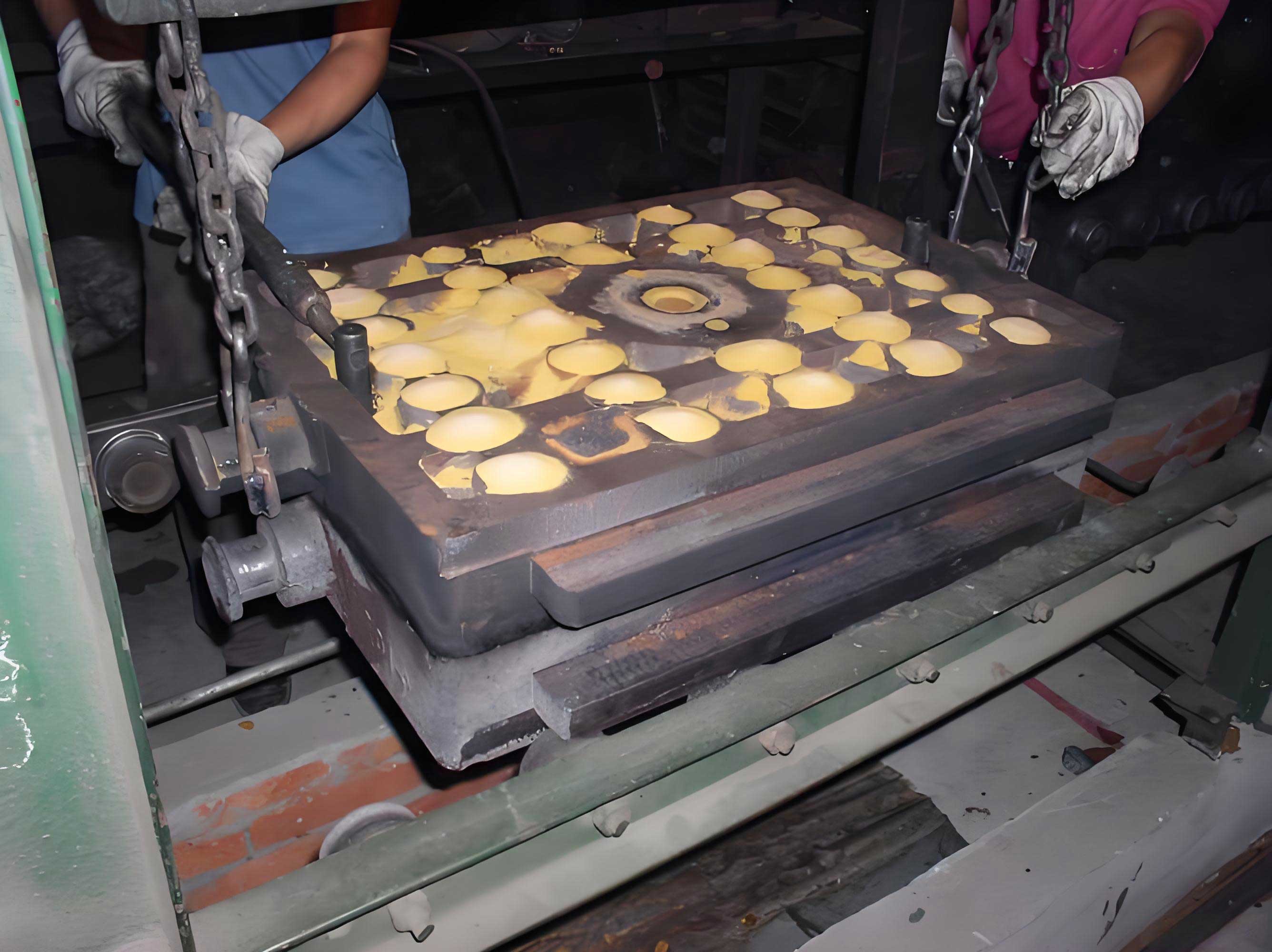
Strategic Design for Sand Coated Iron Mold Casting
Success with sand coated iron mold casting is not automatic; it requires a strategic design philosophy that leverages its inherent strengths. The process enables a shift from purely “feeding-based” compensation to a “controlled expansion-assisted” methodology. The rapid heat extraction by the iron mold causes thin sections and gates to solidify quickly. This early solidification can help to isolate the thicker, slower-cooling sections of the casting, effectively creating a closed volume. As these thick sections subsequently solidify and undergo graphite expansion, the unyielding iron mold contains the pressure, forcing the expanding metal to compensate for its own solidification shrinkage—a phenomenon known as “self-feeding” or “pressure feeding.”
However, for truly thick and complex geometries where thermal isolation is imperfect or expansion is insufficient, relying solely on self-feeding is risky. Here, the modern foundry must integrate advanced simulation and targeted feeding. Numerical Solidification Simulation (NSS) software is an indispensable tool. It allows me to visualize filling patterns, track the evolution of the solid fraction over time, and predict the location and severity of shrinkage porosity using criteria functions (e.g., Niyama criterion). The simulation model must accurately represent the different cooling boundaries: the thin resin sand layer, the massive iron mold, and any insulating or chilling inserts.
By iterating designs in the virtual environment, I can optimize two key aspects specific to sand coated iron mold casting:
- Coating Thickness Distribution: Varying the thickness of the sand layer acts as a local thermal resistor. Areas needing accelerated cooling (like hot spots adjacent to feed paths) can have a thinner coating (e.g., 6-8 mm), while areas that should stay fluid longer to act as feed paths can have a slightly thicker coating (e.g., 10-12 mm).
- Integrated Feeding Strategy: The goal is to use the smallest possible feeding system that ensures soundness. Simulation helps design riser necks that remain open long enough for feed metal to pass, and to position exothermic or insulating risers precisely where the thermal center of the casting is located. An exothermic riser’s efficiency (\( \eta_{riser} \)) in this context is critical: $$ \eta_{riser} = \frac{V_{feed}}{V_{riser}} \times 100\% $$ where a well-designed exothermic system in a rigid mold can achieve \( \eta_{riser} \) values of 30-35%, significantly higher than a plain sand riser.
A Practical Case: From Simulation to Sound Casting
Let me illustrate with a representative example: a heavy-duty pulley wheel, a thick-sectioned rotational symmetry casting weighing approximately 140 kg in QT600-3 (with enhanced strength requirements). The critical areas were the junctions between the hub, spokes, and the outer rim, with wall thickness variations from 15 mm to over 85 mm. The specification demanded ultrasonic testing soundness and consistent hardness.
My initial approach, using only the fast cooling of the sand coated iron mold with small side risers and chills (simulation Scheme A), proved inadequate upon trial. The simulation, while showing mostly sound material, indicated isolated liquid pockets in the heaviest sections. The physical prototype confirmed this—micro-porosity was present at the spoke-rim junctions. The rapid cooling had prematurely solidified the feeding paths before the full graphite expansion in the thermal center could be mobilized effectively.
The solution (simulation Scheme B) involved a strategic combination of the mold’s attributes with active feeding:
- Top Feeding via Exothermic Riser: The main downsprue was integrated into a large, exothermic sleeve riser placed over the central hub. This provided:
- Clean metal entry through a filter.
- A sustained reservoir of hot metal under significant metallostatic pressure.
- A clear, thermally-maintained feed path to the hub.
- Strategic Satellite Risers: Two additional exothermic risers were placed directly on the top of the outer rim at locations identified by simulation as last-to-freeze zones.
- Optimized Coating Thickness: The sand coating on the spokes was made slightly thinner than on the rim hubs to encourage directional solidification toward the rim and the central riser.
The simulation of this revised scheme showed a clear, open feeding channel from the central riser through the hub and into the rim until the final stage of solidification. The thermal gradients were effectively managed. The production castings, upon rigorous testing, validated the model:
| Inspection Method | Result | Specification/Standard |
|---|---|---|
| Ultrasonic Testing (UT) | 100% compliant, no indications | Internal soundness standard |
| Mechanical Properties (from casting) | Tensile Strength: 858 MPa, Elongation: 5.2% | QT600-3 (Enhanced) |
| Hardness (4-point check on rim) | 242 – 255 HB | 240 – 270 HB, max 15 HB spread |
| Macro Etch / Sectioning | Dense, sound structure at all critical junctions | Visual soundness standard |
| Microstructure (at hot spot) | Nodularity >90%, Pearlite >85%, Graphite Size 6-7 | Customer microstructure requirement |
Integrated Process Control Parameters
The efficacy of sand coated iron mold casting is fully realized only when coupled with stringent metallurgical and process control. Based on this and similar projects, I maintain the following parameters as critical to success for thick-section ductile iron:
| Process Stage | Parameter | Target Range / Specification | Rationale |
|---|---|---|---|
| Melting & Chemistry | Charge Make-up | >60% Steel Scrap, balance Returns | Low base sulfur, high purity. |
| Final Chemistry (wt.%) | C: 3.4-3.9, Si: 2.0-2.4, Mgres: 0.035-0.055, P<0.05, S<0.02 | High CE for expansion, low impurities. | |
| Alloying (Cu) | 0.2 – 0.6% | Promotes pearlite, strengthens matrix. | |
| In-Mold Coating Thickness | Gates: 12-15mm, Thin Sections: 6-8mm, General: 8-10mm | Controls local cooling rate to steer solidification. | |
| Sand-to-Metal Ratio | ~0.2 : 1 | Dramatically lower than sand processes, reducing cost and gas generation. | |
| Treatment & Pouring | Inoculation (Post-inoculation) | 0.5-0.9% FeSi alloy (3-8mm) in transfer ladle | Ensures high nodule count for effective expansion. |
| Late Stream Inoculation | 0.1-0.2% Fine-grain FeSi (0.2-0.7mm) | Counteracts fade, refines eutectic cells. | |
| Pouring Temperature | 1340 – 1420 °C | Balances fluidity with liquid contraction. | |
| Total Process Time (Treat to End Pour) | < 8 minutes | Minimizes magnesium and inoculation fade. | |
| Mold Design | Mold Rigidity & Venting | Robust mold locking; strategic venting in upper mold halves | Contains expansion pressure while allowing air and gas escape. |
| Riser Design (for critical sections) | Exothermic sleeves with insulating topping | Maximizes feeding efficiency (\( \eta \approx 30-35\%\)), extends feeding range. |
The formula for success, therefore, becomes a multifaceted equation: $$ Sound Casting = f(High Rigidity Mold, Controlled Cooling, Optimized Feeding, Metallurgical Purity) $$ where the sand coated iron mold casting process provides the first two terms inherently and facilitates the effective implementation of the third.
Conclusion: A Synergistic Solution for Demanding Applications
The journey to produce flawless thick-section ductile iron castings is one of managing contradictions: facilitating feeding while harnessing expansion, achieving rapid cooling without inducing carbides. Through methodical analysis and practical application, I have found that sand coated iron mold casting offers a uniquely synergistic resolution to these challenges. Its high rigidity provides the necessary containment to utilize graphite expansion for internal self-feeding. Its rapid, directional heat extraction helps to establish favorable thermal gradients and shorten the vulnerable mushy zone period. When this inherent capability is strategically guided by modern simulation tools and augmented by precise, high-efficiency feeding systems like exothermic risers, the process transitions from merely viable to highly reliable and efficient.
For foundries facing the exacting demands of modern engineering components—where ultrasonic soundness, high mechanical properties, and dimensional consistency are non-negotiable—investing in the understanding and implementation of sand coated iron mold casting technology is not just an option, but a compelling strategic direction. It represents a mature synthesis of casting science and practical engineering, enabling the production of superior ductile iron castings with remarkable consistency and yield.