
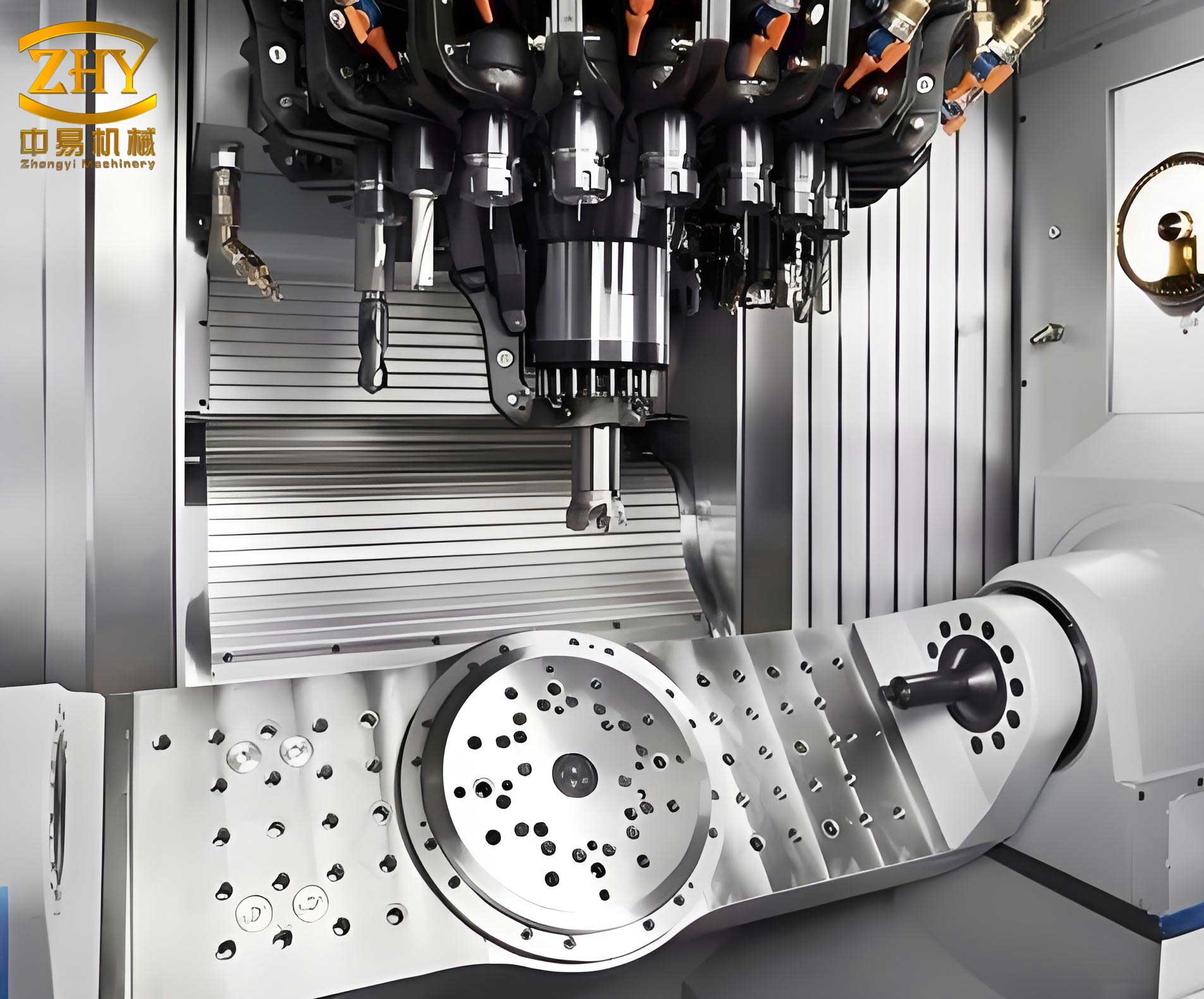
The relentless pursuit of higher speed, precision, and reliability in modern machine tools places exceptional demands on their structural components. Among these, the crossbeam or bed, a quintessential large machine tool casting, is fundamental. Its static and dynamic stiffness, governed by the material’s elastic modulus and tensile strength, directly impacts machining accuracy and stability. Gray cast iron, particularly grades like HT300, remains a preferred material for these applications due to its excellent castability, damping capacity, and cost-effectiveness. However, the very feature that grants it good machinability and damping—graphite flakes—is also the primary determinant and limitation of its mechanical properties. In this investigation, I analyze how the morphology of these graphite flakes within the iron matrix governs the tensile strength and elastic modulus of gray iron, with direct implications for producing superior, high-performance machine tool castings.
1. The Central Role of Graphite in Gray Iron Mechanics
Gray cast iron can be conceptualized as a steel-like matrix permeated by a network of graphite flakes. These flakes act as internal stress concentrators and voids. The mechanical properties are therefore not solely dependent on the matrix strength (typically pearlitic for grades like HT300) but critically on the size, shape, distribution, and quantity of graphite. The elastic modulus (E) of a composite material, which gray iron effectively is, can be viewed through simplified models considering the graphite as inclusions. A higher volume fraction of graphite and, more importantly, larger and straighter flakes reduce the effective load-bearing cross-section of the metal matrix and create sharper stress fields.
The stress concentration factor (Kt) at the tip of an elliptical flaw, which approximates a graphite flake, is given by:
$$
K_t = 1 + 2\sqrt{\frac{a}{\rho}}
$$
where ‘a’ is the flaw (graphite) length and ‘ρ’ is the radius of curvature at its tip. For graphite flakes, the ratio a/ρ is very large. Consequently, as graphite length (a) increases or its curvature (inversely related to ρ) decreases, Kt increases dramatically. This leads to premature micro-yielding and crack initiation under load, lowering both the ultimate tensile strength (UTS) and the apparent elastic modulus. The elastic modulus itself has been empirically related to composition, with one classical relationship showing its dependence on carbon (C) and silicon (Si) content:
$$
E_0 \approx 313,175 – 49,014\omega(C) – 14,082\omega(Si) \quad \text{(in MPa)}
$$
where ω(C) and ω(Si) are the mass fractions of carbon and silicon. This formula highlights that increasing carbon equivalent (CE, which includes Si) inherently decreases the theoretical modulus. However, this equation describes the trend for a constant graphite morphology. In practice, changes in CE and cooling rate profoundly alter graphite morphology, which dominates the actual mechanical properties observed in a machine tool casting.
2. Experimental Methodology & Analysis
To isolate and study these effects, the investigation focused on an HT300-grade iron used for a large crossbeam machine tool casting. The chemical composition range aimed for is summarized in Table 1.
| C | Si | Mn | P (max) | S (max) | Cr | Cu | Sn | CE* |
|---|---|---|---|---|---|---|---|---|
| 2.9-3.2 | 1.7-2.1 | 0.5-1.3 | 0.12 | 0.12 | 0.1-0.6 | ≤0.8 | ≤0.08 | ~3.4-3.8 |
*CE (Carbon Equivalent) ≈ %C + 0.33(%Si)
Two types of test specimens were evaluated: 1) Step-blocks with varying thicknesses (40mm to 200mm) poured from a single heat to study the effect of cooling rate (wall thickness), and 2) Separately cast ϕ30mm test bars attached to actual machine tool castings of different weights to study variations under production conditions. All melts were conducted in a medium-frequency induction furnace, followed by inoculation with a ferrosilicon-based inoculant. Tensile tests and metallographic examinations were performed according to standard procedures. The elastic modulus was measured using a static method with an extensometer. Key results from selected samples are consolidated in Table 2, ordered by decreasing elastic modulus.
| Sample ID | Type / Wall Thickness | C (wt.%) | Si (wt.%) | CE | Tensile Strength (MPa) | Elastic Modulus (GPa) | Graphite Avg. Length (µm) | Graphite Area % |
|---|---|---|---|---|---|---|---|---|
| S-5 | Attached Bar (30mm) | 3.00 | 1.85 | 3.62 | 320 | 109 | 52.4 | 9.92 |
| S-4 | Attached Bar (30mm) | 3.07 | 1.88 | 3.70 | 271 | 98 | 61.8 | 12.94 |
| H-1 | Step-Block (40mm) | 3.10 | 1.90 | 3.74 | 230 | 96 | 76.7 | 12.56 |
| S-3 | Attached Bar (30mm) | 3.09 | 1.77 | 3.68 | 305 | 88 | 61.5 | 13.96 |
| H-2 | Step-Block (80mm) | 3.10 | 1.90 | 3.74 | 229 | 96 | 99.4 | 14.47 |
| S-1 | Attached Bar (30mm) | 3.15 | 1.88 | 3.78 | 260 | 89 | 63.5 | 14.33 |
| S-2 | Attached Bar (30mm) | 3.10 | 1.94 | 3.75 | 256 | 73 | 64.9 | 15.12 |
| H-3 | Step-Block (100mm) | 3.10 | 1.90 | 3.74 | 204 | 84 | 100.9 | 14.71 |
| H-4 | Step-Block (150mm) | 3.10 | 1.90 | 3.74 | 165 | 67 | 101.8 | 14.73 |
| H-5 | Step-Block (200mm) | 3.10 | 1.90 | 3.74 | 166 | 49 | 104.7 | 16.42 |
3. Interpreting the Results: The Morphology-Performance Link
The data in Table 2 clearly establishes the inverse relationship between graphite size/amount and mechanical properties. Sample S-5, with the lowest CE and finest graphite (52.4 µm avg. length, 9.92% area), achieved the highest combination of UTS (320 MPa) and E (109 GPa). In contrast, sample H-5 from the thickest section, despite a similar CE to H-1, exhibited coarse graphite (104.7 µm avg. length, 16.42% area) and consequently the lowest properties (166 MPa, 49 GPa).
3.1. Effect of Wall Thickness (Cooling Rate)
For a constant chemistry (step-block series H-1 to H-5), increasing wall thickness reduces cooling rate. This provides more time for graphite nucleation and growth during the eutectic solidification. The result is fewer, but larger and less curved, graphite flakes. The increase in average graphite length from ~77µm to ~105µm and in area percentage from ~12.6% to ~16.4% directly correlates with the steep decline in both tensile strength and elastic modulus. The thickest section (200mm) showed an elastic modulus nearly 50% lower than the 40mm section. This sensitivity is critical for designing a machine tool casting where wall thickness varies; properties in heavy sections will be inherently lower.
3.2. Effect of Carbon Equivalent (CE)
For similar wall thicknesses (e.g., the attached bars at ~30mm), a lower CE generally promotes improved properties. Lower CE means less total carbon available for graphite formation and a higher melting point of the eutectic, which slightly increases undercooling and promotes a finer graphite structure. Comparing samples S-5 (CE=3.62) and S-2 (CE=3.75), the lower CE sample developed finer, more highly branched graphite, leading to a 25% higher UTS and a 49% higher E. This aligns with the empirical formula for E0 and confirms that controlling CE is a primary lever for enhancing the stiffness of a machine tool casting.
3.3. The Synergistic Damage Mechanism of Coarse Graphite
The deterioration of properties is not merely due to a reduction in load-bearing metal area. The solidification mechanism of gray iron involves the cooperative growth of graphite and austenite (the so-called “coupled eutectic growth”). Coarse graphite flakes form when nucleation is poor or growth conditions are favorable. These large flakes create significant carbon-depleted zones around them, leading to an irregular, coarse austenite structure that later transforms to pearlite. This creates a more heterogeneous matrix. More critically, as the flakes become longer and straighter, their stress concentration effect, per the Kt equation, intensifies. Under an applied load, localized plastic deformation initiates easily at these sharp tips at stress levels far below the global yield point of the matrix. This micro-yielding, distributed throughout the material, causes the material to exhibit a lower macroscopic elastic modulus and reduced tensile strength because failure propagates easily by connecting these graphite-tip-initiated micro-cracks.
4. Implications for Producing High-Performance Machine Tool Castings
To achieve the high stiffness and strength required for modern, precise machine tool castings, the foundry process must be optimized to refine graphite morphology. This involves a multi-faceted approach:
- Chemistry Control: Aim for the lower end of the CE range specified for the grade, balancing strength with castability and avoiding chill. Alloying with elements like Cr, Cu, and Sn strengthens the pearlitic matrix but does not directly refine graphite; their use must be complementary to good inoculation.
- Enhanced Inoculation Practice: Effective and consistent inoculation is paramount. It increases the number of graphite nucleation sites, resulting in a larger population of smaller, more randomly oriented, and more curved flakes. This reduces the average graphite length (a) and increases curvature (ρ), dramatically lowering Kt.
- Thermal Management: While the casting design dictates wall thickness, foundry practices can influence cooling rate. Modifying molding materials (e.g., using chills or high-conductivity sands) in critical, heavy sections of a machine tool casting can accelerate local cooling, moving the graphite morphology closer to that of a thinner wall.
- Process Consistency: Melt superheating temperature, holding time, and pouring temperature must be controlled to ensure reproducible nucleation potential and consistent graphite structure throughout the entire, often massive, machine tool casting.
The relationship between graphite parameters and mechanical properties can be summarized quantitatively for this data set. A multiple linear regression analysis on the compiled data suggests strong correlations of the form:
$$
UTS \approx \alpha_0 – \alpha_1 \cdot L_{avg} – \alpha_2 \cdot A_{\%}
$$
$$
E \approx \beta_0 – \beta_1 \cdot L_{avg} – \beta_2 \cdot A_{\%}
$$
where $L_{avg}$ is the average graphite length and $A_{\%}$ is the graphite area percentage. The constants ($\alpha_i, \beta_i$) are positive, confirming the degrading effect of increasing graphite size and volume.
5. Conclusion
This analysis conclusively demonstrates that the tensile strength and elastic modulus of gray iron, the workhorse material for heavy-duty machine tool castings, are predominantly controlled by graphite morphology rather than matrix strength alone. The flake graphite acts as a network of intrinsic stress raisers. Coarsening of this graphite network—whether induced by slower cooling (increased wall thickness) or higher carbon equivalent—severely degrades both key properties. For a constant chemistry, a fourfold increase in wall thickness can halve the elastic modulus. For a constant wall thickness, a modest increase in CE can lead to a reduction in modulus exceeding 30%. Therefore, the pathway to manufacturing a dimensionally stable, high-stiffness machine tool casting lies in meticulous control of melt chemistry (lower CE), rigorous inoculation to refine graphite, and careful consideration of thermal dynamics during solidification. By mastering these factors, the inherent variability in properties of gray iron can be minimized, yielding cast components that meet the rigorous demands of next-generation machine tools.