
In the aerospace industry, shell castings play a critical role as components in aircraft engines, where they must withstand extreme temperatures and stresses. The production of high-integrity shell castings, particularly using K403 superalloy, presents significant challenges due to the alloy’s susceptibility to defects such as hot tearing, porosity, and shrinkage during solidification. This article delves into a comprehensive study on the investment casting process for K403 shell castings, focusing on optimizing key parameters to mitigate these issues and enhance dimensional accuracy. Through first-person experimentation and analysis, I explore the intricacies of pattern making, shell building, and melting-pouring techniques, leveraging tables and formulas to summarize findings. The goal is to provide a detailed reference for improving the quality and reliability of such shell castings in precision casting applications.
The shell castings in question are typically used in auxiliary systems of aero-engines, featuring complex geometries with substantial variations in wall thickness. For instance, a representative shell casting may have pillars reaching 129 mm in height, lengths of 111 mm, and diameters ranging from 14 mm to 32 mm, with a nominal wall thickness of 6.5 mm. This complexity necessitates a meticulous approach to investment casting, as the K403 alloy’s solidification behavior can lead to inadequate filling, cracks, and porosity if not properly controlled. The primary technical hurdles include difficulties in pattern extraction due to intricate shapes, susceptibility to shell cracking during pouring, and the formation of hot spots that exacerbate shrinkage defects. Addressing these challenges requires a holistic optimization of the entire casting process.
To begin, let’s analyze the K403 alloy composition, which is pivotal for understanding its casting characteristics. The table below summarizes the main chemical elements, highlighting the balance of constituents that confer high-temperature strength but also contribute to casting difficulties.
| Element | Content (wt.%) | Role in Alloy |
|---|---|---|
| C | 0.11–0.18 | Carbide formation, strength |
| Cr | 10.00–12.00 | Oxidation resistance |
| Co | 4.50–6.00 | Solid solution strengthening |
| W | 4.80–5.50 | High-temperature stability |
| Mo | 3.80–4.50 | Creep resistance |
| Ti | 2.30–2.90 | Gamma prime precipitation |
| Al | 5.30–5.90 | Gamma prime formation |
| Ni | Balance | Matrix element |
| Ce, Fe, Si, Mn, S, P | Trace amounts | Impurity control |
The solidification of K403 alloy involves complex phase transformations, where the cooling rate significantly impacts defect formation. For shell castings, the risk of porosity is heightened in thick sections due to slower heat dissipation. To quantify this, the solidification time \( t_s \) for a section can be estimated using Chvorinov’s rule:
$$ t_s = k \left( \frac{V}{A} \right)^n $$
where \( V \) is the volume, \( A \) is the surface area, \( k \) is a mold constant, and \( n \) is an exponent typically around 2. For shell castings with varying thicknesses, this equation underscores the need for controlled cooling in hot spots to prevent shrinkage porosity.
Moving to pattern making, this stage is crucial for achieving dimensional precision in shell castings. In initial trials, I encountered issues with wax pattern assembly, where segmented patterns led to misalignments and dimensional deviations of up to 2.2 mm. To overcome this, I transitioned to a monolithic pattern design, eliminating assembly errors and enhancing consistency. The wax injection process parameters were optimized based on fluid dynamics principles. The wax flow during injection can be modeled using the Bernoulli equation for incompressible fluids:
$$ P + \frac{1}{2} \rho v^2 + \rho gh = \text{constant} $$
where \( P \) is pressure, \( \rho \) is density, \( v \) is velocity, \( g \) is gravity, and \( h \) is height. By adjusting injection pressure and temperature, I improved pattern fidelity. The optimal parameters are summarized below.
| Parameter | Optimal Range | Effect on Shell Castings |
|---|---|---|
| Wax Temperature | 55–63 °C | Ensures adequate fluidity without excessive shrinkage |
| Mold Temperature | 25–35 °C | Reduces thermal shock and improves surface finish |
| Injection Pressure | 15–25 bar | Minimizes air entrapment and enhances detail replication |
| Holding Time | 15–20 s | Compensates for wax contraction to maintain dimensions |
The dimensional accuracy of wax patterns directly influences the final shell castings. The linear shrinkage \( S \) of wax can be expressed as:
$$ S = \alpha_w \Delta T $$
where \( \alpha_w \) is the thermal expansion coefficient of wax and \( \Delta T \) is the temperature change during cooling. By controlling the above parameters, I reduced pattern shrinkage to within acceptable limits, ensuring that the shell castings met stringent tolerances.
Next, shell building is a critical step for achieving robust molds capable of withstanding the thermal stresses of pouring. For shell castings, the shell must exhibit high green and fired strength to prevent cracking. I employed a multi-layer coating process using silica sol and ethyl silicate binders, with refractory materials like zircon flour and alumina sand. To address hot spots in thick sections of shell castings, I implemented a localized shell thinning technique after the fourth coating layer. This involved applying soft wax to specific areas, such as around internal channels and gates, to reduce shell thickness and enhance heat dissipation. The principle behind this is Fourier’s law of heat conduction:
$$ q = -k \frac{dT}{dx} $$
where \( q \) is heat flux, \( k \) is thermal conductivity, and \( \frac{dT}{dx} \) is the temperature gradient. By thinning the shell, the thermal resistance decreases, promoting faster cooling in problematic zones and mitigating porosity in the final shell castings.
The shell-making parameters were carefully tuned, as shown in the table below, to balance strength and permeability for shell castings.
| Layer | Slurry Composition | Viscosity (s) | Stucco Material | Drying Time |
|---|---|---|---|---|
| 1 | Silica sol-Zircon flour | 40–50 | White alumina (70 mesh) | ≥12 h |
| 2 | Ethyl silicate-Shangdian flour | 37–42 | Shangdian sand (36 mesh) | ≥20 min + 10 min ammonia drying |
| 3–8 | Ethyl silicate-Shangdian flour | 13–15 | Shangdian sand (24 mesh) | ≥20 min + 10 min ammonia drying per layer |
| Sealer | Ethyl silicate-Shangdian flour | 13–15 | None | ≥12 h |
Shell preheating prior to pouring is essential for reducing thermal shock and improving metal fluidity in shell castings. I determined that a preheat temperature of 950–1000 °C optimally minimizes the temperature gradient between the mold and molten alloy, as described by the heat transfer equation:
$$ \frac{\partial T}{\partial t} = \alpha \nabla^2 T $$
where \( \alpha \) is thermal diffusivity. This preheating range ensures that the shell castings fill completely while avoiding excessive grain growth.
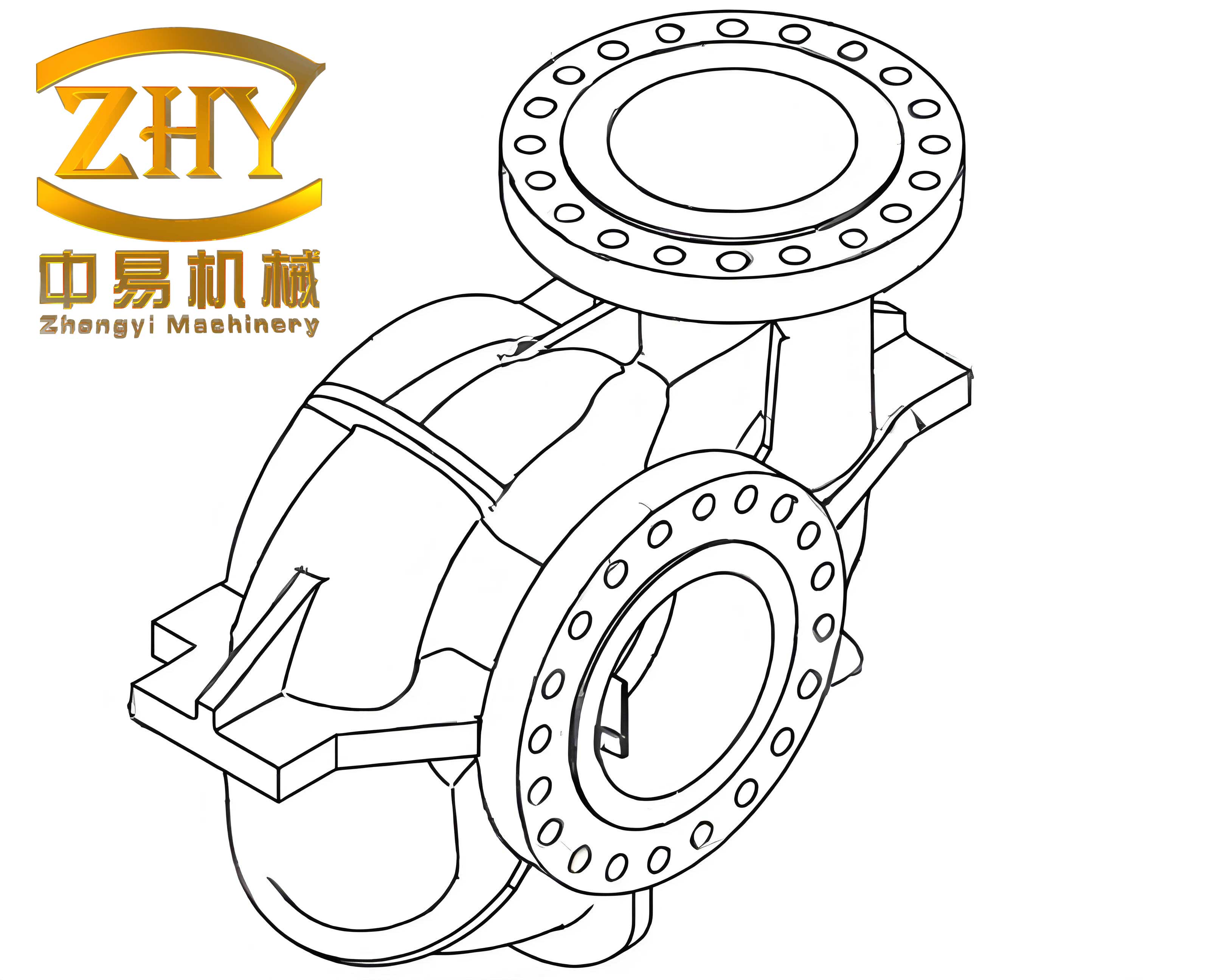
The melting and pouring phase is where the quality of shell castings is ultimately determined. The gating system must support the shell mold and facilitate directional solidification to feed shrinkage. I designed a runner and gate configuration that acts as a thermal reservoir, using the concept of modulus \( M \) to ensure progressive solidification:
$$ M = \frac{V}{A} $$
Sections with higher modulus solidify slower, so gates were sized to have a larger modulus than the casting, promoting feed metal flow into shell castings. The pouring temperature and speed were optimized based on fluid flow and solidification dynamics. The Reynolds number \( Re \) indicates flow regime:
$$ Re = \frac{\rho v D}{\mu} $$
where \( D \) is characteristic diameter and \( \mu \) is viscosity. To avoid turbulence that could entrap gases, I maintained a high but controlled pouring speed. The table below summarizes the key pouring parameters for producing sound shell castings.
| Parameter | Value | Rationale for Shell Castings |
|---|---|---|
| Shell Preheat Temperature | 950–1000 °C | Reduces thermal gradient, enhances fluidity |
| Pouring Temperature | 1430 ± 10 °C | Balances fluidity and minimization of shrinkage defects |
| Pouring Speed | 2–3 s per mold | Ensures rapid filling to prevent cold shuts and misruns |
The solidification shrinkage in shell castings can be approximated using the volume change equation:
$$ \frac{\Delta V}{V_0} = \beta \Delta T $$
where \( \beta \) is the volumetric shrinkage coefficient. By employing hot topping through the gating system, I compensated for this shrinkage, reducing porosity in critical sections of the shell castings.
To validate the optimized process, I conducted a production trial of 40 shell castings. The results demonstrated a significant improvement: 35 castings met all quality standards, yielding a qualification rate of 87.5%. Dimensional inspections confirmed that deviations were within tolerance, and metallographic analysis revealed a marked reduction in porosity and cold shut defects. The success of this trial underscores the effectiveness of the integrated approach to investment casting for complex shell castings.
In conclusion, the study highlights several key insights for producing high-quality K403 shell castings through investment casting. First, adopting a monolithic wax pattern design eliminates assembly-related dimensional errors, which is crucial for precision shell castings. Second, localized shell thinning enhances cooling in hot spots, addressing shrinkage porosity based on heat transfer principles. Third, optimized pouring parameters, guided by fluid dynamics and solidification theory, ensure complete filling and sound microstructure in shell castings. These strategies collectively enhance the manufacturability and reliability of shell castings for demanding aerospace applications. Future work could explore advanced simulation tools to further refine process windows for such intricate shell castings, potentially incorporating machine learning for predictive defect analysis.
Throughout this research, the focus on shell castings has been paramount, with repeated optimization steps tailored to their unique geometry and material challenges. By leveraging empirical data, theoretical formulas, and systematic parameter tuning, I have developed a robust framework for investment casting of K403 shell castings that balances quality and productivity. This approach not only resolves common defects but also provides a scalable model for similar castings in the industry, ensuring that shell castings continue to meet the evolving demands of high-performance engineering systems.