
In my extensive research and practical experience in advanced manufacturing, I have delved deeply into the realm of electroforming and bimetal casting, particularly for large-scale applications. The electroforming process, which involves the controlled electrolytic deposition of metals like nickel onto a master pattern, offers unparalleled advantages for producing complex模具 cavities with fine details. However, the inherent limitation of electroformed shell castings—their thinness, typically ranging from 3 to 8 mm—necessitates a robust backing process to form a complete, durable mold. This backing, or “裱背” as it is often termed, is critical for ensuring structural integrity, especially for large shell castings where issues like cracking and distortion become pronounced. In this article, I will elaborate on the technical challenges and effective solutions in the bimetal casting of large electroforming shell castings, drawing from my hands-on work and theoretical analyses. I will emphasize the importance of material selection, process optimization, and preventive measures, all while integrating key concepts through tables and mathematical formulations to provide a comprehensive guide. The keyword “shell castings” will be frequently referenced to underscore its centrality in this discussion.
The electroforming technique is a rapid and cost-effective method for creating plastic molds, particularly for parts with intricate surface textures, such as the orange-peel pattern on a plastic toolbox. The process begins with a master model, which is made conductive and placed as a cathode in an electroforming bath. Anodes of high-purity nickel are used, and through electrolysis, nickel ions are deposited onto the master, gradually building up a shell. For large shell castings, such as those for toolbox covers and bases with a total projected area of approximately 3,400 cm², this deposition must be carefully controlled to achieve uniform thickness. The electroforming solution, often based on nickel sulfamate, is maintained under specific conditions to ensure quality. The resulting shell castings are precise replicas but are mechanically weak due to their thin walls, necessitating a bimetal casting approach for reinforcement.
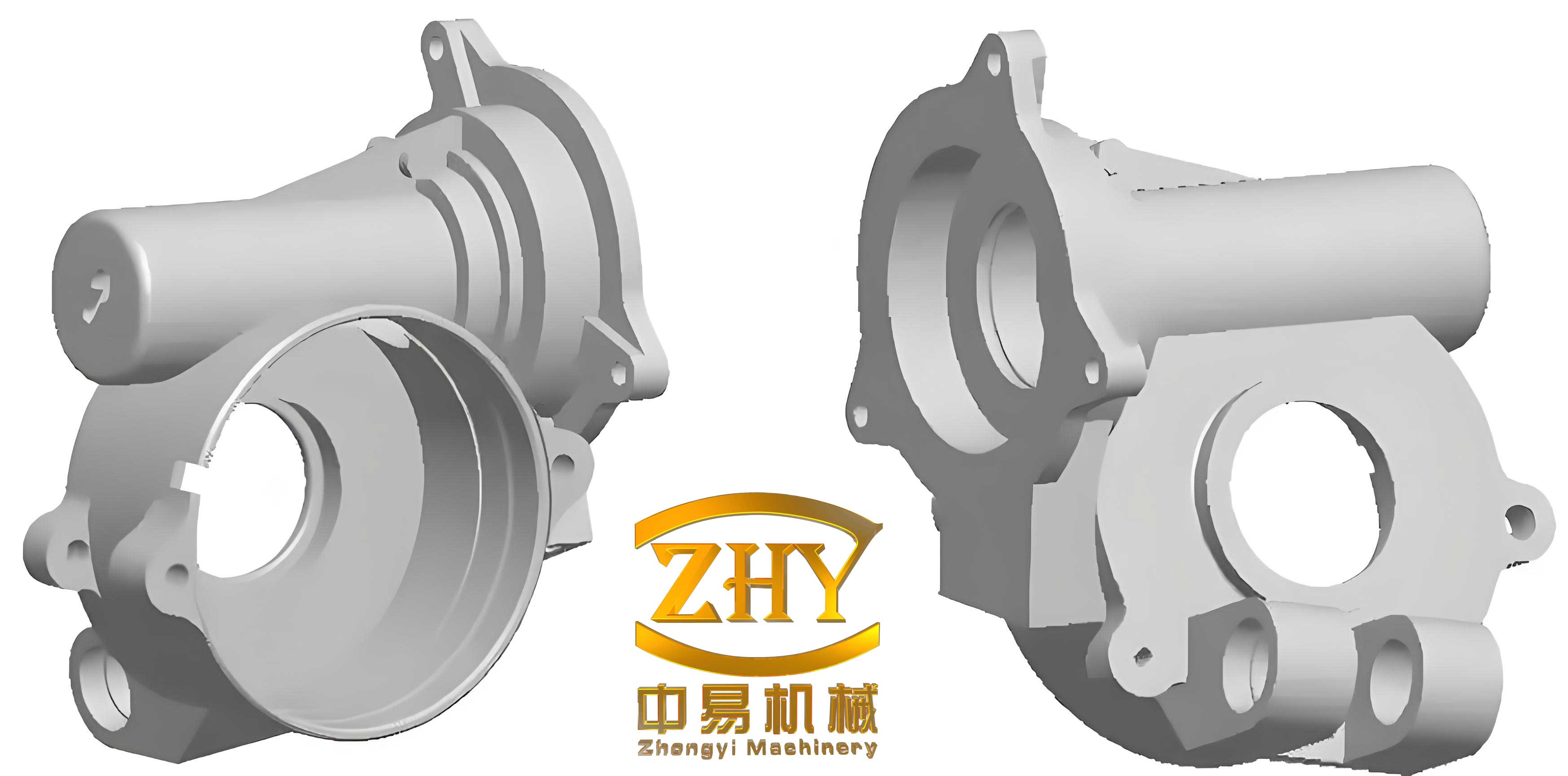
When considering the structure of large electroforming shell castings, a fundamental analysis reveals the interplay between the nickel shell and the backing material. The shell casting, made of nickel, has a high melting point (over 1,400°C) and a specific set of mechanical properties, while the backing material must be chosen to complement it. During the bimetal casting process, as the backing material cools and solidifies, it contracts, but the nickel shell casting acts as a constraint. This differential shrinkage generates casting stresses, which can be modeled using thermal stress theory. The stress ($\sigma$) induced due to thermal contraction mismatch can be approximated by:
$$ \sigma = E_b \cdot (\alpha_b – \alpha_s) \cdot \Delta T $$
where $E_b$ is the elastic modulus of the backing material, $\alpha_b$ and $\alpha_s$ are the coefficients of thermal expansion for the backing material and shell casting, respectively, and $\Delta T$ is the temperature change during cooling. For large shell castings, this stress can exceed the tensile strength of the backing material, leading to cracks. Additionally, the thin shell casting is susceptible to deformation from thermal gradients and gravitational forces. Therefore, selecting a backing material with high tensile strength and low melting point is paramount, and process measures must be implemented to mitigate these stresses.
The preparation of large electroforming shell castings involves a meticulous electroforming process. Using a master model—such as an imported plastic toolbox—the surface is treated for conductivity, often via chemical silver plating. The model is then mounted in a large electroforming tank. The electrodeposition follows Faraday’s laws of electrolysis. The mass ($m$) of nickel deposited is given by:
$$ m = \frac{Q \cdot M}{n \cdot F} $$
where $Q$ is the total electrical charge passed, $M$ is the molar mass of nickel (58.69 g/mol), $n$ is the number of electrons involved in the reduction (2 for Ni²⁺), and $F$ is Faraday’s constant (96,485 C/mol). In practice, multiple electroforming runs may be conducted to achieve the desired thickness of 3–8 mm for the shell castings. The quality of these shell castings is critical, as any defects will propagate through the bimetal casting process. The dimensions of such shell castings are carefully measured to ensure fit for subsequent backing.
Selecting the appropriate backing material is a cornerstone of successful bimetal casting for large shell castings. After evaluating various low-melting-point alloys, I have found that a high-strength zinc-aluminum alloy is particularly suitable. This alloy offers an optimal balance of properties, as detailed in the tables below. Its high tensile strength (over 300 MPa) resists cracking, while its low melting point (440°C) minimizes thermal shock to the nickel shell castings. The alloy also exhibits good fluidity and low gas absorption, which are essential for filling complex backing cavities without defects. The mechanical and physical properties are summarized in Tables 1 and 2, which highlight why this material is ideal for reinforcing large shell castings.
| Property | Value | Unit |
|---|---|---|
| Tensile Strength | 300–320 | MPa |
| Elongation | 1–2 | % |
| Hardness (HB) | 95–110 | – |
| Impact Toughness | 25 | J/cm² |
| Property | Value | Unit |
|---|---|---|
| Melting Point | 440 | °C |
| Linear Shrinkage | 1.3 | % |
| Density | 6.03 | g/cm³ |
| Thermal Conductivity | 116 | W/(m·°C) |
The backing process for large electroforming shell castings is a multi-step procedure that demands precision to ensure a strong bond and prevent defects. Each step addresses specific challenges associated with these delicate shell castings. The process begins with backside cleaning, where the shell casting’s back surface is thoroughly cleaned of contaminants, though protrusions are retained to enhance mechanical interlocking. Next, flux application involves coating the backside with a saturated zinc chloride (ZnCl₂) solution to remove oxides. This is followed by drying, where the shell casting is heated to eliminate moisture, as any residual water can cause explosive vaporization during subsequent steps, jeopardizing the shell castings.
A critical step is the tin coating treatment, which serves as an intermediate layer to promote bonding between the nickel shell casting and the zinc-aluminum backing. For large shell castings, immersing the entire backside in molten tin is impractical. Instead, a segmented side-coating method is employed. The shell casting is vertically mounted on a rack and slowly dipped into a molten tin bath at 270–300°C, focusing on the peripheral sides. The tin (Sn) forms a thin, uniform layer via wetting and interdiffusion. The bonding mechanism can be described by interfacial energy considerations, where the work of adhesion ($W_{ad}$) between tin and nickel (or zinc) is given by:
$$ W_{ad} = \gamma_{Ni} + \gamma_{Sn} – \gamma_{Ni/Sn} $$
where $\gamma_{Ni}$ and $\gamma_{Sn}$ are the surface energies of nickel and tin, and $\gamma_{Ni/Sn}$ is the interfacial energy. A low $\gamma_{Ni/Sn}$ indicates good adhesion, which is essential for the integrity of the shell castings. This tin layer facilitates metallurgical bonding with the backing alloy.
To prevent thermal distortion of the large shell castings during backing material pouring, cavity filling is implemented. The interior of the shell casting is packed with fine sand and reinforced with steel bars arranged in a grid. The bars are cushioned with copper sheets at contact points to protect the intricate surface texture. This filling provides thermal mass and mechanical support, reducing the risk of warping. The effectiveness can be analyzed through heat transfer models. The temperature distribution in the shell casting ($T(x,t)$) during pouring can be modeled using the heat equation:
$$ \frac{\partial T}{\partial t} = \kappa \frac{\partial^2 T}{\partial x^2} $$
where $\kappa$ is the thermal diffusivity. The sand filling acts as an insulator, slowing heat transfer and minimizing thermal gradients that cause deformation in the shell castings.
The mold design for backing is tailored to each shell casting. The shell casting is placed face-down on a metal baseplate, secured with wires to counteract buoyancy forces from the molten alloy. A sand mold is built around it, featuring a gating system. The gate is positioned above a thicker section of the shell casting to promote directional solidification, which reduces shrinkage porosity. A choke gate is used to ensure smooth metal flow, and risers are added for feeding. The solidification time ($t_s$) can be estimated using Chvorinov’s rule:
$$ t_s = C \left( \frac{V}{A} \right)^2 $$
where $V$ is the volume of the backing, $A$ is the surface area, and $C$ is a constant dependent on the mold material and alloy properties. Proper design ensures sound backing for the shell castings.
Pouring involves melting the high-strength zinc-aluminum alloy in an electric furnace, refining it to remove impurities, and pouring at 450–500°C. Tools are coated with zinc chloride to prevent iron contamination. The alloy’s fluidity is crucial for filling the cavity around the shell casting without turbulence. After pouring, stress relief annealing is immediately performed to mitigate residual stresses. The cast assembly is heated to 180–200°C, held for 4 hours, and furnace-cooled. This annealing reduces stress ($\sigma_r$) according to a creep-relaxation model:
$$ \sigma_r(t) = \sigma_0 \cdot e^{-kt} $$
where $\sigma_0$ is the initial stress, $k$ is a rate constant dependent on temperature and material, and $t$ is time. This step is vital for preventing cracks in both the backing and the shell castings.
In summary, the bimetal casting of large electroforming shell castings requires a holistic approach. Key takeaways from my work include: (1) High-strength zinc-aluminum alloy is an excellent backing material for large shell castings, offering high tensile strength and low melting point. (2) Segmented side-coating with tin is an efficient method for large shell castings, saving material and simplifying operations. (3) Preventive measures such as cavity filling with sand and reinforcement, controlled mold design, and post-casting annealing are effective in mitigating cracks and distortion in shell castings. The successful application of these techniques has enabled the production of large electroforming molds, such as for plastic toolboxes, demonstrating the viability of this process. Future advancements could focus on optimizing alloy compositions and simulating stress distributions using finite element analysis to further enhance the durability of shell castings in bimetal systems.
To further elaborate on the material science aspect, the interface between the nickel shell casting and the zinc-aluminum backing can be analyzed through diffusion kinetics. The interdiffusion coefficient ($D$) at the interface follows an Arrhenius relationship:
$$ D = D_0 \exp\left(-\frac{Q}{RT}\right) $$
where $D_0$ is a pre-exponential factor, $Q$ is the activation energy, $R$ is the gas constant, and $T$ is the absolute temperature. During the tin coating and backing processes, interdiffusion promotes bond formation, which is critical for the longevity of the shell castings. Additionally, the thermal expansion mismatch stress can be quantified more precisely by considering the bimetallic strip theory. For a bilayer structure, the curvature ($\kappa$) induced by temperature change is given by:
$$ \kappa = \frac{6(\alpha_b – \alpha_s)(T_0 – T) h_b h_s}{h_b^2 + 4h_b h_s + h_s^2} $$
where $h_b$ and $h_s$ are the thicknesses of the backing and shell casting, respectively, and $T_0$ is the stress-free temperature. This formula helps in predicting deformation in shell castings and guiding design adjustments.
In practice, the quality of large shell castings after bimetal casting can be evaluated through non-destructive testing methods, such as ultrasonic inspection, to detect interfacial delamination or internal cracks. The wave velocity ($v$) in the material relates to its elastic properties:
$$ v = \sqrt{\frac{E}{\rho}} $$
where $E$ is Young’s modulus and $\rho$ is density. Any discontinuities can indicate defects in the shell castings assembly. Moreover, the economic aspect of using these shell castings is significant; electroforming reduces machining time for complex shapes, and bimetal casting extends模具 life, making it cost-effective for large-scale production.
In conclusion, the integration of electroforming and bimetal casting for large shell castings represents a sophisticated manufacturing synergy. By addressing material compatibility, process precision, and stress management, we can produce robust molds that leverage the advantages of both technologies. The repeated focus on “shell castings” throughout this discussion underscores their pivotal role in modern模具 fabrication. As industries demand larger and more intricate parts, the techniques described here will continue to evolve, driven by ongoing research and practical innovation in the field of shell castings.