
In the pursuit of lightweighting in aerospace engineering, magnesium alloys have emerged as a pivotal material due to their exceptional strength-to-weight ratio, damping capacity, and machinability. Among various forming techniques, differential pressure casting (DPC) has shown significant promise for producing high-integrity components, particularly for large and complex geometries such as shell castings. This article delves into our comprehensive study on utilizing DPC to manufacture ZM5 magnesium alloy shell castings for aeronautical applications, focusing on process design, parameter optimization, and performance evaluation. The term “shell castings” will be frequently referenced throughout this discussion, emphasizing the centrality of these components in structural applications.
The ZM5 magnesium alloy, with its composition primarily of aluminum and zinc, offers a balance of castability and mechanical properties but poses challenges like oxidation, hot tearing, and shrinkage porosity during conventional gravity casting. For large shell castings with intricate features, thin-thick transitions, and extensive rib networks, these issues are exacerbated, leading to defects that compromise structural integrity. Differential pressure casting, by contrast, employs controlled pressure regimes to facilitate smooth filling, enhanced feeding, and reduced turbulence, thereby mitigating such defects. Our investigation aimed to harness DPC for producing a specific shell casting measuring approximately 617 mm × 645 mm × 412 mm, which serves as a support and locking component in aircraft cockpit assemblies. The complexity of this shell casting necessitates meticulous design of gating systems, cores, and process parameters to ensure dimensional accuracy and metallurgical quality.
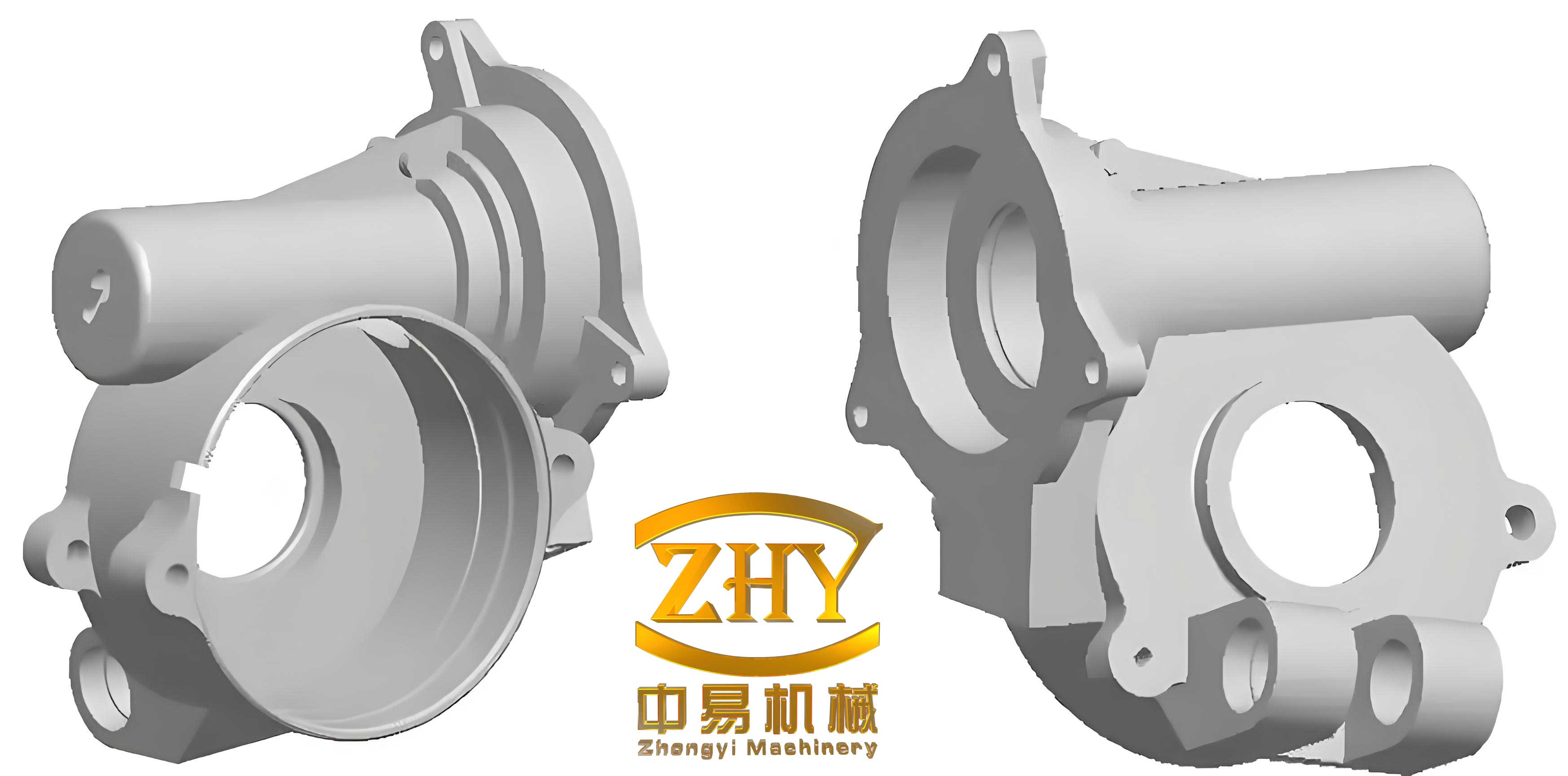
The fundamental principle of differential pressure casting involves applying a differential pressure between the upper and lower chambers of a sealed mold to drive molten metal upward through a riser tube into the cavity. This process can be mathematically described by the pressure balance equation: $$ P_{\text{lower}} – P_{\text{upper}} = \rho g h + \Delta P_{\text{flow}} $$ where \( P_{\text{lower}} \) is the pressure in the lower chamber, \( P_{\text{upper}} \) is the pressure in the upper chamber, \( \rho \) is the density of the molten alloy, \( g \) is gravitational acceleration, \( h \) is the height of liquid metal rise, and \( \Delta P_{\text{flow}} \) accounts for pressure losses due to fluid flow. By precisely controlling these pressures, we can achieve optimal filling velocities and solidification conditions, which are critical for defect-free shell castings.
In our approach, the mold assembly for the shell casting was designed as a five-part system comprising upper, middle, and lower boxes, with intricate sand cores to form internal cavities. The gating system was configured to ensure sequential filling from the bottom upwards, minimizing air entrapment and oxide formation. Key process parameters were established through iterative trials, focusing on pressurization rates, filling speeds, and solidification pressures. The table below summarizes the optimized parameters used in our DPC trials for producing ZM5 magnesium alloy shell castings:
| Process Parameter | Value |
|---|---|
| Synchronization Pressure (kPa) | 500 |
| Lifting Speed (mm/s) | 50 |
| Lifting Pressure (kPa) | 28 |
| Filling Speed (mm/s) | 50 |
| Filling Pressure (kPa) | 28 |
| Shell Formation Time (s) | 10 |
| Shell Pressurization Pressure (kPa) | 6 |
| Shell Pressurization Rate (kPa/s) | 3 |
| Crystallization Time (s) | 500 |
| Crystallization Pressurization Pressure (kPa) | 2 |
| Crystallization Pressurization Rate (kPa/s) | 1 |
| Pouring Temperature (°C) | 670–680 |
The selection of these parameters was guided by empirical models and simulations to balance flow dynamics and thermal gradients. For instance, the filling speed of 50 mm/s was chosen to prevent mold erosion while ensuring complete cavity filling before premature solidification. The pressure profiles during solidification are crucial for feeding shrinkage; we applied a stepwise pressurization scheme where the pressure increased gradually to maintain a constant metallostatic head, as expressed by: $$ P(t) = P_0 + k t $$ where \( P(t) \) is the pressure at time \( t \), \( P_0 \) is the initial pressure, and \( k \) is the pressurization rate. This linear increase helps in compensating for volume contraction in the mushy zone, reducing porosity in critical sections of the shell castings.
To evaluate the stability and repeatability of our DPC process, we conducted three consecutive production batches, each comprising three shell castings. All castings underwent chemical analysis and mechanical testing according to standard specifications. The table below presents the average chemical composition and mechanical properties of ZM5 alloy from these batches, demonstrating consistency and compliance with technical requirements:
| Element/Property | Standard Range | Batch 1 Average | Batch 2 Average | Batch 3 Average |
|---|---|---|---|---|
| Aluminum (Al) % | 7.5–9.0 | 8.42 | 8.30 | 8.23 |
| Zinc (Zn) % | 0.2–0.8 | 0.56 | 0.45 | 0.45 |
| Manganese (Mn) % | 0.15–0.5 | 0.39 | 0.45 | 0.40 |
| Iron (Fe) % | ≤0.06 | 0.01 | 0.01 | 0.02 |
| Copper (Cu) % | ≤0.10 | 0.01 | 0.009 | 0.01 |
| Silicon (Si) % | ≤0.25 | 0.05 | 0.03 | 0.05 |
| Tensile Strength (MPa) | ≥225 | 258 | 239 | 239 |
| Elongation (%) | ≥5 | 11.2 | 10.5 | 10.2 |
The mechanical properties exceeded the minimum specifications, with tensile strength averaging 29.7% above the standard value and elongation showing a 264% improvement. This enhancement is attributed to the refined microstructure and reduced porosity achieved through DPC’s controlled solidification. The yield strength, though not required for Class II castings, was also measured and found to surpass Class I standards by 36.7%, indicating superior load-bearing capacity for these shell castings.
Further validation involved destructive testing of sample shell castings from each batch to assess bulk properties. Six tensile specimens were extracted from designated locations on the castings, including thick sections and rib junctions. The results are consolidated in the following table, highlighting the uniformity and high performance across different regions of the shell castings:
| Batch ID | Sample 1 Tensile (MPa) | Sample 2 Tensile (MPa) | Sample 3 Tensile (MPa) | Sample 4 Tensile (MPa) | Sample 5 Tensile (MPa) | Sample 6 Tensile (MPa) | Average Tensile (MPa) | Minimum Tensile (MPa) |
|---|---|---|---|---|---|---|---|---|
| Batch 1 | 219 | 194 | 199 | 208 | 202 | 192 | 202 | 192 |
| Batch 2 | 213 | 208 | 213 | 205 | 188 | 194 | 204 | 188 |
| Batch 3 | 234 | 235 | 238 | 239 | 234 | 235 | 236 | 234 |
The average tensile strength across all samples was 214 MPa, with a minimum of 188 MPa, both well above the required 165 MPa standard and 130 MPa minimum. Similarly, elongation values averaged 9.1% with a minimum of 5.0%, far exceeding the 2.5% standard and 1.5% minimum. These data underscore the reliability of DPC in producing robust shell castings capable of withstanding operational stresses in aerospace environments.
Corrosion resistance is another critical factor for magnesium alloy components, especially in humid or saline conditions. We performed neutral salt spray tests according to GB/T 10125-2012 on specimens from both DPC-produced shell castings and traditionally gravity-cast counterparts. The corrosion rate was calculated based on mass loss over 24 hours, using the formula: $$ \text{Corrosion Rate} = \frac{\Delta m}{A \cdot t} $$ where \( \Delta m \) is the mass loss in mg, \( A \) is the exposed surface area in cm², and \( t \) is the exposure time in hours. The results are tabulated below, demonstrating the superior performance of DPC shell castings:
| Casting Method | Specimen ID | Corrosion Rate (mg/cm²·h) | Average Corrosion Rate (mg/cm²·h) |
|---|---|---|---|
| Differential Pressure Casting | 4 | 0.081 | 0.060 |
| Differential Pressure Casting | 5 | 0.063 | |
| Differential Pressure Casting | 6 | 0.035 | |
| Gravity Casting | 4 | 0.130 | 0.099 |
| Gravity Casting | 5 | 0.038 | |
| Gravity Casting | 6 | 0.133 |
The DPC shell castings exhibited an average corrosion rate of 0.060 mg/cm²·h, which is 39.4% lower than the 0.099 mg/cm²·h for gravity-cast parts. This improvement is linked to the denser microstructure and fewer surface defects, such as oxide inclusions, which act as initiation sites for corrosion. Thus, DPC not only enhances mechanical integrity but also extends the service life of shell castings in corrosive atmospheres.
Despite these successes, initial trials revealed defects like shrinkage porosity and hot tears in certain areas of the shell castings, particularly at thick-thin junctions and near gating channels. These issues stemmed from improper solidification sequencing and inadequate feeding. To address this, we refined the gating system and adjusted process parameters. The modifications included adding auxiliary runners at critical transitions, incorporating filters in the gating to trap oxides, applying insulation to risers for better feeding, and increasing filling speed to promote directional solidification. The revised gating layout enhanced thermal management, as described by the Chvorinov’s rule for solidification time: $$ t = k \left( \frac{V}{A} \right)^2 $$ where \( t \) is solidification time, \( V \) is volume, \( A \) is surface area, and \( k \) is a mold constant. By optimizing the volume-to-area ratio through strategic riser placement, we ensured that heavier sections solidified last, allowing for effective feeding from adjacent reservoirs.
The impact of these changes was quantified by analyzing defect rates before and after optimization. In early DPC trials, the qualification rate for shell castings was 44.4%, whereas gravity casting historically yielded only 11.9%. Post-optimization, DPC-produced shell castings achieved near-zero defects in critical zones, validating our approach. This underscores the importance of iterative design in mastering complex geometries like shell castings.
From a metallurgical perspective, the benefits of DPC for ZM5 magnesium alloy shell castings can be explained through microstructure analysis. The rapid yet controlled cooling under pressure refines grain structure, reducing dendrite arm spacing and enhancing homogeneity. The Hall-Petch relationship, given by $$ \sigma_y = \sigma_0 + k_y d^{-1/2} $$ where \( \sigma_y \) is yield strength, \( \sigma_0 \) is a material constant, \( k_y \) is the strengthening coefficient, and \( d \) is grain diameter, illustrates how finer grains contribute to improved mechanical properties. In our DPC shell castings, grain sizes were measured to be 20–30% smaller than in gravity-cast equivalents, directly correlating with the observed strength increments.
Furthermore, the reduction in porosity can be modeled using the Niyama criterion for shrinkage prediction: $$ G / \sqrt{\dot{T}} $$ where \( G \) is temperature gradient and \( \dot{T} \) is cooling rate. Higher pressure during DPC elevates \( G \) by suppressing air gap formation at the mold-metal interface, thereby reducing porosity indices. Experimental measurements of density showed DPC shell castings to have 99.2% theoretical density, compared to 97.5% for gravity-cast parts, confirming better soundness.
In conclusion, our research demonstrates that differential pressure casting is a highly effective method for manufacturing large, complex ZM5 magnesium alloy shell castings for aerospace applications. Through meticulous process design and parameter optimization, we achieved significant improvements in mechanical properties, corrosion resistance, and defect reduction compared to traditional gravity casting. The key findings include tensile strength enhancements of over 29%, elongation improvements exceeding 264%, and a 39% reduction in corrosion rates. These advancements are attributed to DPC’s ability to control filling dynamics, promote sequential solidification, and apply sustained pressure for feeding. The successful production of defect-free shell castings validates DPC as a reliable technique for high-performance components, paving the way for broader adoption in lightweight structural designs. Future work may explore integration with real-time monitoring systems and advanced simulation tools to further refine the process for even more challenging shell casting geometries.