
In the automotive and heavy machinery industries, hydraulic steering systems are critical for vehicle control and safety. The steering housing, as the core component, must withstand high operational pressures while ensuring lightweight design for fuel efficiency. Traditionally, these shell castings were manufactured using hybrid methods, combining aluminum pressure casting for low-strength sections with steel welding for high-pressure zones, leading to increased weight and complex production. Our development project aimed to create an integrated, high-strength hydraulic steering shell casting entirely through advanced aluminum pressure casting techniques. This article details my firsthand experience in developing these shell castings, focusing on defect analysis, process optimization using simulation software, and implementation of auxiliary technologies like vacuum casting and local squeezing.
The primary challenge was to produce shell castings that meet stringent performance requirements, including high pressure resistance up to 26 MPa, minimal porosity, and precise dimensional accuracy. The shell castings, weighing 2.6 kg, are made from Al-9Si-3Cu(Fe) aluminum alloy, conforming to DIN EN AC 1706-46000 standards. Key technical specifications include leak-tightness under 1 MPa air pressure, porosity levels per VW 50093 standard (e.g., single pore diameter ≤2.5 mm, spacing ≥8 mm), and specific criteria for high-pressure zones where pores must be ≤0.5 mm. The main cylinder bore, with a length of 230 mm and diameter tolerance of 0–0.039 mm, requires no visible pores after machining, posing significant challenges in mold design and cooling control.
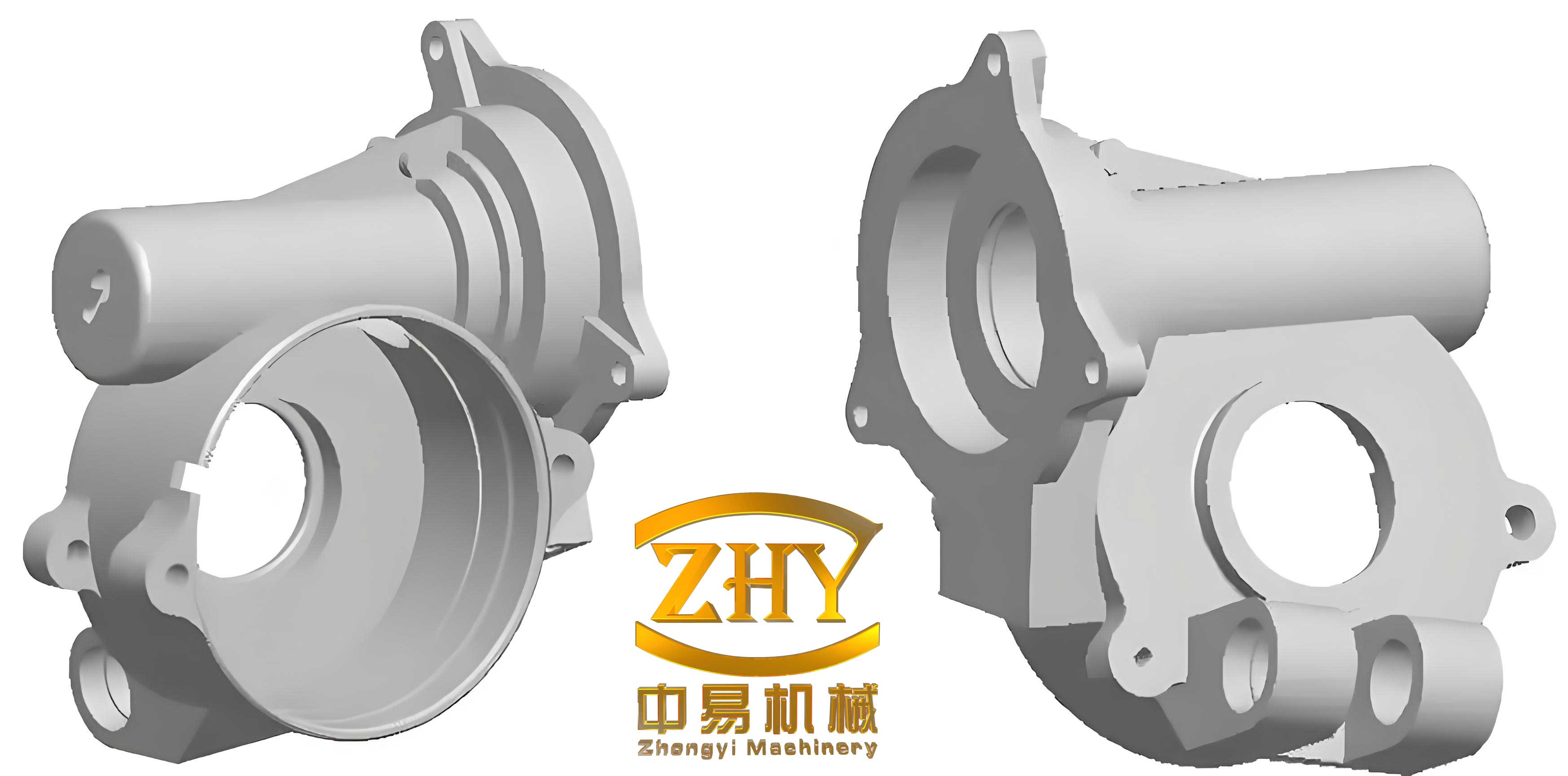
To address these challenges, I initiated a comprehensive analysis of potential defects in shell castings, such as gas entrapment, shrinkage porosity, and poor surface finish. The long cylinder bore, with a draft angle of only 0.3°, complicated demolding, while the high-pressure regions demanded exceptional densification. Using MAGMA software, I simulated various filling patterns to optimize the gating system and minimize defects. Four filling schemes were evaluated: a multi-gate comb pattern, a single-gate end-filling pattern, a double-gate end-filling pattern, and a combined approach. The simulations focused on temperature distribution, material flow tracking, and air entrapment analysis. The single-gate end-filling pattern proved most effective, providing controlled flow that reduces turbulence and gas inclusion, which is crucial for high-integrity shell castings.
The filling time for the shell castings was calculated based on shot sleeve diameter, gate area, and fast shot speed. Using a shot sleeve diameter of 90 mm, a gate area of 495 cm², and a fast shot speed of 3.5 m/s, the gate velocity reached 44.95 m/s, with a theoretical filling time given by:
$$ t_f = \frac{V}{A_g \cdot v_s} $$
where \( t_f \) is the filling time (42.34 ms), \( V \) is the volume of the shell castings, \( A_g \) is the gate area, and \( v_s \) is the fast shot speed. This rapid filling helps prevent premature solidification but requires precise control to avoid defects. The locking force for the die-casting machine was determined by calculating the maximum clamping force, considering both the main cavity and slide forces. With a maximum force per tie-bar of 2,667 kN and a safety factor of 1.15, the required locking force was:
$$ F_{\text{lock}} = 4 \times F_{\text{max}} \times K = 4 \times 2667 \times 1.15 = 12,268.2 \, \text{kN} $$
Thus, a 12,500 kN die-casting machine was selected to ensure stability during production of these shell castings.
The chemical composition and mechanical properties of the Al-9Si-3Cu(Fe) alloy were tightly controlled to enhance the performance of the shell castings. Silicon content was limited to prevent segregation, while iron was restricted to reduce sticking and brittleness. The following tables summarize the internal control standards:
| Element | Content Range (wt%) |
|---|---|
| Si | 8.0–10.5 |
| Fe | 0.6–1.0 |
| Cu | 2.0–4.0 |
| Mn | ≤0.55 |
| Mg | 0.05–0.55 |
| Cr | ≤0.15 |
| Ni | ≤0.55 |
| Zn | ≤1.2 |
| Pb | ≤0.35 |
| Sn | ≤0.15 |
| Ti | ≤0.25 |
| Other Impurities | ≤0.25 |
| Al | Balance |
| Property | Value Range |
|---|---|
| Yield Strength | 150–240 MPa |
| Tensile Strength | 240–300 MPa |
| Elongation | 1–3% |
| Hardness (HB) | 80–110 |
| Density | 2.75 g/cm³ |
Melting was conducted in a central furnace with a capacity of 1 t/h, using a blend of 60–80% primary aluminum and 20–40% returns. The melt temperature was maintained at 760 ± 20°C, and degassing was performed with a graphite rotor and nitrogen to achieve a density index below 5, ensuring low hydrogen content for superior shell castings.
Mold design played a pivotal role in achieving defect-free shell castings. Based on MAGMA simulations, I implemented a cooling system with conventional point cooling for general areas, jet cooling for hot spots at 1.1 MPa water pressure, and intermittent jet cooling for the main cylinder bore at 0.5 MPa to balance solidification. Local squeezing was applied to high-pressure tube interfaces, using squeeze pins of 8 mm diameter and 15 mm stroke at 260 MPa pressure to enhance densification. The mold incorporated vacuum-assisted venting with a centralized system at -90 kPa, activated at a shot position of 150 mm. For the challenging 0.3° draft angle on the cylinder bore, I used a mechanical pre-ejection mechanism with 8 mm travel and Ti/N/C PVD coating on the core to facilitate demolding. The mold featured five hydraulic cores and two local squeeze pins, designed to withstand the high pressures involved in producing these shell castings.
During trial production, I optimized process parameters to ensure consistency. The die-casting machine operated at a cycle time of 75 seconds, with aluminum temperature at 665 ± 10°C. Key parameters included a slow shot speed of 0.25 m/s, fast shot speed of 3.2 m/s, high-speed switch position at 110 mm, casting pressure of 80 MPa, and intensification build-up time of 25 ms. Cooling controls were precisely timed: for the cylinder bore, water flow started at high-speed switch for 15 seconds followed by 20 seconds of air blow; for hot spots, continuous water flow at 180 L/min; and for other areas, flows ranged from 70 to 120 L/min. Local squeezing was delayed by 3.5 seconds, with pressure held for 6 seconds, and core spraying lasted 6 seconds. These settings were critical for maintaining the integrity of the shell castings.
The temperature distribution in the mold was monitored using a thermal imaging camera, revealing uniform cooling that minimized thermal stresses. After production, the shell castings underwent rigorous testing, including 33 MPa burst tests, 300,000-cycle endurance tests, and CT scanning to verify porosity compliance with D5 standards. Results showed a defect rate below 1% for surface pores and less than 0.5% for leak failures at 1 MPa, confirming the effectiveness of our approach. In mass production, initial issues with squeeze pin durability (lasting only 3,000 cycles due to 8 mm diameter and 350 mm length) were resolved by redesigning pins with a stepped structure: 8 mm diameter for the first 100 mm and 16 mm for the remainder, with 0.5 mm clearance in non-fitting sections. This extended pin life to over 10,000 cycles, enhancing the sustainability of manufacturing these shell castings.
To further elaborate on the scientific principles behind our development, I applied fluid dynamics and heat transfer equations to model the behavior of shell castings during filling and solidification. The Reynolds number for flow in the gate can be expressed as:
$$ Re = \frac{\rho v D}{\mu} $$
where \( \rho \) is the density of aluminum (approximately 2,750 kg/m³ for these shell castings), \( v \) is the gate velocity (44.95 m/s), \( D \) is the hydraulic diameter of the gate, and \( \mu \) is the dynamic viscosity of the melt (around 0.0013 Pa·s at casting temperatures). This high Reynolds number indicates turbulent flow, which we mitigated through gating design to reduce gas entrapment. The solidification time for shell castings can be estimated using Chvorinov’s rule:
$$ t_s = B \left( \frac{V}{A} \right)^n $$
where \( t_s \) is the solidification time, \( B \) is a mold constant, \( V \) is the volume, \( A \) is the surface area, and \( n \) is an exponent typically near 2. For the main cylinder bore, with a high volume-to-area ratio, localized cooling was essential to prevent shrinkage defects. The heat transfer during cooling is governed by Fourier’s law:
$$ q = -k \nabla T $$
where \( q \) is the heat flux, \( k \) is the thermal conductivity of the mold steel (about 30 W/m·K), and \( \nabla T \) is the temperature gradient. Our jet cooling system increased \( q \) in critical areas, ensuring rapid heat extraction for dense shell castings.
Another key aspect was the optimization of vacuum levels to reduce porosity in shell castings. The ideal gas law relates pressure and volume of entrapped air:
$$ PV = nRT $$
where \( P \) is the pressure, \( V \) is the volume, \( n \) is the number of moles, \( R \) is the gas constant, and \( T \) is the temperature. By lowering \( P \) to -90 kPa during filling, we minimized \( V \) for any entrapped gas, leading to smaller pores. Additionally, the local squeezing pressure \( P_{\text{squeeze}} \) applied to high-pressure zones can be modeled as:
$$ P_{\text{squeeze}} = \frac{F}{A_p} $$
where \( F \) is the force from the squeeze cylinder (calculated based on 10 MPa hydraulic pressure and cylinder area), and \( A_p \) is the area of the squeeze pin (50.24 mm² for an 8 mm pin). This pressure exceeds the alloy’s yield strength, promoting plastic deformation to seal microshrinkage in shell castings.
In terms of metallurgy, the strengthening mechanisms in Al-9Si-3Cu(Fe) shell castings involve precipitation hardening from Cu-rich phases and dispersion strengthening from Fe-containing intermetallics. The yield strength \( \sigma_y \) can be approximated by the Hall-Petch equation for grain size effects, though for cast structures, it’s more influenced by secondary dendrite arm spacing (SDAS). We controlled SDAS through cooling rates, aiming for values below 30 μm to enhance mechanical properties. The relationship between cooling rate \( \dot{T} \) and SDAS \( \lambda \) is given by:
$$ \lambda = a \dot{T}^{-b} $$
where \( a \) and \( b \) are material constants (typically \( a \approx 50 \, \mu\text{m} \cdot (\text{K/s})^b \) and \( b \approx 0.33 \) for aluminum alloys). Our cooling strategies achieved \( \dot{T} \) up to 10 K/s in critical sections, resulting in fine microstructures for durable shell castings.
For mass production, statistical process control was implemented to monitor key variables. The following table summarizes the optimized parameters for producing high-quality shell castings:
| Parameter | Value | Unit |
|---|---|---|
| Melt Temperature | 665 ± 10 | °C |
| Slow Shot Speed | 0.25 | m/s |
| Fast Shot Speed | 3.2 | m/s |
| High-Speed Position | 110 | mm |
| Casting Pressure | 80 | MPa |
| Intensification Time | 25 | ms |
| Vacuum Pressure | -90 | kPa |
| Cylinder Bore Cooling Pressure | 0.5 | MPa |
| Hot Spot Cooling Pressure | 1.1 | MPa |
| Local Squeeze Pressure | 260 | MPa |
| Cycle Time | 75 | s |
These parameters were fine-tuned through iterative testing, focusing on reducing variability in shell castings. The process capability index (Cpk) for critical dimensions, such as the cylinder bore diameter, was maintained above 1.33, indicating a robust production system. The porosity distribution in shell castings was analyzed using X-ray tomography, with data fitting to a Weibull distribution to predict failure probabilities under pressure. The cumulative distribution function for pore size \( x \) is:
$$ F(x) = 1 – \exp\left(-\left(\frac{x}{\lambda}\right)^k\right) $$
where \( \lambda \) is the scale parameter and \( k \) is the shape parameter. Our process achieved \( \lambda < 0.3 \, \text{mm} \) and \( k > 2 \) for high-pressure zones, ensuring reliability in demanding applications.
Looking ahead, the development of these shell castings has implications for lightweighting in transportation. By integrating high-pressure sections into a single aluminum casting, we reduced weight by approximately 30% compared to welded assemblies, contributing to lower emissions and improved fuel efficiency. The success of this project underscores the importance of simulation-driven design, advanced cooling techniques, and auxiliary processes like local squeezing for high-integrity shell castings. Future work may explore additive manufacturing for mold inserts to further optimize cooling channels, or the use of novel alloys with enhanced thermal conductivity for even better performance.
In conclusion, my experience in developing high-strength hydraulic steering shell castings demonstrates that a systematic approach—combining defect analysis, computational simulation, and precise process control—is essential for achieving demanding specifications. The repeated emphasis on shell castings throughout this process highlights their critical role in modern manufacturing. By leveraging technologies such as MAGMA software, vacuum casting, and local squeezing, we produced shell castings that meet rigorous standards for pressure resistance and porosity, paving the way for more efficient and reliable hydraulic systems. The lessons learned here can be applied to other complex shell castings, driving innovation in the die-casting industry.