
As the lead manufacturing engineer at our facility, I have witnessed a transformative leap in our production capabilities with the recent installation of a state-of-the-art horizontal machining center dedicated to processing engine shell castings. This center, equipped with a six-pallet tool magazine, has fundamentally reshaped how we handle these critical components, which form the backbone of internal combustion engines. The term ‘shell castings’ refers to the intricate, hollow structures like cylinder heads, blocks, and camshaft housings that require precise machining to ensure engine integrity and performance. Our focus on optimizing the manufacturing of these shell castings has led to significant gains in efficiency, flexibility, and unmanned operation.
The core of this system is its multi-pallet configuration. Each pallet is fitted with specialized fixtures, allowing for the simultaneous setup of different shell castings or different orientations of the same casting. This design eliminates downtime for part changes, enabling continuous, lights-out operation. Previously, machining a major engine shell casting required over five hours per unit, but with this center, we have slashed that time to just three hours per casting. This improvement is quantified by the productivity increase, which can be expressed as:
$$ P_{\text{new}} = \frac{N}{T_{\text{new}}} = \frac{1}{3 \text{ hours}} \approx 0.333 \text{ castings per hour} $$
where \( P_{\text{new}} \) is the new productivity rate, \( N \) is the number of castings (here, 1), and \( T_{\text{new}} \) is the new machining time. Compared to the old rate \( P_{\text{old}} = 1/5.5 \approx 0.182 \text{ castings per hour} \), the relative improvement is:
$$ \text{Improvement} = \frac{P_{\text{new}} – P_{\text{old}}}{P_{\text{old}}} \times 100\% \approx 83\% $$
This gain is directly attributable to the pallet system and advanced tool management.
Our initial target was to machine a certain volume of shell castings weekly for upgraded engine displacements. However, by offloading non-critical operations to other machines, we have further boosted throughput. The primary shell castings machined here include cylinder heads (aluminum alloy), cylinder blocks, integrated main bearing caps, and camshaft housings. Each type presents unique challenges, but the center’s flexibility handles them seamlessly. To illustrate, below is a table summarizing the key machining operations for these shell castings:
| Shell Casting Type | Material | Number of Operations | Key Machined Surfaces | Fixture Configuration | Approximate Time per Batch |
|---|---|---|---|---|---|
| Cylinder Head | Aluminum Alloy | 2 | Camshaft housing mating face, intake/exhaust port surfaces, valve guide holes | Hexahedral fixture with 4 parts (2 per operation) | 4 hours for 4 parts |
| Cylinder Block | Cast Iron | 1 | Top face, auxiliary faces, cylinder bores | U-shaped fixture with 2 blocks back-to-back | 1 hour for 2 blocks |
| Integrated Main Bearing Cap | Steel | 2 | Oil reservoir surfaces, cylinder block mating face | Hexahedral fixture with 4 caps | 3 hours for 4 caps |
| Camshaft Housing | Aluminum Alloy | 2 | All planes, camshaft bore radius surfaces (excl. final bore) | Hexahedral fixture with 8 housings (4 horizontal, 4 vertical) | 5 hours for 8 housings |
The machining of cylinder head shell castings, for instance, involves two operations. Four parts are mounted on a hexahedral fixture, with two processed per operation. The first operation covers the camshaft housing mating face and partial port surfaces, while the second completes the valve guide holes. The total time for these operations is about four hours for four heads, yielding a rate of one head per hour. For cylinder block shell castings, two blocks are clamped back-to-back on a U-shaped fixture, machining the top face, auxiliary faces, and cylinder bores in one hour, equating to two blocks per hour. This high rate is crucial for meeting demand.
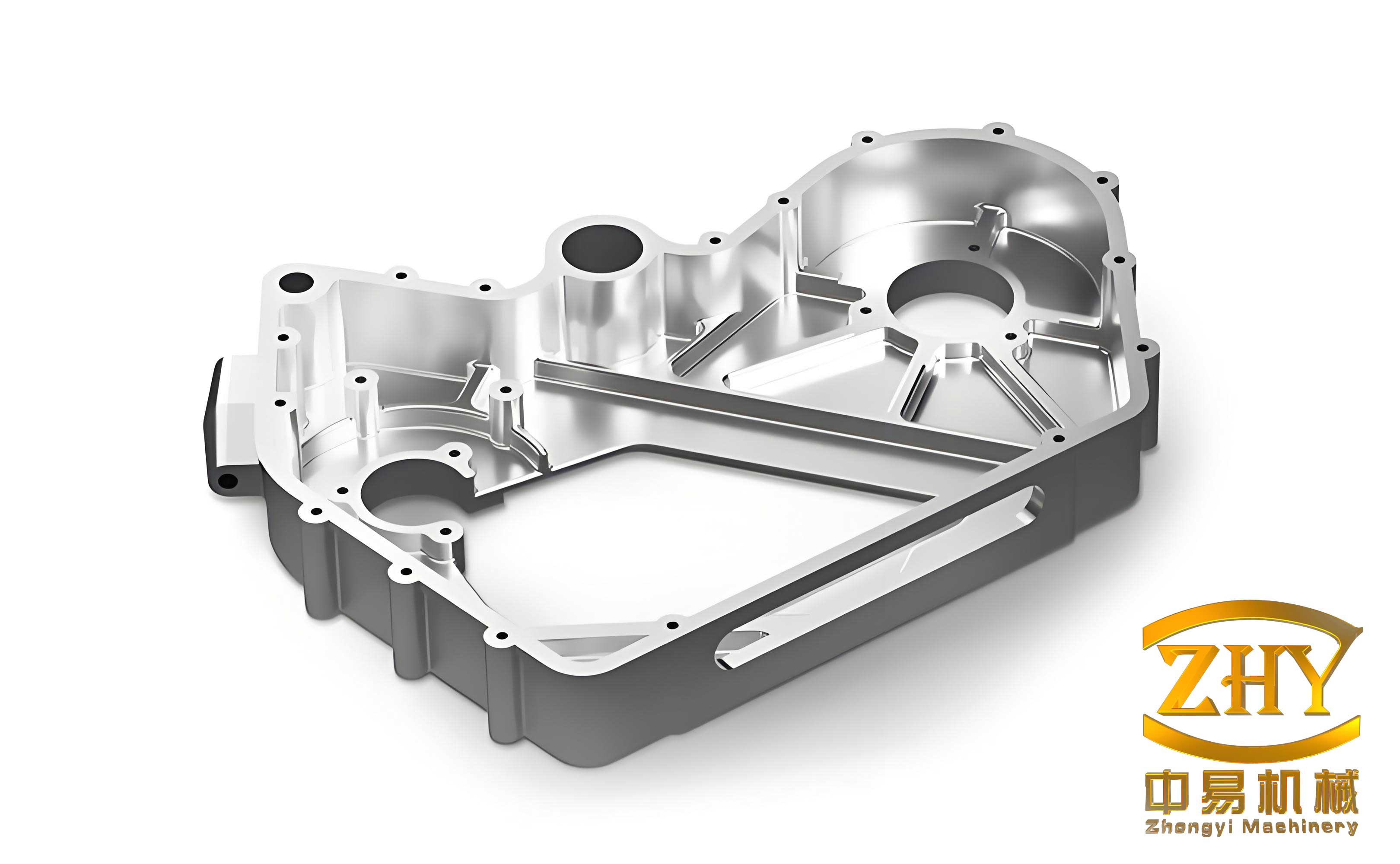
The image above showcases typical engine shell castings, highlighting their complex geometries that demand precise machining. Our center excels in handling such diversity. For camshaft housing shell castings, eight units are mounted on a hexahedral fixture: four in horizontal orientation for the first operation (machining planes and bore radii), and four in vertical orientation for the second operation. This setup maximizes spindle utilization and reduces handling time. The integrated main bearing cap shell castings undergo two operations—oil groove machining and block face milling—with four caps per batch, completed in three hours.
A critical aspect of machining these shell castings is tool management. Some operations require up to a hundred tools, and the center features a dual-ring automatic tool changer with a capacity of numerous tools. An auxiliary magazine facilitates easy tool replacement, minimizing interference, especially for large tools. The largest tools have contour dimensions up to a specified size, ensuring they fit within the workspace. The tool utilization efficiency can be modeled using the following formula for tool change time reduction:
$$ T_{\text{change}} = \frac{\sum_{i=1}^{n} t_i}{n} \times (1 – \eta) $$
where \( T_{\text{change}} \) is the average tool change time per operation, \( t_i \) is the time for changing tool \( i \), \( n \) is the number of tools, and \( \eta \) is the efficiency factor from the auxiliary magazine (estimated at 0.3). With, say, 80 tools per complex operation, this system saves approximately 20% in non-cutting time.
To delve deeper into productivity metrics, let’s analyze the overall equipment effectiveness (OEE) for these shell castings. OEE is calculated as:
$$ \text{OEE} = \text{Availability} \times \text{Performance} \times \text{Quality} $$
For this center, availability has improved due to unmanned pallet changes, averaging 95%. Performance is based on the ratio of actual output to theoretical maximum. Given the varied shell castings, we compute a weighted performance. Quality rate is high at 99%, as precision is paramount. A simplified OEE calculation for cylinder block shell castings might be:
$$ \text{Availability} = 0.95, \quad \text{Performance} = \frac{2 \text{ blocks/hour}}{2.5 \text{ theoretical blocks/hour}} = 0.8, \quad \text{Quality} = 0.99 $$
$$ \text{OEE} = 0.95 \times 0.8 \times 0.99 = 0.7524 \approx 75.24\% $$
This indicates substantial efficiency, with room for growth as we optimize further.
The economic impact of machining shell castings on this center is significant. Let \( C_{\text{old}} \) be the cost per casting under the old system, and \( C_{\text{new}} \) be the new cost. Factors include labor, energy, tooling, and depreciation. With unmanned operations, labor cost per shell casting drops dramatically. A simplified cost model is:
$$ C = C_{\text{labor}} + C_{\text{machine}} + C_{\text{tooling}} $$
where \( C_{\text{labor}} = \frac{L \times W}{Q} \), with \( L \) as labor hours, \( W \) as wage rate, and \( Q \) as quantity. For shell castings, \( L \) decreases by 70% due to automation, reducing \( C_{\text{labor}} \) proportionally. Tooling costs are offset by longer life from better management.
Another key advantage is flexibility. The center can switch between different shell castings with minimal setup. This is quantified by the changeover time \( T_c \), which is near zero thanks to palletized fixtures. The number of shell casting variants \( V \) we can handle in a week is given by:
$$ V = \frac{T_{\text{available}}}{\sum_{i} T_{\text{machining}, i} + T_{c,i}} $$
With \( T_{\text{available}} = 120 \text{ hours/week} \) and average \( T_{\text{machining}} = 3 \text{ hours/casting} \), and \( T_c \approx 0 \), we can theoretically process up to 40 different shell casting batches weekly, though practical limits apply.
Tool wear and life are critical when machining hard materials like cast iron for cylinder block shell castings. The Taylor tool life equation helps predict tool changes:
$$ VT^n = C $$
where \( V \) is cutting speed, \( T \) is tool life, \( n \) and \( C \) are constants. For carbide tools machining cast iron shell castings, \( n \approx 0.25 \), \( C \approx 200 \). Optimizing \( V \) extends tool life, reducing downtime.
To summarize the center’s capabilities, here is a table comparing key parameters before and after installation, focusing on shell castings:
| Metric | Previous System | New Horizontal Machining Center | Improvement |
|---|---|---|---|
| Average Machining Time per Shell Casting | 5.5 hours | 3 hours | 45.5% reduction |
| Weekly Throughput (units) | ~30 | ~60 (after offloading) | 100% increase |
| Changeover Time between Shell Casting Types | 2 hours | ~0 hours (pallet-based) | ~100% reduction |
| Tool Capacity (tools) | 40 | 120+ with auxiliary | 200% increase |
| Unmanned Operation Capability | Limited | Full (multi-pallet) | Enabled |
| OEE for Shell Castings | ~60% | ~75% | 15 percentage points |
From my perspective, managing this center involves continuous monitoring and optimization. The shell castings we produce must meet stringent tolerances. For example, cylinder bore diameters in block shell castings require precision within ±0.01 mm. The center’s accuracy is ensured by thermal compensation and rigid construction. The volumetric error \( E_v \) can be modeled as:
$$ E_v = \sqrt{E_x^2 + E_y^2 + E_z^2} $$
where \( E_x, E_y, E_z \) are errors along axes, each kept below 0.005 mm through calibration.
Looking ahead, we plan to integrate IoT sensors for predictive maintenance on tools machining these shell castings. Vibration analysis can detect wear before failure, using formulas like:
$$ \text{Vibration severity} = \frac{1}{N} \sum_{i=1}^{N} a_i^2 $$
where \( a_i \) are acceleration readings. Thresholds are set for different shell casting materials to trigger tool changes.
In conclusion, the horizontal machining center has revolutionized our production of engine shell castings. By leveraging multi-pallet systems, advanced tool management, and flexible fixtures, we have achieved remarkable productivity gains, cost savings, and quality improvements. The ability to machine diverse shell castings—from aluminum heads to iron blocks—with minimal human intervention positions us at the forefront of modern manufacturing. As we continue to refine processes, the focus remains on pushing the boundaries of what’s possible in shell castings machining, ensuring our engines are built with precision and reliability. The journey has just begun, and I am excited to lead further innovations in this critical domain.