
The relentless pursuit of higher performance in aero-engines demands materials capable of withstanding increasingly severe operational environments. Key components like fuel and oil pump housings are prime examples. These are intrinsically complex, thin-walled structures with intricate internal passages that can only be manufactured via casting. This manufacturing necessity imposes a critical dual requirement on the chosen material: it must possess excellent castability to faithfully reproduce these convoluted geometries and high internal integrity, while simultaneously delivering superior mechanical strength and thermal stability at elevated service temperatures. For years, cast aluminum alloys have been the cornerstone for such applications due to their favorable strength-to-weight ratio and manufacturing flexibility. However, the limitations of conventional alloys are becoming apparent. Alloys like ZL101A (based on the Al-Si-Mg system) offer exceptional casting performance, enabling the production of high-quality, leak-tight complex shell castings, but their strength diminishes rapidly above approximately 150°C, restricting their use in next-generation, hotter-running engines. Conversely, high-strength alloys like ZL205A (based on the Al-Cu system) provide remarkable room-temperature strength, approaching levels of some ferrous metals, but suffer from poor castability—characterized by high hot tearing susceptibility, significant shrinkage porosity tendency, and limited fluidity. These drawbacks make ZL205A notoriously difficult to process via metal mold casting, which is often preferred for achieving the dimensional accuracy and fine surface finish required for precision shell castings.
This performance gap has driven extensive research into next-generation cast aluminum alloys. The Al-Si system remains the foundation due to its inherent excellent castability, low thermal expansion, and good corrosion resistance. The traditional strengthening routes for this system involve the addition of Mg to form β’-Mg2Si precipitates or Cu to form θ’-Al2Cu precipitates. However, the thermal stability of these phases is limited; β’ coarsens rapidly above 150°C, and θ’ becomes unstable above 200°C. A promising strategy is the synergistic addition of both Cu and Mg, which can lead to the formation of more thermally stable phases like Q’ (Al5Cu2Mg8Si6). Furthermore, microalloying with transition elements such as Sc, Zr, and Ti has shown tremendous potential. Scandium (Sc), in particular, is highly effective. It can form nanoscale, coherent Al3Sc precipitates that are extremely resistant to coarsening at high temperatures. Remarkably, Sc has also been found to segregate at the interface between θ’ precipitates and the aluminum matrix, reducing the interfacial energy and thereby enhancing the thermal stability of the θ’ phase itself. This dual mechanism makes Sc a potent microalloying addition for developing cast alloys that retain strength at elevated temperatures.
Building upon this scientific foundation, our work focuses on a novel high-strength, heat-resistant cast aluminum alloy with a nominal composition of Al-7Si-4Cu-0.35Mg-0.15Sc (wt.%). This alloy is designed to bridge the gap between the castability of ZL101A and the high-temperature performance of ZL205A, making it an ideal candidate for critical, complex aero-engine shell castings. This article presents a comprehensive evaluation from a first-person R&D perspective, covering the alloy’s fundamental casting characteristics and mechanical properties, and detailing its successful application in manufacturing a representative complex oil pump casing via metal mold casting.
1. Castability Assessment: Fluidity and Hot Tearing
The manufacturability of any alloy for complex shell castings is first judged by its castability. Two of the most critical parameters are fluidity—the ability of the molten metal to fill thin sections and intricate mold details—and hot tearing resistance—the resistance to cracking during solidification as a result of thermally induced stresses. We conducted standard tests to evaluate these properties for our novel Al-Si-Cu-Mg-Sc alloy and compared them directly with benchmark alloys ZL101A and ZL205A.
Fluidity Test: Using a standard spiral fluidity test mold preheated to 200°C and a consistent pouring temperature of 740°C, the length of the solidified spiral was measured. The results clearly distinguished the alloys:
- ZL101A: Exhibited the best fluidity, with a spiral length >420 mm, consistent with its well-known excellent casting characteristics for thin-walled shell castings.
- Novel Al-Si-Cu-Mg-Sc Alloy: Showed very good fluidity at 400 mm.
- ZL205A: Demonstrated significantly lower fluidity, measuring only 245 mm.
This indicates that the new alloy’s fluidity, while slightly less than that of the highly castable ZL101A, is far superior to that of the high-strength ZL205A, suggesting it is much more suitable for filling the complex cavities of detailed shell castings.
Hot Tearing Susceptibility Test: A constrained ring casting test was employed. In this test, a central steel core constrains the solidifying aluminum ring. Hot tears initiate in the rings with the smallest diameters (highest restraint) first. The alloy with the smallest ring diameter at which the first crack appears is considered more resistant to hot tearing. Our observations were as follows:
- ZL101A: No hot tears were observed even in the smallest ring sections, confirming its excellent resistance.
- Novel Al-Si-Cu-Mg-Sc Alloy: The first hot tear appeared in the ring with a wall thickness of 5.0 mm.
- ZL205A: Hot tears were evident in rings with wall thicknesses of 25.0 mm and 15.5 mm, indicating a markedly higher susceptibility.
This test confirms that the hot tearing tendency of the new alloy is significantly lower than that of ZL205A, positioning it as a more robust choice for castings with varying section thicknesses and complex geometries prone to thermal stress during solidification.
The underlying reason for these castability differences lies in the solidification characteristics. We can analyze this using the Scheil-Gulliver solidification model. Key parameters are the liquidus temperature (TL), solidus temperature (TS), and the freezing range (ΔT = TL – TS).
| Alloy | TL (°C) | TS (°C) | Freezing Range, ΔT (°C) | |dT/dfs1/2| (0.9<fs<0.95)</f |
|---|---|---|---|---|
| ZL101A (Al-Si-Mg) | 612 | 567 | 45 | 39 |
| ZL205A (Al-Cu based) | 650 | 558 | 92 | 436 |
| Novel Al-Si-Cu-Mg-Sc | 600 | 522 | 78 | 207 |
The data reveals crucial insights:
- Fluidity: Fluidity is inversely related to the freezing range and positively related to the superheat (pouring temperature – TL). ZL101A has the narrowest freezing range, promoting good feeding and fluidity. ZL205A has a very wide freezing range, leading to a mushy mode of solidification that severely impedes flow. Our novel alloy has a lower TL than ZL205A, meaning greater effective superheat at the same pouring temperature, and a narrower freezing range. This combination explains its significantly better fluidity, which is critical for producing sound, defect-free complex shell castings.
- Hot Tearing: The parameter |dT/dfs1/2|, where fs is the solid fraction, is a recognized indicator of hot tearing susceptibility. A higher value indicates a greater tendency to crack in the final stages of solidification when liquid feeding is difficult. As shown in Table 1, ZL205A has an exceptionally high value, aligning with its severe hot cracking tendency. The novel alloy’s value is less than half that of ZL205A, confirming its improved resistance. The value can be conceptualized by considering the difficulty of liquid feeding through the semi-solid network as solidification progresses:
$$ \text{Feeding Difficulty} \propto \left| \frac{dT}{d(\sqrt{f_s})} \right| $$
A steeper gradient implies a rapid increase in solid fraction over a small temperature drop, leaving little time and liquid metal to compensate for solidification shrinkage, thus promoting hot tear initiation in constrained shell castings.
2. Microstructure and Mechanical Performance
The alloy was melted, degassed with high-purity argon, and cast. It was subsequently subjected to a T6 heat treatment: solution treatment at 495°C for 24 hours followed by water quenching and artificial aging at 180°C for 8 hours. This treatment is designed to dissolve soluble phases and then precipitate fine, strengthening particles.
Microstructural Evolution: The as-cast structure shows a dendritic α-Al matrix with eutectic silicon particles located in the interdendritic regions. Unlike ZL101A, which contains Mg2Si and β-Al5FeSi phases, the as-cast structure of the novel alloy also reveals the presence of blocky Al2Cu particles and some Al(Cu,Sc) compounds. The solution treatment effectively spheroidizes the eutectic Si and dissolves most of the Al2Cu phase into the matrix. Upon aging, a high density of fine precipitates emerges. Transmission Electron Microscopy (TEM) confirms the coexistence of two key strengthening phases: needle-shaped θ’-Al2Cu and finer, spherical/lath-shaped Q’-Al5Cu2Mg8Si6. The Q’ phase is known for its superior thermal stability compared to θ’, retaining its strengthening effect at temperatures up to 300°C. Furthermore, the microalloying addition of Sc is believed to further stabilize the θ’ interface and may contribute to the formation of fine, dispersed Al3Sc precipitates, although they are more challenging to resolve.
Mechanical Properties: The tensile properties of separately cast test bars (T6 condition) were evaluated at room temperature and elevated temperatures. For application validation, test coupons were also machined directly from the cast and heat-treated complex shell castings (本体试样).
| Material & Specimen Type | Tensile Strength, Rm (MPa) | Yield Strength, Rp0.2 (MPa) | Elongation, A (%) |
|---|---|---|---|
| Novel Alloy (Separate Cast Bar) | 425 ± 7 | 395 ± 10 | 1.2 ± 0.3 |
| Novel Alloy (From Shell Casting) | 448 ± 23 | 410 ± 15 | 1.3 ± 0.3 |
| ZL101A (Separate Cast Bar) | 310 ± 5 | 240 ± 8 | 3.3 ± 0.7 |
| ZL205A (Literature Data) | 484 ± 7 | 420 ± 10 | 7.2 ± 2.0 |
The results are compelling:
- Strength: The novel alloy demonstrates a room-temperature tensile strength significantly higher (by over 115 MPa) than ZL101A. Impressively, the strength measured from the actual shell casting is even higher than that of the separately cast bar, indicating excellent integrity and the absence of gross defects in the component. While its strength is still below the peak level of ZL205A, it represents a substantial improvement over the standard castable alloy.
- Ductility: The elongation of the novel alloy is relatively low (1-1.5%). Fractographic analysis revealed that this is primarily attributable to the presence of micro-shrinkage porosity, with pore sizes ranging from 0.5 to 1 mm. These pores act as stress concentrators and crack initiation sites, limiting ductility. The porosity is a consequence of the alloy’s relatively wide freezing range (78°C), which can hinder perfect feeding during the final stages of solidification, especially in complex shell castings. In areas free of such defects, the fracture surface exhibited fine dimples, indicating good intrinsic matrix ductility.
High-Temperature Performance: The true merit of this alloy for aero-engine applications lies in its elevated temperature capability. Tensile tests were conducted at temperatures up to 250°C.
| Temperature (°C) | Novel Alloy, Rm (MPa) | ZL101A, Rm (MPa) | ZL205A, Rm (MPa) [Ref] |
|---|---|---|---|
| 25 | 425 | 310 | 484 |
| 150 | 346 | 220 | ~390 |
| 180 | 319 | 199 | – |
| 220 | 288 | 175 | – |
| 250 | 242 | 140 | 204 |
The high-temperature performance is exceptional. The novel alloy retains a strength advantage of over 100 MPa compared to ZL101A across the entire temperature range. More importantly, while its room-temperature strength is lower than ZL205A, the rate of strength degradation with temperature is much slower. By 250°C, its tensile strength surpasses that of ZL205A. This can be attributed to the synergistic effect of the thermally stable Q’ phase and the Sc-mediated stabilization of the θ’ phase. The strength retention can be modeled with an exponential decay relationship common for precipitation-strengthened alloys:
$$ R_m(T) = R_{m0} \cdot \exp\left(-\frac{T}{T_c}\right) $$
where \(R_{m0}\) is the room temperature strength and \(T_c\) is a characteristic temperature related to precipitate stability. The novel alloy exhibits a higher \(T_c\) than both ZL101A and ZL205A, indicating superior microstructural stability. For designers of engine shell castings operating in hot sections, this translates to a greater allowable stress or an increased safety margin at service temperatures.
3. Application: Manufacturing of Complex Aero-Engine Oil Pump Shell Castings
The ultimate validation of any new alloy is its successful implementation in a real component. We selected a representative oil pump housing for this purpose. The component features extreme complexity: overall dimensions of approximately 260 x 220 x 60 mm, with wall thickness varying from 4 mm (thin ribs) to 25 mm (mounting lugs). The internal cavity is a labyrinth of intersecting, curved oil galleries. Such a geometry epitomizes the challenge of producing high-integrity shell castings.
Casting Process & Challenges: The component must be produced via metal mold (permanent mold) casting to achieve the necessary dimensional accuracy and surface finish. The internal galleries necessitate the use of complex, thermally cured resin sand cores. The key challenges for producing sound shell castings include:
- Filling: Ensuring complete filling of the thin sections before the metal front freezes.
- Shrinkage Porosity: Feeding the thick sections and thermal centers to prevent shrinkage cavities.
- Hot Tears: Avoiding cracking in areas of high thermal stress concentration during solidification.
- Gas Porosity: Minimizing entrapped gas from the mold and cores.
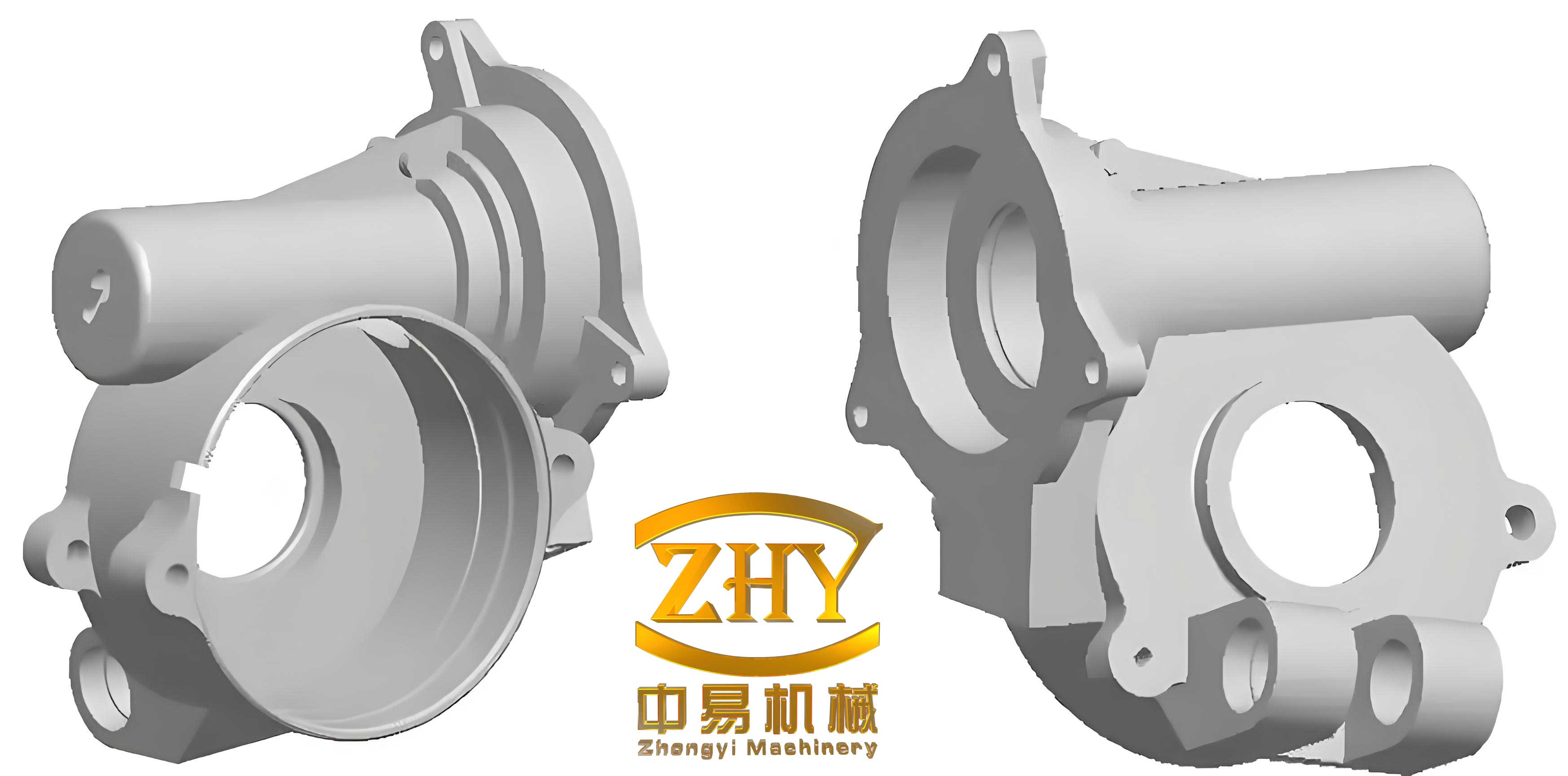
To address these challenges, a tilt-pouring process was employed. In this process, the mold is initially vertical and is gradually tilted during pouring. This allows for a calm, non-turbulent fill, reducing oxide formation and gas entrapment—critical for the pressure tightness of shell castings. The gating and risering system was designed using numerical simulation (AnyCasting software) to ensure progressive solidification toward the risers. Riser necks were optimized to act as hot spots, ensuring they remain liquid longest to feed the thick sections of the casting.
Results and Component Quality: A batch of ten shell castings was produced using the novel Al-Si-Cu-Mg-Sc alloy. After T6 heat treatment and shot blasting, they underwent a full battery of quality inspections as per aerospace standards (analogous to HB 963-2005).
- Surface Quality: Fluorescent penetrant inspection (FPI) revealed no cold shuts, hot tears, or other linear surface defects on any of the ten castings.
- Internal Quality: X-ray radiography showed a dense microstructure with no major shrinkage or gas porosity. The internal quality acceptance rate was 80%, which is comparable to the rate achieved with ZL101A for similar complex shell castings, demonstrating the alloy’s suitability.
- Mechanical Properties: As shown in Table 2, tensile specimens taken from the castings themselves exhibited excellent strength, validating the effectiveness of the process.
- Pressure Integrity: This is the most critical test for pump housings. All ten shell castings successfully passed:
- Air Leak Test: No bubbles were observed when the pressurized (0.5 MPa air) casting was submerged in oil.
- Hydrostatic Burst Test: The castings withstood an internal hydraulic oil pressure of 33 MPa without failure or leakage.
4. Conclusions and Outlook
Through a combined approach of fundamental property evaluation and practical manufacturing validation, this novel Al-7Si-4Cu-0.35Mg-0.15Sc cast aluminum alloy has demonstrated a highly attractive property profile for advanced aero-engine shell castings.
| Property Category | Performance vs. ZL101A | Performance vs. ZL205A | Suitability for Complex Shell Castings |
|---|---|---|---|
| Castability (Fluidity) | Slightly Lower | Significantly Higher | Very Good. Enables filling of intricate details. |
| Castability (Hot Tearing) | Higher Susceptibility | Significantly Lower Susceptibility | Good. Much more robust than ZL205A for constrained geometries. |
| Room Temperature Strength | ~40% Higher | ~12% Lower | Excellent. Provides a major upgrade from standard castable alloys. |
| 250°C Strength | ~70% Higher | ~20% Higher | Outstanding. Key advantage for high-temperature service. |
| Pressure Tightness / Yield | Comparable | Likely Superior | Excellent. Proven to meet stringent aerospace leakage standards. |
The alloy successfully bridges the historical gap between castability and high-temperature performance. It offers a compelling alternative: for applications where ZL101A’s thermal limits are being approached, this alloy provides a substantial increase in strength and temperature capability without the severe manufacturing difficulties associated with ZL205A. The successful production and testing of the complex oil pump housing prove its viability for mission-critical shell castings. Future work will focus on further optimizing the composition and heat treatment to improve ductility by minimizing micro-porosity, potentially through adjustments to the Si/Cu ratio or the use of advanced melt treatment and solidification control techniques. The integration of this material into more engine components represents a significant step towards enabling more powerful and efficient aero-engines.