
In my years of experience in the foundry industry, I have witnessed the evolution of casting techniques, particularly for complex components like shell castings. Shell castings, which involve the production of intricate hollow structures, are critical in applications ranging from pumps and valves to aerospace components. This article delves into two key processes I have been involved with: the melting and casting of brass for large components, and the precision casting of aluminum alloy shells with fine internal oil passages. Both methods highlight advancements in shell castings that enhance performance, reduce labor, and optimize material usage. Throughout this discussion, I will emphasize the role of shell castings in modern manufacturing, using tables and formulas to summarize key data and principles.
The journey begins with the melting of brass for large castings. In our facility, we faced the challenge of producing substantial brass components with consistent quality. The traditional method used coke crucible furnaces, but we developed a more efficient approach using a “three-eye” furnace setup. This innovation not only improved melt control but also reduced worker fatigue. The process involves careful charge sequencing and temperature management to achieve uniform solidification and high mechanical properties.
For brass melting, the charge consists of electrolytic copper, zinc ingots, aluminum ingots, tin, metallic manganese, and low-carbon steel sheets. The order of addition is crucial: copper, metallic manganese, and low-carbon steel sheets are charged cold under a cover of charcoal. After melting, the charcoal is skimmed off, and preheated zinc and tin are added, followed by aluminum. This sequence minimizes oxidation and ensures proper alloying. The total melting time, from start to finish, is approximately 2 to 3 hours, depending on the batch size. We monitor the temperature closely, aiming for a pouring temperature around 1150°C to 1200°C.
To quantify the energy requirements, we use a simple heat balance formula. The total heat input \( Q \) needed to melt the charge can be expressed as:
$$ Q = m_c c_{p,c} \Delta T_c + m_{alloy} c_{p,alloy} \Delta T_{alloy} + L_f m $$
where \( m \) is the mass, \( c_p \) is the specific heat capacity, \( \Delta T \) is the temperature change, and \( L_f \) is the latent heat of fusion. For brass, the specific heat capacity varies with composition, but an average value of 0.38 kJ/kg·K is often used. This calculation helps in optimizing furnace settings for shell castings.
After melting, the brass is transferred to a preheated ladle for pouring. We use an open mold design to allow for controlled cooling. Upon solidification, the shell castings are inspected for thickness uniformity and surface defects. Chemical analysis is performed to verify composition. In one instance, we found that the actual composition deviated slightly from specifications, with higher manganese and lower iron content. This was attributed to minor losses during melting. The mechanical properties, however, were excellent, as shown in the table below.
| Property | Value | Unit |
|---|---|---|
| Tensile Strength | 45-50 | kg/mm² |
| Yield Strength | 20-25 | kg/mm² |
| Elongation | 30-35 | % |
This demonstrates the reliability of our melting method for producing high-integrity shell castings. The “three-eye” furnace setup not only improves efficiency but also reduces physical strain on workers, as handling crucibles and adding coke are easier compared to traditional methods. However, we noted that the process yield was lower than desired, and machining allowances were large. To address this, we are exploring enhanced directional solidification techniques to minimize material waste and machining time for shell castings.
Turning to aluminum alloy shell castings, we tackled the challenge of creating fine internal oil passages. In products like valves and pumps, these passages are essential for fluid control, but machining them is often impractical. Our team developed a casting method that integrates cores made from sand, copper tubes, and steel wires to form complex networks. This approach is a testament to the versatility of shell castings in achieving intricate geometries.
The core-making process begins with a sand mixture. For aluminum alloy shells, we use a blend of quartz sand, oil, syrup, and water. The typical formulation is summarized in the table below.
| Material | Proportion | Notes |
|---|---|---|
| Quartz Sand | 100 parts | Grain size 50/100 |
| Oil | 2-3 parts | Typically桐 oil, but we use synthetic binders |
| Syrup | 1-2 parts | Acts as a binder and lubricant |
| Water | Appropriate amount | For consistency |
The mixing involves blending the syrup and water first, then adding sand, and finally oil. The mixture is processed for 10-15 minutes to achieve a wet compressive strength of 0.4-0.6 kg/cm² and a permeability of 80-100. These properties are critical for ensuring the cores withstand the casting process without collapse, especially for thin sections in shell castings.
Baking the cores requires precise temperature control. Based on core size and composition, we use a profile like this: heat to 150°C over 1 hour, hold for 2 hours, then cool slowly. This ensures proper curing without cracking. The kinetics of binder decomposition can be modeled using an Arrhenius equation:
$$ k = A e^{-E_a / RT} $$
where \( k \) is the reaction rate constant, \( A \) is the pre-exponential factor, \( E_a \) is the activation energy, \( R \) is the gas constant, and \( T \) is the temperature. This helps in optimizing the baking cycle for shell castings cores.
For creating specific passage shapes, we employ various techniques. For example, rectangular passages of 3 mm × 5 mm × 100 mm are formed using 3 mm diameter copper tubes. These tubes serve as both cores and skeletons, providing通气 and定位. They are coated with a mixture of molybdenum disulfide and alcohol to facilitate removal after casting. The coating reduces friction, as described by the Coulomb friction law:
$$ F_f = \mu F_n $$
where \( F_f \) is the friction force, \( \mu \) is the coefficient of friction, and \( F_n \) is the normal force. By lowering \( \mu \), we ensure easy extraction without damaging the shell castings.
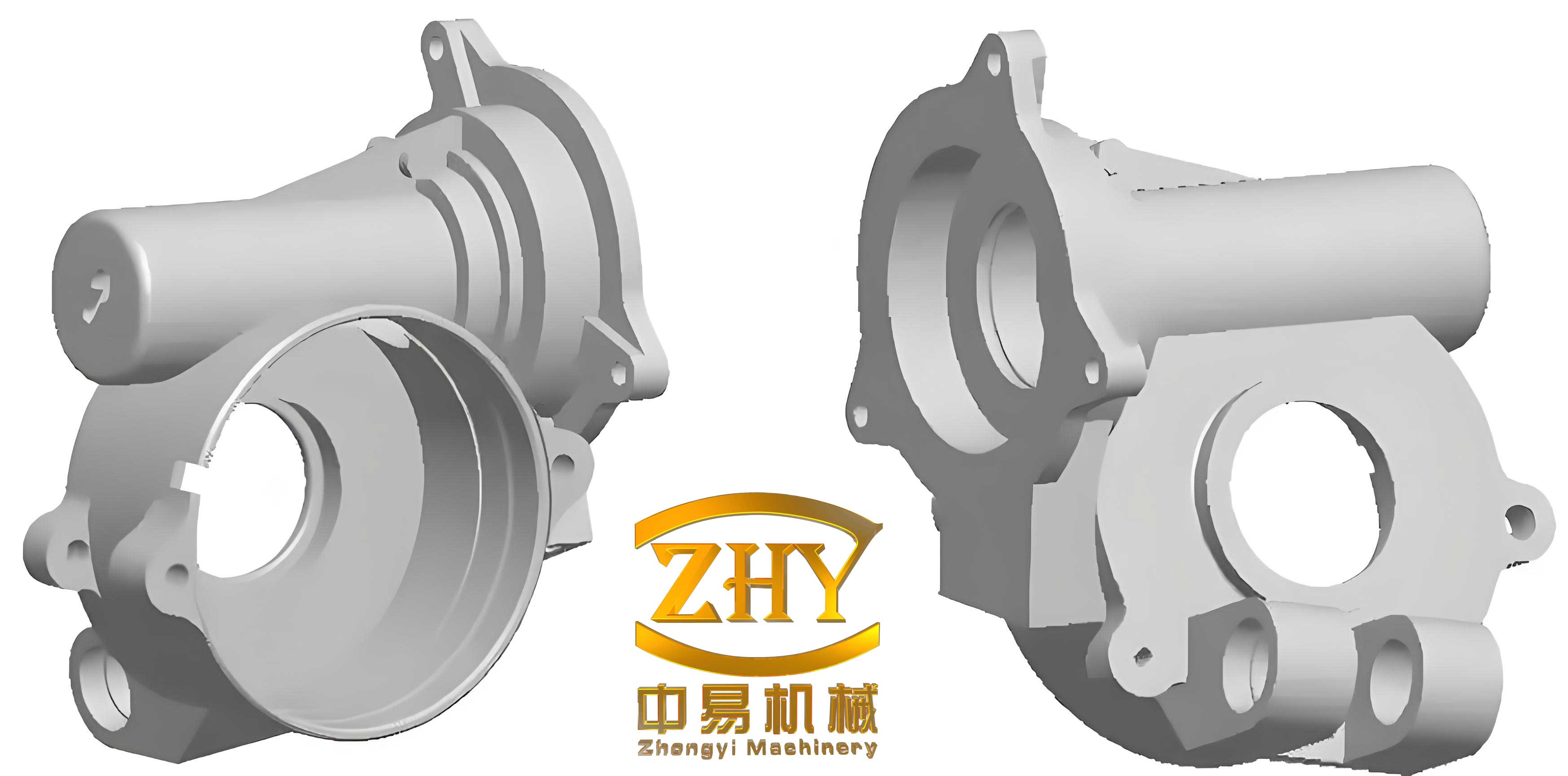
Fine circular passages, such as those with diameters of 1.5 mm, are made using 1.5 mm diameter steel wires. These wires are bent to shape, degreased, and embedded in the core during molding. After baking, they are coated with the molybdenum disulfide mixture and pulled out post-casting. For non-extractable cores, like certain internal labyrinths, we use腐蚀 methods. For instance, copper片 cores are dissolved with nitric acid, leaving clean passages in the shell castings. The腐蚀 rate can be approximated by Faraday’s law:
$$ m = \frac{I t M}{n F} $$
where \( m \) is the mass dissolved, \( I \) is the current (if electrochemical), \( t \) is time, \( M \) is the molar mass, \( n \) is the number of electrons transferred, and \( F \) is Faraday’s constant. This guides our post-processing for complex shell castings.
Core assembly is another critical step. When multiple cores are needed to form intersecting passages, we bond them using adhesives. A common配方 includes waste sulfite pulp liquor, clay, and water. For non-machined surfaces, we use a paste of graphite粉, clay, and salt to seal joints. Each assembly is dried under infrared lamps to prevent位移. The bonding strength \( \sigma_b \) can be related to the adhesive properties:
$$ \sigma_b = k_a \cdot \tau $$
where \( k_a \) is a geometric factor and \( \tau \) is the shear strength of the adhesive. Ensuring adequate strength is vital for maintaining passage integrity in shell castings.
After casting, the aluminum alloy shell castings undergo rigorous inspection. We use visual and X-ray检查 to detect defects like shrinkage porosity or incomplete filling. For oil passage components, they are tested under working pressures up to 150 kg/cm² with hydraulic fluids. The performance is excellent, confirming the reliability of our casting method. Compared to traditional machined parts, these shell castings offer weight reduction, simplified加工, and shorter production cycles—key advantages for industrial applications.
In both brass and aluminum processes, the theme of innovation in shell castings is evident. We continuously refine our methods based on empirical data and theoretical models. For instance, we study fluid flow during pouring using the Bernoulli equation:
$$ P + \frac{1}{2} \rho v^2 + \rho g h = \text{constant} $$
where \( P \) is pressure, \( \rho \) is density, \( v \) is velocity, \( g \) is gravity, and \( h \) is height. This helps in designing gating systems to minimize turbulence and defects in shell castings.
Moreover, we optimize cooling rates to control microstructure. The solidification time \( t_s \) for a shell casting can be estimated using Chvorinov’s rule:
$$ t_s = C \left( \frac{V}{A} \right)^n $$
where \( V \) is volume, \( A \) is surface area, \( C \) is a constant dependent on material and mold properties, and \( n \) is an exponent typically around 2. By adjusting mold geometry, we enhance directional solidification for better mechanical properties in shell castings.
Looking ahead, we are exploring additive manufacturing for core production, which could revolutionize shell castings by enabling even more complex internal features. Additionally, we are integrating real-time monitoring with sensors to track temperature and pressure during casting, using data analytics to predict quality. The future of shell castings lies in smart, sustainable processes that reduce waste and energy consumption.
In conclusion, my experience with brass melting and aluminum alloy shell castings underscores the importance of meticulous process control and innovation. Shell castings are not merely components; they are enablers of advanced engineering solutions. Through tables and formulas, I have summarized key aspects of our work, but the real learning comes from hands-on practice. I encourage fellow foundry professionals to embrace these techniques and push the boundaries of what is possible with shell castings. The journey is ongoing, and each improvement brings us closer to perfection in metal casting.