
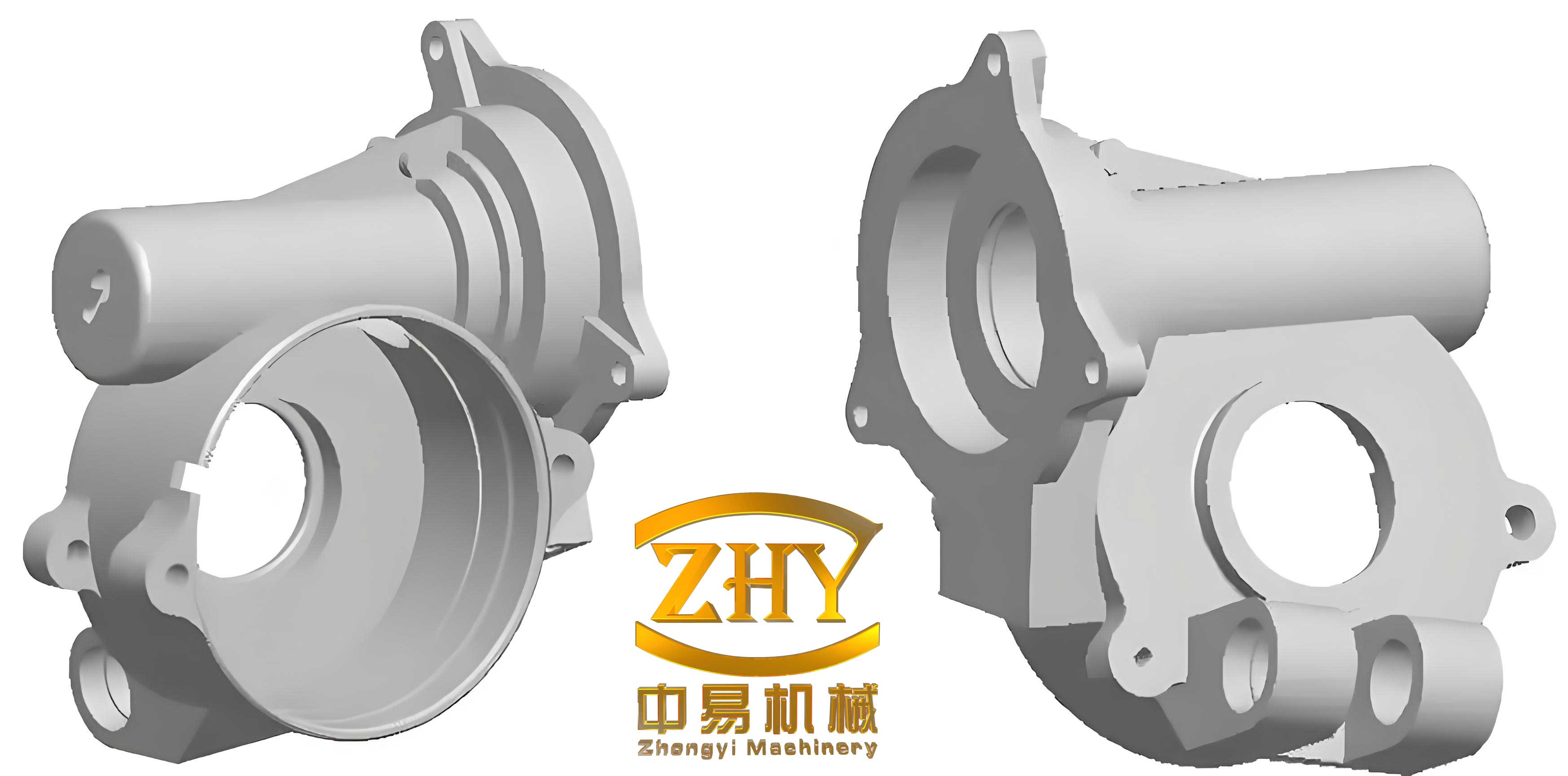
In the rapidly evolving field of new energy vehicles, the on-board charger (OBC) plays a critical role in converting external power sources for battery charging. The OBC housing, or shell casting, must integrate multiple components such as the charger itself, motor controllers, DC-DC converters, vehicle control units, and high-voltage distribution boxes. Consequently, these shell castings must meet stringent requirements for electrical insulation, thermal management, structural integrity, and mechanical load-bearing capacity. However, aluminum alloy shell castings are often plagued by defects like gas porosity, shrinkage cavities, and cold shuts, which compromise quality and increase production costs. Among these, cold shut defects are particularly detrimental, arising when molten metal flows encounter prematurely solidified fronts, leading to incomplete fusion and seam formation. This study focuses on addressing cold shut defects in OBC shell castings through the design and fabrication of conformal cooling inserts using Selective Laser Melting (SLM) technology. By implementing localized heating via conformal channels, we aim to improve mold temperature uniformity and eliminate these defects, thereby enhancing the overall quality and reliability of shell castings.
Cold shut defects in shell castings typically occur in regions with complex geometries, such as deep screw holes, where mold temperatures are insufficient to maintain metal fluidity. The underlying mechanism can be described by heat transfer and fluid dynamics principles. The solidification time \( t_s \) for a molten metal stream can be approximated using Chvorinov’s rule:
$$ t_s = C \left( \frac{V}{A} \right)^n $$
where \( V \) is the volume of the casting section, \( A \) is the surface area, \( C \) is a constant dependent on mold material and pouring conditions, and \( n \) is an exponent typically around 2. For thin sections or areas with high surface-area-to-volume ratios, such as screw holes in shell castings, \( t_s \) decreases significantly, leading to rapid solidification. When multiple metal streams converge with solidified fronts, the interfacial energy barrier prevents re-melting, resulting in a cold shut. The critical temperature gradient \( G \) required to avoid cold shuts can be expressed as:
$$ G > \frac{\Delta T}{\delta} $$
where \( \Delta T \) is the undercooling below the liquidus temperature, and \( \delta \) is the boundary layer thickness. In conventional molds, straight cooling channels cannot provide adequate heating to maintain \( G \) in complex regions, necessitating a conformal approach.
To mitigate cold shuts in OBC shell castings, we designed a conformal cooling insert that replaces traditional straight cores. The insert features a network of internal channels that follow the contour of the defect-prone screw hole area, allowing for precise temperature control via heated oil circulation. The design parameters were optimized using computational fluid dynamics (CFD) simulations to ensure uniform heat distribution. Key dimensions include an overall size of 153 mm × 59 mm × 27 mm, with channel diameters of 8 mm to facilitate efficient heat transfer. The insert was fabricated via SLM using a hybrid material approach: the base was made from H13 tool steel powder for cost-effectiveness, while the active head section was fabricated from 18Ni300 maraging steel powder for superior mechanical properties. The SLM process parameters are summarized in Table 1.
| Parameter | Value | Unit |
|---|---|---|
| Layer Thickness | 0.05 | mm |
| Laser Spot Diameter | 0.06 | mm |
| Laser Scan Speed | 1000 | mm/s |
| Laser Power | 200 | W |
| Build Volume | 280 × 280 × 350 | mm³ |
Post-processing included wire cutting, surface grinding, and heat treatment. The H13 section underwent quenching at 1040°C followed by tempering at 540–650°C to achieve a hardness of HRC 48–52, while the 18Ni300 section was solution-treated at 840°C and aged at 480°C for 6 hours to enhance strength and toughness. The conformal channels were validated through X-ray imaging, confirming their integrity and precise alignment with the screw hole geometry in the shell castings.
The mechanical performance of the SLM-fabricated inserts was rigorously evaluated through microstructural analysis, tensile testing, impact testing, and electrochemical corrosion testing, with comparisons to conventional H13 tool steel. Microstructures were examined using optical microscopy after etching with 4% nitric alcohol. The 18Ni300 steel exhibited a uniform, fine-grained structure with minimal defects, whereas the H13 steel showed occasional micro-porosity. This difference correlates with the relative density \( \rho_r \) achieved in SLM, which can be estimated as:
$$ \rho_r = 1 – \frac{V_p}{V_t} $$
where \( V_p \) is the pore volume and \( V_t \) is the total volume. For 18Ni300, \( \rho_r \) exceeded 99.5%, indicating high打印 quality.
Tensile tests were conducted on plate specimens (dimensions: 25.27 mm gauge length, 8 mm width, 1 mm thickness) according to ISO 6892-1:2009. The stress-strain behavior was analyzed, and key properties are summarized in Table 2. The yield strength \( R_{p0.2} \) and tensile strength \( R_m \) were calculated from the load-displacement curves, with the true stress \( \sigma_t \) given by:
$$ \sigma_t = \sigma (1 + \epsilon) $$
where \( \sigma \) is engineering stress and \( \epsilon \) is engineering strain. The elongation \( A \) and reduction of area \( Z \) were derived from pre- and post-test measurements.
| Material | Yield Strength \( R_{p0.2} \) (MPa) | Tensile Strength \( R_m \) (MPa) | Elongation \( A \) (%) | Reduction of Area \( Z \) (%) |
|---|---|---|---|---|
| 18Ni300 Steel | 1593 | 1697 | 4.88 | 7.85 |
| H13 Steel | 1313 | 1503 | 6.27 | 7.70 |
The 18Ni300 steel demonstrated superior strength but lower ductility compared to H13, which is advantageous for模具 inserts subjected to high pressures and temperatures during casting of shell castings. Fracture surfaces analyzed via scanning electron microscopy (SEM) revealed ductile dimples in 18Ni300, indicative of high toughness, while H13 exhibited quasi-cleavage features with tear ridges, suggesting brittle tendencies.
Impact toughness was assessed using Charpy V-notch specimens (55 mm × 10 mm × 10 mm) at room temperature. The impact energy \( W_k \) was measured, and the impact toughness \( \sigma_k \) was computed as:
$$ \sigma_k = \frac{W_k}{A} $$
where \( A \) is the cross-sectional area. Results are presented in Table 3. The higher \( \sigma_k \) of 18Ni300 confirms its better resistance to sudden loads, crucial for模具 inserts in dynamic casting environments.
| Material | Impact Energy \( W_k \) (J) | Cross-sectional Area \( A \) (cm²) | Impact Toughness \( \sigma_k \) (J/cm²) |
|---|---|---|---|
| 18Ni300 Steel | 28.27 | 1.00 | 28.27 |
| H13 Steel | 27.28 | 1.00 | 27.28 |
Electrochemical corrosion tests in 3.5% NaCl solution revealed that 18Ni300 has a higher corrosion potential \( E_{corr} \) than H13, as shown by polarization curves. The corrosion current density \( i_{corr} \) was lower for 18Ni300, implying better durability in humid conditions common in casting operations. The polarization resistance \( R_p \) can be derived from the Stern-Geary equation:
$$ R_p = \frac{\beta_a \beta_c}{2.303 i_{corr} (\beta_a + \beta_c)} $$
where \( \beta_a \) and \( \beta_c \) are anodic and cathodic Tafel slopes. This enhanced corrosion resistance prolongs the service life of inserts used for producing shell castings.
To validate the efficacy of the conformal cooling insert, production trials were conducted on a DCC1600 die-casting machine using AISi10MgFe aluminum alloy. The molten metal was injected at 680°C into a mold equipped with either a traditional straight-core insert or the SLM-fabricated conformal insert. For the conformal insert, heated oil at 150°C was circulated through the channels via a temperature-controlled unit, maintaining a mold surface temperature of 200°C around the screw hole region. The temperature evolution \( T(t) \) in the mold can be modeled using the heat conduction equation:
$$ \frac{\partial T}{\partial t} = \alpha \nabla^2 T + \frac{q}{\rho c_p} $$
where \( \alpha \) is thermal diffusivity, \( q \) is heat flux from the oil, \( \rho \) is density, and \( c_p \) is specific heat. The conformal design ensures \( q \) is evenly distributed, reducing thermal gradients.
After casting, the OBC shell castings were inspected using X-ray radiography. Comparative images showed that the traditional insert resulted in pronounced cold shut voids in the screw hole area, whereas the conformal insert produced sound, defect-free regions. The improvement can be quantified by the defect area ratio \( D_r \):
$$ D_r = \frac{A_d}{A_t} \times 100\% $$
where \( A_d \) is the defect area and \( A_t \) is the total area of interest. For traditional inserts, \( D_r \) exceeded 5%, while for conformal inserts, it dropped below 0.5%, effectively eliminating cold shuts. This underscores the critical role of conformal temperature management in enhancing the integrity of shell castings.
In conclusion, this study demonstrates that SLM-fabricated conformal cooling inserts, particularly using 18Ni300 steel, offer superior mechanical and corrosion-resistant properties compared to conventional H13 tool steel. The tailored design enables localized heating, which mitigates cold shut defects in complex geometries of OBC shell castings. Through rigorous testing and production validation, we have shown that this approach significantly improves the quality and reliability of shell castings, with potential applications across various automotive and aerospace components. Future work could explore multi-material SLM or advanced channel geometries to further optimize thermal management in the production of high-performance shell castings.