
In the manufacturing of complex metal components, aluminum alloy shell castings present a significant technical challenge. These parts are typically characterized by their irregular shapes, intricate internal geometries featuring undercuts, multiple bosses, ribs, and thin-walled sections that are notoriously difficult to machine. Such complexity inherently increases the difficulty of the casting process, directly impacting production efficiency and product quality for foundries. This article details my first-hand experience in addressing these challenges. Faced with recurring quality issues in a specific shell casting produced via conventional high-pressure die casting (HPDC), I led an initiative to optimize the manufacturing process by transitioning to an indirect squeeze casting (ISC) technique. This shift was driven by the need to meet stringent technical specifications, particularly concerning internal soundness and mechanical properties, which the traditional method was consistently failing to achieve.
The specific shell casting in question serves a critical function where high pressure integrity is paramount. Its design is essentially a tubular structure with numerous internal and external features that complicate metal flow and solidification.
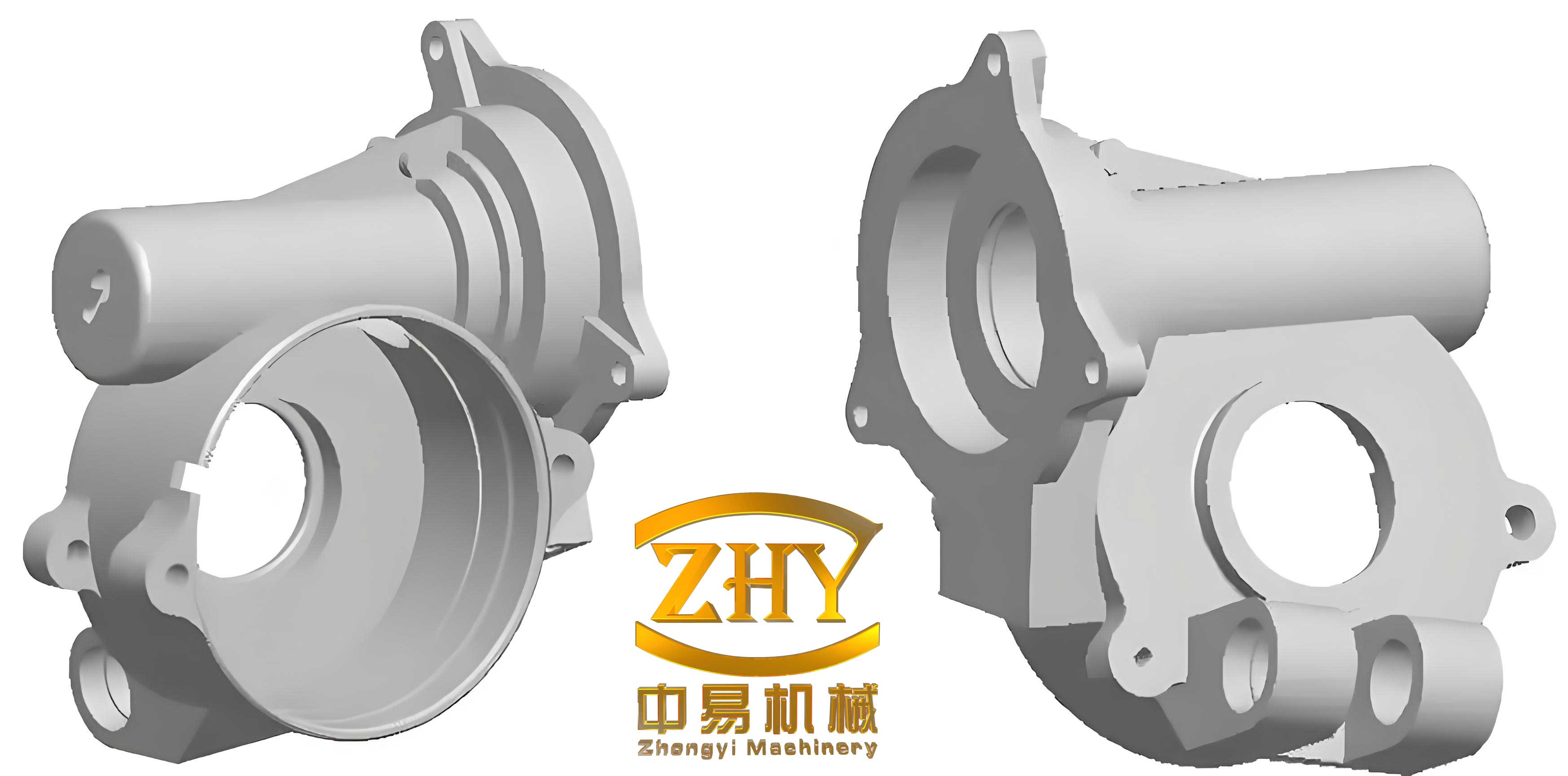
The performance requirements for these aluminum alloy shell castings were clear and demanding: a minimum tensile strength of 245 MPa, a yield strength of 145 MPa, and a strict pressure-tightness qualification requiring the casting to withstand a 1.5 MPa pneumatic leak test without failure. Initially, high-pressure die casting was the chosen method for its high productivity and ability to form complex thin-walled shell castings. However, production yields were unsatisfactory due to persistent defects.
Analysis of Defects in Traditional Die-Cast Shell Castings
The primary failure mode observed in the die-cast aluminum alloy shell castings was the presence of subsurface porosity, often leading to leaks during the final pressure test. Die casting involves injecting molten metal at extremely high velocities (typically 25-80 m/s) into a steel mold under intense pressure. While this allows for rapid filling, it inevitably entraps air and gases from the die lubricant within the melt. For shell castings with complex geometries, the turbulent flow exacerbates this issue, trapping gas in corners, behind ribs, and at the end of fill zones. Although secondary operations like impregnation can sometimes seal these pores, they add cost and are not always fully reliable for high-integrity applications. The entrapped gas porosity severely compromises the mechanical properties, particularly the elongation, which was consistently below 1%, indicating a brittle material behavior unsuitable for demanding service conditions. The quest for denser, more reliable aluminum alloy shell castings necessitated a fundamental process change.
Transition to Indirect Squeeze Casting: A Paradigm Shift
The selection of indirect squeeze casting as the replacement technology was based on its unique solidification characteristics. Unlike die casting’s turbulent fill, ISC involves a slow, laminar filling of the cavity from a shot sleeve (or “transfer chamber”) followed by the application of a high, sustained pressure via a punch during the entire solidification phase. This process offers two key advantages for producing high-quality shell castings: first, the quiescent fill minimizes air entrapment; second, and most critically, the prolonged high pressure actively feeds shrinkage as the metal solidifies, yielding an extremely dense, almost pore-free microstructure. The improvement in mechanical properties, especially ductility, is often dramatic. The core challenge was to adapt this process to the existing shell casting geometry and production infrastructure.
Strategic Process Improvement: Tooling and Parameter Optimization
The implementation required a holistic redesign of both the tooling approach and the process window. The improvements were executed in two main phases.
1. Innovative Mold Design for Shell Castings
The original die cast mold was designed for lateral gating and ejection. For the ISC process, a complete reorientation was necessary. The mold was rotated 90 degrees to facilitate a vertical fill from below, which is more conducive to controlled, bottom-up filling and effective venting of air upwards. The existing gate on the side was sealed off. A new cavity was machined directly beneath the main casting cavity in the mold block to house a dedicated ISC transfer chamber (or “shot sleeve”). The critical components, the punch and the transfer chamber, were manufactured from premium H13 hot-work tool steel with precise dimensional control. The clearance between the punch and the chamber wall is a vital parameter; too tight and it risks seizure, too loose and it allows excessive metal flash. An optimal single-sided clearance was established and maintained between 0.10 mm and 0.15 mm. This fundamental redesign of the tooling system was the first crucial step in enabling the production of superior shell castings.
| Design Feature | Original Die Cast Design | Optimized ISC Design | Rationale for Change |
|---|---|---|---|
| Mold Orientation | Lateral (Horizontal) | Vertical | Promotes laminar, bottom-up fill; improves venting. |
| Gating Position | Side gate, high velocity | Bottom gate from transfer chamber | Eliminates turbulence at the gate; directs fill smoothly. |
| Transfer Chamber | Integrated into injection system | Separate, dedicated chamber below cavity | Allows for independent temperature control and precise shot volume. |
| Punch/Chamber Clearance | N/A (Gooseneck system) | 0.10 – 0.15 mm (single side) | Minimizes flash while ensuring smooth punch movement and thermal expansion allowance. |
| Material (Punch/Chamber) | Standard Tool Steel | Premium H13 Steel, heat-treated | Enhanced resistance to thermal fatigue and wear under high pressure. |
2. Precision Control of Process Parameters
The success of producing flawless aluminum alloy shell castings via ISC hinges on the meticulous control of a set of interdependent thermal and mechanical parameters. The process was implemented on a 5000 kN vertical hydraulic press. The optimized workflow is summarized below, followed by a detailed discussion of each key parameter.
- Mold and transfer chamber preheating to specified temperatures.
- Pouring of precisely metered molten aluminum alloy into the transfer chamber.
- Slow, controlled advancement of the punch to fill the mold cavity (Filling Stage).
- Immediate application and holding of high intensification pressure until complete solidification (Pressurization Stage).
- Pressure release, mold opening, and ejection of the casting.
Filling Velocity and Time: This is the most critical distinction from die casting. In HPDC, fill speeds are on the order of 0.5-1.1 m/s to prevent premature freezing. In ISC, the goal is non-turbulent fill. The punch speed during the filling stage was drastically reduced to a range of 0.03 – 0.05 m/s. This laminar flow front prevents air entrapment. The fill time $t_f$ can be approximated by the ratio of the cavity volume $V_c$ to the volumetric flow rate $Q$, which is determined by the punch velocity $v_p$ and its cross-sectional area $A_p$:
$$ t_f \approx \frac{V_c}{Q} = \frac{V_c}{v_p \cdot A_p} $$
By maximizing the gate cross-sectional area and using the slow fill speed, the fill time for our shell castings was engineered to be approximately 0.2 seconds. This is sufficiently fast to avoid cold shuts but slow enough to maintain laminar flow.
Temperature Management: The thermal profile is crucial. The molten metal pouring temperature $T_p$ for ISC is typically higher than for die casting to delay solidification in the transfer chamber and ensure proper flow. For our Al-Si alloy, it was maintained between 680-700°C. The mold temperature $T_m$ and, uniquely, the transfer chamber temperature $T_{tc}$ are actively controlled. If $T_{tc}$ is too low, a thick solidified skin forms on the chamber walls, increasing resistance to the punch and hindering pressure transmission. If too high, the initial skin is too thin or non-existent, risking liquid metal seepage past the punch (flash) and reducing the thermal gradient needed for directional solidification. An optimal $T_{tc}$ range of 250-300°C was established.
Intensification Pressure and Time: After filling, the punch immediately applies a high pressure, typically 80-120 MPa on the projected area of the casting. This pressure $P$ is held for a duration $t_s$ that must exceed the local solidification time of the thickest section of the casting. This pressure acts to compress any remaining gas pores (following the ideal gas law, $PV=nRT$, compressing them to negligible size) and, more importantly, to continually feed liquid metal to compensate for solidification shrinkage throughout the entire cycle. The required pressure holding time can be estimated from the solidification model for a plate-like section, where solidification time $t_s$ is proportional to the square of the thickness $d$ and inversely proportional to the square of the mold-metal interface heat transfer coefficient $h$ and the temperature difference $\Delta T$:
$$ t_s \propto \frac{d^2}{h^2 \cdot (\Delta T)^2} $$
Applying sufficient pressure for this entire duration is what gives squeeze cast shell castings their exceptional density.
| Parameter | Traditional Die Casting (Baseline) | Optimized Indirect Squeeze Casting | Impact on Shell Casting Quality |
|---|---|---|---|
| Fill Velocity (m/s) | 0.5 – 1.1 | 0.03 – 0.05 | Shift from turbulent to laminar flow; eliminates entrapped air porosity. |
| Fill Time (s) | ~0.01 – 0.05 | ~0.2 | Prevents cold shuts while allowing controlled filling of complex features. |
| Pouring Temperature (°C) | ~660 – 680 | ~680 – 700 | Ensures adequate fluidity for slow fill and reduces premature freezing in the chamber. |
| Transfer Chamber Temp. (°C) | Not Applicable | 250 – 300 | Controls thickness of initial solid skin for optimal pressure transmission. |
| Intensification Pressure (MPa) | ~30 – 50 (short duration) | 80 – 120 (sustained) | Compresses micro-porosity and feeds shrinkage throughout solidification for maximal density. |
| Pressure Hold Time (s) | Short (fraction of a second) | Long (exceeds total solidification time) | Ensures feeding is active until the casting is completely solid. |
Results and Validation of the Improved Shell Castings
The transition to indirect squeeze casting yielded transformative results for the production of these aluminum alloy shell castings. The most immediate and impactful outcome was the dramatic increase in the pressure test yield. The leak rejection rate plummeted, resulting in a final product qualification rate exceeding 97%. This was direct evidence of the elimination of interconnected porosity.
To quantitatively assess the improvement, samples from the squeeze-cast shell castings were subjected to a T6 heat treatment (solutionizing, quenching, and artificial aging) and then tested for mechanical properties. The results were remarkable when compared to the die-cast baseline and the specified requirements.
| Property | Specification Requirement | Die-Cast Baseline (Average) | Squeeze-Cast + T6 (Average) | % Improvement over Die Casting |
|---|---|---|---|---|
| Tensile Strength (MPa) | ≥ 245 | ~250 – 260 | 290 – 310 | ~16% |
| Yield Strength (MPa) | ≥ 145 | ~150 – 160 | ~185 | ~19% |
| Elongation (%) | – | < 1.0 | 8 – 10 | > 800% |
| Brinell Hardness (HB) | ≥ 85 | ~85 – 90 | 95 – 110 | ~18% |
The enhancement in ductility, represented by the elongation, was the most striking. An increase from less than 1% to 8-10% signifies a fundamental change in the material’s microstructure—from a brittle, porous network to a tough, dense matrix. This makes the squeeze-cast shell castings far more reliable under dynamic or shock loading conditions. The improvement in strength and hardness is directly attributable to the combination of a finer, denser as-cast structure and the effective response to subsequent heat treatment, which is often less effective in porous die castings due to blistering risks.
Finally, metallographic analysis provided the definitive proof. Sections cut from critical areas of the squeeze-cast shell castings were polished and examined under magnification. The microstructure showed a uniform distribution of refined eutectic silicon within the α-Aluminum matrix, with no evidence of the large, clustered gas pores or shrinkage cavities that were common in the die-cast counterparts. The material integrity was consistent from the surface to the core, validating the effectiveness of the sustained pressure in feeding the entire casting during solidification.
Conclusion
The journey from a problematic die-cast component to a high-performance, reliable product underscores the critical importance of selecting the right manufacturing process for the application. For complex, high-integrity aluminum alloy shell castings, where internal soundness and superior mechanical properties are non-negotiable, indirect squeeze casting presents a compelling solution. The process improvements detailed here—encompassing a radical redesign of mold orientation and gating, the implementation of a dedicated, temperature-controlled transfer system, and the precise regulation of slow fill velocity coupled with high, sustained intensification pressure—successfully addressed the core limitations of high-pressure die casting. The result was not merely a marginal improvement but a step-change in product quality: leak-tight shell castings with excellent strength and, most notably, exceptional ductility. This case study firmly establishes indirect squeeze casting as a premier technology for manufacturing advanced, high-duty aluminum alloy shell castings, transforming a production challenge into a consistent technical success.