
In our foundry, the production of aluminum alloy shell castings for consumer electronics has been a significant focus due to high market demand. These shell castings, with their intricate geometries and varying wall thicknesses, present unique challenges in metal mold casting. One persistent issue we encountered was the formation of shrink defects, particularly in thicker sections, which compromised the integrity and aesthetics of the final product. This article details our first-person investigation into the causes of these defects and the implementation of a water-cooled core system as a viable solution, supported by theoretical analyses, formulas, and empirical data. Throughout this discussion, the term “shell castings” will be emphasized to underscore its relevance.
The shell casting in question features a complex structure with a contour size of approximately 240 mm by 190 mm by 166 mm, as illustrated below. The wall thickness ranges from a minimum of 6 mm to a maximum of 15 mm, with a prominent thick section at the cylindrical upper area (denoted as region S). This region acts as a thermal hotspot during solidification, leading to localized shrinkage and凹陷 defects. Initial attempts to mitigate this involved traditional methods such as adding cooling fins on the metal core, using copper cores, optimizing mold temperature, and adjusting pouring parameters. However, these measures only partially alleviated the problem, often introducing new issues like cold shuts and inadequate filling in thinner sections. Thus, a more robust approach was necessitated to ensure the quality of our shell castings.
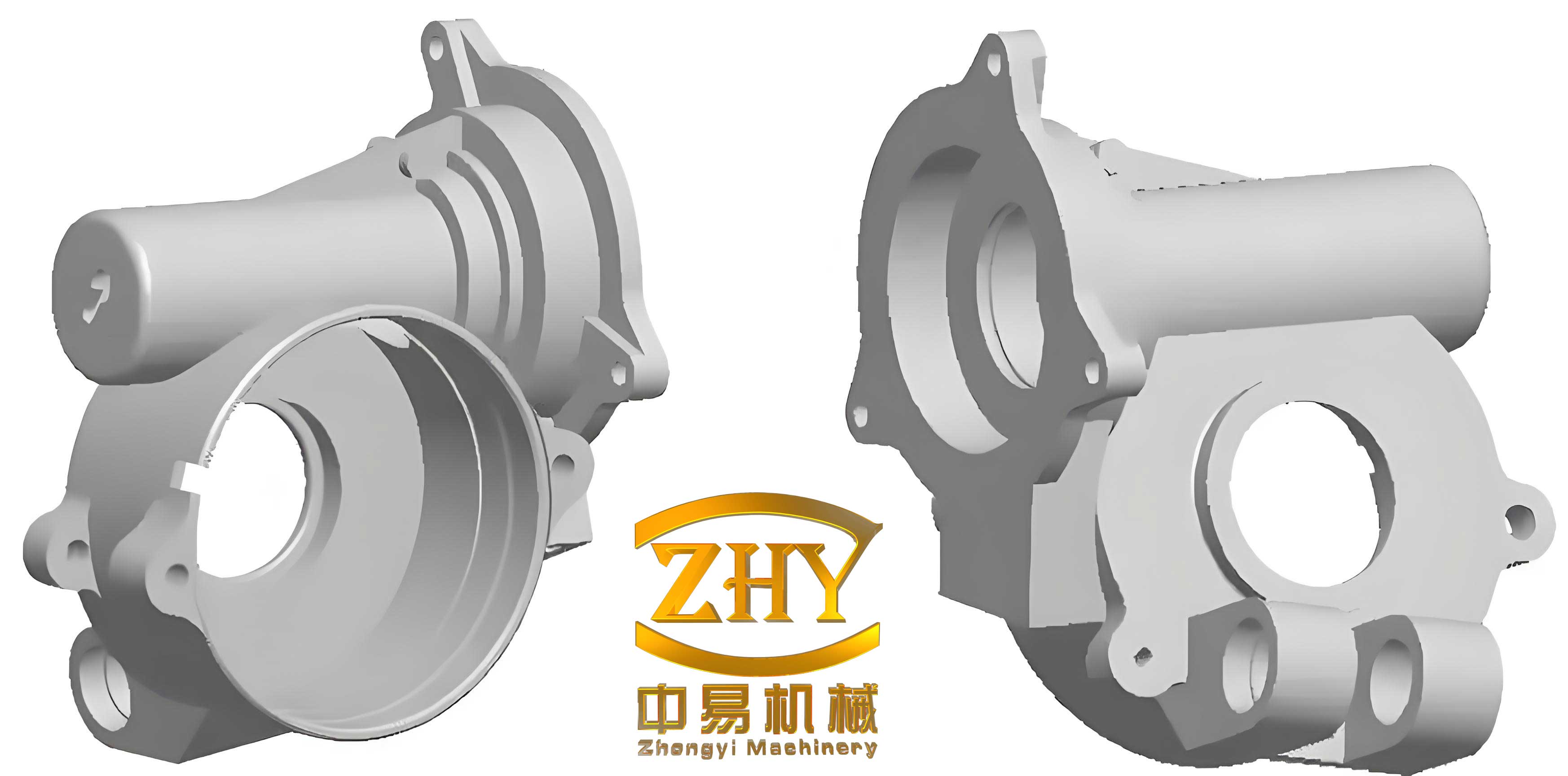
To understand the root cause of shrink defects in shell castings, we analyzed the solidification dynamics. Shrinkage occurs due to volumetric contraction during the phase change from liquid to solid, exacerbated by thermal gradients. In region S, the thicker wall results in a longer local solidification time, creating a hot spot that hinders directional solidification. The thermal profile can be modeled using the heat conduction equation. For a simplified one-dimensional case, the temperature distribution \( T(x,t) \) in the casting wall satisfies:
$$ \frac{\partial T}{\partial t} = \alpha \frac{\partial^2 T}{\partial x^2} $$
where \( \alpha \) is the thermal diffusivity of the aluminum alloy, typically around \( 5 \times 10^{-5} \, \text{m}^2/\text{s} \). The solidification time \( t_s \) for a section of thickness \( d \) can be estimated using Chvorinov’s rule:
$$ t_s = k \left( \frac{V}{A} \right)^n $$
where \( V \) is the volume, \( A \) is the surface area, \( k \) is a mold constant, and \( n \) is an exponent (often taken as 2). For region S, the higher \( V/A \) ratio leads to prolonged \( t_s \), promoting shrinkage porosity. Additionally, the volumetric shrinkage \( \Delta V \) can be expressed as:
$$ \Delta V = \beta V_0 \Delta T $$
with \( \beta \) as the coefficient of thermal contraction (approximately \( 6 \times 10^{-5} \, \text{K}^{-1} \) for aluminum alloys), \( V_0 \) the initial volume, and \( \Delta T \) the temperature drop during solidification. Inadequate cooling in hot spots exacerbates this contraction, causing surface depressions or internal voids in shell castings.
Our initial countermeasures, summarized in Table 1, provided limited success. For instance, cooling fins (2-4 mm triangular profiles) on the core enhanced heat extraction but increased core pulling resistance. Copper cores improved thermal conductivity yet were costly and prone to wear. Adjusting process parameters, such as reducing pouring temperature or extending mold open time, often led to trade-offs like cold defects. This highlighted the need for a targeted cooling solution that could intensively extract heat from region S without adversely affecting other areas of the shell castings.
| Measure | Description | Effect on Shrink Defects | Side Effects |
|---|---|---|---|
| Cooling Fins | Triangular fins (2-4 mm) machined on the metal core to increase surface area. | Partial reduction; shrink persisted in hot spots. | Increased core pulling force; risk of core damage. |
| Copper Core | Replacing steel core with copper for higher thermal conductivity. | Similar partial improvement; no full elimination. | High cost; rapid thermal fatigue and erosion. |
| Mold Temperature Control | Raising overall mold temperature to 200-250°C for better fill. | Minimal impact on shrink; exacerbated thermal gradients. | Increased energy consumption; longer cycle times. |
| Air Cooling on Core | Using compressed air to cool the core surface between cycles. | Slight cooling enhancement; inconsistent results. | Dust accumulation; variable cooling rates. |
| Lower Pouring Temperature | Reducing aluminum melt temperature from 720°C to 680°C. | Reduced shrink severity but increased viscosity. | Cold shuts and misruns in thin sections of shell castings. |
| Optimized Ejection Time | Strict control of core extraction and mold opening times. | Minor improvement in defect consistency. | Complex process control; potential for sticking. |
Given these limitations, we devised a water-cooled core system, leveraging the existing J1130A gravity die casting machine’s coolant circuits. Water cooling offers high efficiency due to its high heat capacity and convective heat transfer coefficient. The cooling power \( Q \) removed by water flow can be approximated by:
$$ Q = \dot{m} c_p \Delta T_w $$
where \( \dot{m} \) is the mass flow rate, \( c_p \) is the specific heat of water (4.18 kJ/kg·K), and \( \Delta T_w \) is the temperature rise of the water. For precise control, we designed a circuit embedded within the core. A 16 mm diameter channel was drilled along the core’s axis, and a 5 mm inner diameter flexible metal hose was inserted, sealed at the ends by brazing. This setup connected to the machine’s inlet and outlet water lines, allowing adjustable flow rates. The core temperature before each pour was maintained between 80°C and 120°C, monitored with thermocouples. This targeted cooling accelerates solidification in region S, shifting the thermal gradient to promote directional solidification toward the feeders (though no explicit feeder was used due to design constraints). The effectiveness stems from the high heat transfer coefficient \( h \) for forced water convection, typically ranging from 500 to 10,000 W/m²·K, compared to about 50-200 W/m²·K for air cooling. Thus, the local solidification time \( t_s \) in shell castings is drastically reduced, mitigating shrink formation.
To quantify the improvement, we conducted a series of experiments, measuring defect rates and microstructural density. The water flow rate \( \dot{V} \) was varied from 0.5 to 5 L/min, and the corresponding shrink defect occurrence was recorded. Table 2 summarizes the optimal parameters and outcomes. At a flow rate of 2 L/min, defect incidence dropped from nearly 100% to below 5%, with no adverse effects on filling or surface finish. Metallographic analysis of sectioned shell castings revealed a dense, equiaxed grain structure in region S, with porosity levels reduced to less than 0.1% by volume. The thermal gradient \( G \) and solidification rate \( R \) are critical factors; water cooling enhances \( G \) locally, which according to the criterion for sound casting:
$$ \frac{G}{R} \geq \frac{\Delta T_c}{D} $$
where \( \Delta T_c \) is the freezing range and \( D \) is the diffusion coefficient, helps suppress shrinkage porosity. Our data confirmed that with water cooling, \( G \) increased by approximately 50% in region S, ensuring a favorable \( G/R \) ratio.
| Parameter | Value or Range | Description and Impact |
|---|---|---|
| Water Channel Diameter | 16 mm | Drilled in the steel core to accommodate cooling hose; ensures sufficient flow area. |
| Cooling Hose Inner Diameter | 5 mm | Flexible metal hose for efficient heat transfer; minimizes pressure drop. |
| Water Flow Rate | 1.5–2.5 L/min (optimal 2 L/min) | Adjustable via machine valves; higher flows increase cooling but risk condensation. |
| Core Temperature Pre-Pour | 80–120°C | Monitored with IR thermometer; maintains thermal balance for shell castings integrity. |
| Heat Extraction Rate | ~500 W per casting cycle | Calculated from temperature differentials; significantly reduces local solidification time. |
| Shrink Defect Incidence | Reduced from ~100% to <5% | Based on visual and X-ray inspection of 200 shell castings; defects nearly eliminated. |
| Microstructural Porosity | <0.1% by volume in region S | Measured via image analysis on polished sections; indicates dense solidification. |
| Cycle Time Impact | Negligible increase (<5%) | Water cooling integrated into existing cycle; no major slowdown in shell castings production. |
The implementation of water cooling also necessitated considerations for mold design and operation. We derived a simplified thermal resistance model to optimize the core geometry. The total thermal resistance \( R_{th} \) from the casting to the coolant includes resistances of the casting wall, core material, and convective boundary:
$$ R_{th} = \frac{L_c}{k_c A_c} + \frac{L_m}{k_m A_m} + \frac{1}{h A_h} $$
where \( L \) and \( k \) denote thickness and thermal conductivity, with subscripts \( c \) for casting, \( m \) for core metal, and \( h \) for the hose interface. For our aluminum shell castings (\( k_c \approx 150 \, \text{W/m·K} \)) and steel core (\( k_m \approx 40 \, \text{W/m·K} \)), reducing \( L_m \) by core profiling minimized \( R_{th} \), enhancing cooling efficiency. Furthermore, we monitored the temperature decay curve in region S using embedded thermocouples, fitted to an exponential decay model:
$$ T(t) = T_0 e^{-t/\tau} $$
with time constant \( \tau = \frac{\rho c_p V}{h A} \), where \( \rho \) is density and \( V \) the volume. With water cooling, \( \tau \) decreased from about 30 seconds to 10 seconds, confirming rapid heat extraction. This aligns with the improved quality of shell castings, as faster cooling refines grain structure and reduces shrinkage susceptibility.
In practice, the water-cooled core system required regular maintenance to prevent scaling or blockage, especially given the hard water in our region. We instituted a quarterly descaling protocol using dilute acetic acid, and flow sensors were added to detect anomalies. Additionally, we explored the interplay between cooling and residual stresses in shell castings. Using finite element analysis (FEA), we simulated thermal stresses \( \sigma_{th} \) during solidification:
$$ \sigma_{th} = E \alpha \Delta T $$
where \( E \) is Young’s modulus and \( \alpha \) the thermal expansion coefficient. The simulations indicated that water cooling introduced moderate compressive stresses in region S, which actually benefited dimensional stability without causing cracking. This comprehensive approach ensured that our shell castings met both aesthetic and mechanical standards.
Beyond the technical aspects, the economic impact was substantial. By virtually eliminating shrink defects, reject rates for shell castings fell from over 30% to below 2%, translating to significant cost savings. The water cooling system itself incurred minimal expenses, as it utilized existing machine infrastructure. We also documented the sustainability benefits: reduced scrap aluminum remelting lowered energy consumption by an estimated 15% per batch of shell castings. These outcomes underscore the viability of targeted cooling solutions in high-volume production environments.
Looking forward, we are adapting this water-cooling methodology to other challenging shell castings geometries, such as those with internal ribs or varying thickness profiles. The principles remain consistent: identify thermal hotspots, design conformal cooling channels, and optimize flow parameters. We are also investigating advanced coolants like nanofluids for even higher heat transfer coefficients, though water remains effective for most aluminum alloy shell castings. Continued monitoring and data collection will further refine our processes, ensuring that shell castings maintain their quality in evolving applications.
In conclusion, the shrink defects in aluminum alloy shell castings produced via metal mold casting were systematically addressed through a water-cooled core system. By analyzing thermal dynamics and implementing targeted cooling, we achieved near-complete elimination of shrink in critical sections, validated by microstructural and operational data. This solution highlights the importance of adaptive cooling strategies in enhancing the integrity and efficiency of shell castings production. As demand for precise, high-quality shell castings grows, such innovations will remain pivotal in foundry operations.