
In the field of advanced manufacturing, the production of large thin-walled aluminum alloy shell castings presents significant challenges due to structural complexity, stringent quality requirements, and precision demands. As a research team engaged in metallurgical and casting processes, we embarked on a comprehensive study to develop and optimize the forming process for such shell castings. Our focus was on a specific large thin-walled shell structure with irregular geometry, a wall thickness of 3.5 mm, and intricate internal cavities that require as-cast surfaces without machining. The final weight target was 60 kg with tight tolerances, making it a representative case for exploring innovative casting techniques. This article details our approach, leveraging simulation tools and practical measures to ensure the integrity and performance of these shell castings.
The structural characteristics of these shell castings necessitate careful consideration. The component features a non-axisymmetric shape with dimensions exceeding 1000 mm in both diameter and height, which is uncommon in domestic production. The material specified is ZL114A aluminum alloy, known for its high mechanical properties within the Al-Si series, but it demands high purity and complex melting procedures to achieve uniform properties. The wall thickness tolerance after machining is set at ±0.5 mm, requiring meticulous control across mold design, casting, and heat treatment stages. Additionally, internal quality standards are rigorous, with full non-destructive testing and fluorescent inspection mandated to eliminate defects like porosity, inclusions, shrinkage, and micro-shrinkage. These aspects underscore the need for a robust process design, particularly for shell castings where thin sections and large areas increase vulnerability to defects.
Our overall process strategy centered on combining resin sand molding with low-pressure casting. Low-pressure casting, as a counter-gravity pouring method, allows controlled filling of the mold under pressure, promoting smooth metal flow and reducing turbulence that can lead to oxidation and gas entrapment. This is crucial for shell castings to maintain dimensional accuracy and internal soundness. Resin sand offers flexibility in incorporating chilling, feeding, and filtration systems, enabling favorable temperature gradients and sequential solidification. Together, these methods enhance the mechanical properties and denseness of the final shell castings. We devised specific parameters: wooden patterns for the outer mold, aluminum core boxes for internal cavities, and self-hardening resin sand for both mold and cores to ensure strength and precision. The gating system employed uniformly distributed slot gates to facilitate balanced filling from the bottom upward, promoting directional solidification along the axis and circumferential uniformity. Cooling chills were placed between slots and at flanges to increase undercooling and refine grain structure. Machining allowances were set at 8–10 mm for outer surfaces, with none for inner surfaces, and shrinkage rates were controlled at 0.8% axially and 0.5% radially.
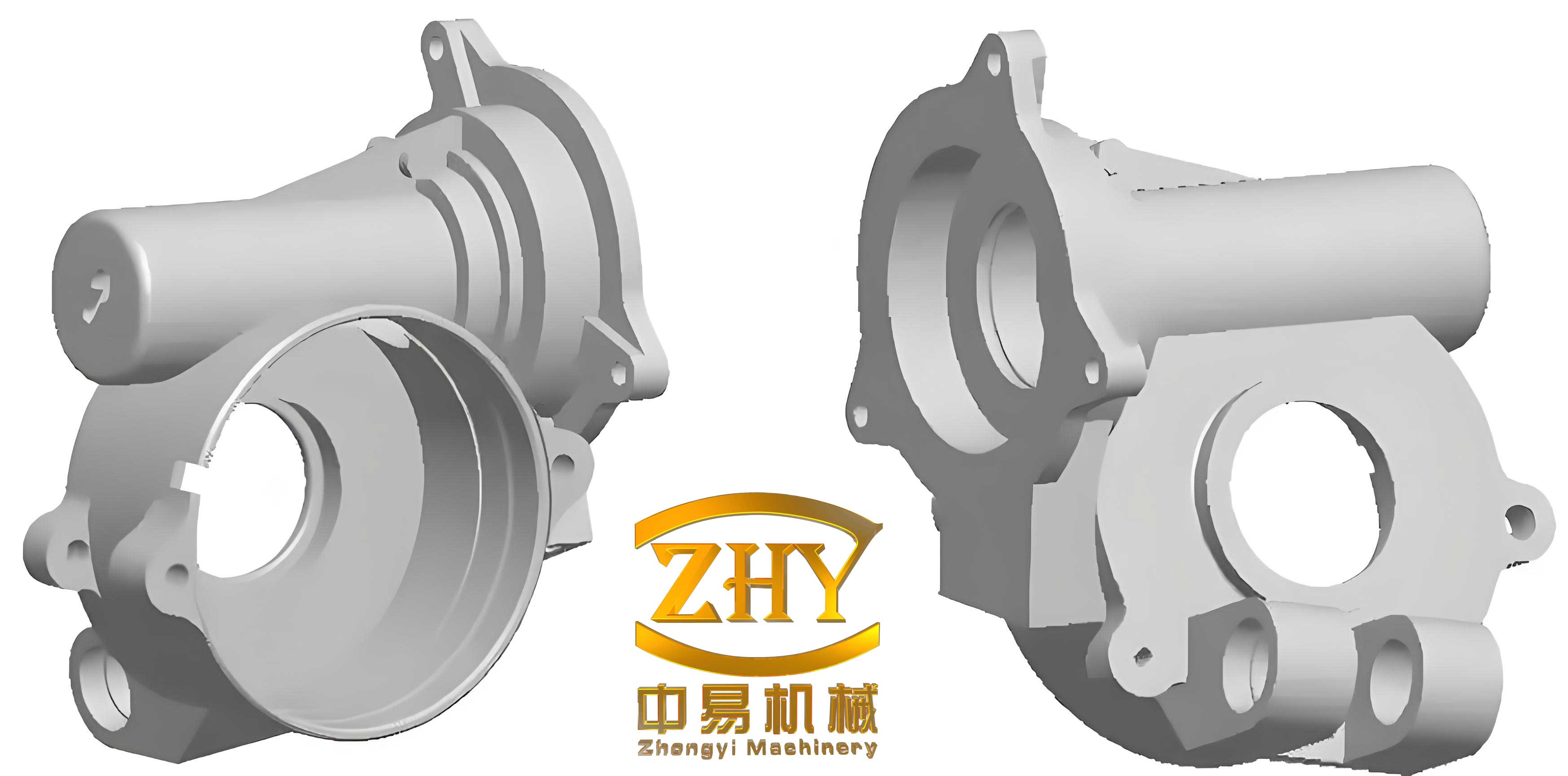
Key technical measures were implemented to address three core aspects: internal quality, material performance, and dimensional accuracy. For internal quality control in shell castings, we targeted common defects. Low-pressure casting ensured平稳充型, minimizing air entrapment and slag formation to avoid inclusions and gas pores. The slot gates, coupled with chills, established a rational solidification sequence—vertical progression from top to bottom and横向补缩 through pressure-assisted feeding from the gates. This helped eliminate shrinkage cavities and porosity. Pin-hole defects were mitigated through triple avenues:炉前 refining using composite techniques with instrumentation to monitor slag and gas content, low-pressure pouring at reduced temperatures (30–40°C lower than gravity casting) to limit gas absorption, and enhanced cooling via chills to rapid solidify and suppress pore formation. These steps are vital for producing defect-free shell castings.
Material performance and本体 properties were optimized through raw material selection and processing. We sourced high-purity aluminum ingots (99.99%) and严格 controlled impurity levels in master alloys. The melting process minimized iron contamination by avoiding iron tools, adhering to ZL114A protocols.冶金 quality was assessed via density tests for slag and gas content, and fracture surface examination for modification effectiveness. This ensured the aluminum alloy for shell castings met mechanical benchmarks.
Dimensional precision in shell castings was achieved through multiple layers of control. The core box design utilized machined aluminum assemblies with CNC-machined surfaces to guarantee accuracy. Process parameters like sand compactness, binder type, shrinkage rates, pouring temperature, and speed were determined through experimentation. To counteract solidification收缩变形, we added process ribs in薄弱部位 to enhance rigidity and均匀ize shrinkage resistance. Heat treatment distortions were managed with tailored positioning and校正工装,配合 precise measurement tools. These measures collectively upheld the tight tolerances required for large thin-walled shell castings.
Casting process simulation played a pivotal role in validating and refining our approach. We employed numerical modeling to analyze the filling and solidification of the aluminum alloy shell castings, using AnyCasting software for iterative optimization. The simulation setup involved: (1) Constructing 3D models of the casting, chills, and sand mold based on draft drawings; (2) Meshing the geometry into 4,838,130 cells; (3) Setting boundary conditions with furan resin sand for the mold and aluminum for chills; (4) Defining process parameters: pouring temperature of 720°C, filling time of 161 s, and initial mold/chill temperature of 26°C. The simulations revealed that metal flow through slot gates was平稳, without vortex-induced gas entrapment, and temperature distribution during filling was均匀. Solidification analysis showed that areas between slot gates solidified first, with the gates themselves solidifying later, promoting局部顺序凝固. The overall temperature gradient supported simultaneous solidification globally with local directional feeding, ideal for minimizing defects in shell castings. However, to confirm the adequacy of temperature gradients for feeding and solidification rates for mechanical properties, we relied on practical trials with adjustments. The simulation outcomes guided modifications to the gating and cooling systems, enhancing the manufacturability of these complex shell castings.
To quantify the thermal dynamics, we incorporated fundamental formulas relevant to shell castings. The solidification time can be estimated using Chvorinov’s rule:
$$ t = B \cdot \left( \frac{V}{A} \right)^n $$
where \( t \) is the solidification time, \( V \) is the volume of the casting, \( A \) is the surface area, and \( B \) and \( n \) are constants dependent on the mold material and alloy properties. For thin-walled shell castings, the high surface-area-to-volume ratio leads to shorter solidification times, necessitating precise control to avoid defects. The temperature gradient \( G \) is critical for directional solidification and is expressed as:
$$ G = \frac{\Delta T}{\Delta x} $$
where \( \Delta T \) is the temperature difference over distance \( \Delta x \). In our simulations, we aimed for a gradient that ensures sequential freezing from the casting body toward the feeders. Additionally, the fluid flow during filling can be described by the Navier-Stokes equations for incompressible flow:
$$ \rho \left( \frac{\partial \mathbf{v}}{\partial t} + \mathbf{v} \cdot \nabla \mathbf{v} \right) = -\nabla p + \mu \nabla^2 \mathbf{v} + \mathbf{f} $$
where \( \rho \) is density, \( \mathbf{v} \) is velocity, \( p \) is pressure, \( \mu \) is dynamic viscosity, and \( \mathbf{f} \) represents body forces. These equations underpin the simulation software’s ability to predict filling patterns, essential for avoiding turbulence in shell castings.
The production results demonstrated the effectiveness of our methodology for shell castings. The cast components were subjected to mechanical testing, and the data are summarized in the table below. All values met or exceeded the standard requirements for ZL114A alloy, confirming the suitability of our process for high-performance shell castings.
| Sample No. | Tensile Strength (MPa) | Yield Strength (MPa) | Elongation (%) | Elastic Modulus (GPa) |
|---|---|---|---|---|
| 1 | 305 | 260 | 3.5 | 74 |
| 2 | 320 | 280 | — | 72 |
| 3 | 315 | 275 | 3.5 | 76 |
| Standard | ≥300 | ≥260 | ≥3 | ≥70 |
Dimensional inspection via 3D scanning revealed that the outer surfaces had machining allowances of 6–7.5 mm against a designed 6 mm, while internal非加工 surfaces showed contour accuracies within -0.7 to 0.4 mm. Some deviations were noted on reinforcing ribs, which were 1–1.5 mm smaller than theoretical values, and局部 areas had excessive material due to casting imperfections. Overall, the shell castings met most geometric specifications, with heat treatment inducing minimal deformation (less than 0.2 mm). Subsequent CNC machining further refined the components, achieving wall thicknesses ranging from 3.07 to 7.79 mm at measured points; however, only 28.3% of points strictly met the target of \( 3.5 \pm 0.5 \) mm, indicating areas for improvement in consistency for such thin-walled shell castings. Surface轮廓度 after alignment was within -0.2 to 0.35 mm locally, with some regions up to 0.66 mm.
To further elaborate on process optimization, we developed additional tables summarizing key parameters. The table below outlines the critical low-pressure casting parameters used for the shell castings, which were derived from simulation and empirical adjustments.
| Parameter | Value | Unit | Remarks |
|---|---|---|---|
| Pouring Temperature | 720 | °C | Optimized for fluidity and defect reduction |
| Filling Time | 161 | s | Controlled to ensure平稳充型 |
| Mold Temperature | 26 | °C | Ambient conditions maintained |
| Pressure Profile | Gradual increase | — | Customized for shell geometry |
| Cooling Chill Material | Aluminum | — | Placed at strategic locations |
Another aspect we considered was the economic and qualitative impact of simulation. By virtual testing, we reduced the need for physical prototypes, saving time and resources. The benefits can be quantified using a simple cost-benefit formula for shell castings production:
$$ C_{savings} = N_{proto} \cdot (C_{material} + C_{labor}) – C_{simulation} $$
where \( C_{savings} \) is the total cost savings, \( N_{proto} \) is the number of prototypes avoided, \( C_{material} \) and \( C_{labor} \) are per-unit costs, and \( C_{simulation} \) is the simulation expense. In our case, iterative simulations allowed us to finalize the design with fewer trials, enhancing the overall efficiency for manufacturing shell castings.
In conclusion, our research demonstrates that a synergistic approach combining low-pressure casting, resin sand molding, and advanced simulation can successfully produce large thin-walled aluminum alloy shell castings with satisfactory internal quality, mechanical properties, and dimensional accuracy. The simulation tools enabled us to optimize gating and cooling systems, predicting filling and solidification behaviors that are critical for defect minimization in shell castings. Practical measures in material handling, process control, and post-casting treatments further ensured compliance with stringent standards. While challenges remain in achieving uniform wall thickness across all features, the overall outcomes validate the工艺方案 as viable for such complex shell castings. Future work could focus on refining simulation models to better account for local variations and integrating real-time monitoring during production. This study contributes to the broader knowledge base on manufacturing high-integrity shell castings for demanding applications.