
In our ongoing efforts to enhance production efficiency and reduce costs in aerospace component manufacturing, we identified a critical need to transition from traditional forged and welded methods to advanced casting techniques for shell castings. This shift, often termed “replacing forging with casting” and “replacing welding with casting,” represents a significant trend in the industry due to its potential for lower costs, shorter lead times, and superior dimensional stability. Specifically, we focused on a tail-section shell casting, which posed stringent technical challenges: non-machined inner walls, a wall thickness of $3 \pm 0.5$ mm after machining, material ZL114A with tensile strength $\geq 320$ MPa, yield strength $\geq 280$ MPa, elongation $\geq 6\%$, and internal quality meeting Class I standards per QJ 169A—2011. At the outset, no domestic enterprise had achieved these mechanical properties for such shell castings, making this development a pioneering endeavor. To address the cost-reduction imperative—aiming to lower production costs by 64,300 CNY per unit—we initiated a Quality Control (QC) activity, leveraging tools like brainstorming, affinity diagrams, orthogonal experimental design, and simulation to systematically tackle the challenges. This article details our first-person journey through the QC process, emphasizing the rigorous application of methodologies to successfully develop high-performance shell castings.
Our primary objective was clear: reduce the production cost of the tail-section shell casting from 144,300 CNY per piece (forged and machined) to 80,000 CNY per piece, equating to a savings of 64,300 CNY per piece. We conducted a feasibility analysis to ensure this target was achievable. Our company possesses extensive experience in counter-gravity casting processes and has handled numerous shell castings projects, providing a strong foundation. The team comprised professionals with comprehensive expertise and rich QC activity experience, ensuring effective collaboration. From a cost perspective, we calculated that if casting succeeded, the per-unit cost would be approximately: casting cost at 220 CNY/kg for a 195 kg casting, with an 80% yield rate, plus machining at 25,740 CNY, totaling around 79,365 CNY per piece. This demonstrated potential savings exceeding 64,300 CNY, confirming target feasibility. Thus, we proceeded with confidence, driven by the goal of revolutionizing shell castings production through innovative casting approaches.
To develop a robust casting process for the shell castings, we employed brainstorming sessions to generate multiple alternatives. Using an affinity diagram, we organized ideas into key categories: molding materials, raw materials, refining methods, modifiers, pouring methods, and heat treatment states. This holistic view allowed us to evaluate each aspect systematically. For instance, in selecting molding materials, we compared resin sand, steel, and composite molds. Resin sand emerged as optimal due to lower mold costs, ease of modification, and proven success in high-performance shell castings from industry benchmarks. Similarly, for raw materials, we chose high-purity aluminum combined with master alloys over finished ingots, as it offers precise composition control, lower impurity levels, and better melt quality—critical for meeting mechanical property demands in shell castings. The table below summarizes our initial screening:
| Category | Options Considered | Selection Rationale |
|---|---|---|
| Molding Material | Resin Sand, Steel, Composite | Resin sand: low cost, easy repair, ensures internal quality for shell castings |
| Raw Materials | Finished Ingots, High-Purity Al + Master Alloys | High-purity Al + master alloys: precise composition, better melt quality for shell castings |
| Refining Method | Argon Rotor Degassing + Flux, (Argon + Flux) Rotor Degassing | (Argon + Flux) rotor degassing: lower hydrogen content per trials |
| Modifier | Ternary, Quaternary, Al-Sr Alloy | Quaternary modifier: finest grain size per trials |
| Pouring Method | Gravity, Low-Pressure, Differential Pressure, Adjustable Pressure | Adjustable pressure: smooth filling, strong feeding, better for shell castings |
| Heat Treatment | T1, T2, T4, T5, T6 | T6: highest mechanical properties, industry standard for shell castings |
Further refinement involved comparative trials. For refining methods, we tested two argon rotor degassing techniques: (1) argon degassing followed by flux addition, and (2) simultaneous argon and flux injection. Hydrogen content measurements via a hydrogen analyzer showed the latter achieved lower values, crucial for dense shell castings. Data from eight melts indicated average hydrogen contents of 0.065 ml/100g for (argon + flux) degassing versus 0.075 ml/100g for the sequential method, leading to its selection. For modifiers, we evaluated ternary, quaternary, and Al-Sr alloys using grain size analysis (0–10 scale, higher is finer). Quaternary modifier yielded grain sizes of 8–9, outperforming others (6–7 for ternary, 7 for Al-Sr), thus chosen to enhance microstructure in shell castings.
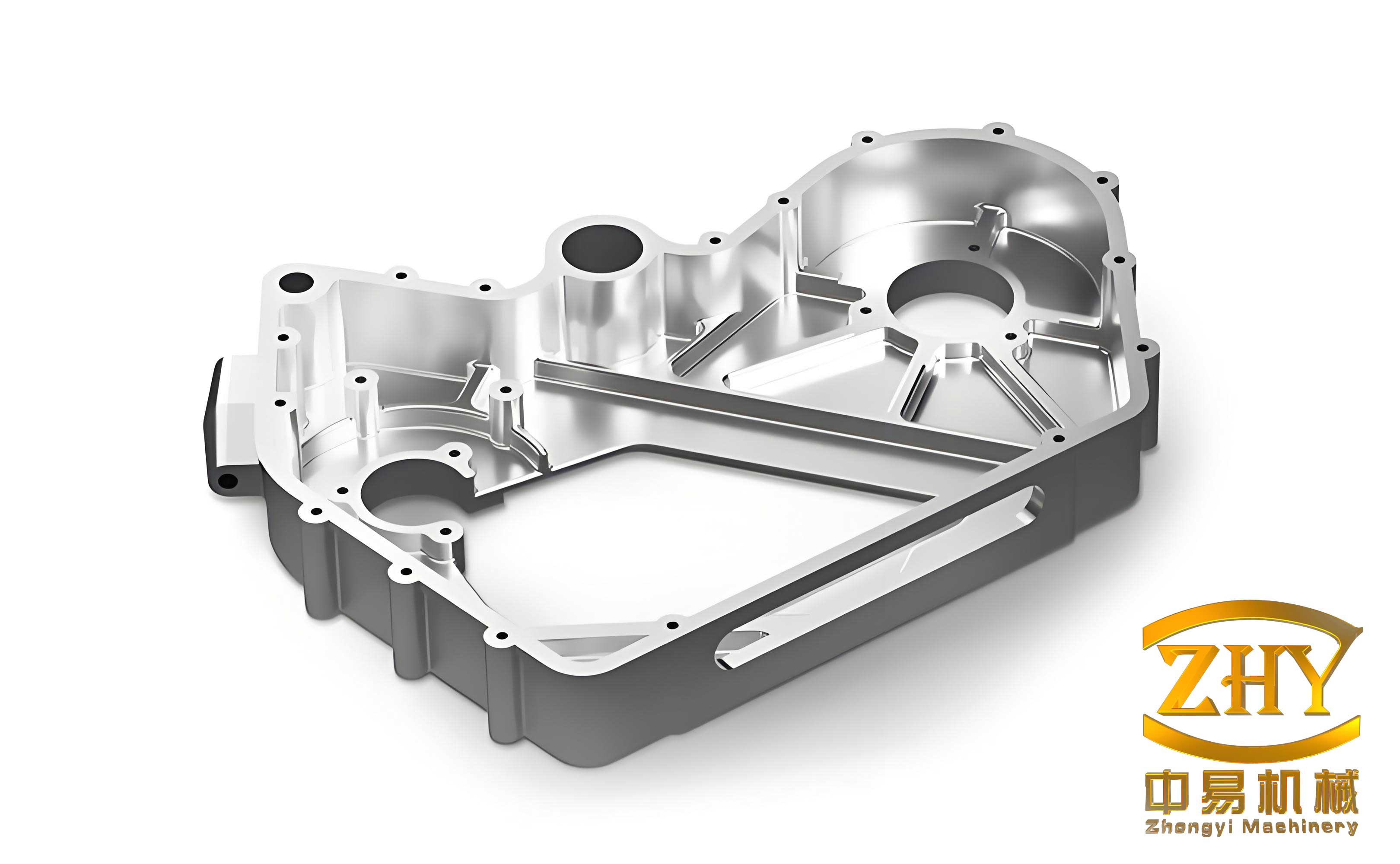
Based on these findings, we converged on an overall process: ZL114A resin sand adjustable pressure casting for the shell castings. To detail this, we used a tree diagram to break down sub-elements: mold type, pouring scheme, melting parameters, and heat treatment. For mold type, wooden patterns were selected over aluminum due to lower cost, easier modifications, and adequate precision for shell castings wall thickness. Pouring scheme evaluation considered two orientations: large plane downward versus upward. Through simulation, we assessed maximum wall thickness and cavity pressure—key factors affecting shrinkage and porosity in shell castings. The large plane downward orientation yielded a thinner maximum wall (54 mm vs. 60 mm) and lower peak pressure (0.19 MPa vs. 0.51 MPa), reducing defect risks. Thus, it was deemed optimal. The image below illustrates a typical shell casting structure, highlighting the complexity we addressed:
Next, we optimized melt composition and heat treatment parameters using orthogonal experimental design, a powerful QC tool for multi-factor optimization. For melt composition, the standard ZL114A range is broad: Si 6.5–7.5%, Mg 0.45–0.75%, Ti 0.08–0.25%, Be 0.04–0.07%. To pinpoint optimal levels for shell castings, we treated Si, Mg, Ti, and Be as controllable factors (A, B, C, D) each at three levels, and their fluctuations as error factors (A’, B’, C’, D’). The orthogonal array $L_9(3^4)$ was employed for inner and outer design via direct product method. The objective function aimed to maximize yield strength ($\sigma_y$) and elongation ($\delta$), both “larger-the-better” characteristics. The signal-to-noise ratio (S/N) for such traits is calculated as: $$ \eta = -10 \log_{10} \left( \frac{1}{n} \sum_{i=1}^{n} \frac{1}{y_i^2} \right) $$ where $y_i$ are measured responses. We conducted trials with six separately cast specimens per run, averaging results. Analysis of mean S/N ratios revealed optimal combination: $A_1B_1C_1D_3$, corresponding to Si 6.665%, Mg 0.5%, Ti 0.11%, Be 0.065%. This precise formulation ensured superior mechanical properties in shell castings. Similarly, for heat treatment T6, we optimized parameters: solution temperature (535–545°C), solution time (10–12 h), aging temperature (160–170°C), aging time (4–8 h). Another $L_9(3^4)$ design identified best levels: solution at 545°C for 11 h, aging at 165°C for 6 h, enhancing strength and ductility in shell castings.
The finalized best practice for shell castings incorporated all these elements: resin sand molds from wooden patterns, large-plane-down pouring, adjustable pressure casting with precise melt composition and refining, quaternary modification, and optimized T6 heat treatment. To implement this, we developed a detailed action plan using 5W1H (What, Why, Where, When, Who, How). The table below outlines key countermeasures:
| No. | Countermeasure | Target | Actions | Responsible |
|---|---|---|---|---|
| 1 | Casting Process Design | Smooth filling, directional solidification, porosity < 0.4% | 3D modeling, gating and chill design, adjustable pressure parameter calculation, simulation optimization | Process Team |
| 2 | Mold Design & Manufacturing | Inner diameter 1190 ± 1 mm, other dimensions to drawing | Integral core box with loose pieces, mold inspection and validation | Pattern Shop |
| 3 | Melt Composition Control | Si: 6.665 ± 0.1%, Mg: 0.5 ± 0.02%, Ti: 0.11 ± 0.02%, Be: 0.065 ± 0.002% | Accurate calculation, strict weighing, coating and drying of crucibles and tools | Melting Team |
| 4 | Melt Refining Control | Hydrogen ≤ 0.06 ml/100g | (Argon + flux) rotor degassing, preheated flux, adjusted rotor speed and gas flow | Melting Team |
| 5 | Melt Modification Control | Grain size ≥ 8 | Quaternary modifier at 2%, preheated, added uniformly, stirred, and settled | Melting Team |
| 6 | Heat Treatment Control | Solution: 545 ± 1°C, 11 ± 0.01 h; Aging: 165 ± 1°C, 6 ± 0.01 h | Equipment calibration, strict parameter input | Heat Treatment Team |
Execution followed this plan meticulously. For instance, in melt composition control, we used high-purity aluminum (99.9%) and master alloys, with weight adjustments based on the formula: $$ W_{\text{master}} = \frac{(C_{\text{target}} – C_{\text{base}}) \times W_{\text{melt}}}{C_{\text{master}} – C_{\text{target}}} $$ where $W$ denotes weight and $C$ concentration. Refining involved a rotor operating at 400–500 rpm with argon and flux mixture, ensuring hydrogen levels below 0.06 ml/100g. Modification required quaternary modifier (Na-K-Sr based) preheated to 300°C for 4 hours, added at 2% of melt weight, and thoroughly mixed. Heat treatment used calibrated furnaces with ±1°C accuracy, and specimens were monitored via thermocouples. Throughout, we emphasized consistency for shell castings quality.
To verify effectiveness, we produced a prototype tail-section shell casting. Dimensional inspection confirmed wall thickness of $3.0 \pm 0.3$ mm, inner diameter of $1190 \pm 0.8$ mm, and overall compliance with CT9 grade. X-ray radiography showed no defects exceeding Class I limits, meeting QJ 169A—2011 for shell castings. Mechanical tests on specimens from the casting body yielded: tensile strength 335 MPa, yield strength 290 MPa, elongation 7.5%, surpassing targets. Subsequently, four more shell castings were manufactured; three were fully qualified, while one had minor sand inclusion and was scrapped. The qualified shell castings underwent machining and passed static load tests, integration drills, and training rounds, validating performance. Cost analysis revealed: casting cost per piece averaged 40,754.65 CNY (based on 220 CNY/kg, 195 kg, 80% yield), machining 23,396 CNY, and scrap recovery 1,584 CNY. For the four good pieces, average cost per finished shell casting was 73,943.31 CNY, saving 70,356.69 CNY per piece versus forging—exceeding our 64,300 CNY goal. Overall, the project saved 281,426.76 CNY across four shell castings, against investments of 21,000 CNY for molds and 265,800 CNY for trials, promising long-term economic benefits as production scales.
Beyond cost, this QC activity delivered significant technical and social value. We advanced our capability in producing high-integrity shell castings with precise geometry and superior properties, applicable to other components like guidance sections and warhead cabins. The systematic use of QC tools—orthogonal design, simulation, and statistical analysis—enhanced team problem-solving skills and fostered a culture of continuous improvement. To institutionalize gains, we documented the process into standard operating procedures, conducted training, and ensured knowledge transfer. This standardization ensures future shell castings production maintains high quality consistently.
In conclusion, our journey in developing tail-section shell castings underscores the potency of QC methodologies in overcoming complex manufacturing challenges. By integrating tools like affinity diagrams, orthogonal experiments, and 5W1H planning, we achieved a breakthrough in casting performance while drastically reducing costs. The success with shell castings has paved the way for broader adoption of casting in aerospace structures, reinforcing trends toward efficiency and reliability. Moving forward, we plan to extend QC initiatives to other critical components, further optimizing processes and pushing the boundaries of shell castings technology. Through such endeavors, we continue to drive innovation and excellence in manufacturing.