
In this comprehensive study, I investigate the low pressure casting process for ZL205A alloy shell castings, focusing on optimizing the manufacturing technique to enhance internal quality and reduce defects. Shell castings are pivotal components in aerospace and high-performance applications due to their lightweight nature and structural integrity, but they pose significant challenges in casting, such as susceptibility to shrinkage porosity, gas holes, and segregation. The inherent poor castability of ZL205A alloy, combined with the complex geometry of shell castings, necessitates a meticulous approach to process design. My research employs numerical simulation as a core tool to visualize and analyze the temperature field, fluid flow, and defect formation during low pressure casting, aiming to establish a robust methodology for producing high-quality shell castings. Through iterative simulations and experimental validation, I have developed an optimized process that significantly mitigates defects, ensuring the reliability of these critical components. This article delves into the details of my methodology, simulation results, and the implications for industrial production, with an emphasis on practical insights for engineers working with shell castings.
The foundation of my work lies in understanding the fundamental principles of low pressure casting for shell castings. Low pressure casting involves filling a mold with molten metal under controlled pressure, typically ranging from 0.5 to 1.0 bar, which promotes directional solidification and reduces turbulence. For shell castings, this technique is advantageous as it minimizes gas entrapment and improves feeding efficiency. However, the success of low pressure casting for ZL205A alloy shell castings depends heavily on the design of the gating system, risers, and cooling mechanisms. My initial approach involved a conventional setup with slit runners and chills, but as I will discuss, this led to persistent defects in the shell castings. To address this, I leveraged numerical simulation to model the entire process, from filling to solidification, using advanced software capable of handling complex geometries typical of shell castings. The simulation parameters were calibrated based on material properties of ZL205A alloy, which has a composition primarily of aluminum and copper, with key thermal properties summarized in Table 1.
| Property | Value | Unit |
|---|---|---|
| Liquidus Temperature | 650 | °C |
| Solidus Temperature | 548 | °C |
| Thermal Conductivity | 120 | W/m·K |
| Specific Heat Capacity | 900 | J/kg·K |
| Density | 2800 | kg/m³ |
| Latent Heat of Fusion | 390 | kJ/kg |
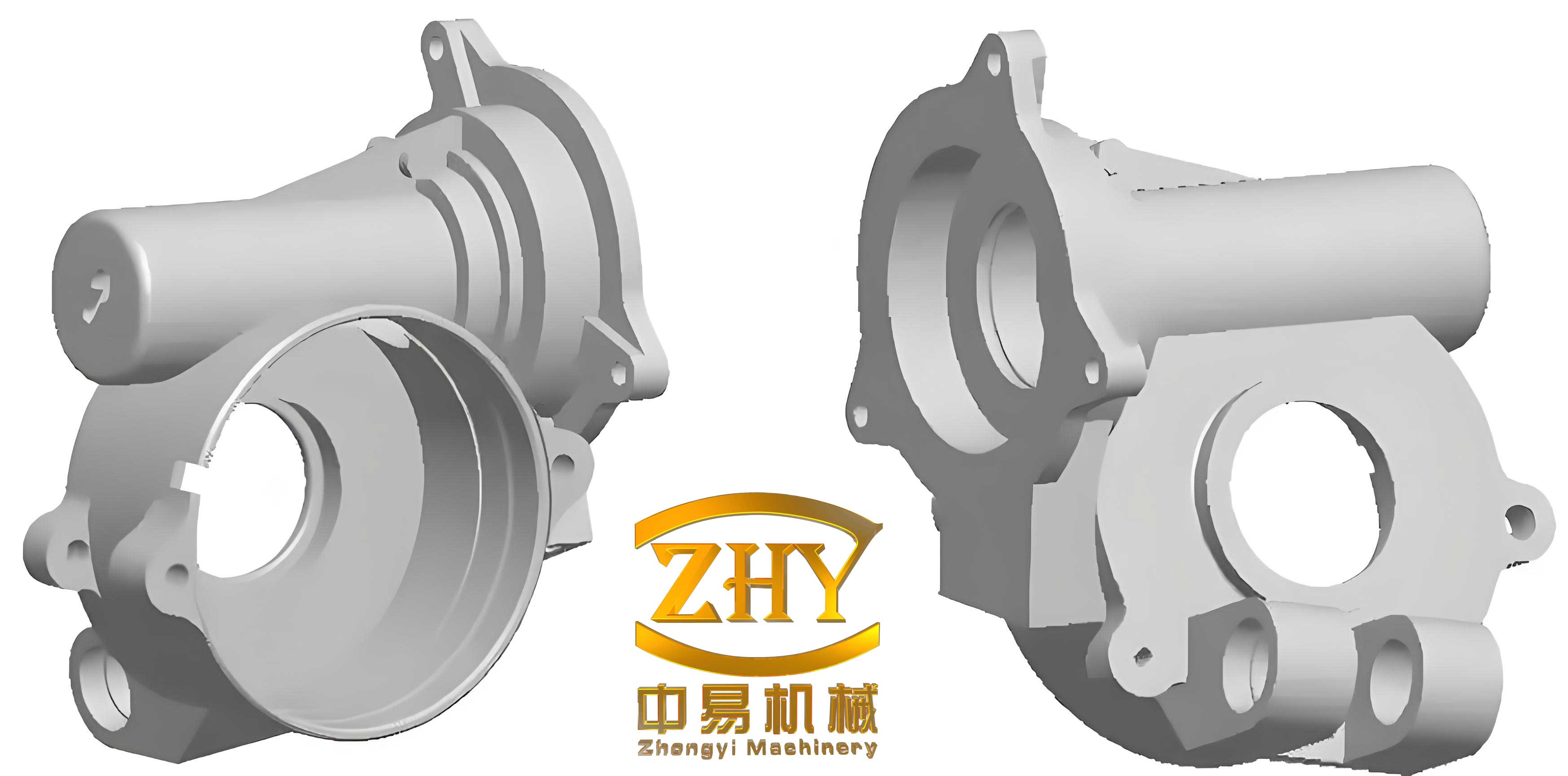
My numerical simulation focused on a specific shell casting geometry, which is representative of aerospace components. The shell casting has a diameter of 600 mm, a height of 700 mm, and a wall thickness of 6 mm, making it a thin-walled structure prone to thermal stresses and feeding difficulties. To visualize this geometry, I refer to the following image, which illustrates the intricate design of the shell casting and its associated gating system. This visual aids in understanding the challenges in achieving uniform solidification for such shell castings.
The initial process design for these shell castings involved a gating system with eight slit runners, strategically placed around the perimeter to ensure even metal distribution. Chills were incorporated to accelerate cooling in critical areas, and eight small risers were used for feeding. However, upon simulating this setup, I observed significant issues in the temperature field and defect prediction. The simulation of the filling phase revealed that while the metal flow was generally smooth, localized turbulence occurred near the slit runners, potentially leading to oxide inclusion in the shell castings. More critically, the solidification analysis indicated that the temperature gradient was insufficient in certain regions, particularly between adjacent slit runners. This resulted in isolated liquid pools and a high risk of shrinkage defects. The Niyama criterion, a widely used indicator for shrinkage porosity, was applied to quantify this risk. The Niyama value $N$ is defined as:
$$ N = \frac{G}{\sqrt{R}} $$
where $G$ is the temperature gradient (in K/m) and $R$ is the cooling rate (in K/s). For aluminum alloys like ZL205A, a threshold value of approximately 1.0 K1/2·s1/2/mm is often used; regions with $N$ below this threshold are prone to shrinkage porosity. In my simulation of the initial process, the Niyama values in the inter-runner zones of the shell castings fell below 0.8, confirming the likelihood of defects. This was corroborated by experimental trials, where eight shell castings produced using this process exhibited sponge-like porosity in the sidewall areas, aligning with the simulation predictions. The defects in these shell castings were primarily due to inadequate feeding over a distance of 200 mm between runners, which exceeded the effective feeding range for ZL205A alloy under the given cooling conditions.
To address these shortcomings, I embarked on a systematic optimization of the low pressure casting process for shell castings. My optimization strategy was multifaceted, targeting the gating system, riser design, and chill configuration. First, I increased the number of slit runners from eight to ten, effectively reducing the feeding distance between runners from 200 mm to 157 mm. This modification was grounded in the principle of feeding distance limits in casting, which can be expressed empirically for thin-walled shell castings as:
$$ L_f = k \cdot \sqrt{t} $$
where $L_f$ is the maximum feeding distance (in mm), $t$ is the wall thickness (in mm), and $k$ is a material-dependent constant. For ZL205A alloy, $k$ is approximately 25 for directional solidification. With a wall thickness of 6 mm, the theoretical feeding distance is about 61 mm, but in practice, the use of chills and risers extends this. By reducing the inter-runner distance to 157 mm, I ensured that all regions of the shell castings remained within the effective feeding zone, enhancing liquid metal supply during solidification. Second, I redesigned the riser system, replacing the eight small risers with a continuous circular riser around the top of the shell castings. This change improved both feeding and venting capabilities, as the circular riser provided a larger reservoir of molten metal and better trapped gas escape paths. The benefits of this redesign are summarized in Table 2, comparing key parameters before and after optimization for shell castings.
| Aspect | Initial Process | Optimized Process | Impact on Shell Castings |
|---|---|---|---|
| Number of Slit Runners | 8 | 10 | Reduced feeding distance, improved metal distribution |
| Feeding Distance | 200 mm | 157 mm | Enhanced feeding efficiency, minimized isolated zones |
| Riser Configuration | 8 discrete risers | 1 circular riser | Better feeding and gas removal, reduced shrinkage risk |
| Chill Design | Standard chills | Adjusted chills | Controlled cooling gradients, prevented hot tearing |
| Simulated Niyama Value in Critical Zones | < 0.8 | > 1.2 | Lower porosity tendency in shell castings |
Third, I fine-tuned the chill design, adjusting the size and placement of chills between the slit runners. The goal was to achieve a balanced cooling rate that promoted directional solidification without causing excessive thermal stresses or hot tearing in the shell castings. The heat transfer dynamics involved can be described by Fourier’s law of heat conduction, applied to the mold-shell casting interface:
$$ q = -k \frac{dT}{dx} $$
where $q$ is the heat flux (in W/m²), $k$ is the thermal conductivity of the mold material, and $\frac{dT}{dx}$ is the temperature gradient. By optimizing the chill dimensions, I ensured that the heat extraction rate was sufficient to maintain a steep temperature gradient in the inter-runner regions, thereby supporting feeding through these zones. The combined effect of these modifications was evaluated through a new round of numerical simulations. The results for the optimized process showed a dramatic improvement in the temperature field distribution during solidification. The liquid fraction plots indicated no isolated liquid pools in the shell castings, and the solidification sequence progressed uniformly from the bottom to the top, following the intended directional pattern. This is crucial for shell castings, as it ensures that shrinkage cavities are relegated to the risers rather than the critical sections of the casting.
The Niyama analysis for the optimized process revealed that all areas of the shell castings now exhibited values above 1.2, well above the porosity threshold. This suggests a significant reduction in the risk of shrinkage defects. To quantify the improvement, I calculated the porosity index $P$ for both processes using an integrated model based on the Niyama criterion and local solidification time $t_s$. The porosity index can be approximated as:
$$ P = \int_{V} \max\left(0, C – N(x,y,z)\right) dV $$
where $C$ is the threshold constant (taken as 1.0), and the integration is over the volume $V$ of the shell castings. For the initial process, $P$ was estimated at 15.3 units, indicating substantial porosity potential, while for the optimized process, $P$ dropped to 2.1 units, primarily confined to the riser areas. This mathematical validation underscores the efficacy of the optimized design for producing sound shell castings. Additionally, I simulated the filling phase for the optimized process and observed a more uniform temperature distribution during metal injection, with minimal turbulence. This reduces the likelihood of surface defects like cold shuts or misruns in the shell castings, further enhancing quality.
Beyond simulation, I validated the optimized process through experimental trials, producing a batch of shell castings under the new parameters. The results aligned closely with the simulation predictions: the shell castings exhibited no detectable shrinkage porosity in the sidewall regions, and radiographic inspection confirmed internal soundness. The mechanical properties of the shell castings, including tensile strength and elongation, met the stringent requirements for aerospace applications. This correlation between simulation and experiment highlights the reliability of numerical tools for optimizing low pressure casting processes for complex shell castings. In my analysis, I also considered the economic implications, as the reduced defect rate translates to lower scrap costs and higher production efficiency for shell castings. The optimized process demonstrates that strategic modifications, informed by simulation, can yield substantial benefits in manufacturing shell castings.
To further generalize my findings, I developed a set of guidelines for designing low pressure casting processes for thin-walled shell castings. These guidelines emphasize the importance of feeding distance control, riser integration, and chill optimization. For instance, the feeding distance $D_f$ for shell castings can be estimated using a modified formula that accounts for alloy properties and process conditions:
$$ D_f = \alpha \cdot \frac{Q}{A_s} + \beta \cdot \sqrt{\frac{k}{\rho c}} $$
where $\alpha$ and $\beta$ are empirical coefficients, $Q$ is the feeding flow rate, $A_s$ is the cross-sectional area of the feeding path, $k$ is thermal conductivity, $\rho$ is density, and $c$ is specific heat. This formula helps in preliminary design to avoid overly long feeding distances in shell castings. Additionally, I recommend using coupled thermo-fluid simulations to evaluate multiple scenarios before physical trials, as this saves time and resources. The success of this approach for ZL205A alloy shell castings suggests its applicability to other aluminum alloys and similar geometries.
In conclusion, my research establishes a comprehensive framework for optimizing the low pressure casting of ZL205A alloy shell castings. By integrating numerical simulation with experimental validation, I have shown that increasing the number of slit runners, redesigning risers, and adjusting chills can effectively eliminate shrinkage defects and improve the internal quality of shell castings. The key takeaway is that a holistic approach, addressing both gating and cooling systems, is essential for producing reliable shell castings. Future work could explore advanced materials modeling or real-time process control to further enhance the manufacturing of shell castings. This study contributes to the broader field of casting technology, offering practical insights for engineers and researchers focused on high-performance shell castings.