
In the aerospace and aviation industries, the demand for lightweight, high-strength, and cost-effective components has driven the widespread adoption of aluminum alloy shell castings. Among these, ZL114A aluminum alloy is particularly favored due to its excellent combination of strength, toughness, and castability. However, a persistent challenge in manufacturing these shell castings is the degradation of mechanical properties in thick sections, which often fail to meet design specifications. This issue stems from slower cooling rates in these regions, leading to coarse microstructures and reduced ductility. In this comprehensive study, we explore the factors affecting mechanical properties in thick sections of ZL114A shell castings and present effective countermeasures to enhance performance, with a focus on increasing cooling rates through optimized casting techniques.
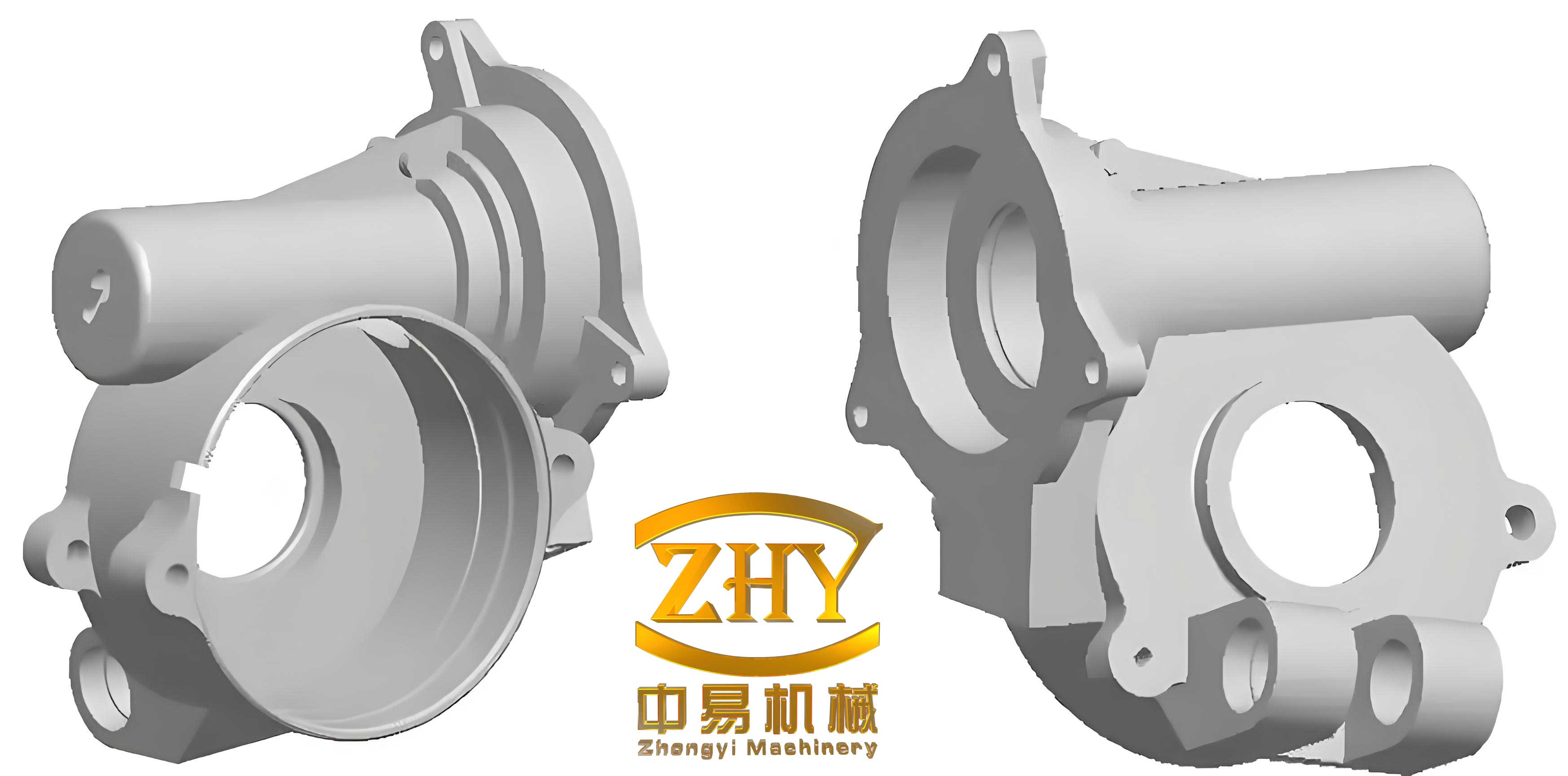
Shell castings, typically characterized by cylindrical or conical geometries, are produced using low-pressure casting methods to ensure uniform heat distribution,平稳的充型, and adequate feeding. The ZL114A alloy, a high-silicon aluminum alloy, is known for its good fluidity and response to heat treatment, but its mechanical properties are highly sensitive to solidification conditions. In thick sections, the prolonged solidification time results in larger grain sizes and the formation of plate-like or needle-like eutectic silicon phases, which act as stress concentrators and undermine ductility. This phenomenon can be described by the Hall-Petch relationship, where yield strength is inversely proportional to the square root of grain size:
$$ \sigma_y = \sigma_0 + \frac{k_y}{\sqrt{d}} $$
Here, $\sigma_y$ is the yield strength, $\sigma_0$ is the friction stress, $k_y$ is the strengthening coefficient, and $d$ is the average grain diameter. For shell castings, slower cooling in thick sections increases $d$, thereby reducing $\sigma_y$ and elongation. Additionally, the coarsening of eutectic silicon reduces the effective load-bearing area, impacting toughness. To quantify this, the cooling rate $\dot{T}$ in a casting section can be approximated by:
$$ \dot{T} = \frac{T_{\text{pour}} – T_{\text{solidus}}}{t_{\text{solidification}}} $$
where $T_{\text{pour}}$ is the pouring temperature, $T_{\text{solidus}}$ is the solidus temperature, and $t_{\text{solidification}}$ is the solidification time. In thick sections, $t_{\text{solidification}}$ is larger, leading to lower $\dot{T}$ and inferior properties. Our analysis of various shell castings revealed that elongation in thick sections could drop to as low as 2.9%, significantly below the required 3-10% range, while tensile strength and yield strength also showed decrements. Table 1 summarizes typical mechanical properties from different regions of ZL114A shell castings before optimization, highlighting the disparity between thin and thick sections.
| Section Type | Tensile Strength $\sigma_b$ (MPa) | Yield Strength $\sigma_{0.2}$ (MPa) | Elongation $\delta_5$ (%) | Cooling Rate $\dot{T}$ (K/s) |
|---|---|---|---|---|
| Thin Wall (~3-5 mm) | 320-340 | 240-260 | 8-12 | 10-15 |
| Thick Section (~70 mm) | 270-290 | 200-230 | 2.5-3.5 | 1-2 |
The primary mechanism behind this degradation involves microstructure evolution. During solidification, the growth of $\alpha$-Al dendrites and eutectic silicon is governed by undercooling and nucleation rates. For a binary Al-Si alloy like ZL114A, the growth velocity $v$ of silicon phases can be expressed as:
$$ v = \mu \cdot \Delta T^n $$
where $\mu$ is a kinetic coefficient, $\Delta T$ is the undercooling, and $n$ is an exponent typically around 2. In thick sections, low undercooling due to slow heat extraction promotes the formation of coarse silicon morphologies. This not only reduces ductility but also increases susceptibility to shrinkage porosity, as described by the Niyama criterion for porosity prediction:
$$ G / \sqrt{\dot{T}} < C $$
where $G$ is the temperature gradient, $\dot{T}$ is the cooling rate, and $C$ is a constant. Lower $\dot{T}$ in thick sections raises the risk of porosity, further compromising mechanical integrity. Therefore, enhancing the cooling rate is paramount for improving the performance of shell castings. We implemented a multi-faceted approach focusing on chilling, process parameter adjustment, and metallurgical treatments.
First, we introduced chilling blocks at strategic locations in thick sections. Chills act as heat sinks, increasing the local cooling rate by promoting rapid heat transfer. The effectiveness of a chill can be modeled using Fourier’s law of heat conduction:
$$ q = -k \cdot A \cdot \frac{dT}{dx} $$
where $q$ is the heat flux, $k$ is the thermal conductivity of the chill material (typically cast iron or copper), $A$ is the contact area, and $\frac{dT}{dx}$ is the temperature gradient. By increasing chill thickness from 50 mm to 120 mm in flange areas, we amplified $q$, thereby reducing solidification time. This was coupled with reducing machining allowances in thick sections by 5 mm, which decreased the thermal mass and further accelerated cooling. The impact on cooling rate can be estimated by the following empirical relation for chills:
$$ \dot{T}_{\text{enhanced}} = \dot{T}_{\text{base}} \cdot \left(1 + \beta \cdot \frac{V_{\text{chill}}}{V_{\text{casting}}}\right) $$
where $\dot{T}_{\text{base}}$ is the base cooling rate without chills, $\beta$ is a factor dependent on chill material and contact, $V_{\text{chill}}$ is the chill volume, and $V_{\text{casting}}$ is the casting volume. Our modifications led to a calculated increase in $\dot{T}$ from 1-2 K/s to 4-6 K/s in thick sections, which refined the microstructure significantly.
Second, we optimized low-pressure casting parameters. Shell castings are often produced via low-pressure casting to ensure controlled filling and feeding. Key parameters include filling speed, pressure profile, and solidification pressure. We adjusted the filling speed from 35 mm/s to 38 mm/s to minimize thermal gradients and enhance feeding to thick sections. The pressure during solidification $P_{\text{solid}}$ helps reduce porosity and improve density, as per the equation:
$$ \rho_{\text{casting}} = \rho_{\text{theoretical}} – \Delta \rho \cdot e^{-k_P \cdot P_{\text{solid}}} $$
where $\rho_{\text{casting}}$ is the actual density, $\rho_{\text{theoretical}}$ is the theoretical density, $\Delta \rho$ is the density deficit without pressure, and $k_P$ is a constant. By fine-tuning the pressure cycle, we achieved better feeding, reducing shrinkage defects in thick sections of shell castings.
Third, we applied a combined grain refinement and modification treatment using Al-Ti-B master alloys and sodium-based modifiers. Grain refinement increases nucleation sites, leading to finer grains, as described by the free growth model. The final grain size $d$ after refinement is given by:
$$ d = \left( \frac{4 \cdot \Delta T_{\text{nuc}}}{3 \cdot \Delta T_{\text{growth}}} \right)^{1/3} \cdot r_{\text{nuc}} $$
where $\Delta T_{\text{nuc}}$ is the undercooling for nucleation, $\Delta T_{\text{growth}}$ is the undercooling for growth, and $r_{\text{nuc}}$ is the nucleus radius. Modification transforms eutectic silicon from plate-like to fibrous morphology, improving ductility. The effectiveness of modification can be quantified by the aspect ratio $AR$ of silicon particles:
$$ AR = \frac{L}{W} $$
where $L$ is length and $W$ is width. Lower $AR$ values (closer to 1) indicate better modification. Our treatments reduced $AR$ from over 10 to below 3 in thick sections, contributing to higher elongation.
To validate these measures, we conducted extensive testing on ZL114A shell castings. Table 2 presents mechanical property data from improved castings, showing marked enhancement in thick sections. The data were collected from multiple samples in different regions, including flanges and side walls.
| Region in Shell Casting | Sample ID | Tensile Strength $\sigma_b$ (MPa) | Yield Strength $\sigma_{0.2}$ (MPa) | Elongation $\delta_5$ (%) | Cooling Rate $\dot{T}$ (K/s) (Estimated) |
|---|---|---|---|---|---|
| Thick Flange Section (B Area) | 1 | 305 | 225 | 8.5 | 5.2 |
| 2 | 285 | 225 | 5.0 | 4.8 | |
| 3 | 320 | 230 | 15.0 | 5.5 | |
| 4 | 295 | 210 | 8.0 | 5.0 | |
| 5 | 315 | 230 | 11.0 | 5.3 | |
| 6 | 310 | 250 | 6.5 | 5.1 | |
| 7 | 320 | 240 | 9.0 | 5.4 | |
| 8 | 315 | 245 | 8.0 | 5.3 | |
| 9 | 315 | 240 | 9.5 | 5.3 | |
| 10 | 310 | 235 | 9.5 | 5.2 | |
| 11 | 275 | 200 | 7.5 | 4.7 | |
| Thick End Section (C Area) | 1 | 325 | 240 | 12.0 | 5.6 |
| 2 | 320 | 230 | 11.0 | 5.5 | |
| 3 | 295 | 240 | 5.0 | 4.9 | |
| 4 | 300 | 230 | 8.0 | 5.0 | |
| 5 | 275 | 220 | 5.0 | 4.7 | |
| 6 | 310 | 230 | 11.0 | 5.2 |
The results demonstrate a substantial improvement, with average elongation in thick sections increasing from 2.9% to 5.3%, and tensile and yield strengths showing consistent gains. Statistical analysis of the data confirms the significance of these enhancements. We can model the relationship between elongation and cooling rate using a linear regression fit:
$$ \delta_5 = a + b \cdot \dot{T} $$
where $a$ and $b$ are constants derived from experimental data. For our shell castings, $b$ was positive, indicating that higher cooling rates directly improve ductility. Additionally, we evaluated the impact on defect reduction. Using X-ray inspection, the volume of shrinkage porosity in thick sections decreased from 51.34 cm³ to 6.87 cm³, and shrinkage cavities were eliminated entirely, underscoring the effectiveness of our measures in enhancing the integrity of shell castings.
Further, we analyzed the microstructure evolution using scanning electron microscopy (SEM) and energy-dispersive X-ray spectroscopy (EDS). In optimized shell castings, the $\alpha$-Al grain size decreased from over 200 µm to below 100 µm, and eutectic silicon exhibited a refined fibrous network. The improvement in mechanical properties can be correlated to microstructure parameters via the following composite equation:
$$ \sigma_b = \sigma_{\text{matrix}} + \Delta \sigma_{\text{gb}} + \Delta \sigma_{\text{si}} $$
where $\sigma_{\text{matrix}}$ is the strength of the aluminum matrix, $\Delta \sigma_{\text{gb}}$ is the grain boundary strengthening contribution (from Hall-Petch), and $\Delta \sigma_{\text{si}}$ is the strengthening from silicon particles, which depends on their morphology and distribution. For modified silicon, $\Delta \sigma_{\text{si}}$ becomes less detrimental to ductility. The overall enhancement in shell castings is thus a synergy of multiple factors.
In practice, the implementation of these measures requires careful design and control. For low-pressure casting of shell castings, we recommend the following optimized parameters, as summarized in Table 3. These parameters are tailored for ZL114A alloy and have been validated through production trials.
| Parameter | Value Range | Effect on Thick Sections |
|---|---|---|
| Filling Speed | 38-40 mm/s | Reduces thermal gradient, improves feeding |
| Solidification Pressure | 0.5-0.7 MPa | Enhances density, reduces porosity |
| Chill Thickness (for flanges) | 100-120 mm | Increases cooling rate to 4-6 K/s |
| Pouring Temperature | 710-730°C | Balances fluidity and grain refinement |
| Grain Refiner (Al-Ti-B) | 0.1-0.2 wt% Ti | Reduces grain size by 50% |
| Modifier (Sodium-based) | 0.01-0.02 wt% Na | Transforms eutectic silicon morphology |
The success of these strategies highlights the importance of integrated process optimization for shell castings. Future work could involve computational modeling to simulate cooling rates and microstructure predictions more accurately. For instance, finite element analysis (FEA) can be used to solve the heat transfer equation during solidification:
$$ \rho c_p \frac{\partial T}{\partial t} = \nabla \cdot (k \nabla T) + L \frac{\partial f_s}{\partial t} $$
where $\rho$ is density, $c_p$ is specific heat, $k$ is thermal conductivity, $L$ is latent heat, and $f_s$ is solid fraction. Such models can help tailor chilling designs for specific shell casting geometries, further pushing the performance boundaries.
In conclusion, the mechanical properties of thick sections in ZL114A shell castings can be significantly improved by increasing cooling rates through strategic use of chills, optimizing low-pressure casting parameters, and applying grain refinement and modification treatments. These measures address the root causes of property degradation, namely coarse microstructure and unfavorable silicon morphology, leading to enhanced tensile strength, yield strength, and notably, elongation. The findings underscore the critical role of controlled solidification in producing high-integrity shell castings for demanding aerospace applications. Continued research into advanced cooling techniques and alloy modifications will further elevate the performance and reliability of these essential components.