
In the aerospace industry, the demand for lightweight components with high strength and durability has driven extensive research into magnesium alloys, particularly for applications such as shell castings. These shell castings often feature complex geometries and large dimensions, making their manufacturing processes challenging. As a researcher focused on advanced casting technologies, I have explored the use of numerical simulation to optimize the production of ZM5 magnesium alloy shell castings. This article presents a comprehensive analysis comparing sand mold casting and differential pressure casting for such components, leveraging MAGMA software to simulate temperature fields, flow fields, and solidification behaviors. The goal is to identify potential defects and propose improvements to enhance the quality and reliability of these critical shell castings.
Magnesium alloys, especially ZM5, are favored for shell castings due to their high specific strength, excellent damping capacity, and good machinability. However, the casting of large, complex shell castings often encounters issues like shrinkage porosity, cold shuts, and turbulence-induced defects. Traditional sand mold casting, while widely used, can lead to uneven filling and solidification, whereas differential pressure casting offers more controlled metal flow and reduced defect formation. Through this study, I aim to demonstrate how simulation tools can guide the design of casting processes for shell castings, ensuring optimal performance in aerospace applications.
The methodology involved setting up simulation parameters based on real-world casting conditions for ZM5 magnesium alloy shell castings. Key parameters included the thermophysical properties of the alloy and mold materials, as summarized in Table 1. These values were input into MAGMA software to model both sand mold and differential pressure casting processes.
| Parameter | Value | Unit |
|---|---|---|
| Alloy Material | ZM5 Magnesium Alloy | – |
| Pouring Temperature | 690 | °C |
| Liquidus Temperature | 600 | °C |
| Solidus Temperature | 480 | °C |
| Mold Temperature (Sand) | 200 | °C |
| Heat Transfer Coefficient | 480 | W/(m²·K) |
| Specific Heat Capacity | 1.0 | J·kg⁻¹·K⁻¹ |
| Metal Density | 1580 | kg/m³ |
For differential pressure casting, additional parameters were defined, such as a synchronized pressure of 500 kPa, filling velocity of 35 mm/s, and a shell time of 8 seconds. The resistance coefficient was set to 1. These settings allowed for a realistic simulation of the metal flow and heat transfer during casting. The governing equations for the simulation include the energy equation for temperature distribution and the Navier-Stokes equations for fluid flow. For instance, the heat conduction can be described by Fourier’s law: $$ q = -k \nabla T $$ where \( q \) is the heat flux, \( k \) is the thermal conductivity, and \( \nabla T \) is the temperature gradient. Similarly, the fluid flow is modeled using: $$ \rho \left( \frac{\partial \mathbf{v}}{\partial t} + \mathbf{v} \cdot \nabla \mathbf{v} \right) = -\nabla p + \mu \nabla^2 \mathbf{v} + \mathbf{f} $$ where \( \rho \) is density, \( \mathbf{v} \) is velocity, \( p \) is pressure, \( \mu \) is dynamic viscosity, and \( \mathbf{f} \) represents body forces. These equations are solved numerically to predict the behavior of the molten metal during casting of shell castings.
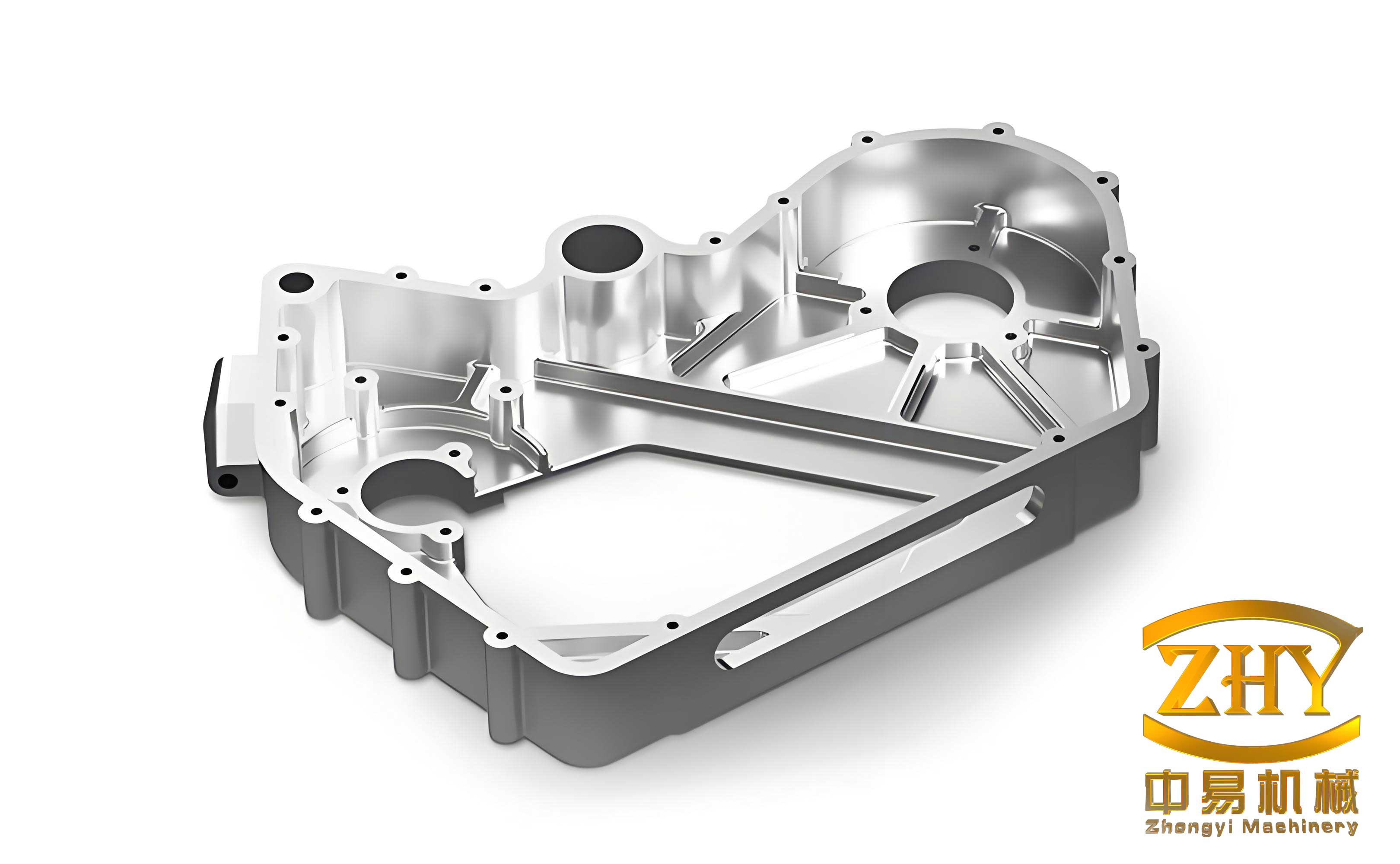
The simulation of sand mold casting for ZM5 magnesium alloy shell castings revealed several challenges. The gating system was designed with vertical sprues and horizontal runners to fill the complex geometry of the shell castings. During filling, the temperature field showed significant variations, as depicted in Figure 2 of the original study. Metal entered the mold at high temperatures but cooled rapidly in thin sections, increasing the risk of cold shuts. The flow was turbulent in certain regions, leading to potential defect formation. The solidification process was analyzed through temperature field evolution over time. Initially, the molten metal filled the cavity, but thin walls solidified quickly, isolating liquid pockets and creating shrinkage defects. The solidification time \( t_s \) can be estimated using the Chvorinov’s rule: $$ t_s = C \left( \frac{V}{A} \right)^n $$ where \( V \) is volume, \( A \) is surface area, \( C \) is a constant, and \( n \) is an exponent. For shell castings with varying thicknesses, this rule highlights the importance of controlling cooling rates. Table 2 summarizes the temperature data at key locations during sand mold casting.
| Time (s) | Temperature at Sprue (°C) | Temperature at Thin Wall (°C) | Temperature at Thick Section (°C) |
|---|---|---|---|
| 2 | 680 | 650 | 670 |
| 10 | 660 | 600 | 640 |
| 30 | 640 | 480 | 580 |
| 60 | 620 | 460 | 520 |
These results indicate that thin sections of the shell castings cool too rapidly, hindering proper feeding and leading to porosity. The flow velocity also varied, with high speeds at the gates causing erosion and low speeds in remote areas resulting in incomplete filling. To address these issues, differential pressure casting was explored as an alternative for producing high-quality shell castings.
In differential pressure casting, the gating system was simplified with four vertical sprues along the sides of the shell castings. This design promoted bottom-up filling, reducing turbulence and ensuring a more uniform temperature distribution. The simulation showed that metal flow was smoother, with velocities maintained within an optimal range. The temperature field during filling remained relatively consistent, as seen in Figure 9 of the original study. Key observations included slower cooling in thick sections and better thermal gradients for directional solidification. The modulus method was used to design the feeding system, where the modulus \( M \) is given by: $$ M = \frac{V}{A} $$ This helps identify hot spots that require additional risers or chills. For the shell castings, the modulus distribution indicated that the bottom plane had a higher modulus, necessitating it to be placed downward for effective feeding. The filling process was tracked using material tracing, revealing that metal entered the cavity evenly from the sprues, minimizing gas entrapment and shrinkage.
A comparative analysis between the two casting processes for shell castings is presented in Table 3. This highlights the advantages of differential pressure casting in terms of temperature uniformity and defect reduction.
| Aspect | Sand Mold Casting | Differential Pressure Casting |
|---|---|---|
| Temperature Uniformity | Low: Rapid cooling in thin walls | High: Gradual cooling across sections |
| Flow Characteristics | Turbulent: High velocity at gates | Laminar: Controlled velocity profile |
| Defect Probability | High: Shrinkage porosity, cold shuts | Low: Reduced isolated liquid pockets |
| Solidification Time | Short: Leads to premature solidification | Optimal: Supports sequential solidification |
| Gating System Complexity | High: Multiple runners needed | Low: Simplified vertical sprues |
The solidification simulation for differential pressure casting of shell castings showed that the four vertical sprues contracted near the gates, creating potential shrinkage zones. This suggests that enlarging the dimensions of these sprues could improve feeding and reduce defects. Additionally, the use of chills and enhanced venting in the mold can further mitigate porosity. The temperature field during solidification, as illustrated in Figure 10, indicated that the bottom center and sprue gates were the last to solidify, requiring careful design to ensure adequate compensation.
To optimize the casting process for shell castings, several recommendations are proposed based on the simulation results. First, the sprue dimensions should be increased to account for contraction during solidification. This can be quantified by the shrinkage volume \( V_s \), which depends on the alloy’s solidification shrinkage factor \( \beta \): $$ V_s = \beta \cdot V_c $$ where \( V_c \) is the volume of the casting. For ZM5 magnesium alloy, \( \beta \) is approximately 4-6%, so adjustments must be made accordingly. Second, the placement of chills at critical locations, such as thick sections or junctions, can accelerate cooling and prevent hot spots. The chill effectiveness can be modeled using the heat extraction rate: $$ Q = h_c A_c (T_m – T_c) $$ where \( h_c \) is the heat transfer coefficient between metal and chill, \( A_c \) is the chill area, \( T_m \) is metal temperature, and \( T_c \) is chill temperature. Third, mold venting should be improved to reduce gas entrapment, which is common in complex shell castings. This involves designing vents with adequate cross-sectional areas to allow air escape during filling.
Furthermore, the simulation approach can be extended to other magnesium alloys or casting methods for shell castings. For instance, the effects of varying pouring temperatures or pressure parameters can be studied using sensitivity analysis. The use of machine learning algorithms to predict defect formation based on simulation data is also a promising area for future research. In all cases, the focus remains on achieving high-integrity shell castings for aerospace applications.
In conclusion, this study demonstrates the value of numerical simulation in optimizing casting processes for large complex ZM5 magnesium alloy shell castings. Differential pressure casting offers superior temperature and flow uniformity compared to sand mold casting, reducing the likelihood of defects such as shrinkage and cold shuts. Key insights include the need to enlarge sprue dimensions and incorporate chills and vents for better solidification control. These findings can guide manufacturers in producing reliable shell castings with improved mechanical properties and lower rejection rates. As casting technologies evolve, simulation tools will continue to play a crucial role in advancing the design and production of shell castings for demanding industries.
The integration of simulation into the casting workflow for shell castings not only saves time and resources but also enhances product quality. By iteratively refining gating systems and process parameters, engineers can achieve near-net-shape castings with minimal post-processing. This is particularly important for shell castings used in aerospace, where weight reduction and performance are critical. Future work may involve experimental validation of the simulation results and exploration of hybrid casting techniques for even better outcomes. Ultimately, the goal is to push the boundaries of what is possible with magnesium alloy shell castings, contributing to lighter and more efficient aerospace components.
Throughout this article, the term “shell castings” has been emphasized to underscore the specific application focus. The simulations detailed here provide a roadmap for addressing common challenges in casting such components, from initial design to final solidification. By leveraging advanced software and fundamental principles of heat and fluid dynamics, we can unlock new potentials in manufacturing. I encourage further research in this area, as the demand for high-performance shell castings continues to grow in sectors like aerospace, defense, and automotive industries.