
In the field of aerospace engineering, the production of high-integrity shell castings is paramount for ensuring the reliability and performance of critical components such as those used in aircraft engines. Among these, shell castings made from K403 high-temperature alloys via investment casting present significant challenges due to their complex geometries, varying wall thicknesses, and stringent quality requirements. This study delves into the intricate process of manufacturing K403 shell castings, addressing common defects like porosity, cracks, cold shuts, and dimensional inaccuracies that often plague initial production trials. Through a first-person perspective, I will detail the systematic optimization of mold-making, shell-building, and melting-pouring parameters, culminating in a robust process that enhances casting quality and yield. The focus remains on shell castings, a term that will be frequently emphasized to underscore the centrality of these components in precision casting applications.
Shell castings, particularly those fabricated from K403 alloy, are integral to aerospace systems, where they must withstand extreme temperatures and stresses. K403 is a nickel-based superalloy known for its excellent high-temperature strength and corrosion resistance, but its casting behavior is fraught with difficulties. The alloy’s solidification characteristics, including a wide freezing range and susceptibility to hot tearing, make it prone to defects. In this research, I aimed to overcome these hurdles by refining each step of the investment casting process. The goal was to achieve shell castings with precise dimensions, superior metallurgical quality, and enhanced mechanical properties, thereby facilitating their deployment in demanding environments.
Structural Analysis and Technical Challenges of Shell Castings
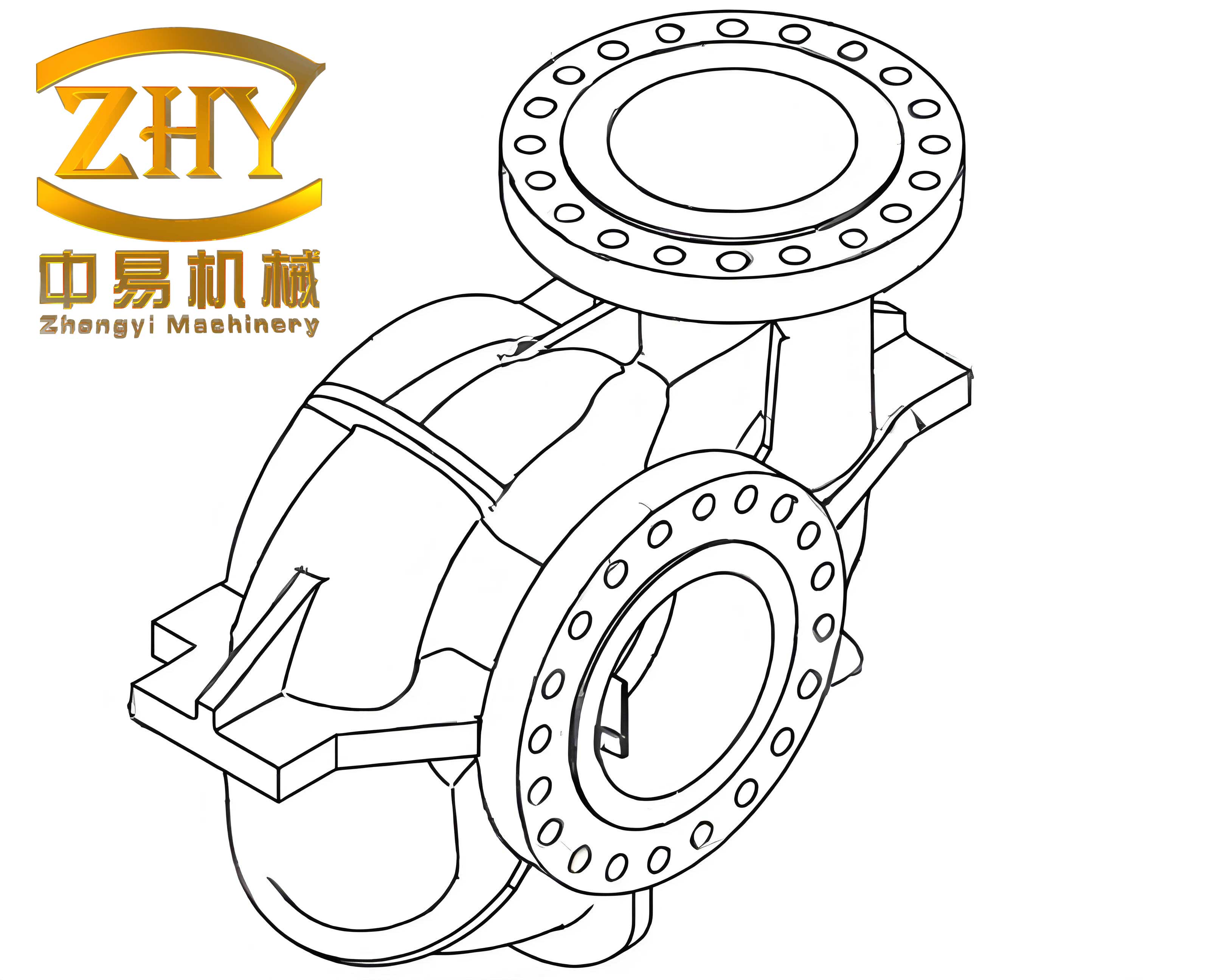
The shell casting under investigation features a complex architecture with significant variations in wall thickness, as illustrated in the 3D model. Key dimensions include a pillar height of 129 mm, a length of 111 mm, and diameters ranging from 14 mm to 32 mm, with a nominal wall thickness of 6.5 mm. This geometry results in multiple thermal junctions, which are hotspots during solidification, leading to defects like shrinkage porosity and cold shuts. The technical challenges are threefold: First, the intricate shape complicates wax pattern removal and often causes dimensional distortions. Second, the structural constraints during pouring can induce shell cracking, resulting in runouts and fins. Third, the presence of numerous thermal junctions impedes proper metal feeding, fostering porosity and crack formation.
To quantitatively assess the material, the chemical composition of K403 alloy is critical. Below is a table summarizing its main elements, which influence fluidity, solidification behavior, and defect propensity in shell castings.
| Element | Content (Mass Fraction, %) |
|---|---|
| C | 0.11–0.18 |
| Cr | 10.00–12.00 |
| Co | 4.50–6.00 |
| W | 4.80–5.50 |
| Mo | 3.80–4.50 |
| Ti | 2.30–2.90 |
| Al | 5.30–5.90 |
| Ce | ≤ 0.01 |
| Fe | ≤ 2.00 |
| Si | ≤ 0.50 |
| Mn | ≤ 0.50 |
| S | ≤ 0.01 |
| P | ≤ 0.02 |
| Ni | Balance |
The high content of alloying elements like W and Mo enhances strength but reduces fluidity, complicating the filling of thin sections in shell castings. This necessitates precise control over process parameters to mitigate defects. The solidification shrinkage of K403 can be modeled using the following formula, which relates volume change to temperature drop:
$$ \Delta V = V_0 \cdot \beta \cdot (T_l – T_s) $$
where \(\Delta V\) is the volume shrinkage, \(V_0\) is the initial volume, \(\beta\) is the volumetric shrinkage coefficient (approximately 4–6% for K403), \(T_l\) is the liquidus temperature (around 1350°C), and \(T_s\) is the solidus temperature (around 1280°C). This shrinkage must be compensated through effective gating and risering to prevent porosity in shell castings.
Optimization of Mold-Making for Shell Castings
The foundation of high-quality shell castings lies in the production of precise wax patterns. In initial trials, the wax patterns were fabricated in three separate segments and assembled using a jig, leading to dimensional inconsistencies. Measurements revealed deviations such as a 1.7–2.2 mm offset between the centers of ϕ14 mm and 2-ϕ23 mm cylinders, and a 0.5–0.87 mm shift due to upward warping. To address this, I redesigned the tooling to enable monolithic wax pattern production, eliminating assembly errors and ensuring dimensional fidelity for shell castings.
Key parameters in wax injection include wax temperature, mold temperature, injection pressure, and holding time. These factors directly impact the surface finish, dimensional accuracy, and defect formation in wax patterns, which later translate to shell castings. An empirical relationship for wax pattern shrinkage can be expressed as:
$$ S_w = k_1 \cdot \Delta T_w + k_2 \cdot P^{-1} $$
where \(S_w\) is the linear shrinkage of the wax pattern, \(\Delta T_w\) is the difference between wax injection temperature and ambient temperature, \(P\) is the injection pressure, and \(k_1\), \(k_2\) are material-specific constants. Optimizing these parameters reduces shrinkage and minimizes defects like cold shuts or sinks. After experimentation, I established the following optimal settings for producing wax patterns for K403 shell castings:
| Parameter | Optimal Range |
|---|---|
| Wax Temperature | 55–63°C |
| Mold Temperature | 25–35°C |
| Injection Pressure | 15–25 bar |
| Holding Time | 15–20 s |
Higher injection pressures and longer holding times promote better packing, reducing internal voids and surface imperfections. This optimization is crucial for achieving the tight tolerances required for aerospace-grade shell castings.
Optimization of Shell-Building for Shell Castings
The shell-building process is vital for creating a robust mold capable of withstanding thermal stresses during pouring. For shell castings with thick sections, localized shell thinning was implemented to enhance cooling rates at thermal junctions. After applying the fourth coating layer, soft wax was applied to specific areas, such as the upper and lower holes and around the eight ingates, to reduce shell thickness in these regions. This approach accelerates heat dissipation, promoting directional solidification and reducing porosity in shell castings.
The shell-building parameters were meticulously tuned to balance strength and permeability. Below is a table summarizing the multi-layer coating process for shell castings:
| Layer | Slurry Composition | Viscosity | Stucco | Drying Time | Ammonia Drying | Ventilation |
|---|---|---|---|---|---|---|
| 1 | Silica Sol-Zircon Flour | 40–50 s | White Alumina WAF70 | ≥ 12 h | – | – |
| 2 | Ethyl Silicate Hydrolysate-Shangdian Flour | 37–42 s | Shangdian Sand 36 mesh | ≥ 20 min | 10 min | ≥ 10 min |
| 3–8 | Ethyl Silicate Hydrolysate-Shangdian Flour | 13–15 s | Shangdian Sand 24 mesh | ≥ 20 min | 10 min | ≥ 10 min |
| Sealing | Ethyl Silicate Hydrolysate-Shangdian Flour | 13–15 s | – | ≥ 12 h | – | – |
Shell preheating is another critical factor. The preheat temperature affects the thermal gradient during pouring, influencing fluidity and solidification patterns in shell castings. A higher preheat temperature reduces the metal-shell temperature differential, improving fill but potentially leading to coarse grains and porosity. The optimal preheat temperature range was determined to be 950–1000°C, based on trials with K403 shell castings. The heat transfer during preheating can be described by Fourier’s law:
$$ q = -k \cdot \frac{dT}{dx} $$
where \(q\) is the heat flux, \(k\) is the thermal conductivity of the shell material, and \(\frac{dT}{dx}\) is the temperature gradient. By controlling preheating, we manage solidification rates to minimize defects in shell castings.
Optimization of Melting and Pouring for Shell Castings
The melting and pouring stages are decisive for the metallurgical quality of shell castings. K403 alloy was vacuum melted and poured to prevent oxidation and gas entrapment. The gating system must provide adequate feeding to compensate for solidification shrinkage while ensuring complete mold filling. Pouring temperature and speed are key variables; excessive temperature increases shrinkage defects, while insufficient temperature causes cold shuts. For K403 shell castings, the pouring temperature was set at 1430°C ± 10°C, approximately 80°C above the liquidus temperature, to balance fluidity and shrinkage.
Pouring speed directly impacts the dynamic pressure of the molten metal, affecting mold filling. A faster pour enhances filling but may cause erosion or turbulence. The ideal pouring speed was established as 2–3 seconds per mold, ensuring rapid and uniform filling. The relationship between pouring speed \(v\) and fill time \(t\) for a shell casting can be approximated by:
$$ t = \frac{V}{A \cdot v} $$
where \(V\) is the mold cavity volume and \(A\) is the cross-sectional area of the gating system. Optimizing this minimizes cold shuts and misruns in shell castings. The table below summarizes the final pouring parameters:
| Parameter | Value |
|---|---|
| Shell Preheat Temperature | 950–1000°C |
| Pouring Temperature | 1430°C ± 10°C |
| Pouring Speed | 2–3 s per mold |
Directional solidification is promoted by designing the gating system to act as a thermal riser, feeding molten metal to thick sections of shell castings until they solidify. This reduces porosity and enhances mechanical properties.
Effect Verification and Quality Assessment of Shell Castings
Implementing the optimized parameters led to a significant improvement in the quality of K403 shell castings. A batch of 40 castings was produced, with 35 meeting all specifications, yielding a qualification rate of 87.5%. Dimensional inspections using coordinate measuring machines confirmed compliance with tolerances, and metallographic analysis revealed reduced porosity and crack incidence. The effectiveness of shell thinning was evident in the improved soundness of thermal junction areas. Below is a table comparing defect rates before and after optimization for shell castings:
| Defect Type | Pre-Optimization Rate (%) | Post-Optimization Rate (%) |
|---|---|---|
| Porosity | 25 | 5 |
| Cracks | 15 | 3 |
| Cold Shuts | 20 | 4 |
| Dimensional Deviation | 30 | 7 |
The mechanical properties of the shell castings were also enhanced, with tensile strength and fatigue life meeting aerospace standards. This validates the process optimizations and underscores the importance of integrated parameter control in producing high-integrity shell castings.
Conclusions and Future Perspectives
This research demonstrates that through systematic optimization of investment casting parameters, high-quality K403 shell castings can be consistently manufactured. Key findings include: First, monolithic wax pattern production eliminates assembly-induced dimensional errors in shell castings. Second, localized shell thinning at thermal junctions accelerates cooling, reducing porosity. Third, precise control of pouring temperature and speed ensures complete filling while minimizing shrinkage defects. The integration of these strategies has elevated the production yield and quality of shell castings, providing a reference for similar complex components.
Future work could explore advanced simulation tools to model fluid flow and solidification in shell castings, further refining process windows. Additionally, investigating alternative shell materials or cooling techniques may offer new avenues for enhancing the performance of shell castings in extreme environments. The continual evolution of investment casting technology will undoubtedly drive improvements in the reliability and efficiency of shell castings for aerospace applications.
In summary, the successful optimization of K403 shell castings hinges on a holistic approach that addresses each stage of the investment casting process. By prioritizing dimensional accuracy, metallurgical soundness, and process robustness, we can meet the ever-increasing demands for precision shell castings in critical engineering domains.