
In the rapidly evolving landscape of advanced manufacturing, the demand for lightweight, precise, and high-quality aluminum alloy components has surged, particularly for complex shell castings used in aerospace, automotive, and defense applications. Traditional casting methods often involve lengthy mold fabrication processes, which are costly and time-consuming, especially for low-volume production or prototype development. As a practitioner in this field, I have explored and implemented digital patternless precision forming technology to streamline the development of aluminum alloy shell castings. This approach integrates CAD, CAE, and CAM technologies, eliminating the need for physical molds and significantly reducing lead times and defect rates. In this article, I will delve into the systematic workflow, from product design to actual casting production, emphasizing the role of numerical simulation and digital machining. The focus will be on shell castings, a critical category of components that require intricate geometries and stringent performance standards. Through detailed explanations, formulas, and tables, I aim to provide a comprehensive guide to this innovative process.
The core of this methodology lies in digital patternless casting, which leverages subtractive manufacturing principles. By using CNC machining directly on sand molds and cores based on 3D CAD models, we bypass the traditional pattern-making stage. This not only accelerates production but also allows for rapid iterations in design. For shell castings, which often feature thin walls, complex internal cavities, and uneven thickness distributions, this technology offers unparalleled flexibility. In my experience, the integration of simulation software ensures that the casting process is optimized before any physical production begins, minimizing trial-and-error and resource wastage. The following sections will outline the entire development path, supported by technical details and practical insights.
Overview of Digital Patternless Casting Technology
Digital patternless casting is a transformative approach that combines computer-aided design, engineering analysis, and computer-aided manufacturing. At its heart, it involves the direct machining of sand molds and cores from 3D models, using equipment like CNC milling machines specifically designed for soft materials like resin-bonded sand. This technology is particularly advantageous for shell castings, as it enables the production of complex geometries without the constraints of mold tooling. The process begins with a detailed CAD model of the casting, which includes all necessary allowances for shrinkage, machining, and gating systems. By eliminating molds, we reduce costs by up to 60% and cut development cycles from weeks to mere days, making it ideal for prototyping and small batches. Key benefits include:
- Reduced lead time: From design to casting in as little as one week.
- Lower costs: No investment in hard tooling or patterns.
- Enhanced flexibility: Easy modifications to CAD models for design iterations.
- Improved accuracy: Digital precision ensures tight tolerances for shell castings.
The technology relies on advanced software tools for simulation and machining path generation, ensuring that every aspect of the casting process is controlled. For aluminum alloy shell castings, which are prone to defects like porosity and shrinkage due to their high thermal conductivity, this integrated approach is crucial. In the next sections, I will break down the workflow into discrete steps, illustrating each with examples and data.
New Product Development Workflow for Shell Castings
The development of aluminum alloy shell castings follows a structured path that integrates CAD, CAE, and CAM. Based on my projects, I have refined this workflow to ensure efficiency and quality. The diagram below summarizes the key stages, but in practice, each step involves detailed analysis and execution.
| Stage | Description | Tools/Technologies | Output |
|---|---|---|---|
| 1. CAD Design | Create 3D model of casting with gating, risers, and allowances. | CAD software (e.g., SolidWorks, UG) | 3D CAD model |
| 2. CAE Simulation | Analyze flow field and temperature field to optimize process. | Simulation software (e.g., ProCAST) | Optimized casting parameters |
| 3. Mold/Core Design | Split CAD model into mold halves and cores for machining. | CAD software | Machinable 3D models |
| 4. CAM Programming | Generate CNC toolpaths for machining sand molds/cores. | CAM software (e.g., UG CAM module) | G-code for CNC machine |
| 5. Digital Machining | Machine sand molds and cores using patternless CNC equipment. | CNC milling machine for sand | Physical sand molds/cores |
| 6. Assembly & Coating | Assemble mold parts, apply coatings to prevent defects. | Manual assembly, spraying equipment | Ready-to-pour mold assembly |
| 7. Pouring & Finishing | Pour molten aluminum, cool, and remove casting for inspection. | Furnace, handling tools | Final shell casting |
This workflow is iterative; simulation results may lead back to CAD modifications, ensuring that the final design is robust. For shell castings, the initial focus is on geometry complexity and wall thickness variations. I often start by analyzing the component’s structure to identify potential hot spots or thin sections that could lead to defects. The integration of CAE early in the process is a game-changer, as it allows us to predict and mitigate issues before any physical resources are committed. In one project, for instance, we reduced the rejection rate for shell castings by over 30% through simulation-driven optimization.
Casting Process Design Based on CAD
The design of the casting process begins with a thorough understanding of the shell casting’s geometry. Aluminum alloys, such as ZL104 commonly used for shell castings, have high thermal conductivity and significant solidification shrinkage, necessitating careful planning of gating and risering systems. In my work, I use CAD software to model the entire casting system, including the part, gates, runners, and risers. For a typical aluminum alloy shell casting with dimensions around 500 mm × 400 mm × 100 mm and a weight of 20 kg, the gating system must ensure smooth, turbulent-free filling to avoid oxide inclusion and gas entrapment.
A bottom-gating system is often preferred for shell castings to minimize冲击 on complex cores. The gating ratio is designed to be open, with larger cross-sectional areas in the runners to enhance slag trapping and reduce flow velocity. The key formula for calculating the choke area, based on fluid dynamics principles, is:
$$F_{\text{choke}} = \frac{G_{\text{casting}}}{\rho \sqrt{2g} \cdot t \cdot \delta_w}$$
where:
- \(F_{\text{choke}}\) is the choke cross-sectional area (mm²),
- \(G_{\text{casting}}\) is the weight of the casting (kg),
- \(\rho\) is the density of the aluminum alloy (approximately 2.7 kg/dm³ for ZL104),
- \(g\) is gravitational acceleration (9.8 m/s²),
- \(t\) is the filling time (s), estimated based on wall thickness,
- \(\delta_w\) is a material constant, typically 0.31 for aluminum alloys.
For example, in a recent project for a shell casting weighing 20.2 kg, the calculated areas were: sprue = 1250 mm², runner = 2400 mm², and ingate = 2700 mm². This ensures a filling time of about 6-7 seconds, which is optimal for minimizing temperature loss. Additionally, risers are placed at thick sections to promote directional solidification. The CAD model includes all these elements, allowing for virtual validation before proceeding. Below is a table summarizing typical design parameters for aluminum alloy shell castings:
| Parameter | Typical Value Range | Notes |
|---|---|---|
| Wall Thickness | 5-15 mm | Thinner walls require faster filling |
| Gating System Type | Bottom-gating with open ratio | Reduces turbulence for shell castings |
| Pouring Temperature | 720-740°C | For ZL104 alloy |
| Mold Temperature | 20-30°C | Room temperature sand molds |
| Filling Time | 5-10 seconds | Depends on casting volume |
| Riser Size | 1.2-1.5 times hot spot volume | Ensures adequate feeding |
By leveraging CAD, we can quickly iterate on these designs, ensuring that the gating system is tailored to the specific geometry of the shell casting. This digital approach reduces errors that often arise from manual calculations.
Numerical Simulation for Process Optimization
Once the CAD design is complete, I use CAE software to simulate the casting process. This step is critical for shell castings, as it predicts potential defects like cold shuts, porosity, and shrinkage. Simulation involves coupled analysis of fluid flow and heat transfer during mold filling and solidification. In my practice, I employ tools like ProCAST, which uses finite element methods to solve the governing equations. For an aluminum alloy shell casting, the key equations include the Navier-Stokes equations for fluid flow:
$$\rho \left( \frac{\partial \mathbf{v}}{\partial t} + \mathbf{v} \cdot \nabla \mathbf{v} \right) = -\nabla p + \mu \nabla^2 \mathbf{v} + \rho \mathbf{g}$$
and the heat conduction equation for solidification:
$$\rho c_p \frac{\partial T}{\partial t} = \nabla \cdot (k \nabla T) + \dot{Q}$$
where \(\mathbf{v}\) is velocity, \(p\) is pressure, \(\mu\) is viscosity, \(T\) is temperature, \(k\) is thermal conductivity, \(c_p\) is specific heat, and \(\dot{Q}\) is latent heat release. Boundary conditions are set based on the mold material and pouring parameters.
For a specific shell casting project, I simulated a case with an initial pouring temperature of 735°C and a sand mold at 25°C. The mesh size was refined to 4 mm, resulting in over 1.2 million elements to capture thin walls accurately. The interfacial heat transfer coefficient was set to 500 W/(m²·K). The flow field simulation revealed that filling took 6.9 seconds, with metal entering the cavity smoothly from the bottom and rising at a rate of 20 mm/s. This minimized air entrapment, but the top regions showed potential for cold shuts due to late filling. The temperature field simulation indicated hot spots at thick sections, with temperature gradients favoring directional solidification toward risers. However, isolated liquid pockets were predicted at certain locations, prompting redesign of riser sizes.
The table below summarizes key simulation findings for optimizing shell castings:
| Simulation Aspect | Observation | Optimization Action |
|---|---|---|
| Flow Velocity | High at ingates, causing splashing | Enlarge runner cross-section to reduce speed |
| Temperature Distribution | Hot spots at thick walls | Add risers or chilling pads to promote cooling |
| Solidification Sequence | Isolated liquid zones in internal features | Modify gating to ensure feeding paths |
| Defect Prediction | Porosity likely in top regions | Increase venting or adjust pouring temperature |
Through simulation, I can visualize the entire process virtually, making adjustments to the CAD model before machining. This reduces the need for physical trials, saving time and materials. For shell castings, which often have complex internal geometries, this predictive capability is invaluable. In one instance, simulation helped increase the yield of sound castings by 25% by identifying optimal riser placements.
Digital Machining of Molds and Cores
After finalizing the design through simulation, the next step is to machine the sand molds and cores using patternless CNC technology. This involves converting the CAD models into machinable components by splitting them into upper and lower mold halves, along with any internal cores. For shell castings, the core design is particularly important due to intricate cavities. I typically use materials like phenolic resin-bonded sand (70/140 mesh) for molds and coated sand (100/200 mesh) for cores, as they offer good strength and surface finish.
The machining process begins with preparing sand blocks. For molds, I mix resin and catalyst with sand to form blocks of required dimensions. For cores, I use shell molding techniques with oven curing. The CAD models are imported into CAM software, such as UG’s machining module, to generate toolpaths. Roughing is done with a 16 mm PCD tool at a depth of cut of 3.5 mm, and finishing with a 6 mm tool at 0.3 mm cut. The CNC machine, specifically designed for sand, operates at speeds up to 180 mm/s with spindle speeds of 2500 rpm. To ensure stability during machining, I add support structures and virtual borders to the sand blocks.
The machining time for a complete mold set for a shell casting can range from 20 to 30 hours, depending on complexity. Below is a table outlining typical machining parameters:
| Parameter | Mold (Resin Sand) | Core (Coated Sand) |
|---|---|---|
| Material Mesh Size | 70/140 | 100/200 |
| Tool Type | PCD (Polycrystalline Diamond) | Carbide for fine details |
| Cutting Speed | 150-180 mm/s | 100-120 mm/s |
| Feed Rate | 3-5 mm for roughing, 0.2-0.5 mm for finishing | Similar, adjusted for hardness |
| Machining Time | 10-15 hours per half | 5-10 hours per core set |
Once machined, the molds and cores are assembled with precision. For very complex internal features of shell castings, I sometimes use additive manufacturing like selective laser sintering to produce small sand pieces, which are then glued into the main core assembly. This hybrid approach combines the flexibility of 3D printing with the efficiency of CNC machining. The digital nature of this process ensures that every shell casting produced is consistent with the design intent, reducing variations common in manual mold-making.
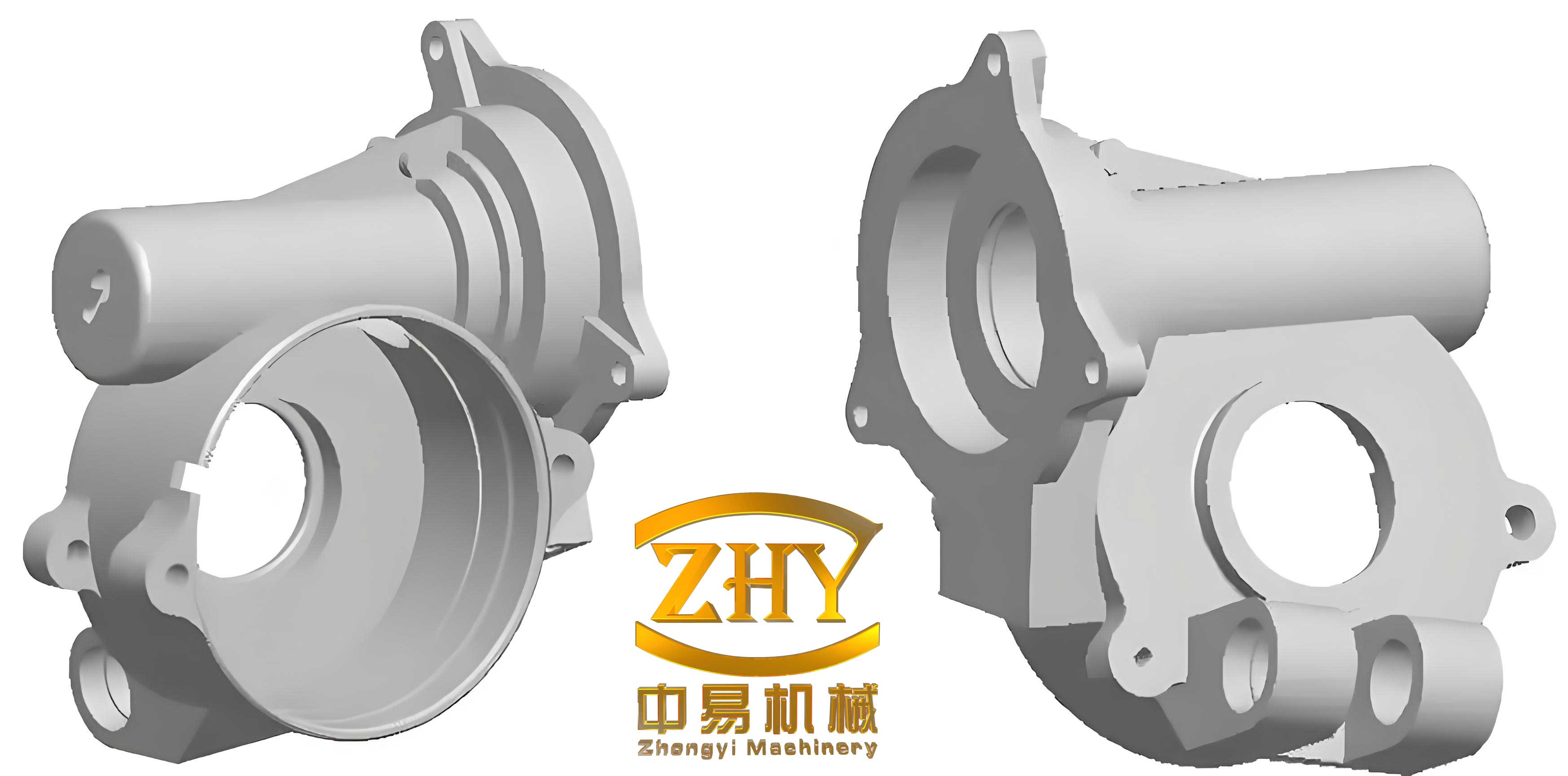
The image above illustrates a typical aluminum alloy shell casting produced via this method, showcasing the smooth surface and intricate details achievable with digital patternless casting. Such visual results reinforce the efficacy of the process for high-quality shell castings.
Pouring Trials and Quality Assessment
With the molds and cores ready, the final stage involves pouring molten aluminum alloy. For shell castings, I preheat the molds to around 100°C to reduce thermal shock and apply a refractory coating to prevent sand erosion and improve surface finish. The pouring is done using a ladle from a furnace maintained at 730-740°C for ZL104 alloy. After pouring, the casting is allowed to cool in the mold before shakeout.
The resulting shell castings are then inspected for defects. In my trials, I have achieved castings with clear contours, smooth surfaces, and no visible cracks or porosity. Sectioning of critical areas confirms the absence of shrinkage cavities, thanks to the optimized risering predicted by simulation. Mechanical testing and leak tests (e.g., pneumatic or hydraulic pressure tests) are conducted to ensure integrity, especially for shell castings used in pressurized environments. The table below summarizes typical quality metrics:
| Metric | Result | Industry Standard |
|---|---|---|
| Surface Roughness (Ra) | 6.3-12.5 μm | ≤ 12.5 μm for most applications |
| Dimensional Accuracy | ±0.5 mm on critical dimensions | Depends on part size; often ±1 mm |
| Defect Rate (Visual) | < 5% | Typically 10-15% in traditional casting |
| Leak Test Pass Rate | Over 95% | Varies with design; target >90% |
| Mechanical Properties | Meets ZL104 specs (e.g., tensile strength ~240 MPa) | As per alloy standards |
These results demonstrate that digital patternless casting can produce high-integrity shell castings efficiently. The rapid turnaround—from design to finished casting in about a week—makes this approach ideal for prototyping and low-volume production. Moreover, the ability to simulate and adjust the process digitally reduces material waste, aligning with sustainable manufacturing goals.
Discussion: Advantages and Challenges
The adoption of digital patternless casting for aluminum alloy shell castings offers numerous advantages, but it also presents challenges that need addressing. From my perspective, the key benefits include:
- Speed: Development cycles are shortened from months to days, enabling faster time-to-market for new products involving shell castings.
- Cost-Effectiveness: Elimination of mold costs reduces upfront investment, particularly beneficial for custom or low-volume shell castings.
- Flexibility: Design changes can be implemented quickly by modifying CAD models, without the need for new tooling.
- Precision: Digital control ensures high accuracy, critical for complex shell castings with tight tolerances.
However, challenges exist. The machining of sand molds requires specialized CNC equipment, which may have high initial costs. Sand material consumption can be significant for large shell castings, though recycling systems can mitigate this. Additionally, the process may generate dust and fumes during machining and pouring, necessitating proper ventilation and safety measures. For very large shell castings (over 1 meter in size), machining time and sand handling become logistical hurdles.
Future improvements could focus on enhancing simulation accuracy for defect prediction in shell castings, integrating artificial intelligence for automatic gating design, and developing more sustainable sand materials. Hybrid approaches combining additive manufacturing for cores with subtractive machining for molds may further optimize the process. As technology advances, I believe digital patternless casting will become even more accessible, driving innovation in sectors reliant on high-performance shell castings.
Conclusion
In summary, digital patternless casting represents a paradigm shift in the production of aluminum alloy shell castings. By integrating CAD, CAE, and CAM, this technology enables rapid, low-cost development without the need for physical molds. Through detailed process design, numerical simulation, and digital machining, I have successfully produced high-quality shell castings with reduced lead times and defect rates. The workflow outlined—from 3D modeling to pouring—ensures that every aspect is optimized for the unique challenges of shell castings, such as thin walls and complex geometries. As demonstrated, the use of formulas for gating design and simulation for thermal analysis is crucial for success. While challenges remain, the benefits make this approach a valuable tool for manufacturers seeking agility and efficiency. Moving forward, continued refinement of these techniques will further solidify the role of digital patternless casting in the advanced manufacturing ecosystem, particularly for critical applications involving shell castings.
The journey from concept to casting has never been faster, and as we embrace these digital tools, the potential for innovation in shell castings is boundless. I encourage practitioners to explore this methodology, leveraging its strengths to overcome traditional limitations and unlock new possibilities in aluminum alloy component production.