
In the field of heavy machinery manufacturing, particularly for mining equipment, the production of high-integrity shell castings is paramount. As a researcher deeply involved in this domain, I have focused on optimizing the casting process for critical components such as the rocker arm shell of shearers. These shell castings are subjected to extreme operational loads, demanding exceptional mechanical properties and structural soundness. The inherent challenges in casting these complex shell castings, primarily due to the poor fluidity and high shrinkage characteristics of alloy cast steel, make riser design a cornerstone of the foundry process. This article details our systematic approach to riser design, employing simulation-led methodologies to eliminate shrinkage defects and ensure the quality of these vital shell castings.
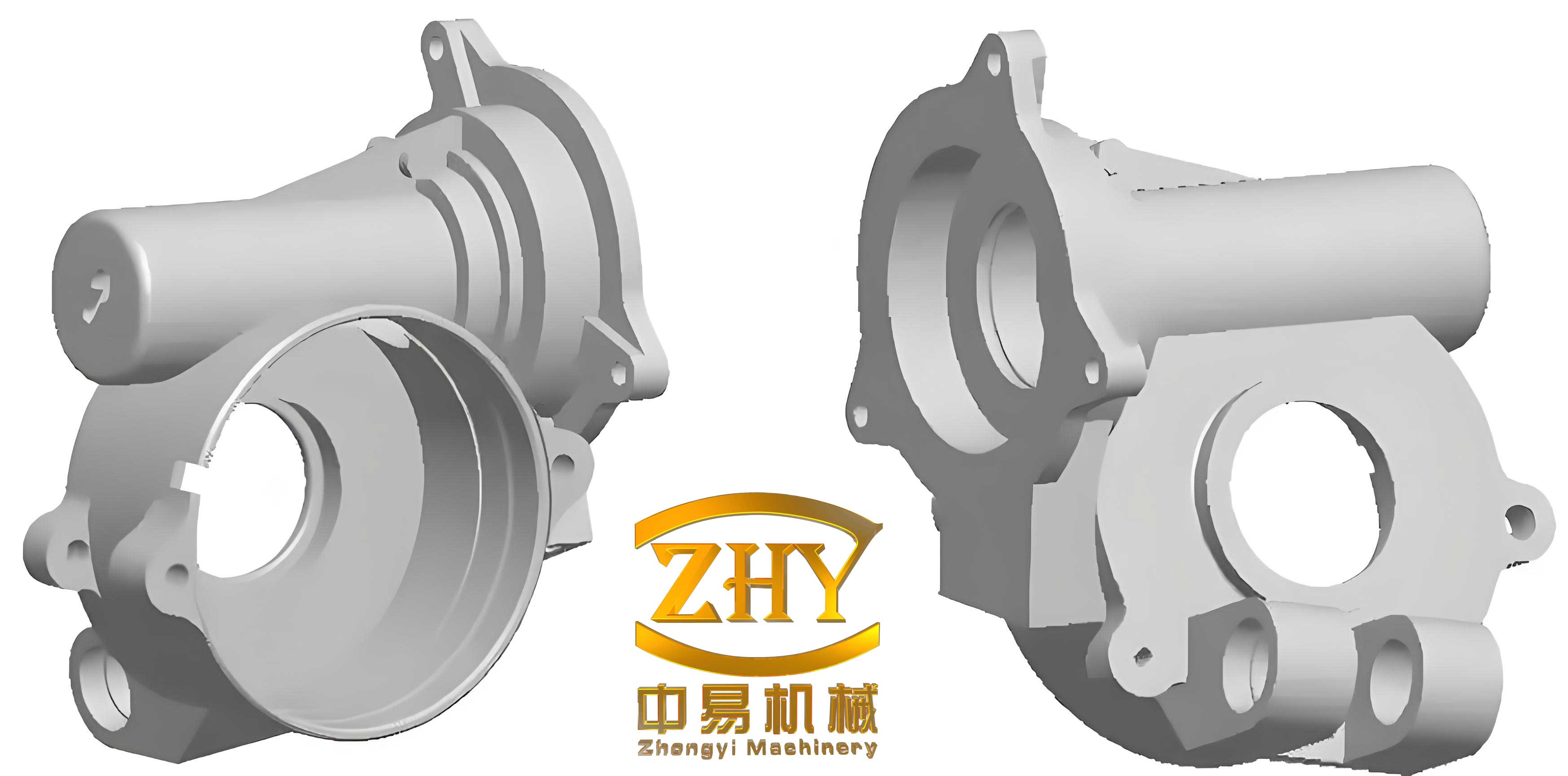
The rocker arm shell serves as the foundational housing for the cutting unit of a shearer. Its internal cavity accommodates the cutting motor, gear transmission systems, and internal spray devices, while its exterior interfaces with planetary gear mechanisms and the cutting drum. A defining feature of these shell castings is the integrated cooling水道 (water channel) network on the surface, essential for thermal management during operation. Geometrically, the component is highly intricate, with numerous axle holes, non-uniform wall thicknesses ranging from 60-70 mm in standard sections to over 200 mm in localized regions. This complexity categorizes it as a challenging thick-walled, complex shell casting. The variation in wall thickness creates multiple thermal centers, or hot spots, which are prone to shrinkage porosity and cavities during solidification if not properly fed.
Our process began with a thorough analysis of the potential defect zones. We employed a dedicated casting simulation software, Huazhu CAE, to model the solidification process without any risers. The simulation predicted significant shrinkage defects, visually represented as concentrated regions in the model. The results confirmed our hypotheses: major defect zones formed at the top of the motor cylinder and the planetary head mounting cylinder due to their substantial mass and elevated position. Furthermore, unexpected but critical defect areas appeared at the bottom of the motor cylinder and the connecting regions between the gearbox and other sections. This occurred because the large central cavity and the parting plane location caused isolated liquid pools that could not be fed from above. This initial simulation was crucial for mapping the problem areas in these shell castings.
The core of our work was the iterative design of the riser system. The primary goal was to ensure directional solidification towards the risers. We initially opted for top risers positioned at the highest points of the predicted hot spots. The design process utilized the modulus method, specifically the “Perimeter Quotient” method, for calculating riser dimensions to ensure feeding efficiency while minimizing excess metal. The fundamental formula for the riser’s perimeter quotient \( Q_m \) is derived from the casting characteristics:
$$ Q_m = \frac{\epsilon Q_b}{(1-\epsilon)f^3 – f^2} $$
Where \( \epsilon \) is the liquid shrinkage rate of the metal (4.5% for ZG25MnNi at 1560°C), \( f \) is the modulus enlargement factor, and \( Q_b \) is the perimeter quotient of the casting section being fed. The perimeter quotient for any shape is defined as its volume divided by the cube of its modulus \( (V/M^3) \). Using 3D modeling software, we precisely calculated the volume and surface area of each feeding zone within the shell castings to determine \( Q_b \). Based on these calculations, we proposed an initial scheme (Scheme 1) with four top risers: two open risers on the sides and two blind risers in the central region. The calculated and practically adjusted dimensions are summarized below.
| Riser ID | Location | Type | Calculated Dimensions (mm) | Final Adjusted Dimensions (mm) |
|---|---|---|---|---|
| R1 | Planetary Head Top | Open (Elongated) | 250x375x312 | 280x420x350 |
| R2 | Gearbox Center Top | Blind (Cylindrical) | φ240×240 | φ240×320 |
| R3 | Gearbox-Motor Rib Top | Blind (Cylindrical) | φ240×240 | φ240×320 |
| R4 | Motor Cylinder Top | Open (Elongated) | 240x360x300 | 280x420x790 |
Simulation of Scheme 1 showed improvement but was insufficient. Shrinkage defects remained at the junction between the planetary head and gearbox, and significantly at the bottom regions of the shell castings. This led to Scheme 2, where we added two additional blind risers (R5 and R6) at these critical junctions, each with dimensions of φ240 mm x 320 mm. While this virtually eliminated top-surface defects, bottom defects persisted, confirming that top risers alone could not provide adequate feeding distance for the lower sections of such deep shell castings.
To address the bottom defects, we introduced feeding pads (chills or padding) below specific risers. Pads effectively increase the effective feeding distance of a riser by altering the local thermal geometry, promoting directional solidification. We designed tapered pads for risers R1, R4, R5, and R6. The height and taper slope of each pad were customized based on the local geometry and solidification profile of the shell castings. The parameters are listed in the following table.
| Associated Riser | Pad Height (mm) | Pad Taper Slope (%) | Purpose |
|---|---|---|---|
| R1 | 480 | 21 | Feed planetary head bottom |
| R4 | 600 | 12 | Feed motor cylinder bottom |
| R5 | 500 | 14 | Feed gearbox-planetary junction bottom |
| R6 | 500 | 14 | Feed gearbox-motor junction bottom |
This new configuration, termed Scheme 3, was simulated. The results were markedly better, with shrinkage now concentrated only within the risers and pads, except for one stubborn area at the very bottom of the motor cylinder-gearbox connection. The presence of reinforcing ribs above this area created a thermal barrier that the top risers, even with pads, could not overcome. This is a common challenge in complex shell castings where internal geometry impedes optimal heat transfer.
The final step involved designing a side riser to tackle this isolated hot spot. A side riser (R7) was attached via a neck to the lateral wall of the shell casting at the problematic bottom junction. For side risers, which are less efficient than top risers due to their lower thermal gradient, we used a slightly oversized design compared to a theoretical top riser for the same volume. We specified a blind cylindrical riser with dimensions of φ240 mm x 320 mm and a neck height of 400 mm to ensure adequate feeding pressure. The incorporation of this side riser led to our final Scheme 4.
The simulation of Scheme 4 yielded optimal results. The defect analysis plot showed that all shrinkage porosity and cavities were successfully relegated to the riser bodies—R1 through R7—and their associated feeding pads. The actual casting of the shell was sound and free from internal defects. The final riser layout for these shell castings comprised seven risers: two open top risers, four blind top risers (with pads), and one blind side riser. The strategic placement and scientific sizing ensured efficient metal usage while guaranteeing quality. The mathematical foundation for our riser sizing can be generalized. The modulus \( M \) of a casting section is given by:
$$ M = \frac{V}{A} $$
Where \( V \) is volume and \( A \) is the cooling surface area. For a riser to be effective, its modulus \( M_r \) must be greater than the modulus of the casting section \( M_c \) it feeds, typically by a factor \( f \) (usually 1.1 to 1.2). The relationship is:
$$ M_r \geq f \cdot M_c $$
The perimeter quotient method we used is a more refined version of this principle, accounting for the specific shape factor of both the casting and the riser, which is crucial for irregular shell castings. The total riser volume \( V_{r,total} \) can be compared to the feeding volume of the casting \( V_{feed} \) to estimate yield \( \eta \):
$$ \eta = \frac{V_{casting}}{V_{casting} + V_{r,total}} \times 100\% $$
In our final design, the careful calculation of each riser’s dimensions based on the local \( Q_b \) of the shell casting sections maximized this yield, demonstrating an efficient design tailored for complex shell castings.
In conclusion, our iterative, simulation-driven methodology for riser design in complex shell castings has proven highly effective. The process underscores the importance of: (1) Initial CAE-based defect prediction to identify hot spots in shell castings; (2) Application of modulus-based calculations like the perimeter quotient method for initial riser sizing; (3) Strategic use of feeding pads to extend the effective range of top risers in thick sections of shell castings; and (4) The supplemental use of side risers to feed isolated hot spots inaccessible to top risers. The final design not only ensures the structural integrity of the cast component by eliminating shrinkage but also optimizes material usage. This systematic approach provides a reliable framework for tackling the manufacturing challenges of other large, thick-walled, and geometrically intricate shell castings in heavy industrial applications. The repeated focus on the term ‘shell castings’ throughout this study highlights its central role; every design decision, from riser placement to pad slope, was made with the unique solidification behavior of these shell castings in mind.