
In the rapidly evolving field of rail transportation, the demand for lightweight components has become paramount. Lightweighting not only reduces vehicle weight and raw material consumption but also minimizes traction and braking forces, leading to significant energy savings and reduced emissions. As such, the pursuit of lightweight shell castings is a key objective within the casting industry. Traditionally, rail transit components have been manufactured from lower-grade ductile iron, such as QT400 to QT600. However, to meet higher performance standards, my research focuses on the development of high-grade austempered ductile iron (ADI), specifically QT800-10, for rail transit shell castings. This material offers superior mechanical properties, including high strength and toughness, while being lighter than steel, making it ideal for demanding applications.
The shell castings in question are structural components used in rail vehicles, characterized by complex geometries and uneven wall thicknesses. These features pose significant challenges for both casting and subsequent heat treatment processes. A typical shell casting may have a mass of around 36.7 kg, with wall thicknesses ranging from a minimum of 9 mm to a maximum of 58 mm. This non-uniformity can lead to defects such as shrinkage porosity if not properly addressed during manufacturing. To illustrate the structure, consider the following representation:
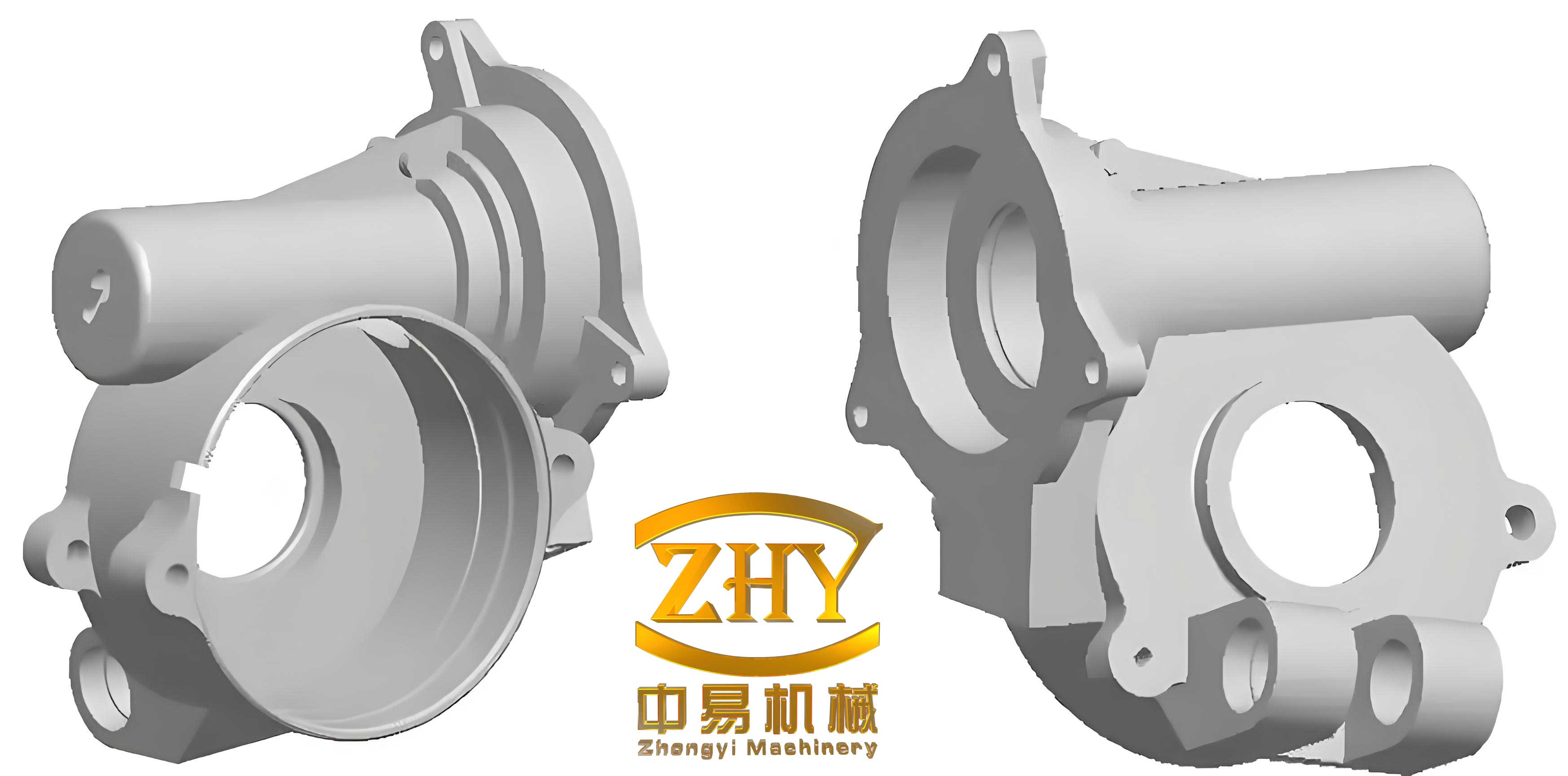
The design of these shell castings requires meticulous attention to detail to ensure integrity under operational stresses. In my work, I have employed advanced simulation tools and experimental methods to optimize the entire process, from alloy composition to final heat treatment. The goal is to produce shell castings that meet stringent customer standards for strength, elongation, and hardness, while also achieving the desired lightweight characteristics. Throughout this article, I will delve into the various aspects of this development, emphasizing the role of shell castings in modern rail transit systems and how ADI can enhance their performance.
Let me begin by discussing the chemical composition design for ADI shell castings. The base material is ductile iron, which is modified through alloying and heat treatment to achieve the desired properties. For rail transit shell castings, the target grade is QT800-10, which requires a tensile strength greater than 800 MPa, a yield strength above 500 MPa, and an elongation of at least 10%, along with a Brinell hardness between 260 and 320 HBW. The microstructure should consist of ausferrite (a mixture of acicular ferrite and stabilized austenite) to provide a balance of strength and ductility. To achieve this, the chemical composition must be carefully controlled. Key elements include carbon (C), silicon (Si), manganese (Mn), copper (Cu), and magnesium (Mg), with phosphorus (P) and sulfur (S) kept low to avoid detrimental effects. The following table outlines the typical composition ranges used in my study for these shell castings:
| Element | Pre-furnace Composition (wt.%) | Final Composition (wt.%) |
|---|---|---|
| C | 3.85–3.95 | 3.60–3.80 |
| Si | 1.90–2.00 | 2.35–2.55 |
| Mn | 0.3–0.5 | 0.3–0.5 |
| P | ≤0.05 | ≤0.05 |
| S | 0.006–0.018 | 0.006–0.018 |
| Cu | 0.4–0.7 | 0.4–0.7 |
| Mg | – | 0.035–0.055 |
Carbon and silicon are crucial for graphite formation and matrix structure. Silicon, in particular, promotes ferrite formation and enhances strength, but excessive amounts can lead to embrittlement. Manganese and copper are added to improve hardenability, ensuring that the shell castings achieve a fully ausferritic microstructure after heat treatment. Copper also contributes to strength and corrosion resistance. Magnesium is used for nodularizing the graphite, while low phosphorus and sulfur levels minimize the risk of carbides and inclusions. In my experiments, I explored variations in these elements to optimize the properties of the shell castings. The carbon equivalent (CE) is a key parameter, calculated using the formula:
$$ CE = C + \frac{Si}{3} + \frac{P}{3} $$
For ADI shell castings, a CE in the range of 4.4 to 4.6 is often targeted to ensure good castability and mechanical properties. However, higher CE can lead to graphite flotation or coarse graphite, so it must be balanced with other factors. In my work, I found that a composition of 3.65% C, 2.52% Si, 0.38% Mn, and 0.44% Cu, along with 0.15% bismuth-containing inoculant, yielded the best combination of tensile strength, yield strength, and elongation. This will be detailed later in the analysis section.
Moving on to the casting process design, the complexity of rail transit shell castings necessitates advanced simulation techniques to predict and prevent defects. I used MAGMA simulation software to model the filling and solidification processes. The initial casting process involved a two-part mold (cope and drag) with multiple cores for intricate features. The gating system was designed as open, with a sprue, runner, and ingates to ensure smooth metal flow and minimize turbulence. Filters were placed to trap inclusions. The risers were sized based on the modulus method, where the riser modulus should be about 1.2 times the casting modulus to provide adequate feeding. The modulus (M) is calculated as the volume-to-surface area ratio:
$$ M = \frac{V}{A} $$
where V is the volume and A is the surface area of the casting section. For the shell castings, the modulus varied due to uneven wall thickness, so multiple risers were placed at strategic locations. However, initial simulations revealed potential issues. The MAGMA analysis showed isolated liquid pockets and hot spots within the casting, indicating a risk of shrinkage porosity. This is common in thick sections of shell castings where solidification is not directional. To address this, I optimized the process by incorporating chills. Chills are metallic inserts placed in the mold to accelerate cooling in specific areas, thereby promoting directional solidification and reducing shrinkage defects. The design of chills depends on their mass and contact area. The chill thickness (δ) can be estimated using:
$$ \delta = \frac{G}{\rho \times A} $$
where G is the chill mass, ρ is the density of the chill material (typically iron or steel), and A is the contact area with the casting. In my optimized design, I added two types of chills: one with dimensions 130 mm × 70 mm × 50 mm and another with 100 mm × 70 mm × 40 mm, placed in the thicker regions of the shell castings. This modification significantly improved the thermal gradients, as confirmed by subsequent simulations. The final simulation results showed no isolated liquid phases, and all hot spots were confined to the risers, indicating that the shell castings would be free from major shrinkage defects. Below is a summary of the key simulation parameters used in the MAGMA analysis for these shell castings:
| Parameter | Value |
|---|---|
| Casting Material | QT800 (ADI) |
| Molding Sand Material | Tidal film sand |
| Initial Pouring Temperature | 1400°C |
| Pouring Time | |
| Sand Temperature | 25°C |
The use of chills not only enhanced the soundness of the shell castings but also refined the microstructure by increasing the cooling rate in critical areas. This is particularly important for ADI, as a finer graphite structure improves ductility and toughness. With the optimized process, I proceeded to produce trial castings for further analysis. The shell castings were poured in a production foundry using a vertical molding line, with one mold producing two castings. After shaking out and cleaning, the castings were subjected to heat treatment to develop the ADI microstructure.
The heat treatment process for ADI shell castings involves two main stages: austenitizing and austempering. Austenitizing transforms the matrix into austenite, while austempering allows for the formation of ausferrite. In my work, I used a batch-type austempering furnace. The shell castings were first preheated to reduce thermal shock, then heated to an austenitizing temperature between 860°C and 920°C. They were held at this temperature for 2–3 hours to ensure complete austenitization, depending on the section thickness of the shell castings. Subsequently, the castings were rapidly transferred to a salt bath maintained at 350–400°C. This transfer must be quick to prevent the formation of pearlite, which would degrade the properties. The shell castings were held in the salt bath for 1–2 hours, during which the ausferrite microstructure forms. The salt bath was agitated to ensure temperature uniformity and cooling severity. Finally, the castings were air-cooled to room temperature. The heat treatment cycle can be represented by the following curve, which is critical for achieving the desired properties in ADI shell castings:
$$ \text{Temperature} = f(\text{time}) \quad \text{with} \quad T_{\text{austenitize}} = 880^\circ\text{C}, \quad T_{\text{austemper}} = 370^\circ\text{C} $$
This process results in a unique microstructure of acicular ferrite and carbon-enriched austenite, providing high strength, good wear resistance, and improved fatigue performance. For rail transit shell castings, this translates to enhanced durability under dynamic loads. After heat treatment, I conducted extensive testing to evaluate the properties of the shell castings.
The evaluation of ADI shell castings involved chemical analysis, mechanical testing, and metallographic examination. Samples were taken from specific locations on the castings, such as thick and thin sections, to assess uniformity. Chemical composition was determined using optical emission spectrometry. Mechanical tests included tensile testing to measure ultimate tensile strength (Rm), yield strength (Rp0.2), and elongation (A), as well as Brinell hardness (HBW) measurements. Metallographic samples were prepared by standard grinding and polishing, followed by etching with 4% nital to reveal the microstructure. Graphite nodularity and count were assessed according to ISO 945 standards. I investigated three different alloying schemes to understand the effects of composition on the shell castings. The table below summarizes the chemical compositions for these experimental schemes:
| Scheme | Location | C (wt.%) | Si (wt.%) | Mn (wt.%) | Cu (wt.%) | Bi (wt.%) |
|---|---|---|---|---|---|---|
| 1 | T1 | 3.75 | 2.35 | 0.49 | 0.66 | – |
| T2 | 3.75 | 2.35 | 0.49 | 0.66 | – | |
| 2 | T1 | 3.69 | 2.52 | 0.47 | 0.53 | 0.10 |
| T2 | 3.69 | 2.52 | 0.47 | 0.53 | 0.10 | |
| 3 | T1 | 3.65 | 2.52 | 0.38 | 0.44 | 0.15 |
| T2 | 3.65 | 2.52 | 0.38 | 0.44 | 0.15 |
Scheme 1 relied on higher manganese and copper for hardenability but without bismuth inoculation. Scheme 2 reduced manganese and copper slightly and added 0.10% bismuth-containing inoculant. Scheme 3 further lowered manganese and copper while increasing the bismuth inoculant to 0.15%. The results showed that Scheme 3 produced the best mechanical properties for the shell castings. The tensile strength reached 984 MPa, yield strength was 610 MPa, and elongation was as high as 20%, with a hardness of 296 HBW. The microstructure exhibited 95% nodularity and a graphite count of 345 nodules/mm², with a fully ausferritic matrix. In contrast, Scheme 1 had lower nodularity (80%) and graphite count (166 nodules/mm²), leading to inferior elongation (6.5%) and strength. Scheme 2 showed improvements, but Scheme 3 was optimal. This demonstrates the importance of balanced alloying and effective inoculation for high-performance shell castings. The bismuth inoculant enhanced graphite nucleation, resulting in finer and more numerous graphite nodules, which improved both strength and ductility. The following table compiles the properties and microstructure data for the shell castings under each scheme:
| Scheme | Location | HBW | Rm (MPa) | Rp0.2 (MPa) | A (%) | Nodularity (%) | Graphite Count (mm⁻²) | Ausferrite (%) |
|---|---|---|---|---|---|---|---|---|
| 1 | T1 | 318 | 770 | 487 | 6.5 | 80 | 166 | 100 |
| T2 | 321 | 801 | 502 | 6.0 | – | – | – | |
| 2 | T1 | 309 | 897 | 572 | 10.5 | 90 | 307 | 100 |
| T2 | 309 | 918 | 581 | 13.5 | – | – | – | |
| 3 | T1 | 296 | 984 | 610 | 20.0 | 95 | 345 | 100 |
| T2 | 293 | 971 | 602 | 16.5 | – | – | – |
The data clearly indicates that Scheme 3 meets and exceeds the requirements for QT800-10 ADI shell castings. The high elongation is particularly notable, as it ensures good toughness for impact resistance in rail applications. The microstructure analysis revealed a uniform ausferrite structure without carbides or other detrimental phases. This is attributed to the precise control of composition and heat treatment parameters. Furthermore, the use of chills in the casting process contributed to a finer graphite distribution, which synergized with the alloy design to enhance performance. These shell castings are now capable of withstanding the rigorous demands of rail transit, including cyclic loading and environmental exposures.
In addition to the mechanical and microstructural aspects, I also considered the economic and environmental implications of producing ADI shell castings. The lightweight nature of ADI reduces material usage and energy consumption during vehicle operation. Moreover, the durability of these shell castings extends service life, lowering maintenance costs and downtime. The casting process optimization, including chill usage, minimizes scrap rates and improves yield, making it a sustainable manufacturing approach. For instance, the reduction in shrinkage defects directly translates to less rework and waste. In mass production, such efficiencies are crucial for meeting the growing demand for rail transit shell castings worldwide.
To further elucidate the relationship between composition and properties, I developed empirical models based on my experimental data. For example, the tensile strength (Rm) of ADI shell castings can be correlated with key elements using a linear regression approach. While the exact coefficients depend on processing conditions, a general form might be:
$$ Rm = k_0 + k_1 \cdot C + k_2 \cdot Si + k_3 \cdot Mn + k_4 \cdot Cu + k_5 \cdot Bi $$
where \(k_i\) are constants determined from regression analysis. In my case, the data suggested that silicon and copper have positive effects on strength, while manganese should be limited to avoid brittleness. Bismuth inoculation primarily improves ductility through graphite refinement. Similarly, the elongation (A) can be modeled as inversely related to carbide-forming elements and directly related to nodularity. These models help in fine-tuning the composition for specific applications of shell castings. However, it is important to note that heat treatment parameters also play a critical role. The austempering temperature and time influence the proportion of ferrite and austenite, thus affecting the balance between strength and ductility. For the shell castings, I found that an austempering temperature of 370°C for 1.5 hours provided the optimal microstructure.
Looking ahead, there are opportunities for further improvement in ADI shell castings. Advanced inoculation techniques, such as the use of composite inoculants containing bismuth, cerium, or other elements, could enhance graphite morphology even more. Additionally, real-time monitoring during casting and heat treatment could ensure consistency in large-scale production. Simulation tools like MAGMA can be integrated with machine learning algorithms to predict defects and optimize processes dynamically. The goal is to achieve zero-defect manufacturing for critical components like rail transit shell castings. Furthermore, the application of ADI could be expanded to other sectors, such as automotive or heavy machinery, where lightweight and high-strength shell castings are in demand.
In conclusion, the development of austempered ductile iron for rail transit shell castings has been a comprehensive endeavor involving alloy design, process simulation, and heat treatment optimization. Through my research, I have demonstrated that by carefully controlling the chemical composition—specifically, using 3.65% C, 2.52% Si, 0.38% Mn, 0.44% Cu, and 0.15% bismuth-containing inoculant—and implementing an optimized casting process with chills, followed by a two-stage austempering heat treatment, it is possible to produce shell castings that meet the high standards of QT800-10. These shell castings exhibit superior mechanical properties, including tensile strength over 980 MPa, yield strength above 600 MPa, and elongation up to 20%, along with a fully ausferritic microstructure. The use of simulation software validated the process, ensuring sound castings free from shrinkage defects. This advancement not only contributes to the lightweighting of rail vehicles but also enhances their performance and sustainability. The successful application of ADI in shell castings paves the way for broader adoption in the transportation industry, offering a compelling combination of strength, toughness, and weight savings. As the demand for efficient and durable rail systems grows, such innovations in materials and manufacturing will continue to play a pivotal role.