
Aluminum alloys, renowned for their excellent comprehensive mechanical properties and light weight, are extensively utilized across industries such as railways, defense, aerospace, automotive, and medical devices. To meet the strategic demand for weight reduction in future aerospace vehicles, equipment is evolving towards faster, higher, and longer-range capabilities. As a mature light-weight, high-strength material, the consumption of aluminum alloys in aerospace is substantial. Consequently, enhancing the comprehensive performance of aluminum alloy castings is critically important for improving aircraft performance, reducing development and production costs, and increasing service reliability.
Among these alloys, ZL116 is frequently employed for manufacturing key engine load-bearing components and parts requiring airtightness due to its favorable sealing characteristics, castability, weldability, and room-temperature mechanical properties, allowing for long-term use at temperatures up to 200°C. Therefore, advanced casting techniques for this material are of significant importance for achieving high performance in new-generation engines.
Porosity and shrinkage defects are common in castings, compromising the integrity and continuity of the microstructure and significantly degrading mechanical properties. During solidification, molten metal undergoes liquid contraction, solidification contraction, and solid-state contraction. When poured into a ceramic shell, the high-temperature metal loses heat primarily through the shell, establishing a temperature gradient. A thin solidified skin forms rapidly at the interface due to the temperature difference, thickening progressively. If the combined liquid and solidification shrinkage exceeds the solid-state shrinkage of the already solidified metal, the liquid separates from the solid surface, eventually forming shrinkage cavities. When the solidification range is wide and the undercooling of the liquid metal is small, coarse, well-developed equiaxed dendrites readily form and quickly interconnect. This process isolates the remaining liquid into small, non-communicating pools, resulting in dispersed micro-porosity, i.e., shrinkage porosity.
The wider the crystallization temperature range of an alloy, the greater the tendency for shrinkage porosity. For ZL116 alloy, the solidus and liquidus temperatures are approximately 572°C and 609°C, respectively, resulting in a relatively wide crystallization range of about 37°C. During investment casting of aluminum, the temperature difference between the melt and the preheated shell is typically only 300–400°C. The instantaneous solidified skin is therefore relatively thin. When the casting section reaches a certain thickness, the shell’s heat dissipation rate may be insufficient to establish a positive temperature gradient for directional solidification. The aluminum melt then undergoes mushy solidification, and without timely feeding, shrinkage porosity and cavities inevitably form. These defects reduce the density and strength of the casting, failing to meet the stringent high-performance and high-quality requirements of advanced engines.
Furthermore, machining allowances are required on assembly or mounting surfaces per design drawings. Typical wall thicknesses for aluminum alloy parts range from 2–5 mm, and machining allowances in casting are usually 3–5 mm. This can result in allowance thicknesses exceeding the nominal wall thickness of the part itself. If the gating system or pouring process is inadequately designed, these thickened sections may suffer from insufficient feeding or inadequate cooling, becoming prone to porosity. Moreover, increased wall thickness can diminish the radiographic indication of such defects, potentially allowing them to be exposed or aggravated only after machining. To ensure internal quality, stricter control requirements for such shell castings are necessary.
Aluminum alloy castings typically require heat treatment to achieve specified mechanical properties, during which significant distortion can occur. Therefore, anti-distortion structures must be incorporated into the casting design within the gating system to ensure dimensional accuracy. These structures must possess sufficient strength to resist distortion while avoiding the creation of new hot spots that could compromise the internal soundness of the casting.
Investment casting, or precision casting, enables the accurate forming of complex components with excellent dimensional accuracy and surface finish, serving as a fundamental technological pillar for the development of long-life, low-cost, lightweight, and precision components in advanced aerospace and defense sectors. In recent years, numerical simulation technology has matured significantly within the foundry field, greatly shortening product development cycles and reducing R&D costs.
This study focuses on a ZL116 aluminum alloy housing shell casting as the research subject. By employing finite element numerical simulation combined with process experimentation via the investment casting method, the internal quality of the aluminum casting was investigated. The primary goal was to ensure the coaxiality of critical ports while eliminating shrinkage porosity. Through iterative simulation analysis, an optimal process scheme was developed and validated by actual production, yielding castings with no porosity indications, exceeding standard requirements. Subsequent machining verified that the final part met all design specifications.
1. Experimental Materials and Methods
1.1 Casting Structure and Requirements
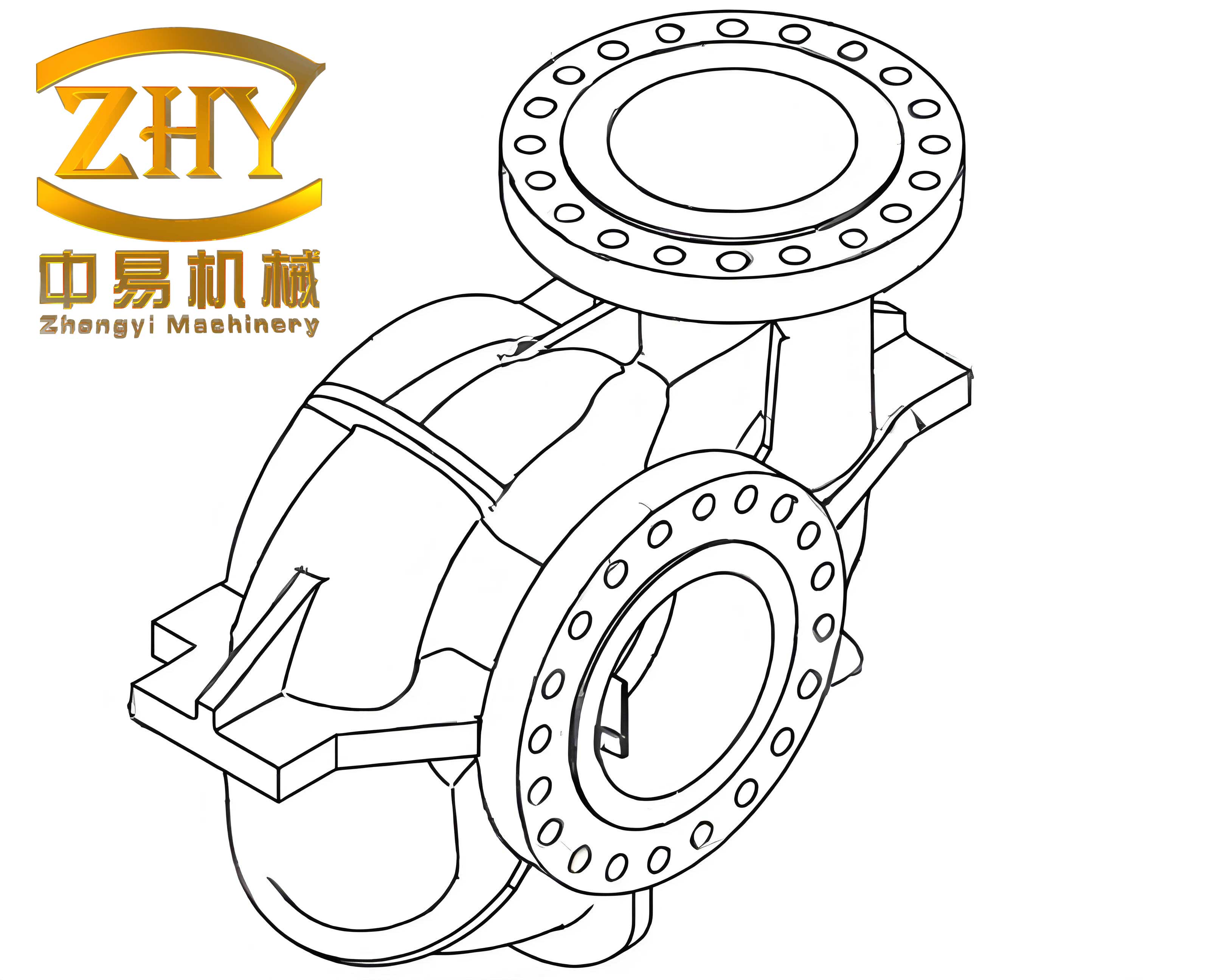
The subject is a housing-type aluminum alloy shell casting with an outline dimension of approximately 318 mm × 125 mm × 148 mm. The nominal thin-wall thickness is 6 mm, adjacent to substantial bosses up to 30 mm thick, creating a significant variation in section thickness that increases the risk of distortion during solidification and subsequent T5 heat treatment. Three port locations on the casting require a coaxiality tolerance of ±0.35 mm, necessitating specific anti-distortion measures. Additionally, the part has a stringent airtightness requirement: the internal cavity must hold 1 MPa of air for 15 minutes without leakage. The internal surfaces of the cavity carry machining allowances of 2–4 mm, which in some areas are 1.5 to 4 times the nominal wall thickness. Therefore, the control requirement for porosity had to be elevated from the standard allowable level (Grade 2) to “none” to guarantee the final part’s airtightness.
1.2 Production Process
The investment casting process was used, involving pattern wax injection, cluster assembly, ceramic shell building, melting and pouring, shell removal and cutoff, and heat treatment. The key materials and equipment are summarized below:
| Process Stage | Material / Equipment | Specification / Type |
|---|---|---|
| Pattern Making | Medium-Temperature Wax | – |
| Shell Building | Mullite Sand | – |
| Melting & Pouring | ZL116 Ingot | Composition per Table 1 |
| Shell Building Robot | Industrial Robot | IRC5 Single |
| Melting Furnace | Vacuum Induction Melter | ZG-0.04L |
1.3 Inspection Methods and Equipment
The main inspection workflow included dimensional checks, physical/chemical testing, and radiographic inspection. Initial Digital Radiography (DR) was performed using an Xlcube Compact 320 kV system, with final X-ray inspection conducted using MXR-225/22 and MXR-320/26 X-ray units.
2. Results and Analysis: Numerical Simulation and Optimization
2.1 Gating System Design and Initial Simulation Setup
After 3D modeling, the part (nominal) and the casting (with machining allowances and anti-distortion ribs) were imported into numerical simulation software. The models were meshed with a surface mesh size of 4 mm. Process parameters were set based on empirical knowledge, as shown in Table 2. Given the high density requirement for the shell castings, porosity distribution was analyzed for areas with a predicted shrinkage porosity rate > 0.5%.
| Parameter | Value |
|---|---|
| Shell Thickness | 8 mm |
| Interface Heat Transfer Coefficient | 200 W/(m²·K) |
| Pouring Time | 15 s |
| Shell Pre-heat Temperature | 350 ± 25 °C |
| Pouring Temperature | 710 ± 5 °C |
| Cooling Method | Air Cooling |
2.2 Solidification Simulation Analysis
2.2.1 Analysis of the Part and Casting (Without Gating)
Simulations of the nominal part and the casting (with allowances/ribs) without a gating system were compared. The results were striking:
- Solidification Time Increase: The total solidification time increased dramatically from 194 s for the part to 415 s for the casting.
- Hot Spot Inheritance and Creation: All original thermal hot spots from the part were present in the casting. Two new significant hot spots emerged precisely at locations where machining allowances were added.
- Altered Solidification Sequence: For the nominal part, solidification initiated at the thinnest port sections and progressed inwards. Adding mass at the ports changed this sequence, causing mid-sections of outer walls to solidify first and reducing the overall temperature gradient.
The consequence was an increased tendency for mushy solidification. Porosity simulation under the >0.5% criterion confirmed this: the total porous volume increased by approximately 20%, from 21.35 cm³ for the part to 26.49 cm³ for the casting, with porosity appearing or worsening at all thickened sections.
The extended local solidification time $t_f$ in a section of thickness $d$ can be approximated by Chvorinov’s rule, relating it to the volume-to-surface area ratio:
$$
t_f = B \left( \frac{V}{A} \right)^n
$$
where $B$ is the mold constant and $n$ is an exponent (typically ~2). Adding machining allowance increases the volume $V$ while the cooling surface area $A$ may not increase proportionally, leading to a higher $(V/A)$ ratio and a longer $t_f$. This promotes a wider mushy zone and hinders directional feeding.
2.2.2 Initial Gating System Design and Simulation
Based on the above analysis, an initial gating system was designed with the following rationale: ports and outer walls should act as “cold ends,” while internal hot spots should be fed via gates acting as “hot ends,” aiming to establish a positive temperature gradient from thin to thick sections, and from the casting towards the gates. This system included several ingates and anti-distortion ribs.
Simulation of this initial scheme showed improved but insufficient directional solidification. Key issues remained:
- Anti-Distortion Rib Side: The temperature gradient was shallow, with almost the entire side solidifying within two narrow time bands, indicating a high risk of mushy solidification and porosity.
- Internal Cavity and Ports: Critical port sections failed to act as effective chill zones. The entire internal cavity structure, including thick flanges, resided within a similar solidification time range, preventing the establishment of a favorable thermal gradient for feeding.
The porosity simulation predicted a porous volume of 1.38 cm³, primarily located at the outer wall (near the rib), internal cavity flanges, and port flanges.
2.3 Process Optimization and Validation
2.3.1 Root Cause Analysis of Defects
The analysis pinpointed the core issue: insufficient heat extraction. The 8 mm thick shell had inherently poor cooling capacity. Internally, the cavity structure left minimal gaps (15-20 mm) for air circulation after shell building, effectively turning the entire internal port-and-cavity assembly into a single thermal mass. Furthermore, the thick (ϕ15 mm) anti-distortion rib created a new hot spot, raising the local temperature and preventing the adjacent port from acting as a chill. The result was a near-isothermal condition promoting mushy solidification.
The temperature gradient $G$ is crucial for directional solidification. A low or negative $G$ leads to equiaxed, mushy solidification prone to porosity. The thermal resistance of the shell $R_{shell}$ is a key factor:
$$
R_{shell} = \frac{\delta_{shell}}{k_{shell}}
$$
where $\delta_{shell}$ is the shell thickness and $k_{shell}$ is its thermal conductivity. A thicker shell increases $R_{shell}$, reducing the heat flux $q$ extracted for a given temperature difference $\Delta T$:
$$
q = \frac{\Delta T}{R_{shell}}
$$
Reduced heat flux lowers $G$, compromising the solidification mode.
2.3.2 Optimized Scheme and Simulation
Three key modifications were implemented to enhance cooling and establish a positive thermal gradient:
- Shell Thinning: Reduce shell thickness from 8 mm to 6 mm to lower its thermal resistance and increase internal cavity gaps.
- Rib Optimization: Reduce anti-distortion rib diameter from ϕ15 mm to ϕ8 mm to minimize its thermal mass and increase air gaps.
- Active Air Cooling: Apply forced air cooling specifically to the external rib area and the internal cavity during solidification.
The effect of air cooling can be modeled as an enhanced convective boundary condition. The heat flux $q_{cool}$ due to air cooling is:
$$
q_{cool} = h_{air} (T_{surface} – T_{air})
$$
where $h_{air}$ is the convective heat transfer coefficient (increased by forced air), $T_{surface}$ is the shell surface temperature, and $T_{air}$ is the ambient air temperature. This additional heat extraction increases the local $G$.
Re-simulation of the optimized scheme showed marked improvement:
- The temperature field on the rib side showed a much larger area solidifying in the first time interval, indicating a steeper thermal gradient.
- Within the internal cavity, a clear directional solidification sequence was established: port flange (coolest) → internal cavity flange → main hot spot fed by the ingate (hottest).
The predicted porous volume reduced by approximately 50%, from 1.38 cm³ to 0.70 cm³, and was confined to minimal, acceptable levels. The Niyama criterion $G/\sqrt{R}$ (where $R$ is the solidification rate), often used to predict shrinkage porosity, would show a significant increase in critical areas with these modifications, indicating a lower porosity risk.
| Metric | Initial Scheme | Optimized Scheme | Improvement |
|---|---|---|---|
| Predicted Porosity Volume (>0.5% criterion) | 1.38 cm³ | 0.70 cm³ | ~49% Reduction |
| Thermal Gradient at Critical Flange (Estimated) | Low / Shallow | Steep / Positive | Significantly Improved |
| Solidification Sequence | Near-isothermal, Mushy zones | Directional, Sequential | Corrected |
2.3.3 Trial Production Validation
The optimized process scheme was put into production. The resulting shell castings were subjected to DR inspection. The radiographic results showed no indications of shrinkage porosity on the outer walls, internal flanges, or any other area, confirming the simulation predictions. After machining, the final parts successfully passed the 1 MPa, 15-minute airtightness test, and all dimensional requirements, including the ±0.35 mm coaxiality, were met. This validated the effectiveness of the integrated optimization strategy for producing high-integrity aluminum alloy shell castings.
3. Conclusions
- The integrated optimization measures—thinning the ceramic shell, reducing the size of anti-distortion ribs, and implementing targeted air cooling—proved highly effective. These actions enhanced heat extraction, established a positive temperature gradient for directional solidification, and successfully eliminated shrinkage porosity in the produced ZL116 aluminum alloy shell castings. The final machined parts met all stringent design requirements, including dimensional accuracy and airtightness.
- The numerical simulation results exhibited a high degree of correlation with the actual casting inspection results. This demonstrates the powerful capability of simulation technology to guide process design, diagnose defect root causes, and iterate towards optimal solutions, thereby significantly improving the first-pass success rate and production efficiency for complex shell castings.
The success of this study underscores the importance of a holistic approach to casting process design, where gating, feeding, cooling, and distortion control must be co-optimized, supported by advanced simulation tools, to achieve the highest levels of internal quality in demanding aerospace components like thin-walled aluminum shell castings.