
The rapid development of the automotive industry in recent years has imposed a significant burden on resources and the environment. Achieving carbon neutrality has emerged as a long-term strategic goal for both our nation and the global community in addressing climate change, making the reduction of carbon emissions an urgent challenge. Automotive lightweighting technology stands as one of the most critical pathways for reducing fuel consumption and emissions in conventional vehicles and for lowering energy consumption and extending the range of new energy vehicles. Aluminum alloys, renowned for their low density, excellent corrosion resistance, and good thermal conductivity, represent an ideal lightweight material and have seen widespread application in automotive lightweighting technologies in recent years. Among key automotive components, transmission housings are crucial load-bearing parts within powertrain systems. Traditionally, such housings were often manufactured from ductile iron via gravity casting, resulting in high weight and a propensity for casting defects. Consequently, A356 aluminum alloy has been selected as the forming material for these components. Low-pressure die casting, as one of the primary forming methods for aluminum alloys, effectively resolves the inherent contradiction between smooth mold filling and directional solidification feeding found in traditional gravity casting. This process enables the production of transmission housings with dense microstructures and superior mechanical properties.
This work focuses on the optimization of the low-pressure casting process for an aluminum alloy gearbox housing. The study employs numerical simulation software to analyze the initial casting process, predict potential shrinkage porosity defects, and investigate their formation mechanisms. Building upon this analysis, the cooling system design is improved. Subsequently, a multi-objective optimization of key process parameters is conducted using the orthogonal experimental design method. The goal is to enhance the quality of the final shell castings and improve production efficiency simultaneously.
Initial Process Design and Numerical Simulation Analysis
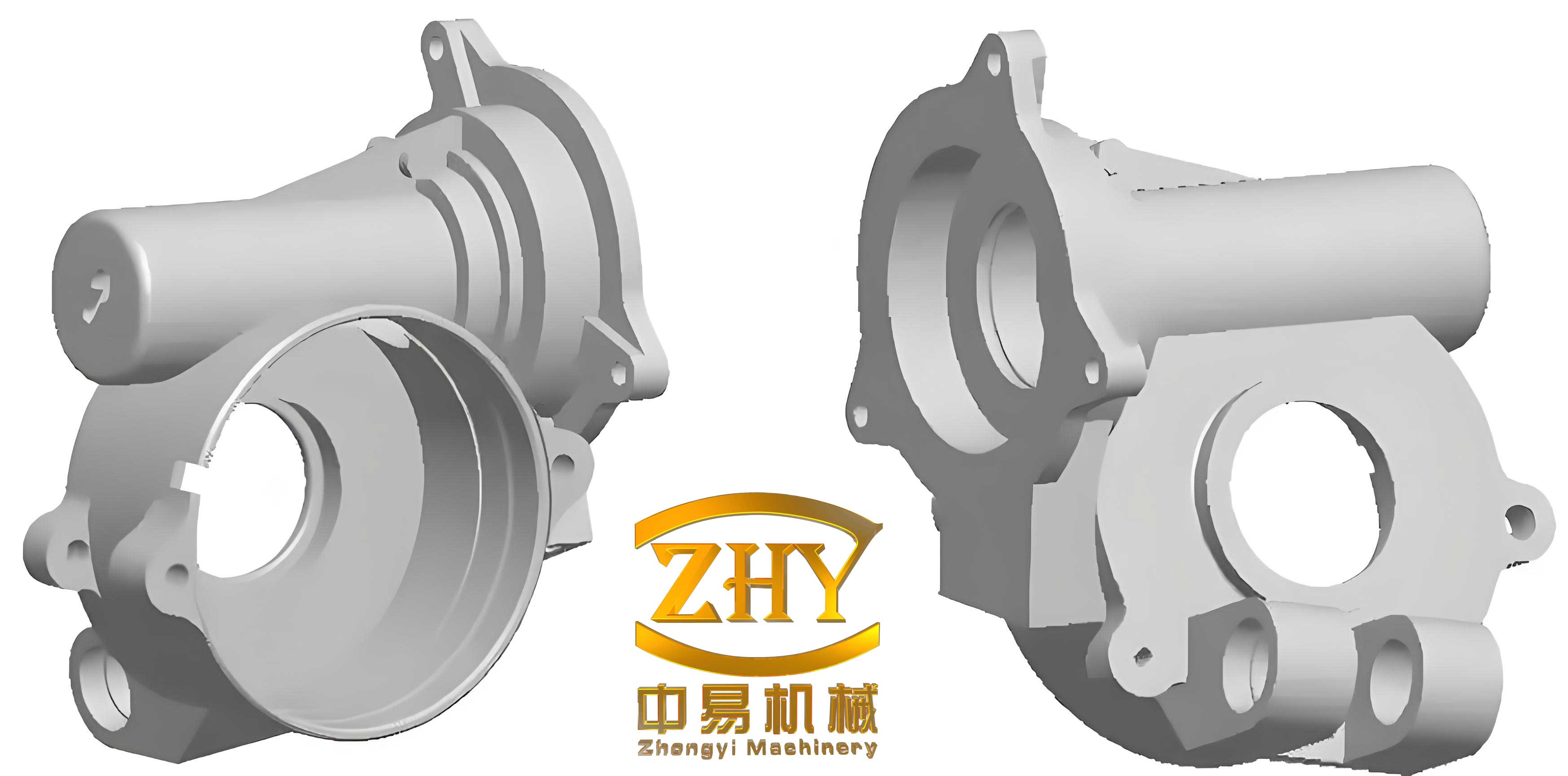
The first step involved creating a three-dimensional model of the gearbox housing and its gating system. The housing is a complex, thin-walled structure with significant variations in wall thickness, presenting considerable casting challenges. To promote directional solidification and establish effective feeding channels, a bottom-gated, pressurized gating system was designed. The three-dimensional model was imported into simulation software for meshing in preparation for analysis.
The shell castings material was defined as A356 aluminum alloy. Its chemical composition and key thermophysical properties are summarized in the tables below.
| Element | Si | Mg | Fe | Ti | Sr | Cr+Cu+Mn+Ni+Sn+Zn | Al |
|---|---|---|---|---|---|---|---|
| Wt.% | 6.6 | 0.36 | 0.09 | 0.19 | <0.005 | <0.01 | Bal. |
| Property | Value |
|---|---|
| Density (kg/m³) | 2430 |
| Liquidus Temperature (°C) | 613 |
| Solidus Temperature (°C) | 542 |
| Latent Heat (kJ/kg) | 430 |
| Thermal Conductivity (W/m·K) | 70 |
The mold material was set as H13 steel. The low-pressure casting cycle parameters, including pressurization profile for filling and intensification, were established based on Pascal’s principle and empirical formulas. Initial process parameters were set as follows: a pouring temperature of 720°C and a mold preheat temperature of 280°C. Appropriate interfacial heat transfer coefficients were assigned between the metal, mold, and environment.
The simulation of the initial process revealed issues in the solidification pattern. While an overall directional trend was observed, localized areas, particularly where thin walls met thicker reinforcing ribs, exhibited premature solidification that isolated liquid pools. The formation of isolated liquid regions is a primary cause of shrinkage defects, as subsequent volumetric contraction cannot be compensated by feeding from surrounding liquid metal under pressure. This can be described by considering the local thermal gradient and solidification rate. A critical condition for sound feeding is maintaining a positive temperature gradient towards the feeder. When an isolated liquid zone forms, this condition fails. The Niyama criterion, often used to predict shrinkage porosity, relates to this local thermal history:
$$G / \sqrt{R} \leq \text{Constant}$$
where \(G\) is the temperature gradient and \(R\) is the cooling rate. Low values of this parameter indicate a higher risk of microporosity. The simulation results visually confirmed areas with a high risk of shrinkage in the initial design for the shell castings.
Cooling System Optimization
To address the problematic solidification sequence identified in the initial simulation, the cooling system was redesigned. The objective was to modify the local thermal field to eliminate isolated liquid pools and enforce a more robust directional solidification pattern towards the main feeder (the riser or pressure source in low-pressure casting).
Water-cooling channels were strategically placed in the mold adjacent to the identified hot spots—the thicker sections that solidified last. The diameter, water flow rate, and activation timing for each cooling line were carefully designed. The opening time was typically set shortly after the mold cavity filled to allow initial natural cooling, and the closing time was set before complete solidification to avoid over-cooling. The initial cooling scheme parameters are listed below:
| Line No. | Diameter (mm) | Coolant | Flow Rate (m³/h) | Start Time (s) | Stop Time (s) |
|---|---|---|---|---|---|
| 1 | 12 | Water | 1.5 | 20 | 100 |
| 2, 3 | 16 | Water | 1.5 | 11 | 100 |
| 4, 5 | 16 | Water | 1.5 | 7 | 90 |
| 6-8 | 16 | Water | 3.0 | 4 | 80 |
| 9 | 12 | Water | 3.0 | 4 | 80 |
| 10 | 16 | Water | 2.0 | 170 | 220 |
This active cooling approach directly extracts heat from specific mold regions, increasing the local solidification rate and altering the solidification front progression. The governing heat transfer can be modeled by Fourier’s law and Newton’s law of cooling at the mold-coolant interface. The heat flux \(q\) removed by a cooling channel is approximately:
$$q = h_c A (T_m – T_c)$$
where \(h_c\) is the heat transfer coefficient between the mold and coolant, \(A\) is the effective contact area, \(T_m\) is the mold surface temperature, and \(T_c\) is the coolant temperature. By adjusting \(h_c\) (via flow rate) and the duration of cooling (\(\Delta t\)), the total energy extracted \(Q\) can be controlled:
$$Q = \int_{t_{start}}^{t_{stop}} q \, dt$$
This controlled extraction is crucial for optimizing the solidification path of complex shell castings.
Multi-Objective Process Parameter Optimization via Orthogonal Experimentation
With an improved cooling layout in place, the focus shifted to optimizing the key process parameters that significantly influence the quality and productivity of the shell castings. Three critical factors were identified: Pouring Temperature (A), Mold Preheating Temperature (B), and Cooling Water Temperature (C). Each factor was studied at four levels. An L₁₆(4³) orthogonal array was employed to design the simulation experiments efficiently, requiring only 16 runs instead of the full factorial 64.
The levels for each factor are shown in the table below:
| Level | A: Pouring Temp. (°C) | B: Mold Temp. (°C) | C: Water Temp. (°C) |
|---|---|---|---|
| 1 | 680 | 240 | 20 |
| 2 | 700 | 260 | 25 |
| 3 | 720 | 280 | 30 |
| 4 | 740 | 300 | 35 |
Three key quality metrics were selected as evaluation criteria:
- Shrinkage Porosity Criterion Value: A scalar output from the simulation software. A value greater than 1 at a location indicates a high probability of shrinkage defect formation. Minimizing the maximum value in the casting is the primary goal.
- Secondary Dendrite Arm Spacing (SDAS, μm): A critical microstructural feature inversely related to mechanical properties. A finer microstructure (lower SDAS) generally yields higher strength and ductility. SDAS is strongly influenced by the local solidification time \(t_f\), often related by an equation of the form:
$$ \text{SDAS} = k (t_f)^n $$
where \(k\) and \(n\) are material constants. Therefore, controlling the thermal history is key to refining the microstructure of the shell castings.
- Total Solidification Time (s): Directly related to production cycle time and thus productivity. Shorter solidification times are desirable, provided quality is not compromised.
The results for all 16 orthogonal trials are summarized in the following table:
| Run No. | A | B | C | Shrinkage Index | SDAS (μm) | Solidification Time (s) |
|---|---|---|---|---|---|---|
| 1 | 1 | 1 | 1 | 6.00 | 46.18 | 193.80 |
| 2 | 1 | 2 | 2 | 4.39 | 46.57 | 197.83 |
| 3 | 1 | 3 | 3 | 8.15 | 47.00 | 202.68 |
| 4 | 1 | 4 | 4 | 6.21 | 48.21 | 217.70 |
| 5 | 2 | 1 | 2 | 8.47 | 46.41 | 197.09 |
| 6 | 2 | 2 | 3 | 7.20 | 46.79 | 201.33 |
| 7 | 2 | 3 | 4 | 5.99 | 47.39 | 212.06 |
| 8 | 2 | 4 | 1 | 5.93 | 48.65 | 228.34 |
| 9 | 3 | 1 | 3 | 11.09 | 46.55 | 200.62 |
| 10 | 3 | 2 | 4 | 3.64 | 46.98 | 204.98 |
| 11 | 3 | 3 | 1 | 4.34 | 48.14 | 219.37 |
| 12 | 3 | 4 | 2 | 23.48 | 48.98 | 230.05 |
| 13 | 4 | 1 | 4 | 0.98 | 46.87 | 206.35 |
| 14 | 4 | 2 | 1 | 2.68 | 47.60 | 215.11 |
| 15 | 4 | 3 | 2 | 2.62 | 48.72 | 229.53 |
| 16 | 4 | 4 | 3 | 3.69 | 49.89 | 236.07 |
A mean value and range analysis was performed on the results for each criterion to determine the influence of each factor and its optimal level. The analysis for the Shrinkage Index is detailed below, with similar tables constructed for SDAS and Solidification Time.
| Factor | Mean Shrinkage Index by Level | Range | Optimal Level | |||
|---|---|---|---|---|---|---|
| L1 | L2 | L3 | L4 | |||
| A (Pouring T.) | 6.19 | 6.90 | 10.64 | 2.49 | 8.15 | A4 (740°C) |
| B (Mold T.) | 6.64 | 4.48 | 5.28 | 9.83 | 5.35 | B2 (260°C) |
| C (Water T.) | 5.31 | 9.74 | 6.96 | 4.21 | 5.53 | C4 (35°C) |
The analysis yielded the following insights:
- Shrinkage Porosity: Pouring Temperature (A) had the greatest influence (largest range). The optimal combination for minimizing shrinkage was A4B2C4. Interestingly, a higher pouring temperature (A4) was beneficial, likely because it delayed solidification in thin sections, allowing better feeding from the thick sections under pressure.
- Secondary Dendrite Arm Spacing (SDAS): Mold Preheating Temperature (B) was the most significant factor. Lower mold temperatures (B1) resulted in finer dendrites due to faster cooling. The optimal combination for fine microstructure was A1B1C4.
- Solidification Time: Again, Mold Preheating Temperature (B) dominated. Lower preheat temperatures (B1) drastically reduced cycle time. The fastest solidification was also achieved with A1B1C4.
The conflict between objectives is clear: the best parameters for mechanical properties and productivity (A1B1C4) were not the best for eliminating shrinkage (A4B2C4). A compromised, multi-objective optimization was necessary.
Determination and Validation of the Optimal Process
Several candidate parameter sets were simulated based on the orthogonal analysis:
- Candidate 1 (A4B2C4): Prioritizes defect-free casting.
- Candidate 2 (A4B1C4): Lowers mold temperature from Candidate 1 to improve SDAS and time, while keeping high pouring temp for feeding.
- Candidate 3 (A4B1C1): Further lowers cooling water temperature from Candidate 2 to enhance cooling rate, potentially refining structure further and reducing time.
- Candidate 4 (A1B1C4): The theoretical best for SDAS and time, but high shrinkage risk.
The simulation results for these candidates are compared below:
| Candidate | Parameters (A-B-C) | Shrinkage Index | SDAS (μm) | Solidification Time (s) |
|---|---|---|---|---|
| 1 | 740°C, 260°C, 35°C | 0.94 | 47.62 | 215.31 |
| 2 | 740°C, 240°C, 35°C | 0.98 | 46.87 | 206.35 |
| 3 | 740°C, 240°C, 20°C | 0.95 | 46.83 | 205.76 |
| 4 | 680°C, 240°C, 35°C | 5.89 | 46.29 | 195.03 |
Candidate 4 was rejected due to its high shrinkage index (>1). Among the remaining defect-free options (Index < 1), Candidate 3 offered the best combination: the lowest SDAS (implying better mechanical properties) and the shortest solidification time (higher productivity). Therefore, Candidate 3 (A4B1C1: Pouring Temperature 740°C, Mold Preheating Temperature 240°C, Cooling Water Temperature 20°C) was selected as the optimal process for manufacturing these aluminum shell castings.
The temperature history at critical points within the casting was examined for the optimal process. The curves showed a clear, non-intersecting progression of solidification fronts from thin to thick sections, confirming a sound directional solidification pattern was achieved, which is essential for producing high-integrity shell castings.
A production trial was conducted using the optimized process parameters. The resulting aluminum alloy gearbox housing was free from macroscopic shrinkage defects, with good surface quality and dimensional accuracy.
Metallographic samples were extracted from various locations of the trial-produced shell casting, including areas previously prone to defects. After preparation and etching, microscopic examination revealed a uniform, fine-grained microstructure throughout the component. No microscopic shrinkage porosity or gas pores were observed. The secondary dendrite arm spacing was consistent with the simulation predictions. This metallographic analysis provided definitive validation that the optimized low-pressure casting process is capable of producing sound, high-quality aluminum alloy shell castings with reliable internal integrity.
Conclusion
This study successfully demonstrated an integrated approach to optimizing the low-pressure die casting process for complex aluminum alloy shell castings. The methodology combined numerical simulation, targeted cooling system design, and multi-objective parameter optimization using orthogonal experimentation.
- Numerical simulation of the initial process effectively identified the root cause and locations of potential shrinkage porosity defects, guiding the redesign of the cooling system to enforce directional solidification.
- The orthogonal experiment quantitatively analyzed the effects of pouring temperature, mold preheating temperature, and cooling water temperature on shrinkage formation, microstructure fineness (SDAS), and production cycle time. The analysis revealed trade-offs between these objectives.
- The optimal process parameters were determined to be a pouring temperature of 740°C, a mold preheating temperature of 240°C, and a cooling water temperature of 20°C. This combination ensures the production of defect-free shell castings while also promoting a fine microstructure and a relatively short solidification time.
- The validity of the optimized process was confirmed through actual production trials and subsequent metallographic analysis, which verified the absence of defects and the attainment of a uniform, refined grain structure in the aluminum alloy shell castings.
This work provides a systematic and effective framework for process development in low-pressure casting, particularly for challenging thin-walled and structurally complex components like transmission housings, contributing to the advancement of lightweight automotive manufacturing.