
In the realm of automotive component manufacturing, the production of high-integrity shell castings, particularly for critical assemblies like steering pumps, demands meticulous attention to core preparation. As an engineer deeply involved in foundry process optimization, I have extensively studied and refined the methods for crafting sand cores used in these shell castings. The performance, dimensional accuracy, and surface quality of the final steering pump housing are intrinsically linked to the design and production quality of its internal sand cores. This article delves into a first-person, detailed examination of the entire sand core preparation workflow, from initial design to final curing, emphasizing data-driven optimization strategies. I will incorporate numerous tables and mathematical models to summarize key parameters and relationships, all while frequently referencing the central theme of producing superior shell castings.
The internal cavity of an automotive steering pump shell casting is complex, typically comprising a main chamber, return oil passages, and valve bore holes. To facilitate core manufacturing, handling, and assembly within the mold, the core assembly is strategically divided into multiple segments. Based on principles of ease in core shooting, stripping, and placement, I designed a two-core system. One core, which I will refer to as Core A, forms the main chamber and the interconnected return oil gallery. The second core, Core B, is dedicated to forming the valve bore, which often features a U-shaped oil passage. This separation is crucial because a single, monolithic core for the entire cavity would be geometrically locked, making it impossible to extract from the core box. Core B, which forms a cantilevered feature, requires precise location. Its core print (the extension that sits in the mold) is designed with a circular hole and a square seat to ensure positive location and fixation on the bottom mold plate. Core A, placed atop the bottom mold before mold closing, features a square recess at its base that mates with a corresponding square peg on the mold, ensuring anti-rotation and accurate positioning. The top of Core A also has a square print that fits into a square cavity in the top mold, preventing any movement during mold assembly and metal pouring.
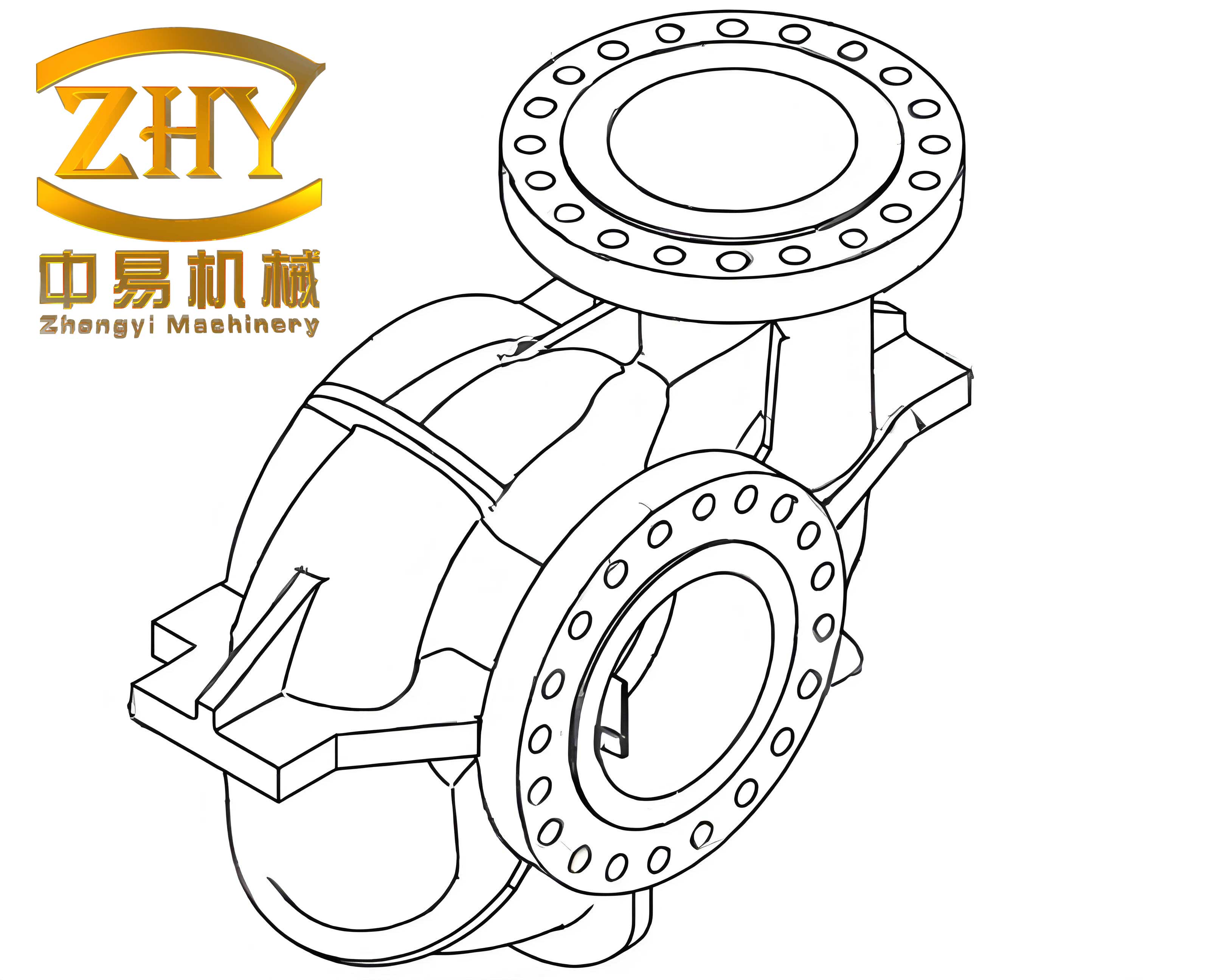
The visualization above illustrates the intricate geometry typical of such shell castings and their cores. These sand cores are manufactured using the shell core process, which employs resin-coated sand (Resin Coated Sand, or RCS). The process involves shooting the RCS into a heated metal core box where the resin undergoes rapid thermal curing, producing a hard, dimensionally stable shell core. The superiority of this method for producing precise cores for shell castings cannot be overstated.
Core Design Principles and Mathematical Modeling
Designing an efficient core starts with a thorough analysis of the casting’s internal geometry. The primary goals are to minimize the number of core joints (to reduce potential leakage paths for molten metal), ensure proper venting for gases generated during casting, and guarantee adequate core strength to withstand metallostatic pressure. For the steering pump shell, the two-core solution represents an optimal trade-off. The core print design is critical for location. The required print area can be estimated based on the buoyant force exerted by the molten metal on the core. The buoyancy force ($F_b$) is given by:
$$F_b = V_c \cdot (\rho_m – \rho_c) \cdot g$$
where $V_c$ is the volume of the core submerged in molten metal, $\rho_m$ is the density of the molten metal (e.g., aluminum alloy, approximately 2500 kg/m³), $\rho_c$ is the density of the cured sand core (approximately 1500 kg/m³), and $g$ is acceleration due to gravity. The core print must provide sufficient frictional and mechanical resistance to counteract this force. The necessary print contact area ($A_p$) can be derived from:
$$A_p \geq \frac{F_b}{\mu \cdot P_a}$$
where $\mu$ is the coefficient of friction between the core sand and the mold material (typically 0.2-0.3 for sand-on-metal), and $P_a$ is the allowable bearing pressure on the mold sand or metal. For shell cores used in metal molds, this calculation ensures the prints are adequately sized. A summary of key design parameters for the two cores is presented in Table 1.
| Core Designation | Primary Function | Approximate Volume (cm³) | Core Print Design | Estimated Buoyancy Force (N) | Minimum Required Print Area (cm²) |
|---|---|---|---|---|---|
| Core A (Main Chamber) | Forms main cavity & return gallery | 185 | Square recess (base), square peg (top) | ~18.2 | ~3.5 |
| Core B (Valve Bore) | Forms U-shaped valve bore passage | 65 | Circular hole & square seat (base) | ~6.4 | ~1.5 |
The core material is hot-box resin-coated sand. The selection of resin type and coating percentage is vital for the shell casting’s internal surface finish. A typical formulation involves silica sand coated with 2.5-4.0% phenolic or furan resin. The curing kinetics of the resin are temperature-dependent, following an Arrhenius-type relationship. The degree of cure ($\alpha$) over time ($t$) at a constant core box temperature ($T$) can be modeled as:
$$\alpha(t) = 1 – \exp\left(-k(T) \cdot t^n\right)$$
where $k(T) = A \exp\left(-\frac{E_a}{RT}\right)$.
Here, $A$ is the pre-exponential factor, $E_a$ is the activation energy for the resin cure reaction, $R$ is the universal gas constant, and $n$ is the reaction order (often close to 1 for these systems). For practical purposes in shell core production for shell castings, a target cure depth of 5-10 mm is desired to ensure handleable strength upon ejection. The curing time ($t_c$) to achieve a specific cure depth ($d$) in a semi-infinite medium with constant surface temperature can be approximated by a heat conduction and reaction model. A simplified form for estimating the cycle time is:
$$t_c \approx \frac{d^2}{4 \cdot \alpha} + \tau_r$$
where $\alpha$ is the thermal diffusivity of the sand-resin mixture, and $\tau_r$ is the characteristic resin reaction time at the set temperature. This interplay dictates the core production cycle.
Core Shooting Machine Selection and Operational Dynamics
For mass production of these cores, automated shooting machines are indispensable. I have worked with machines similar to the Z94 series vertical parting shell core shooters. These machines can be configured for full or semi-automatic operation. The core shooting process is a coupled thermo-fluidic event. The compressed air used to propel the sand mix does work on the sand, fluidizing it momentarily. The pressure drop ($\Delta P$) across the sand bed in the shooting nozzle and the core box cavity influences the sand packing density. A basic momentum balance relates the shooting pressure to the final core density ($\rho_{core}$):
$$\Delta P \propto \frac{\mu_{eff} \cdot v \cdot L}{K}$$
where $\mu_{eff}$ is the effective viscosity of the fluidized sand-air mixture, $v$ is the flow velocity, $L$ is the flow path length, and $K$ is the permeability of the sand mix. Higher, well-controlled shooting pressure leads to more uniform packing, which is critical for the structural integrity of the shell castings’ cores. The selected machine features two core box stations, allowing simultaneous or staggered production of different cores. Its cycle consists of several phases: index/close core box, shoot sand, cure, open box, and eject core. The cure time is the longest segment and is temperature-controlled. The machine’s productivity ($P$, cores per hour) for a single station is given by:
$$P = \frac{3600}{t_{cycle}}$$
where $t_{cycle}$ is the total cycle time in seconds. For a dual-station machine producing two cores per cycle, the effective productivity doubles, provided curing occurs in parallel. Table 2 breaks down the typical cycle for our specific cores.
| Process Step | Core A (Main) Time (s) | Core B (Valve) Time (s) | Remarks |
|---|---|---|---|
| Core Box Close & Index | 3 | 3 | Machine dependent |
| Sand Shooting & Packing | 2 | 2 | ~0.5-0.7 MPa air pressure |
| Resin Curing (at 230°C) | 15 | 30 | Temperature and geometry dependent |
| Core Box Open & Ejection | 4 | 4 | Includes mechanical stripping |
| Total Cycle Time (per station) | 24 | 39 | Measured from field data |
| Theoretical Output (cores/hr/station) | 150 | ~92 | 3600 / Cycle Time |
This disparity in cycle times, primarily due to the different curing times required by the core geometries, has significant implications for production line balancing when manufacturing cores for shell castings.
Detailed Core Manufacturing Process Sequence
The post-shooting operations are equally critical for ensuring the quality of the final shell castings. The process sequence I have implemented and optimized consists of three major stages: shooting, coating, and baking.
Stage 1: Core Shooting. As described, the Z94 machine shoots the resin-coated sand into the heated core boxes (maintained at 220-250°C). The resin flows, wets the sand grains, and upon heating, cross-links to form a rigid polymer network. The cured shell thickness ($\delta$) is a function of the core box temperature ($T_{box}$) and contact time ($t$). An empirical relationship often used is:
$$\delta = C \cdot \sqrt{t} \cdot \exp\left(-\frac{Q}{2RT_{box}}\right)$$
where $C$ is a material constant and $Q$ is an activation energy. For the shell cores in our pump shell castings, we target a thickness of 6-8 mm, which provides an excellent balance between strength, weight, and gas permeability.
Stage 2: Core Coating Application. After shooting, ejection, and minimal trimming to remove fins or flash, the cores are coated. The coating serves multiple purposes: it prevents metal penetration (mechanical and chemical sand burn-on), reduces surface roughness, and can improve the collapsibility of the core after casting. I typically use a water-based zirconite or graphite coating applied via dipping or spraying. The coating thickness ($h_{coat}$) must be controlled precisely. Too thin, and it’s ineffective; too thick, and it can crack or impede gas evolution. The coating weight per unit area ($W/A$) is a key metric:
$$\frac{W}{A} = \rho_{coat} \cdot h_{coat}$$
For our shell castings’ cores, a target coating weight of 0.8-1.2 mg/mm² is maintained. The spraying operation takes approximately 29 seconds per core, including handling. The coating slurry’s viscosity ($\eta$) is critical for application and is adjusted using additives to meet a target flow time in a Ford cup, often around 40-50 seconds. The drying of this aqueous layer before baking is a diffusion-limited process, but it is usually done at ambient conditions for a short period.
Stage 3: Core Baking (Drying & Strengthening). This is a crucial thermal treatment process. The coated cores are placed on trays and loaded into a convection oven. The baking serves to: 1) completely evaporate the water from the coating, 2) further cure any under-cured resin in the core body (post-curing), and 3) develop the final bond strength of the coating. The baking cycle is a three-stage thermal profile as viewed from the core’s perspective:
- Heating Phase: The core temperature rises from ambient to the hold temperature. The rate must be controlled to avoid steam generation within the coating layer, which could cause blistering. The heat transfer is governed by:
$$ \frac{\partial T}{\partial t} = \alpha \nabla^2 T $$
where $\alpha$ is the thermal diffusivity of the coated core. - Soaking/Holding Phase: The cores are held at a constant temperature, typically 280-320°C, for a specified time ($t_{soak}$). This ensures complete moisture removal and coating sintering. The required soak time depends on the core’s thickest section. A simplified model for ensuring complete drying is:
$$t_{soak} > \frac{L_c^2}{D_{eff}}$$
where $L_c$ is the characteristic diffusion length (half-thickness for a slab) and $D_{eff}$ is the effective moisture diffusivity in the coating at the bake temperature. - Cooling Phase: The cores are cooled slowly within the oven to room temperature to prevent thermal shock, which could crack the coating or the core itself.
In practice, for the shell castings’ cores we produce, the total bake time ranges from 1.5 to 2.0 hours in an oven capable of holding 140 cores per batch. After baking, the cores are cooled for at least two hours before being released to the molding line. This ensures they are at a stable, manageable temperature and have released any residual stresses.
Production Data Analysis and Line Balancing
A key challenge in high-volume production of shell castings is synchronizing the output of different core types, as each steering pump housing requires one of each core (Core A and Core B). The data collected from the shop floor reveals a bottleneck. The curing time for Core B is nearly double that of Core A, leading to a lower intrinsic production rate for Core B if an equal number of machines are used. Let’s define the following based on measured data:
- $t_{A}$ = Cycle time for Core A shooter = 24 s (produces 2 cores/cycle, so 12 s/core).
- $t_{B}$ = Cycle time for Core B shooter = 46 s (produces 2 cores/cycle, so 23 s/core).
- $N_A$ = Number of Core A shooting machines.
- $N_B$ = Number of Core B shooting machines.
The production rate for each core type ($R_A$, $R_B$ in cores/hour) is:
$$R_A = N_A \cdot \frac{3600}{t_{A}} \cdot 2 \quad \text{(since 2 cores/cycle)}$$
$$R_B = N_B \cdot \frac{3600}{t_{B}} \cdot 2$$
For a balanced production line where $R_A = R_B$ (to match the 1:1 consumption ratio at molding), we require:
$$N_A \cdot \frac{3600}{24} \cdot 2 = N_B \cdot \frac{3600}{46} \cdot 2$$
Simplifying, we get the machine ratio:
$$\frac{N_B}{N_A} = \frac{46}{24} \approx 1.92$$
This implies that to balance the line, we need approximately two Core B shooting machines for every one Core A shooting machine. In the initial setup with one machine for each type, Core B production was the bottleneck. Adding a second Core B machine alleviates this. However, we must also consider the downstream operations: deflashing, coating, and baking. The takt time, or required production rate per core type, is determined by the molding line’s demand. If the molding line produces $M$ castings per hour, then $R_A = R_B = M$. Solving for the required number of machines gives us a more complete picture, incorporating efficiency factors ($\eta$, typically 0.85-0.90).
Let’s assume a target of 120 shell castings per hour. Therefore, we need 120 of each core per hour. The required number of machines for Core A ($N_A$) is:
$$N_A = \frac{R_A}{\eta \cdot \left( \frac{3600}{t_A} \cdot 2 \right)} = \frac{120}{0.88 \cdot \left( \frac{3600}{24} \cdot 2 \right)} = \frac{120}{0.88 \cdot 300} \approx 0.45$$
This calculation suggests that even one Core A machine is more than sufficient. For Core B:
$$N_B = \frac{120}{0.88 \cdot \left( \frac{3600}{46} \cdot 2 \right)} = \frac{120}{0.88 \cdot 156.5} \approx 0.87$$
Thus, one Core B machine at 88% efficiency can theoretically meet demand, but it operates very close to its limit. Adding a second machine provides robust capacity and accounts for downtime. The post-shooting operations must also be balanced. Table 3 summarizes the time requirements and staffing analysis for a target output of 120 shell castings per hour.
| Operation | Time per Core (s) | Cores per Hour per Station | Required Stations for 120 cores/hr | Recommended Setup |
|---|---|---|---|---|
| Core A Shooting | 12 (effective) | 300 | 0.4 | 1 machine (with excess capacity) |
| Core B Shooting | 23 (effective) | ~156.5 | 0.77 | 2 machines (for redundancy & balance) |
| Deflashing/Cleaning | 19 | ~190 | 0.63 | 1 shared station for both cores |
| Coating Application | 29 | ~124 | 0.97 | 2 coating stations (manual or automated) |
| Baking (Batch Process) | 7200 s (2 hr) per batch | 70 cores/hr* | 1.71 batch lines | 2 ovens, staggered loading |
*Batch oven output rate = (140 cores/batch) / (2 hr cycle time + 0.5 hr load/unload) = ~56 cores/hr. Two ovens yield ~112 cores/hr, close to the 120 target, requiring slight optimization of bake time.
The baking stage, being a batch process, requires careful scheduling. Using Little’s Law, the work-in-progress (WIP) in the baking queue can be estimated: $WIP = \lambda \cdot W$, where $\lambda$ is the arrival rate of cores to baking (120 sets/hr = 240 cores/hr) and $W$ is the flow time through baking (~2.5 hours including cooling). This gives a WIP of about 600 cores, justifying the need for sufficient tray and handling infrastructure. This entire analysis underscores the systems thinking required to optimize core production for high-volume shell castings.
Problem Identification and Solution Framework
Throughout the implementation of this process for shell castings, several recurring issues were identified and addressed. A root cause analysis, often formalized using a Fishbone diagram, pointed to key areas.
1. Core Breakage at Thin Sections: The valve bore core (Core B) had fragile features. Solution: We modified the resin formulation to include a tougher, more flexible resin (a hybrid phenolic-isocyanate) and optimized the shooting parameters to ensure denser packing in these thin areas. The core strength ($\sigma_c$) can be related to the resin content ($w_r$) and curing degree ($\alpha$) by an empirical power law:
$$\sigma_c = K \cdot (w_r)^m \cdot (\alpha)^p$$
where $K, m, p$ are constants. Increasing $w_r$ from 2.8% to 3.2% provided a strength increase of roughly 25% without significantly impacting gas evolution.
2. Veining Defects on the Casting Interior: This occurred due to thermal cracking of the core surface during metal pouring. Solution: The core coating formulation was altered to include more refractory fillers (like zircon) and organic binders that leave a cushiony char, improving the coating’s thermal shock resistance. The coating’s thermal expansion coefficient ($\beta_{coat}$) was engineered to better match that of the core sand ($\beta_{core}$) to minimize interfacial stress:
$$\Delta \epsilon = \Delta T \cdot (\beta_{metal} – \beta_{coat})$$
Minimizing this mismatch reduces crack initiation.
3. Dimensional Variation in Core A: Slight warpage was observed after baking, affecting the final casting wall thickness. Solution: We implemented statistical process control (SPC) on the core shooter’s temperature profile and curing time. A designed experiment (DOE) revealed that maintaining the core box temperature within a tighter range (235°C ± 5°C) and using a two-stage curing profile (high initial temperature, lower soak) reduced internal stresses. The warpage ($\delta$) can be modeled as proportional to the temperature gradient ($\nabla T$) and the part’s characteristic length squared ($L^2$):
$$\delta \propto \frac{\beta \cdot L^2 \cdot \nabla T}{h}$$
where $\beta$ is the coefficient of thermal expansion and $h$ is the part thickness. Reducing $\nabla T$ during curing minimizes warpage.
4. Production Bottleneck at Coating: The manual coating operation was time-variable and created a bottleneck. Solution: We transitioned to an automated dipping and draining station with controlled immersion time and withdrawal speed. The withdrawal speed ($v_w$) for a Newtonian fluid dictates the coated thickness ($h_{coat}$) via the Landau-Levich equation:
$$h_{coat} \approx 0.94 \frac{(\eta v_w)^{2/3}}{\gamma_{lv}^{1/6} (\rho g)^{1/2}}$$
where $\eta$ is viscosity, $\gamma_{lv}$ is liquid-vapor surface tension, and $\rho$ is density. Automating this allowed us to achieve a consistent coating layer and increased throughput to match the shooting rate, which is vital for the economics of producing these shell castings.
Advanced Considerations and Future Directions
The pursuit of excellence in manufacturing cores for shell castings drives continuous innovation. I am exploring several advanced areas. First, the integration of simulation software to model the core shooting process (computational fluid dynamics – CFD) and the curing process (finite element analysis – FEA) can predict and eliminate defects before tooling is made. The Navier-Stokes equations for the sand-air mixture flow and the heat conduction equation with a reactive source term are solved concurrently:
$$\rho \left( \frac{\partial \mathbf{v}}{\partial t} + \mathbf{v} \cdot \nabla \mathbf{v} \right) = -\nabla p + \nabla \cdot \boldsymbol{\tau} + \rho \mathbf{g}$$
$$\rho C_p \frac{\partial T}{\partial t} = \nabla \cdot (k \nabla T) + \dot{Q}_{rxn}$$
where $\dot{Q}_{rxn}$ is the heat generation rate from the exothermic resin cure. Second, the use of 3D printing (binder jetting) for prototype or low-volume complex cores is revolutionary, allowing geometries impossible with traditional core boxes. The economic break-even point between conventional tooling and additive manufacturing for shell castings cores is a function of volume ($V$) and complexity ($C$), which can be modeled as:
$$C_{conv} = F_{tool} + v_{conv} \cdot V$$
$$C_{AM} = v_{AM} \cdot V$$
where $F_{tool}$ is the fixed cost of the core box, and $v$ are variable costs per core. Solving for $V$ finds the crossover volume. Third, the development of environmentally friendly, low-emission resin systems (e.g., bio-based phenolics) is critical for sustainable foundry operations. The volatile organic compound (VOC) emission ($E$) during curing can be modeled as:
$$E = f(T, t, \phi) \cdot m_{resin}$$
where $\phi$ is the resin formulation parameter. Optimizing this function minimizes the environmental footprint of producing shell castings.
In conclusion, the preparation of sand cores for automotive steering pump shell castings is a multifaceted engineering discipline that blends mechanical design, materials science, thermal engineering, and production management. Through a first-hand, detailed analysis encompassing structural design, machine selection, process parameter optimization, and line balancing, I have demonstrated a systematic approach to achieving high-quality, high-volume core production. The frequent use of mathematical models and data summaries in tables, as presented throughout this discussion, provides a quantitative foundation for decision-making. The ultimate goal is to produce flawless shell castings with high dimensional fidelity and surface finish, and the core is the heart of that endeavor. By continuously refining each step—from the drawing board to the baked core ready for molding—we can significantly enhance the reliability and efficiency of manufacturing these critical automotive components, ensuring that every shell casting meets the stringent demands of modern engineering.