
In my experience with heavy machinery components, the shell castings for pavement mechanical vibrators represent a critical challenge in foundry engineering. These shell castings are essential parts of vibratory rollers, where they house偏心配重块 that generate centrifugal force to compact surfaces. The operational principle relies on converting rotational偏心 force into反向 pressure, enabling energy transformation for durable, stable, and efficient performance under harsh conditions. Moreover, their advanced design contributes to noise reduction and energy efficiency, aligning with modern environmental standards. However, achieving the required quality for these shell castings is demanding due to their complex geometry and stringent specifications, including non-destructive testing like PT, UT, and RT. The primary issues in production often involve slag inclusions, shrinkage porosity, low yield, and high sand-to-metal ratios. In this article, I will detail the optimization of the casting process for these shell castings, focusing on design improvements, metallurgical control, and economic benefits.
The shell castings have a盆-shaped structure with an external flange at the top opening and internal hubs with reinforcing ribs at the bottom. This geometry complicates solidification and feeding, necessitating precise工艺设计. Key specifications include a material grade of QT450-12 (equivalent to 1E0356), a weight of 152 kg, maximum dimensions of ϕ900 mm × 500 mm, wall thicknesses ranging from 15 mm to 40 mm, and rigorous mechanical and microstructural requirements. To illustrate the complexity, consider the following tables summarizing the chemical composition and mechanical properties that must be met for these shell castings.
| Element | Composition Range (wt%) |
|---|---|
| C | 3.5–3.9 |
| Si | 2.4–2.8 |
| Mn | ≤ 0.4 |
| Cr | ≤ 0.08 |
| Ti | ≤ 0.025 |
| Mg | 0.025–0.055 |
| P | ≤ 0.05 |
| S | ≤ 0.02 |
This composition ensures the desired球墨铸铁 properties, but control is crucial to avoid defects in the shell castings. Similarly, the mechanical performance targets are as follows:
| Property | Minimum Requirement |
|---|---|
| Tensile Strength | ≥ 415 MPa |
| Yield Strength | ≥ 275 MPa |
| Elongation | ≥ 7% |
| Hardness | 156–217 HBW |
Microstructurally, the shell castings must exhibit a pearlite content ≤ 10%, carbides ≤ 1%, and片状石墨层 ≤ 0.35 mm, with graphite spheroidization of grade 5–8 and球化率 ≥ 90%. Achieving this consistently requires an optimized process.
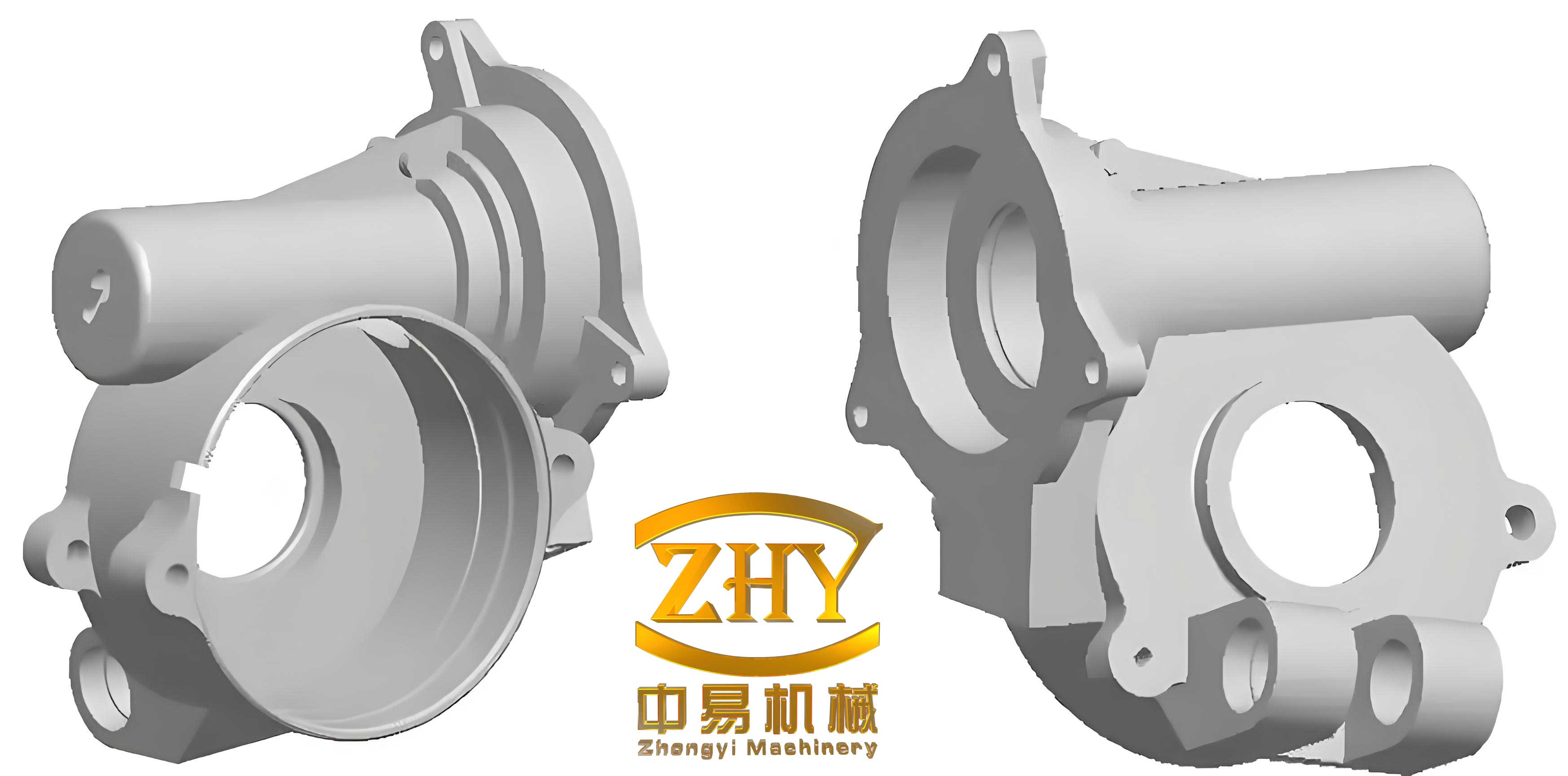
Originally, the casting process for these shell castings employed a top-pouring dispersed gating system in呋喃自硬树脂砂 molds. The shell castings were oriented with the flange facing upward, using standard 1400 mm × 1200 mm sand boxes. The gating ratio was set as ∑S直∶∑S横∶∑S内 = 1∶1.75∶1.3, with a直浇道 of ϕ60 mm,横浇道 of 40/50 mm × 55 mm, and multiple flat内浇口 along the flange. Four发热冒口 (ϕ80 mm × 120 mm) and two additional冒口 in the hub region were placed, along with冷铁 and foam ceramic filters in the横浇道. However, this approach led to several issues. The top-pouring caused turbulent flow, resulting in slag inclusions due to氧化夹渣. Moreover, the feeding efficiency was poor, especially in the hub area, leading to shrinkage porosity in the shell castings. The process yield was only 62%, with a sand-to-metal ratio of 7:1, and a scrap rate of 8%, making it economically inefficient. To quantify the浇注 dynamics, the initial gating area ratio can be expressed as:
$$ \text{Gating Ratio} = \frac{\sum A_{\text{sprue}}}{\sum A_{\text{runner}}}{\sum A_{\text{ingate}}} = 1 : 1.75 : 1.3 $$
where A represents the cross-sectional areas. This ratio contributed to high velocity and turbulence during pouring, exacerbating defects in the shell castings.
To address these challenges, I spearheaded a comprehensive optimization of the casting process for the shell castings. The key improvement was adopting a middle-bottom pouring filtered gating and riser system, integrated into a combined shell mold design. This involved creating upper and lower shell molds from覆膜砂, which were assembled with embedded filters, insulating risers, sprue tubes, and exhaust ropes. This integrated system merged the gating, filtration, feeding, and venting functions, simplifying造型操作 and enhancing metal quality. The gating ratio was revised to ∑S直∶∑S横∶∑S内 = 1∶1.1∶0.9, with a直浇道 of ϕ60 mm,横浇道 of 35/40 mm × 40 mm, and two ϕ40 mm内浇道. This design promoted smoother filling and better filtration, reducing turbulence and slag formation in the shell castings. Additionally, the冒口 were downsized to ϕ70 mm保温冒口 and four ϕ70 mm × 120 mm发热冒口, improving feeding efficiency while minimizing material use.冷铁 were strategically placed, and the sand boxes were customized to a conical shape welded into standard frames, reducing sand用量 and the sand-to-metal ratio. The new layout was validated using MAGMA simulation software to predict solidification and defect formation in the shell castings, as shown in the thermal analysis. The optimized parameters can be summarized in the table below:
| Parameter | Original Process | Optimized Process |
|---|---|---|
| Gating Ratio | 1:1.75:1.3 | 1:1.1:0.9 |
| Riser Size | ϕ80 mm × 120 mm | ϕ70 mm (insulating) |
| Sand-to-Metal Ratio | 7:1 | 2.5:1 |
| Process Yield | 62% | 80% |
| Scrap Rate | 8% | 2% |
The metallurgical process was also refined to enhance the quality of the shell castings. For melting, high-purity pig iron and clean scrap steel were used, with pretreatment using 0.4–0.5% silicon carbide. The球化处理 employed a ladle凹坑冲入法 with lanthanum-containing silicon-iron-magnesium alloy (1.1–1.3% addition), which reduced shrinkage and chill tendencies in the shell castings. The composition of the球化剂 was: Si 44–48%, Mg 5.8–6.5%, Ca 2.5–3.0%, La 0.8–1.2%, Al ≤ 1.0%. Inoculation involved multiple stages: covering with high-Si-Ba inoculant (0.6–0.7%) and随流孕育 with low-Si-Ba inoculant (0.1%). The chemical reactions during球化 can be approximated by:
$$ \text{Mg} + \text{S} \rightarrow \text{MgS} + \text{Heat} $$
This helps in石墨球化, critical for the ductility of the shell castings. The pouring temperature was controlled at 1380–1420°C, with a tap temperature ≥ 1520°C, ensuring proper fluidity and reduced defects in the shell castings.
Production验证 of the optimized process demonstrated significant improvements in the shell castings. After implementation, the shell castings were dissected and subjected to X-ray inspection, revealing no shrinkage porosity or slag inclusions, with ratings reaching Grade 1. Mechanical tests on the shell castings showed tensile strength of 455 MPa, yield strength of 308 MPa, elongation of 18.5%, and hardness of 178 HBW, all exceeding specifications. Microstructurally, the shell castings achieved pearlite ≤ 3%, carbides ≤ 1%,片状石墨层 ≤ 0.20 mm, graphite grade 6, and球化率 ≥ 90%. These results confirm that the optimization effectively enhanced the integrity and performance of the shell castings. The economic impact was substantial: annual production reached 30,000 shell castings with a综合加工合格率 over 98%, reducing costs through lower sand consumption and higher yield. The sand-to-metal ratio decrease from 7:1 to 2.5:1 alone resulted in significant savings, as sand usage is a major cost driver in foundries. This can be expressed quantitatively: if the metal mass per shell casting is 152 kg, the original sand mass was 152 × 7 = 1064 kg, whereas the optimized sand mass is 152 × 2.5 = 380 kg, saving 684 kg of sand per shell casting. For 30,000 shell castings annually, this translates to:
$$ \text{Annual Sand Savings} = 30,000 \times 684 \, \text{kg} = 20,520,000 \, \text{kg} = 20,520 \, \text{tons} $$
Such reductions not only cut material costs but also lower environmental impact by minimizing waste.
In conclusion, the optimization of the casting process for pavement mechanical vibrator shell castings has proven highly successful. By transitioning to a middle-bottom pouring filtered gating system with integrated shell molds, we achieved smoother filling, better filtration, and efficient feeding, eliminating defects like slag inclusions and shrinkage porosity in the shell castings. The use of advanced球化剂 and inoculation techniques further enhanced the metallurgical quality, ensuring high球化率 and mechanical properties. The redesign of sand boxes reduced the sand-to-metal ratio dramatically, boosting process yield from 62% to 80% and lowering scrap rates from 8% to 2%. These improvements have enabled mass production of high-quality shell castings, meeting stringent technical requirements while delivering notable economic benefits. This case underscores the importance of holistic工艺设计 in foundry operations, where combining模拟, material science, and innovative tooling can transform challenging components like shell castings into reliable, cost-effective products. Future work may explore further refinements, such as real-time monitoring or advanced alloys, to continue advancing the performance of shell castings in demanding applications.