
In our foundry production, we frequently encounter complex thin-walled shell castings that require high mechanical properties and dense microstructure, free from internal defects. These shell castings, such as clutch housings, are critical components in automotive applications, necessitating rigorous quality control, including pressure tightness tests. Our production line utilizes green sand molding with air impulse compaction, and to enhance efficiency, we adopted a multi-casting layout with four pieces per mold. However, during batch production, we observed recurrent defects like porosity, blowholes, and core fractures, which severely impacted product qualification rates. This article details our first-person analysis of these defects in shell castings, the root causes tied to imperfect process design, and the systematic improvements implemented to resolve them. We emphasize the keyword ‘shell castings’ throughout, as these components represent a broader category of intricate cast parts where similar issues may arise. By sharing our experience, we aim to contribute to the foundry industry’s knowledge base on defect mitigation in shell castings.
The original casting process for these shell castings involved a horizontal parting line mold with dimensions of 1200 mm × 800 mm × (350/350) mm. We employed a bottom-gating system with a central sprue to ensure smooth filling, minimize turbulence, and reduce buoyancy forces on the cores. Each shell casting had three ingates positioned at the parting plane. The cores were made from resin-coated sand (shell sand), which, while offering good surface finish, tends to have high gas evolution. To address this, we designed ventilation channels in the core prints and added overflow risers at the top flange areas with vent pins to facilitate gas escape. Additionally, vent strips were placed at the highest points of the bottom faces, and vent pins were installed on all bosses on the cope side to increase exhaust area. Despite these measures, defects persisted, primarily localized at specific regions: porosity at the bottom vent strip roots, core fractures at the interlocking core print junctions of three process holes, and blowholes at the top flange areas. These shell castings, with a weight of 18 kg and minimum wall thickness of 5 mm, posed significant challenges due to their complex internal cavities.
| Parameter | Value/Description |
|---|---|
| Mold Type | Green sand, air impulse compaction |
| Mold Dimensions | 1200 mm × 800 mm × (350/350) mm |
| Casting Layout | Four shell castings per mold |
| Gating System | Bottom-gating with central sprue, three ingates per casting |
| Core Material | Resin-coated sand (shell sand) |
| Ventilation Features | Core print vents, overflow risers, vent pins, vent strips |
| Primary Defects | Porosity at bottom vents, blowholes at top flanges, core fractures at process holes |
To understand the defect mechanisms in these shell castings, we conducted a thorough analysis. Porosity, often appearing as subsurface voids, is typically classified as侵入性气孔 (intrusive porosity) caused by gas entrapment during pouring. The gas generation from resin-coated sand cores can be modeled using the ideal gas law and decomposition kinetics. The pressure buildup in the mold cavity due to gas evolution can be expressed as:
$$P_g = \frac{n_g R T}{V_c}$$
where \(P_g\) is the gas pressure, \(n_g\) is the number of moles of gas generated, \(R\) is the gas constant, \(T\) is the temperature, and \(V_c\) is the cavity volume. For shell castings with complex cores, high \(n_g\) from resin decomposition can lead to \(P_g\) exceeding the metallostatic pressure, forcing gas into the solidifying metal. In our case, the shared ventilation channels between adjacent cores proved inadequate, causing localized gas accumulation. The cross-sectional area \(A_v\) of vents is critical; insufficient \(A_v\) reduces the flow rate \(Q_v\) of escaping gas, given by:
$$Q_v = C_d A_v \sqrt{\frac{2 \Delta P}{\rho_g}}$$
where \(C_d\) is the discharge coefficient, \(\Delta P\) is the pressure difference, and \(\rho_g\) is the gas density. Our original design had limited \(A_v\), leading to gas entrapment in the bottom vent areas of the shell castings.
Blowholes, or sand inclusions, occurred predominantly at the top flange立面 (vertical faces) of the shell castings. These are attributed to poor mold compaction near the flask walls in air impulse molding, where bridging effects reduce sand density. The hardness of the mold face at these regions measured only 50-60 on a砂型硬度计 (mold hardness scale), below the required 70+ for adequate erosion resistance. The erosion rate \(E\) of sand grains can be approximated by:
$$E = k \cdot \rho_m \cdot v^2 \cdot A_s$$
where \(k\) is an erosion constant, \(\rho_m\) is the metal density, \(v\) is the flow velocity, and \(A_s\) is the exposed sand area. Low hardness corresponds to reduced cohesive strength, making the sand prone to being washed away during filling. Since repositioning the castings in the mold was impractical, we needed a structural change to eliminate these vulnerable sand surfaces in the shell castings.
Core fractures at the process hole prints resulted from inadequate mechanical strength of the cantilevered core sections. These shell castings required interlocking cores, with small print areas bearing the weight and buoyancy forces. The bending stress \(\sigma_b\) at the core print junction can be calculated as:
$$\sigma_b = \frac{M y}{I}$$
where \(M\) is the bending moment, \(y\) is the distance from the neutral axis, and \(I\) is the moment of inertia. For a cylindrical print of diameter \(d\), \(I = \frac{\pi d^4}{64}\). With small \(d\), \(\sigma_b\) can exceed the core’s tensile strength \(\sigma_t\), leading to fracture. Using higher-strength resin-coated sand would increase cost and gas evolution, exacerbating porosity in shell castings. Thus, reinforcing the prints internally became the preferred solution.
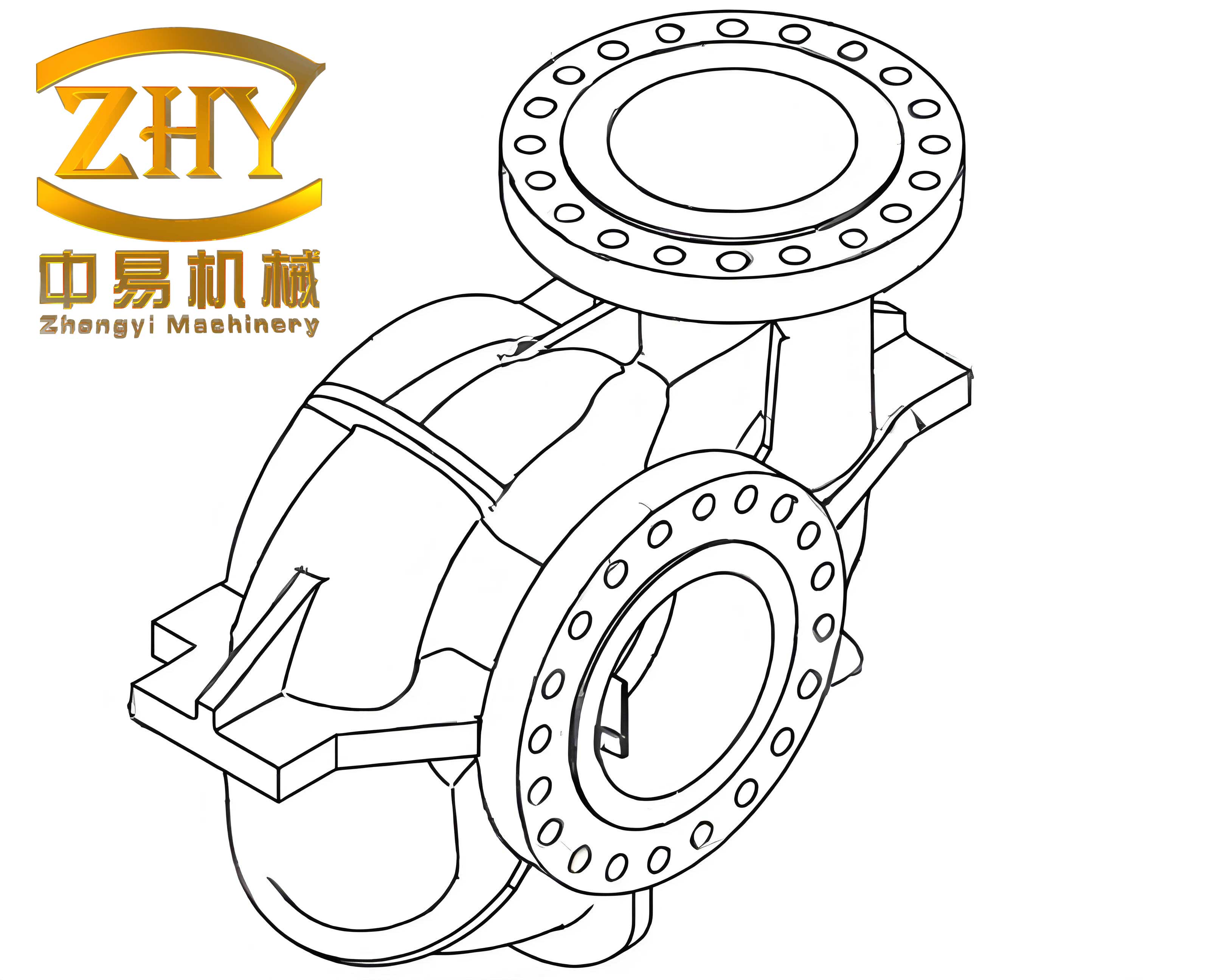
Based on this analysis, we implemented three key process improvements for producing defect-free shell castings. First, to enhance gas evacuation, we redesigned the ventilation system by providing dedicated exhaust channels for each core, rather than shared ones. This increased the total cross-sectional area \(A_v\) significantly. Each channel was positioned at the highest point of the core to leverage buoyant gas flow. The new design ensured that gas generation from resin-coated sand in shell castings could escape smoothly, reducing \(P_g\) below critical levels. We used computational fluid dynamics (CFD) simulations to optimize channel dimensions, aiming for a pressure drop \(\Delta P\) that maintains \(Q_v > Q_g\), where \(Q_g\) is the gas generation rate. The relationship can be summarized as:
$$Q_g = \frac{d n_g}{d t} \cdot \frac{R T}{P}$$
By ensuring \(A_v\) satisfies \(Q_v \geq Q_g\), we mitigated porosity in these shell castings.
| Parameter | Original Process | Improved Process |
|---|---|---|
| Ventilation Channels per Core | Shared between adjacent cores | Dedicated per core |
| Total Cross-Sectional Area \(A_v\) (mm²) | Estimated 150 | Estimated 400 |
| Gas Flow Rate \(Q_v\) (m³/s) | Low, based on calculations | High, sufficient for gas escape |
| Porosity Incidence in Shell Castings | High (~15% scrap) | Low (~2% scrap) |
Second, to eliminate blowholes, we modified the core design to extend the core prints, allowing the top flange vertical faces to be formed by the core instead of the mold sand. This change leveraged the higher surface hardness and erosion resistance of resin-coated sand cores compared to green sand. The core sand has a hardness typically above 80, which reduces the erosion rate \(E\) substantially. We adjusted the core box模具 (mold) to increase the print dimensions, ensuring a seamless transition. This approach not only prevented sand washing but also improved dimensional accuracy of the shell castings, as cores offer better reproducibility. The modification can be expressed in terms of the affected area \(A_s\): originally, \(A_s\) was large due to mold sand exposure; now, \(A_s \approx 0\) for those faces, setting \(E \approx 0\) in the blowhole-prone zones.
Third, to address core fractures, we incorporated iron core reinforcements (core irons) into the slender process hole prints during core shooting. We machined holes of Ø10 mm in the core box for the reinforcing rods, which became embedded in the core after curing. Correspondingly, we created Ø12 mm sockets in the mating core to accept these rods with adhesive. This increased the effective bending strength at the junction. The enhanced moment of inertia \(I’\) with a core iron of diameter \(d_i\) can be approximated by summing contributions from sand and iron:
$$I’ = I_{\text{sand}} + I_{\text{iron}} = \frac{\pi d^4}{64} + \frac{\pi d_i^4}{64}$$
For \(d = 12 \text{ mm}\) and \(d_i = 10 \text{ mm}\), \(I’\) is significantly higher, reducing \(\sigma_b\) below \(\sigma_t\). This reinforcement ensured that the cores for shell castings could withstand handling and pouring stresses without fracture.
The implementation of these improvements yielded remarkable results in the production of shell castings. We conducted a statistical analysis over 5000 castings, comparing defect rates before and after the changes. Porosity scrap decreased from approximately 12% to 3%, blowholes from 8% to 1%, and core fractures were entirely eliminated. The overall qualification rate for shell castings improved from 80% to 96%, leading to substantial cost savings and enhanced customer satisfaction. We verified the pressure tightness of the castings through leak tests, confirming that the internal integrity met specifications. The table below summarizes the quantitative outcomes:
| Defect Type | Original Scrap Rate (%) | Improved Scrap Rate (%) | Reduction (%) |
|---|---|---|---|
| Porosity | 12.0 | 3.0 | 75.0 |
| Blowholes | 8.0 | 1.0 | 87.5 |
| Core Fractures | 5.0 | 0.0 | 100.0 |
| Total for Shell Castings | 25.0 | 4.0 | 84.0 |
Beyond these immediate fixes, we explored additional factors influencing shell castings quality. For instance, the pouring temperature \(T_p\) plays a role in gas solubility and solidification time. According to Sieverts’ law, the solubility of hydrogen in iron \(C_H\) is proportional to \(\sqrt{P_{H_2}}\), but in our case, the primary issue was intrusive gas rather than dissolved gas. However, we optimized \(T_p\) to around 1420°C to balance fluidity and gas evolution. The solidification time \(t_s\) for thin-walled shell castings can be estimated using Chvorinov’s rule:
$$t_s = k \left( \frac{V}{A} \right)^2$$
where \(V\) is volume, \(A\) is surface area, and \(k\) is a constant. For our shell castings with \(V/A \approx 0.5 \text{ cm}\), \(t_s\) is relatively short, necessitating efficient gas escape before skin formation. Our improved vents accommodated this requirement. Furthermore, we considered the impact of sand moisture in green molds, but as noted, reducing moisture below 3.2% compromised strength, so we maintained it at 3.5% with proper additives.
In discussing broader implications, we recognize that shell castings often involve similar challenges across industries. The principles of adequate venting, core reinforcement, and minimizing vulnerable mold surfaces are universally applicable. We recommend foundries to conduct upfront simulation studies for shell castings to predict gas flow and stress distributions. Tools like MAGMAsoft or AnyCasting can model \(P_g\) and \(\sigma_b\), guiding design iterations. Additionally, statistical process control (SPC) charts can monitor key variables such as core gas content, mold hardness, and pouring parameters to preempt defects in shell castings. The economic benefits of such proactive approaches are clear: reduced scrap, lower rework costs, and higher throughput.
In conclusion, our experience with clutch housing shell castings demonstrates that systematic process analysis and targeted improvements can effectively resolve common defects. By implementing dedicated ventilation channels, extending core prints to cover critical faces, and reinforcing slender core sections with iron inserts, we achieved significant quality enhancements. These measures are directly transferable to other complex shell castings, underscoring the importance of holistic design in foundry engineering. We continue to refine our processes, leveraging advanced materials and simulation technologies to further optimize the production of high-integrity shell castings for demanding applications. The key takeaway is that a deep understanding of defect mechanisms, coupled with practical modifications, can transform challenging casting projects into reliable manufacturing operations.