
In my extensive practice specializing in investment casting, particularly shell castings for demanding applications, I recently undertook the challenge of developing a reliable manufacturing process for a deep-well submersible pump discharge housing. This component is integral to pump efficiency and longevity, and its intricate geometry necessitated a meticulous approach to shell casting. The primary objective was to achieve high-dimensional accuracy, superior surface finish, and sound internal integrity in a thin-walled, complex stainless steel casting. Through iterative design, simulation, and practical refinement, I successfully established a robust shell casting process that overcame significant technical hurdles. This account details my first-person journey from initial concept to validated production, emphasizing the critical role of process optimization in advanced shell castings.
The discharge housing, a key element in the hydraulic assembly, features a convoluted internal flow path defined by eight slender, curved vanes. My analysis of the component blueprint revealed several formidable challenges for shell castings. The wall and vane thicknesses are consistently around 5 mm, classifying it as a thin-walled structure. The internal cavity is remarkably confined, and the vanes present substantial undercuts. Dimensional stability is paramount, as the housing must maintain tight coaxiality with other pump elements like the impeller for effective sealing and performance. Furthermore, the functional surfaces of the internal vanes demand an exceptionally smooth finish, with a required roughness (Ra) between 1.6 and 3.2 μm. The presence of a flanged edge with multiple bosses created dispersed hot spots, while the central core region posed a significant risk for shrinkage porosity. These factors collectively defined a non-trivial shell casting endeavor.
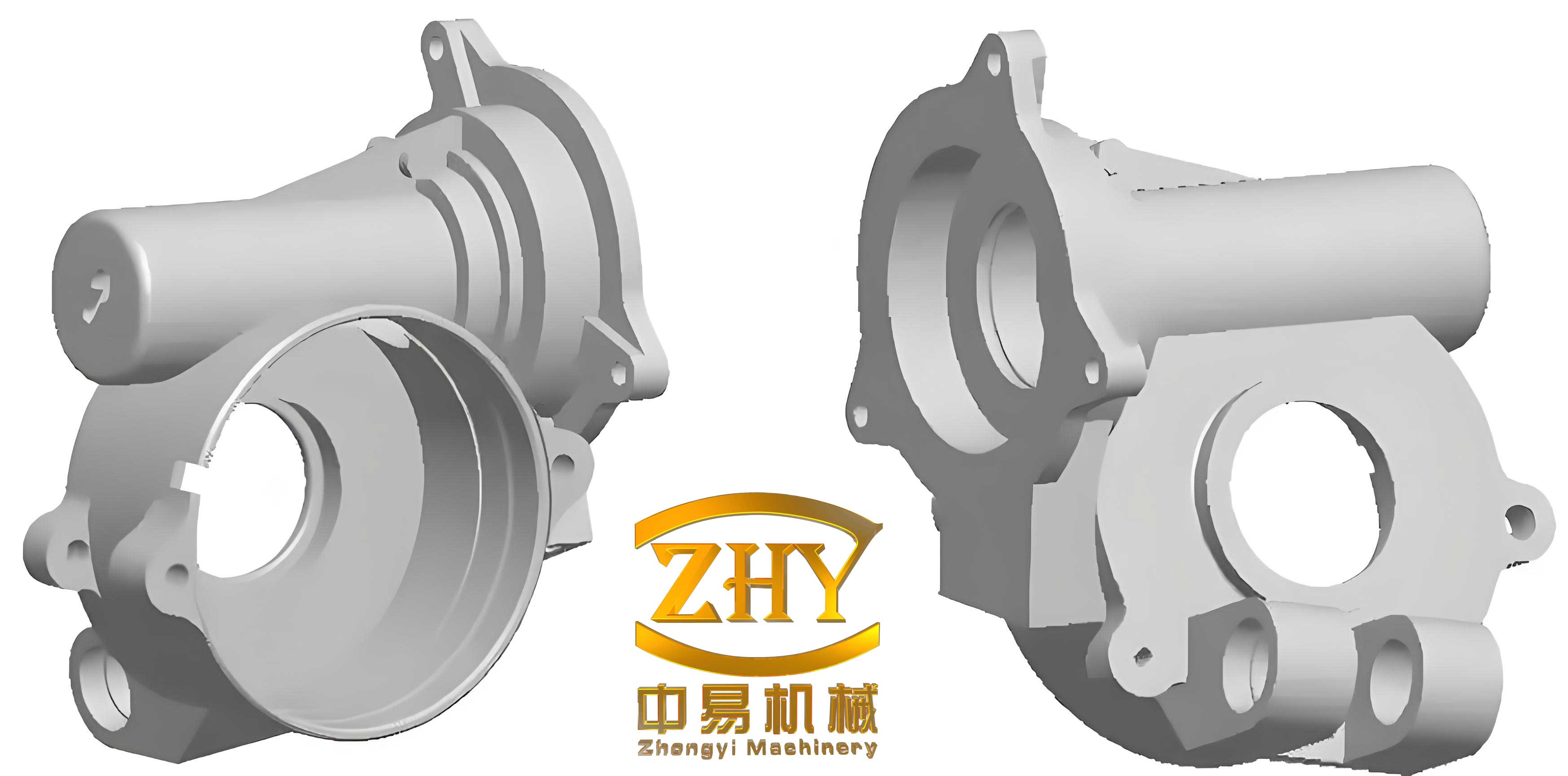
My foundational strategy was to employ a silica-sol binder system with mid-temperature wax patterns for building the ceramic shell. This choice was deliberate; silica-sol shells offer excellent high-temperature strength, resistance to deformation, and can replicate fine details to achieve the necessary surface quality for such precise shell castings. The initial focus of my process design was on feeding and solidification control for the critical sections: the two flange ends and the central hub.
I devised and tested two distinct gating and orientation strategies for the initial trial batch. The first concept involved a horizontal pouring arrangement with side gating. The second, which I hypothesized might offer better stability, was a vertical bottom-pouring setup. In both designs, I incorporated a dedicated “feeding ring” around the lacy flange. This ring acts as a thermal reservoir and feed path, effectively consolidating the multiple isolated hot spots from the individual bosses into a single, manageable thermal mass that can be efficiently fed by the gate. This is a crucial technique in shell castings for parts with dispersed heat centers.
The trial production of five prototypes immediately highlighted vulnerabilities in the shell casting process. The horizontal scheme (Concept 1) resulted in catastrophic shell failure—one mold cracked at the core during pouring, and another suffered a run-out at the base. The vertical bottom-pour concept (Concept 2) was more successful in producing intact castings but revealed quality issues. Non-destructive inspection showed slight shrinkage porosity at the roots of the gates feeding both the lacy flange and the central hub. Furthermore, a more insidious problem emerged during dewaxing: fine cracks appeared on the shell in areas adjacent to the thin-walled body. This was a clear indicator of shell stress during wax removal.
My root-cause analysis pinpointed several key issues. The dewaxing cracks were a result of pressure buildup. The thin sections of wax melted rapidly, but the thicker gating system acted as a bottleneck, trapping molten wax and exerting hydraulic pressure on the still-green shell. For the horizontal molding, the shell-building process itself introduced a weakness. As each ceramic layer was applied and dried with the mold cup facing downward, stucco sand and slurry tended to pool on the lower horizontal surfaces of the pattern, creating an uneven shell thickness. The thinnest region, consequently, was unable to withstand the metallostatic pressure during pouring. The shrinkage in Concept 2 was traced to gate design. The gates were too short, causing the gate roots to become thermal hotspots that solidified last, leading to microporosity. Additionally, the top riser in the bottom-pour system remained relatively cold, impairing its feeding efficiency for the central hub.
Armed with these insights, I engineered a comprehensive optimized process. I retained the vertical bottom-pour orientation for its inherent stability but made critical modifications. I significantly increased the height of the gates attached to both the lacy flange and the central hub. This simple change moves the thermal junction away from the casting body, preventing the gate root from becoming a vulnerable hot spot. The mathematical rationale for gate detachment can be related to the solidification modulus. To ensure proper feeding, the modulus of the feeding system (gate + riser) must exceed that of the section it feeds. By increasing gate height, its volume-to-surface area ratio improves, enhancing its feeding capacity. A simplified representation of this principle is:
$$ M_g = \frac{V_g}{A_g} > k \cdot M_c $$
where $M_g$ is the modulus of the gate, $V_g$ its volume, $A_g$ its cooling surface area, $M_c$ is the modulus of the casting hot spot, and $k$ is a safety factor (typically >1).
To proactively eliminate dewaxing stress, I incorporated strategic “dewaxing vents” made from wax rods attached to the highest points of the mold assembly and at the base of reinforcing ribs. These channels provide escape paths for molten wax, relieving internal pressure. After shell building, the vent openings are cleared and later plugged before firing. To supercharge the feeding of the central hub, I implemented a two-stage pouring technique: the mold is first filled through the bottom gate until the metal level reaches the base of the top riser; then, a second, quick pour directly into the top riser is performed. This “re-pouring” replenishes the riser with hotter metal, significantly boosting its thermal gradient and feeding effectiveness. Post-pouring, I covered the exposed surfaces of the sprue and risers with asbestos blankets to slow their cooling, further promoting directional solidification towards these feeders.
Before committing to production, I leveraged casting simulation software to validate my optimized design. I modeled the process with an initial shell temperature of 1000°C and a fill time of 12 seconds. The simulation’s prediction was gratifying: the shrinkage porosity was successfully isolated within the volume of the side and top risers, with the casting body itself showing a high probability of being sound. This virtual validation gave me high confidence in the robustness of the revised shell casting process.
A small batch of ten castings produced with this optimized protocol yielded excellent results. Dewaxing cracks were absent, no run-outs occurred, and preliminary inspection showed no shrinkage defects in the critical sections. However, when scaling to a batch of one hundred units, a new, subtler issue surfaced. A few castings exhibited minor fins or veining on the sensitive vane surfaces, and one shell failed due to internal leakage. This pointed towards an inconsistency in the shell-building process for the intricate internal cavity. Despite careful drying, the complex, narrow passages between vanes were not achieving uniform and complete drying of each ceramic layer, leading to localized weak zones in the shell.
This challenge led to the final, transformative improvement in the shell casting sequence: the adoption of prefabricated ceramic cores for the entire internal cavity. By replacing the traditional process of building the internal surfaces layer-by-layer with a single, precise ceramic insert, I eliminated the most demanding aspect of shell construction for this part. The core was manufactured using a silica-sol based slurry with 320-mesh fused silica flour, gelled and sintered to achieve high strength and leachability. The core process is summarized below:
| Processing Step | Key Parameters | Purpose in Shell Castings |
|---|---|---|
| Slurry Preparation | Silica-sol binder, Fused SiO2 flour (320 mesh), Additives | Create injectable mixture for core shape |
| Injection & Gelling | Into master die, Ammonia vapor exposure | Form green core strength via sol-gel transition |
| Drying & Sintering | Controlled humidity, 980-1000°C for 80 min | Remove volatiles, achieve final strength and stability |
| Core Assembly | Inserted into wax pattern assembly | Define internal geometry without manual shell building |
The introduction of the ceramic core dramatically simplified the shell building. The shell now needed only to be built on the external surfaces of the wax pattern, which included the core. This ensured perfectly formed, smooth internal vane surfaces directly from the core’s own finish. The leachability of the silica-based core also meant it could be easily removed after casting via standard chemical or mechanical methods. A follow-up validation batch confirmed all objectives were met: dimensional accuracy was maintained, internal shrinkage was absent, and the surface roughness of the vane passages consistently measured below Ra 3.2 μm, meeting the stringent specification.
The entire development cycle underscored several fundamental principles for successful shell castings of complex components. First, proactive feeding system design, aided by tools like feeding rings and modulus calculations, is essential to manage solidification in parts with dispersed thermal masses. The feeding ring efficacy can be conceptualized by considering the total solidification time of the ring versus the attached bosses. Using Chvorinov’s rule:
$$ t_f = C_f \left( \frac{V}{A} \right)^2 $$
where $t_f$ is freezing time and $C_f$ is the mold constant. A well-designed ring has a larger $(V/A)^2$ ratio than the individual bosses, ensuring it remains liquid to feed them.
Second, managing process-induced stresses is critical. The implementation of dewaxing vents is a simple yet powerful solution to prevent shell cracking, a common failure mode in thin-walled shell castings. The pressure relief can be modeled by considering the flow of molten wax. The pressure drop $\Delta P$ through a vent of length $L$ and diameter $d$ for a fluid with viscosity $\mu$ and flow rate $Q$ is given by the Hagen-Poiseuille equation for laminar flow:
$$ \Delta P = \frac{128 \mu L Q}{\pi d^4} $$
Providing adequate vent area (large $d$, multiple vents) minimizes $\Delta P$, keeping shell stress below its green strength.
Third, the strategic use of specialized materials like ceramic cores can resolve otherwise intractable problems related to internal geometry and shell integrity. This elevates the capability of the shell casting process to new levels of complexity and quality. Finally, a disciplined, iterative approach—combining practical trials with numerical simulation—is indispensable for refining shell casting processes from a theoretical design to a reliable production reality. The journey with this pump housing reaffirmed that success in advanced shell castings lies not in a single silver bullet, but in the synergistic optimization of every step in the chain, from pattern and core design through shell building, dewaxing, and solidification control.