
In my extensive experience in foundry engineering, the production of large and complex shell castings presents unique challenges, particularly in achieving uniform internal structure, effective gas venting, and slag removal. Traditional methods often lead to inconsistencies, but through rigorous process optimization, I have developed a reliable approach for high-quality shell castings. This article details the first-person perspective on implementing an “vertical molding and pouring” strategy, which has proven effective for tall and intricate shell castings. The focus is on minimizing defects, enhancing mechanical properties, and ensuring process reliability, with repeated emphasis on the critical aspects of shell castings fabrication.
The core of this methodology revolves around several key stages: parting surface selection, core segmentation, gating system design, sand quality control, oil sand core fabrication, molding precision, core assembly, and melting control. Each stage is interconnected, and slight deviations can compromise the entire shell castings project. Below, I elaborate on each phase, incorporating quantitative data, formulas, and tables to summarize the technical parameters. The goal is to provide a comprehensive guide that underscores the importance of systematic planning in shell castings production.
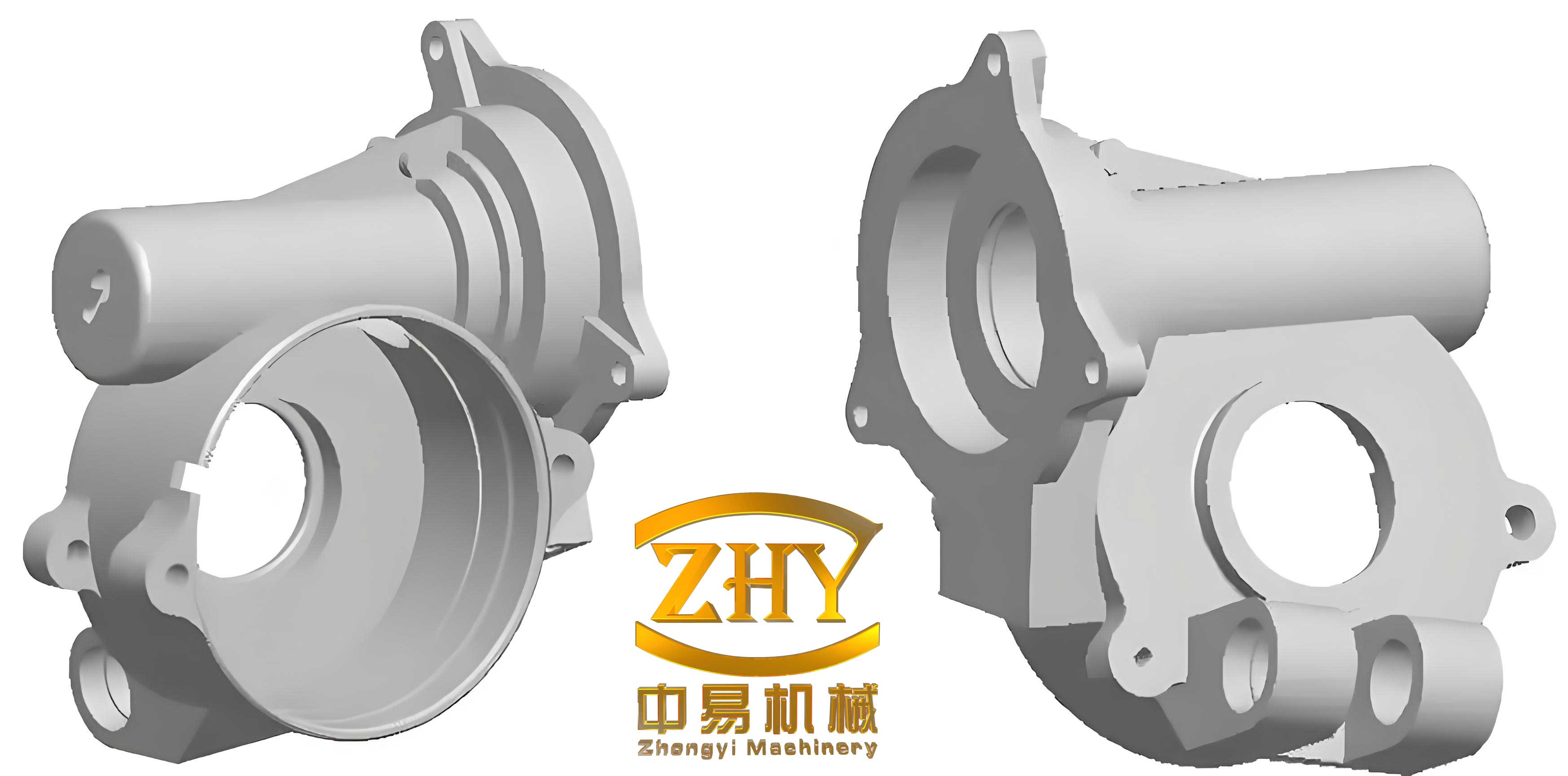
When dealing with large shell castings, the choice of parting surfaces is paramount. I opted for a “vertical molding and pouring” scheme to mitigate issues like non-uniform internal organization and poor venting. This approach involves a multi-part mold design. Specifically, for a tall shell castings component, I employed a “four-flask, three-parting” strategy: one central parting surface along the mold line, and two curved parting surfaces at the upper and lower ends, manually controlled to follow the arc of the shell castings. This design offers advantages such as improved wood pattern strength, reduced deformation, simpler molding, and fewer casting seams. However, it introduces challenges like numerous core extensions and potential sand rubbing during flask assembly, which must be managed carefully. The parting surfaces are kept as flat as possible to avoid undercuts, ensuring smoother operations for shell castings.
The segmentation of sand cores is a critical step in the manufacturing of complex shell castings. In this case, the difficulty primarily lies in core making and placement. For instance, the six holes in the shell castings correspond to two-layer air jacket cores. By splitting these cores into four sections and installing core seats, the curved air jacket cores become stable and allow for proper gas venting. This segmentation facilitates easier handling and reduces the risk of core shift during pouring, which is vital for the dimensional accuracy of shell castings. The core design must account for both strength and permeability, as inadequate venting can lead to gas defects in the final shell castings.
The gating system design is crucial for achieving sound shell castings. I adopted a three-layer annular gate with a step-pouring method, which ensures progressive filling and reduces turbulence. The calculation of pouring time is based on empirical formulas. For shell castings, the optimal pouring time \( t \) (in seconds) can be estimated using:
$$ t = S \sqrt[3]{\delta G} $$
where \( \delta \) is the wall thickness of the shell castings in millimeters, \( G \) is the total weight including gates and risers in kilograms, and \( S \) is a coefficient typically ranging from 1.1 to 2.0. In practice, for a shell castings weighing approximately 3000 kg with a wall thickness of 40 mm, and taking \( S = 1.5 \), the theoretical pouring time is:
$$ t = 1.5 \times \sqrt[3]{40 \times 3000} \approx 1.5 \times \sqrt[3]{120000} \approx 1.5 \times 49.3 \approx 74 \text{ seconds or } 1.23 \text{ minutes}. $$
Actual measurements during pouring showed times of 1.5 to 2 minutes, excluding riser feeding, aligning closely with predictions. The gating system ratio for shell castings was designed as a closed system with specific cross-sectional areas. The theoretical choke area \( A_{\text{choke}} \) (in cm²) is given by:
$$ A_{\text{choke}} = \frac{G}{\rho \cdot t \cdot v} $$
where \( \rho \) is the molten metal density (approximately 7.2 g/cm³ for cast iron), and \( v \) is the flow velocity. For simplicity, empirical values are often used. In this case, the theoretical ingate area was 28 cm² with 4 ingates, but practically, 32 cm² with 4 ingates was implemented. The gating ratio used was \( A_{\text{sprue}} : A_{\text{runner}} : A_{\text{ingate}} = 1 : 1.5 : 2 \), with actual dimensions: sprue diameter of 60 mm (one sprue), runner cross-section of 6 cm × 6 cm (36 cm²), and ingates totaling 32 cm². This configuration ensures balanced flow for shell castings, minimizing erosion and slag entrapment.
| Component | Theoretical Area (cm²) | Actual Area (cm²) | Number | Dimensions |
|---|---|---|---|---|
| Sprue | 28.3 (based on 60 mm diameter) | 28.3 | 1 | Ø60 mm |
| Runner | 36 | 36 | 1 | 6 cm × 6 cm |
| Ingates | 28 | 32 | 4 | 8 cm² each (approx.) |
Improving sand quality is essential to prevent defects like scabbing, peeling, and swelling in large shell castings. I adhere to the principle of “coarse sand for large castings” and formulated a new sand mixture. The composition by weight percentage includes Xiangtan sand (50%), 40/70 mesh sand (40%), bentonite (5%), and water (5%). The physical properties were tested to ensure suitability for shell castings, as summarized below:
| Property | Value | Unit |
|---|---|---|
| Green Permeability | 150 | cm³/min |
| Green Compression Strength | 0.08 | MPa (≈80 kPa) |
| Dry Tensile Strength | 0.15 | MPa (≈150 kPa) |
This formulation provides adequate strength and permeability, critical for maintaining mold integrity during the pouring of shell castings. The sand must be uniformly compacted to avoid soft spots that could lead to defects in shell castings.
For core making, I developed high-strength oil sand cores, which are particularly advantageous for complex shell castings due to their excellent collapsibility and surface finish. The oil sand composition was optimized to enhance both green and dry strength, facilitating core handling and installation. The mix includes Ganqika sand (92%), bentonite (3%), tung oil (2%), dextrin (1%), and water (2% approximately). The physical properties are as follows:
| Property | Value | Unit |
|---|---|---|
| Green Permeability | 80 | cm³/min |
| Green Compression Strength | 0.05 | MPa (≈50 kPa) |
| Dry Tensile Strength | 0.8 | MPa (≈800 kPa) |
Although permeability is lower, it is compensated by incorporating venting aids like wax lines and straw ropes during core making. The cores are baked with controlled heating and cooling rates to remove oil and moisture thoroughly, improving permeability for shell castings. Additionally, robust iron armatures are used based on templates and layout lines, ensuring core support and easy shakeout after casting, which is vital for the intricate geometries of shell castings.
Molding quality directly impacts the surface finish and dimensional accuracy of shell castings. I emphasize uniform sand ramming, smooth finishing, and pre-placing垫铁 (pads) under small core prints. During core setting, the core bones contact these pads, securing the cores firmly. This attention to detail prevents core movement and ensures precise alignment in shell castings. Each core is inspected for dimensions, sealed with paste, and vent holes are carefully directed outside the flask and marked. To avoid sand mold moisture absorption or damage, continuous operations are maintained until flask clamping is complete, safeguarding the integrity of shell castings.
Core assembly and flask closing are critical phases. I implement strict checks: every core is positioned accurately, with vents properly routed. This minimizes the risk of gas entrapment and misalignment, which are common pitfalls in shell castings production. The use of reference marks and sequential assembly ensures that all components fit perfectly, contributing to the overall quality of shell castings.
Melting and pouring control are paramount for achieving desired mechanical properties in shell castings. I employ inoculation treatment to enhance the quality of molten iron. Given the production conditions, a combination of electric arc furnace and工频炉 (line-frequency furnace) melting is used to meet the 3-ton requirement for shell castings. The chemical composition is adjusted based on ladle analysis, with inoculation performed at the furnace spout. Specifically, for shell castings, I maintain a residual inoculation amount of 0.3-0.5% and control the tapping temperature. The process involves first tapping 1.5 tons from the arc furnace into a 3-ton ladle, adding inoculant, then pouring 1.5 tons from the line-frequency furnace at 1380°C into the same ladle, followed by stirring and slag removal before pouring. The mechanical properties of test bars cast alongside the shell castings are evaluated to ensure compliance. The results typically show tensile strength around 250 MPa, bending strength of 450 MPa, and hardness of 200 HB, meeting the technical requirements for shell castings. This demonstrates the effectiveness of the melting and inoculation practices for shell castings.
The pouring speed must be meticulously controlled for shell castings. I start with a fast pour to quickly fill the mold cavity, then slow down as the metal approaches the cope to reduce turbulence. Once the risers are filled to about 2/3 height, pouring from the main ladle ceases, and a smaller ladle is used to top up the risers completely. This practice minimizes shrinkage and ensures sound feeding for shell castings. After shakeout and heat treatment, the shell castings exhibit smooth surfaces, and machining reveals no defects such as sand inclusions, gas holes, or shrinkage cavities. Pressure tests (hydraulic and pneumatic) confirm the integrity of the shell castings, validating the entire process.
In summary, the optimized process for large shell castings involves integrated strategies from mold design to pouring. Key takeaways include the use of vertical molding, segmented cores, calculated gating systems, enhanced sand and core materials, precise molding, and controlled melting. These elements collectively address the challenges of producing high-integrity shell castings. The success of this approach is reflected in the consistent quality and performance of the final shell castings, underscoring the importance of holistic process engineering in foundry operations. Future advancements may involve simulation software to further refine gating and solidification for shell castings, but the principles outlined here remain foundational. Through continuous improvement, the production of shell castings can achieve even higher reliability and efficiency, meeting the demands of various industrial applications.