
As a researcher in the field of advanced materials, I have witnessed the remarkable evolution of austempered nodular cast iron, commonly referred to as ADI. This material has emerged as a pivotal engineering solution due to its exceptional combination of strength, ductility, and wear resistance. The journey of ADI began in the 1930s with Bain’s pioneering work on isothermal transformation in steel, which later extended to gray iron in the 1940s and eventually to nodular cast iron in the 1950s. It wasn’t until the late 1970s that simultaneous breakthroughs in Finland, the United States, and China propelled ADI into practical applications, such as automotive gears and agricultural machinery components. The core of ADI lies in its unique microstructure—a mixture of acicular ferrite and high-carbon stabilized austenite—which imparts superior mechanical properties. For instance, grades like QTD1600 achieve tensile strengths exceeding 1600 MPa, while QTD800-10 offers elongation over 10%. This makes nodular cast iron a prime candidate for replacing forged and cast steels in weight-sensitive applications, aligning with the global push toward lightweighting in industries like automotive and machinery.
The production of austempered nodular cast iron has seen significant advancements in recent decades. From a foundational perspective, systematic studies have deepened our understanding of how original microstructure and heat treatment parameters influence the final properties of ADI. Key factors include the carbon content in austenite during austenitization and the kinetics of the isothermal transformation process. These insights are crucial for optimizing industrial processes. Moreover, the establishment of specialized ADI heat treatment centers has been instrumental in scaling production, mirroring trends in the U.S. and Europe where over 70% of ADI components are processed in such facilities. In China, several companies have set up dedicated centers, enhancing the consistency and quality of ADI parts. Additionally, the development of stepped quenching lines, such as those using salt baths or oil-based media, has improved efficiency and reduced distortion in complex castings. Underpinning all this is the enhanced quality of nodular cast iron坯件, achieved through purer raw materials, advanced球化 and孕育 techniques like wire feeding, and rigorous process controls. Non-destructive testing methods, including ultrasonic and magnetic particle inspection, further ensure product integrity. These collective efforts have stabilized the production of nodular cast iron substrates, which is essential for reliable ADI performance.
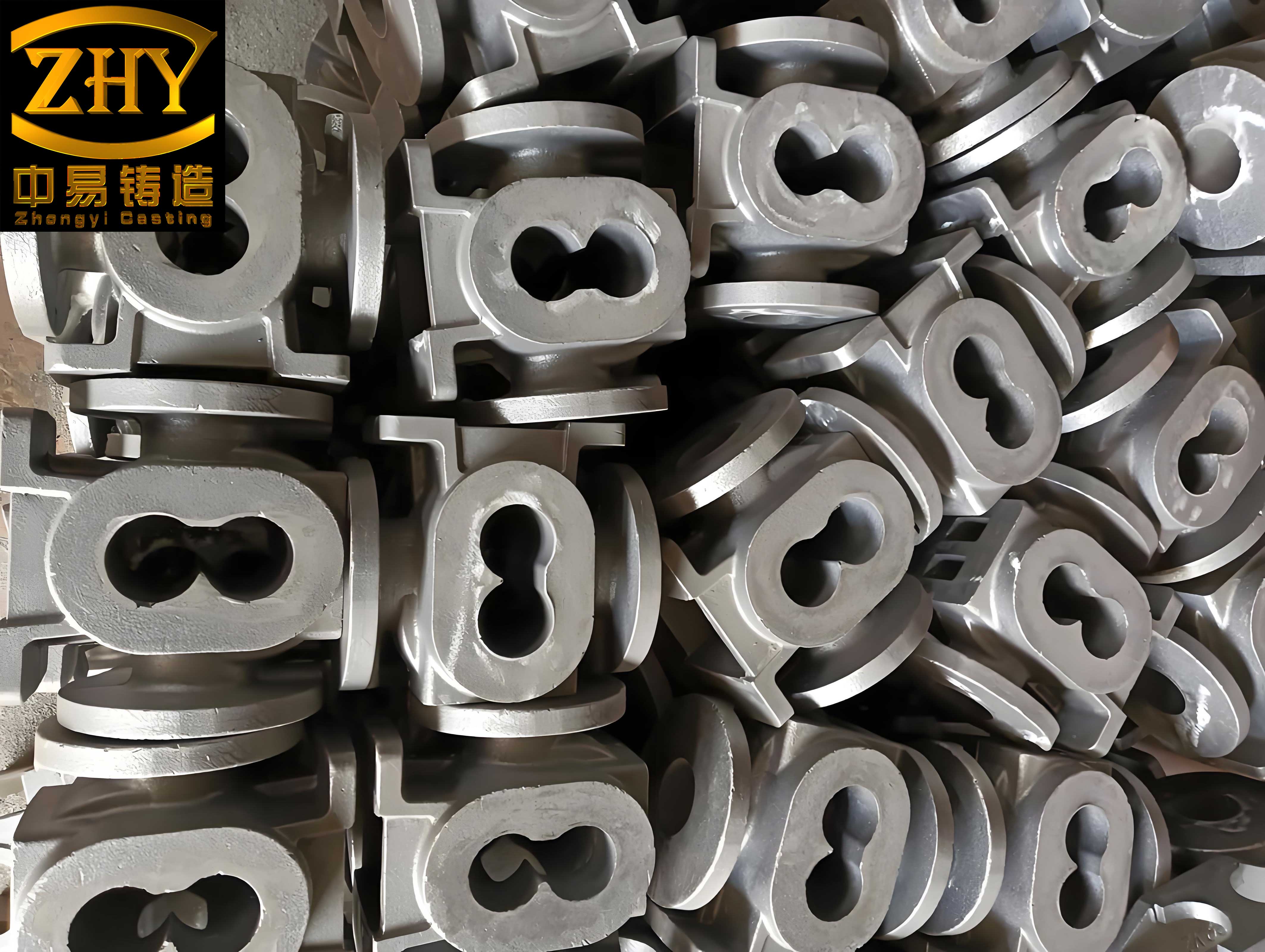
To quantify the properties of austempered nodular cast iron, it is helpful to summarize key mechanical and compositional data. The following table outlines typical ADI grades and their performance metrics, demonstrating the versatility of nodular cast iron in engineering applications.
| Grade Designation | Tensile Strength (MPa) | Yield Strength (MPa) | Elongation (%) | Hardness (HBW) |
|---|---|---|---|---|
| QTD800-10 | >800 | >500 | >10 | 250-320 |
| QTD1050-700-6 | >1050 | >700 | >6 | 310-380 |
| QTD1200-2 | >1200 | >850 | >2 | 340-440 |
| QTD1600 | >1600 | >1100 | >1 | 400-500 |
The chemical composition of nodular cast iron used for ADI is carefully controlled to achieve these properties. A general range for key elements is presented below, highlighting the importance of low impurities and balanced alloying.
| Element | Composition Range (wt%) | Role in ADI |
|---|---|---|
| Carbon (C) | 3.4-3.7 | Promotes graphite nodule formation and austenite stability |
| Silicon (Si) | 2.4-2.7 | Enhances ferrite formation and inhibits carbide precipitation |
| Manganese (Mn) | ≤0.5 | Minimized to avoid segregation and brittleness |
| Phosphorus (P) | ≤0.06 | Kept low to improve toughness |
| Sulfur (S) | ≤0.02 | Reduced to enhance nodularization efficiency |
| Alloying (e.g., Cu, Mo) | 0.2-0.6 | Increases hardenability and refines microstructure |
The heat treatment process for austempering nodular cast iron involves two critical stages: austenitization and isothermal quenching. The austenitizing temperature, denoted as \( T_a \), typically ranges from 850°C to 950°C, depending on the desired austenite carbon content. The holding time \( t_a \) is a function of section thickness and can be estimated using empirical relations. For example, for a thickness \( d \) in millimeters, a common approximation is:
$$ t_a = k \cdot d^n $$
where \( k \) is a material constant (e.g., 1.5 min/mm for nodular cast iron) and \( n \) is an exponent often around 1.5. After austenitization, the casting is rapidly quenched to an isothermal temperature \( T_i \), usually between 250°C and 400°C, and held for a time \( t_i \) to allow the transformation to ausferrite (acicular ferrite + austenite). The transformation kinetics can be modeled using the Avrami equation:
$$ f = 1 – \exp(-k t_i^m) $$
Here, \( f \) is the fraction transformed, \( k \) is a rate constant dependent on \( T_i \) and composition, and \( m \) is an exponent typically between 1 and 2 for nodular cast iron. The resulting microstructure directly influences mechanical properties. For instance, higher \( T_i \) yields more retained austenite, enhancing ductility but reducing strength. This trade-off can be expressed as:
$$ \sigma_u = A – B \cdot \gamma_R $$
where \( \sigma_u \) is the ultimate tensile strength, \( \gamma_R \) is the volume fraction of retained austenite, and \( A \) and \( B \) are constants derived from experimental data on nodular cast iron. Similarly, hardness \( H \) correlates with the ausferrite spacing \( \lambda \), approximated by:
$$ H = H_0 + C \cdot \lambda^{-1/2} $$
with \( H_0 \) and \( C \) being material-specific parameters. These relationships underscore the tunable nature of ADI through process control.
In practical applications, austempered nodular cast iron has found diverse uses across industries. Below is a summary of notable case studies, illustrating the adaptability of nodular cast iron components. These examples avoid specific company names to maintain anonymity, as per the guidelines.
| Application Sector | Component | ADI Grade Equivalent | Key Properties Achieved | Production Scale |
|---|---|---|---|---|
| Heavy-Duty Vehicles | Rear Axle Leaf Spring Seat | QTD1200-2 | Rm >1200 MPa, A >2%, HB 340-440 | Batch production |
| Commercial Trucks | Protection Bracket | QTD1050-700-6 | Rm >1050 MPa, A >6%, HB 310-380 | ~2000 tons/year |
| Agricultural Machinery | Plow Share Tip (CADI) | Alloyed ADI | High wear resistance, hardness >500 HB | Mass production |
| Automotive Transmission | Fork Lever | Custom ADI | Rm ~1050 MPa, A ~7%, HB 302-375 | Small batches |
| Off-Road Vehicles | Gear Housing and Cover | QTD800-10 | Rm ~885 MPa, A ~15%, HB ~270 | Series production |
| Mining Equipment | Grinding Balls (CADI) | High-Cr ADI | Impact toughness >60 J, wear life extended | Large volumes |
The heat treatment parameters for these components vary. For instance, a typical process for a medium-section casting might involve austenitizing at 900°C for 75 minutes, followed by isothermal quenching at 330°C for 60 minutes. The cooling rate during quenching is critical and can be described by Newton’s law of cooling:
$$ \frac{dT}{dt} = -h (T – T_{\text{media}}) $$
where \( h \) is the heat transfer coefficient, \( T \) is the casting temperature, and \( T_{\text{media}} \) is the quenchant temperature. For salt baths, \( h \) is relatively high, ensuring rapid heat extraction. The effectiveness of the quenchant can be quantified by the Grossmann quench severity factor \( H \), which for nodular cast iron in nitrate salts ranges from 0.5 to 1.0. This factor influences the critical diameter \( D_c \) that can be fully hardened:
$$ D_c = \frac{k}{H} $$
with \( k \) being a constant dependent on the nodular cast iron composition. Such calculations aid in designing heat treatment cycles for complex geometries.
Beyond traditional applications, recent innovations have expanded the scope of austempered nodular cast iron. For example, horizontal continuous casting of nodular cast iron billets offers a dense, fine-grained substrate ideal for ADI processing without requiring extensive alloying. Studies have optimized the austenitizing temperature \( T_a \) and isothermal time \( t_i \) to maximize performance. Using response surface methodology, empirical models for tensile strength \( \sigma_u \) and elongation \( A \) have been developed:
$$ \sigma_u = \alpha_0 + \alpha_1 T_a + \alpha_2 T_i + \alpha_3 t_i + \alpha_4 T_a T_i $$
$$ A = \beta_0 + \beta_1 T_a + \beta_2 T_i + \beta_3 t_i + \beta_4 T_i t_i $$
where \( \alpha_i \) and \( \beta_i \) are coefficients determined from experimental data on nodular cast iron. These models enable precise control over ADI properties. Additionally, the integration of computer simulations has advanced process optimization. Finite element analysis (FEA) can predict temperature distributions and phase transformations during quenching, reducing trial-and-error in production. The microstructure evolution is often simulated using phase-field models, where the free energy density \( f \) of the nodular cast iron system is expressed as:
$$ f = f_{\text{chem}} + f_{\text{grad}} + f_{\text{elast}} $$
comprising chemical, gradient, and elastic energy terms. This holistic approach enhances the reproducibility of ADI components.
Looking ahead, the future of austempered nodular cast iron appears promising, driven by the demand for lightweight and durable materials. In the automotive sector, ADI is being explored for electric vehicle components, such as motor housings and suspension parts, where its high strength-to-weight ratio is advantageous. For heavy trucks, ADI parts can reduce weight by up to 20% compared to steel alternatives, directly improving fuel efficiency. The fatigue properties of nodular cast iron are particularly notable; bending fatigue limits can reach 420-500 MPa, and contact fatigue strength exceeds 1600 MPa, making ADI suitable for gears and bearings. These values can be estimated using the following relation for fatigue limit \( \sigma_f \) based on tensile strength:
$$ \sigma_f = 0.4 \cdot \sigma_u + 100 \, \text{MPa} $$
for nodular cast iron with a fully ausferritic matrix. Moreover, the damping capacity of ADI, quantified by the logarithmic decrement \( \delta \), is superior to many steels, reducing noise and vibration in machinery. This is expressed as:
$$ \delta = \frac{1}{n} \ln \left( \frac{A_0}{A_n} \right) $$
where \( A_0 \) and \( A_n \) are initial and nth cycle amplitudes, respectively. Such attributes underscore the multifunctional nature of nodular cast iron after austempering.
In conclusion, austempered nodular cast iron represents a transformative material in modern manufacturing. Its development, from early research to industrial maturation, reflects sustained innovation in metallurgy and processing. The establishment of heat treatment centers and advanced production lines has standardized quality, while ongoing research continues to refine microstructure-property relationships. As industries prioritize sustainability and efficiency, the role of nodular cast iron in lightweighting initiatives will likely expand. With its tunable mechanics, excellent wear resistance, and economic viability, ADI stands as a testament to the potential of nodular cast iron to replace traditional steels in demanding applications. The journey of this material is far from over; future advancements in alloy design, process digitalization, and recycling will further elevate its prominence, solidifying austempered nodular cast iron as a cornerstone of engineering materials.