
In the rapidly evolving field of rail transit, the demand for lightweight vehicle components has become increasingly critical. Lightweighting not only reduces vehicle weight and raw material consumption but also minimizes traction and braking forces, leading to significant energy savings and lower emissions. As such, the pursuit of lightweight castings has become a central goal in the foundry industry. Traditional rail transit castings often utilize low-grade nodular cast iron, such as QT400 to QT600, but these materials have limitations in strength and toughness. To address this, our research team embarked on developing high-performance austempered ductile iron (ADI), specifically QT800-10, for rail transit shell castings. This material offers superior mechanical properties, including high strength and ductility, while being lighter than steel, making it ideal for lightweight applications. In this study, we detail our comprehensive approach to designing, optimizing, and validating the casting and heat treatment processes for these components, leveraging advanced simulation tools and experimental analysis to achieve customer standards.
The rail transit shell casting under investigation presents significant challenges due to its complex geometry and varying wall thicknesses. With a mass of 36.7 kg, the casting features minimum and maximum wall thicknesses of 9 mm and 58 mm, respectively. This non-uniformity complicates both the casting process and the subsequent heat treatment, as it can lead to defects like shrinkage porosity and inconsistent microstructure. The structural complexity necessitates meticulous process design to ensure integrity and performance. To illustrate the casting’s intricate shape, we include a visual representation below, which aids in understanding the design challenges. This image highlights the thin and thick sections that require careful thermal management during solidification.
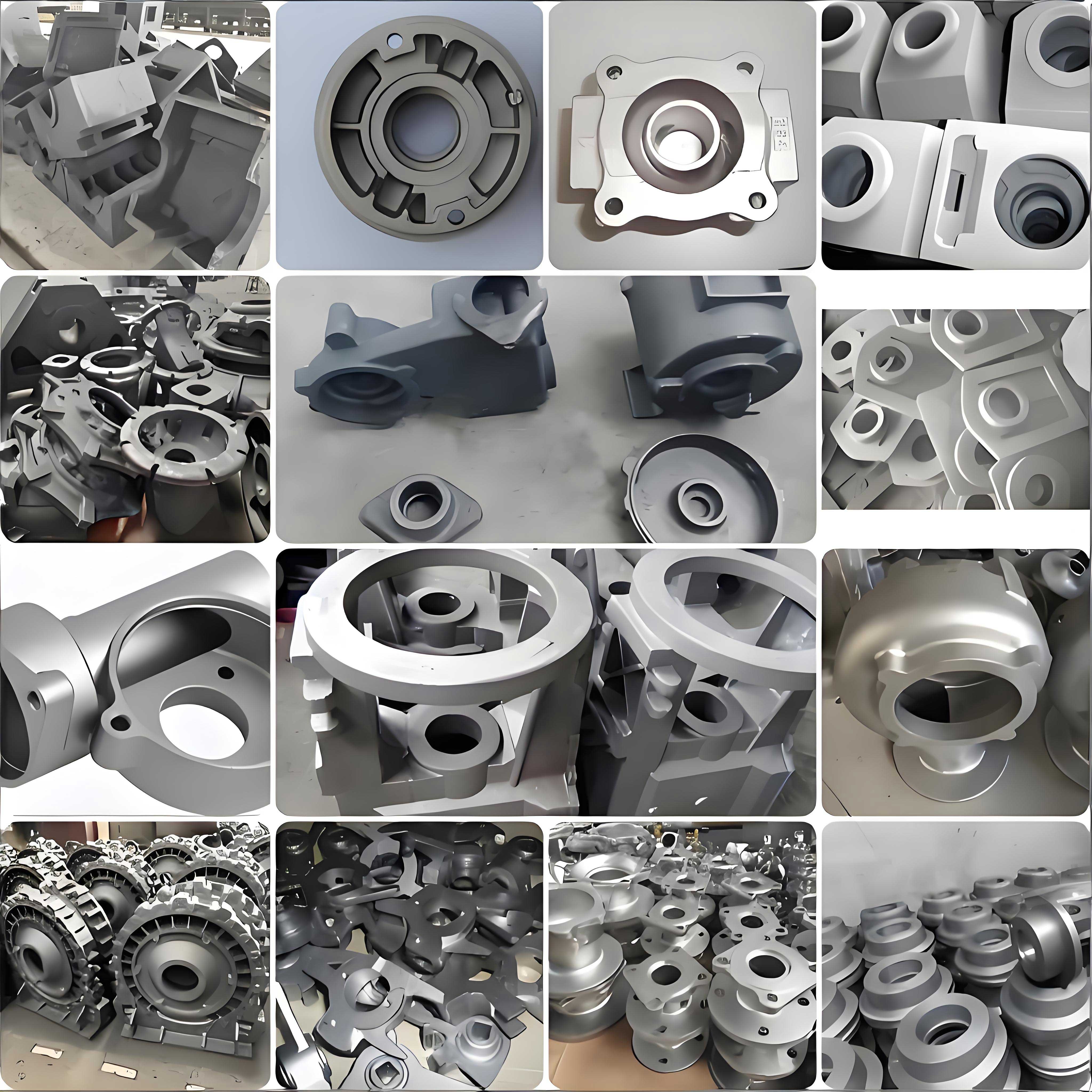
In our approach, we first focused on the chemical composition design for the nodular cast iron. The goal was to achieve a high carbon equivalent while controlling alloying elements to enhance hardenability and mechanical properties. We aimed for a composition that would facilitate the formation of spherical graphite and a fully austenitic matrix after heat treatment. The base requirements included low phosphorus and sulfur contents to minimize brittleness, with additions of copper to improve淬透性. The target chemical composition and technical specifications are summarized in the tables below. These parameters were critical in guiding our melting and inoculation practices, ensuring the nodular cast iron met the desired benchmarks for strength and elongation.
| Element | Pre-furnace Range | Final Range |
|---|---|---|
| Carbon (C) | 3.85–3.95 | 3.60–3.80 |
| Silicon (Si) | 1.90–2.00 | 2.35–2.55 |
| Manganese (Mn) | 0.30–0.50 | 0.30–0.50 |
| Phosphorus (P) | ≤0.05 | ≤0.05 |
| Sulfur (S) | 0.006–0.018 | 0.006–0.018 |
| Copper (Cu) | 0.40–0.70 | 0.40–0.70 |
| Magnesium (Mg) | – | 0.035–0.055 |
| Material | Tensile Strength (MPa) | Yield Strength (MPa) | Elongation (%) | Brinell Hardness (HBW) | Microstructure |
|---|---|---|---|---|---|
| EN-GJS-800-10 | >800 | >500 | >10 | 260–320 | Austenite |
The casting process was designed using MAGMA simulation software to predict and mitigate potential defects. Initially, we adopted a traditional gating and risering system with an open-type pouring configuration. The gating ratio was set as $$F_{\text{直}}:F_{\text{横}}:F_{\text{内}} = 1156:1935:2212 = 1.00:1.67:1.91$$, where $$F_{\text{直}}$$, $$F_{\text{横}}$$, and $$F_{\text{内}}$$ represent the cross-sectional areas of the sprue, runner, and ingate, respectively. This ratio ensured rapid filling to avoid cold shuts and slag inclusions. Riser dimensions were calculated based on the modulus method, with the riser modulus being 1.2 times the casting modulus, expressed as $$M_{\text{riser}} = 1.2 \times M_{\text{casting}}$$. Here, the modulus $$M$$ is defined as the volume-to-surface area ratio, crucial for determining solidification characteristics. However, simulation results revealed isolated liquid zones and hot spots within the casting, indicating a high risk of shrinkage porosity. To address this, we optimized the process by incorporating chills, which accelerate cooling in thick sections and extend the feeding range of risers. The chill design followed the formula: $$\delta = \frac{G}{\rho \times A}$$, where $$\delta$$ is the chill thickness, $$G$$ is the chill mass, $$\rho$$ is the density of the chill material, and $$A$$ is the contact area. We placed two types of chills in the lower mold: Chill 1 (130 mm × 70 mm × 50 mm) and Chill 2 (100 mm × 70 mm × 40 mm). This modification promoted directional solidification, transferring potential defects to the risers. The optimized simulation confirmed the absence of isolated液相 and hot spots, validating the effectiveness of our approach. The simulation parameters are detailed in the table below, providing insights into the computational setup.
| Parameter | Value |
|---|---|
| Casting Material | QT800 |
| Molding Sand Material | Tidal Film Sand |
| Initial Pouring Temperature | 1400°C |
| Pouring Time | 10 s |
| Sand Temperature | 25°C |
Following the casting process, we implemented an austempering heat treatment to transform the nodular cast iron into ADI. The treatment involved two stages: austenitization and isothermal quenching. First, the castings were preheated and then heated to an austenitizing temperature range of 860–920°C, held for 2–3 hours to ensure complete austenitization. Subsequently, they were rapidly quenched into a salt bath at 350–400°C to avoid pearlitic transformation. The transfer speed was critical to prevent premature phase changes. The castings were held in the salt bath for 1–2 hours, depending on wall thickness and alloy content, with mechanical搅拌 and water additions to enhance fluidity and cooling intensity. Finally, they were air-cooled to room temperature. This process yielded a microstructure of ausferrite (acicular ferrite and retained austenite), contributing to the high strength and toughness of the nodular cast iron.
To evaluate the impact of alloying elements, we conducted experimental trials with varying compositions of manganese, copper, and bismuth-containing inoculant. Three distinct schemes were formulated, as summarized in the table below. Each scheme involved melting nodular cast iron with specific additions, followed by casting, heat treatment, and testing. We used optical emission spectroscopy to measure chemical composition, tensile testing to determine mechanical properties, metallography to assess microstructure, and Brinell hardness testing. The sampling locations on the casting were standardized to ensure consistency, typically from thick and thin sections to capture variations.
| Scheme | Location | C | Si | Mn | Cu | Bi |
|---|---|---|---|---|---|---|
| 1 | T1 | 3.75 | 2.35 | 0.49 | 0.66 | – |
| T2 | 3.75 | 2.35 | 0.49 | 0.66 | – | |
| 2 | T1 | 3.69 | 2.52 | 0.47 | 0.53 | 0.10 |
| T2 | 3.69 | 2.52 | 0.47 | 0.53 | 0.10 | |
| 3 | T1 | 3.65 | 2.52 | 0.38 | 0.44 | 0.15 |
| T2 | 3.65 | 2.52 | 0.38 | 0.44 | 0.15 |
The results from these schemes are presented in the table below, highlighting the mechanical properties and microstructural characteristics. Scheme 1, with higher manganese and copper but no bismuth, exhibited a nodularity of only 80% and graphite counts of 166 per mm², along with some碎块状石墨. This led to inferior tensile strength and elongation, around 6%. Scheme 2, with reduced manganese and copper and the addition of 0.10% bismuth-containing inoculant, showed improved nodularity (90%) and graphite counts (307 per mm²), meeting the QT800-10 requirements. Scheme 3, further降低 manganese and copper while increasing bismuth to 0.15%, achieved the best performance: nodularity of 95%, graphite counts of 345 per mm², tensile strength of 984 MPa, yield strength of 610 MPa, and elongation of 20%. These findings underscore the importance of optimizing alloy content and inoculation in nodular cast iron to enhance graphite morphology and mechanical properties.
| Scheme | Location | Hardness (HBW) | Tensile Strength (MPa) | Yield Strength (MPa) | Elongation (%) | Nodularity (%) | Graphite Count (per mm²) | Ausferrite (%) |
|---|---|---|---|---|---|---|---|---|
| 1 | T1 | 318 | 770 | 487 | 6.5 | 80 | 166 | 100 |
| T2 | 321 | 801 | 502 | 6.0 | – | – | – | |
| 2 | T1 | 309 | 897 | 572 | 10.5 | 90 | 307 | 100 |
| T2 | 309 | 918 | 581 | 13.5 | – | – | – | |
| 3 | T1 | 296 | 984 | 610 | 20.0 | 95 | 345 | 100 |
| T2 | 293 | 971 | 602 | 16.5 | – | – | – |
Our analysis revealed that the carbon equivalent (CE) plays a pivotal role in the performance of nodular cast iron. The carbon equivalent is calculated using the formula: $$CE = C + \frac{Si}{3} + \frac{P}{3}$$, though for our purposes, we focused on C and Si. In Scheme 3, with 3.65% C and 2.52% Si, the CE was approximately 4.43–4.60%, which promoted fine graphite formation and high ductility. The reduction in manganese and copper minimized carbide formation, while bismuth acted as a potent inoculant, increasing graphite nucleation sites and refining the microstructure. This refinement is expressed through the Hall-Petch relationship, where strength is inversely proportional to grain size: $$\sigma_y = \sigma_0 + \frac{k}{\sqrt{d}}$$, with $$\sigma_y$$ being yield strength, $$\sigma_0$$ a material constant, $$k$$ a strengthening coefficient, and $$d$$ the grain diameter. In nodular cast iron, graphite sphericity and count directly influence effective grain size, thereby enhancing strength and toughness. Furthermore, the ausferritic microstructure after austempering contributed to the superior properties, as the retained austenite provides ductility while acicular ferrite offers strength.
The successful development of this nodular cast iron component underscores the synergy between process optimization and material science. By integrating MAGMA simulation, we effectively predicted and mitigated casting defects, demonstrating the value of computational tools in modern foundry practices. The use of chills proved essential for managing solidification in complex geometries, a principle that can be extended to other nodular cast iron applications. Moreover, our heat treatment protocol ensured consistent transformation to ADI, meeting the rigorous standards for rail transit components. This research highlights the potential of high-grade nodular cast iron in lightweighting initiatives, paving the way for broader adoption in transportation and beyond. Future work could explore additional alloying elements or alternative quenching media to further enhance performance. Ultimately, our findings contribute to the advancing field of nodular cast iron technology, offering a reliable solution for demanding engineering applications.