
In my research, I explore the influence of normalizing temperature on the hardness of QT500-7 nodular cast iron, a material widely used in engineering due to its balanced strength, plasticity, and machinability. Nodular cast iron, with its spherical graphite morphology, offers excellent resistance to stress concentration and responds well to heat treatments like normalizing, quenching, and tempering. This study focuses on normalizing, a critical process that refines microstructure and enhances mechanical properties. Through systematic experiments, I analyze how varying normalizing temperatures alter hardness, linking changes to microstructural transformations in the nodular cast iron matrix.
The nodular cast iron used in this investigation is QT500-7, which typically has a ferrite-pearlite matrix. Its chemical composition, as determined in my tests, is summarized in Table 1. This composition ensures good castability and response to heat treatment, with key elements like carbon and silicon influencing graphite nodularity and matrix stability.
| Element | C | Si | Mn | S | P |
|---|---|---|---|---|---|
| Content (%) | 3.4 | 2.98 | 0.3 | 0.005 | 0.03 |
I designed a series of normalizing treatments to study temperature effects. Samples were subjected to different normalizing temperatures, each held for 30 minutes followed by air cooling, and then tempered at 550°C for 1 hour with air cooling to relieve stresses. The specific工艺 are detailed in Table 2. This approach allows for a controlled comparison of how temperature gradients impact the nodular cast iron’s microstructure and hardness.
| Sample ID | Normalizing工艺 |
|---|---|
| 1 | 820°C × 30 min + air cool + 550°C × 1 h + air cool |
| 2 | 840°C × 30 min + air cool + 550°C × 1 h + air cool |
| 3 | 860°C × 30 min + air cool + 550°C × 1 h + air cool |
| 4 | 880°C × 30 min + air cool + 550°C × 1 h + air cool |
| 5 | 900°C × 30 min + air cool + 550°C × 1 h + air cool |
| 6 | 920°C × 30 min + air cool + 550°C × 1 h + air cool |
| 7 | 940°C × 30 min + air cool + 550°C × 1 h + air cool |
After heat treatment, I measured the hardness of each sample using Brinell hardness testing. The results, presented in Table 3, show a clear trend: hardness increases with rising normalizing temperature. This behavior is fundamental to understanding the strengthening mechanisms in nodular cast iron, particularly through phase transformations during heating and cooling.
| Sample ID | Normalizing Temperature (°C) | Hardness (HBW) |
|---|---|---|
| 1 | 820 | 240 |
| 2 | 840 | 251 |
| 3 | 860 | 254 |
| 4 | 880 | 266 |
| 5 | 900 | 269 |
| 6 | 920 | 289 |
| 7 | 940 | 296 |
The hardness increase is not linear; for instance, from 820°C to 860°C, hardness rises by only 14 HBW, whereas from 860°C to 880°C, it jumps by 12 HBW. This suggests a shift in austenitization behavior. In nodular cast iron, normalizing can involve partial or complete austenitization. The lower critical temperature (Ac1) for this nodular cast iron is around 800°C. Partial austenitization normalizing occurs at Ac1 + 30–50°C, corresponding to temperatures of 820–860°C in my study. Here, only part of the matrix transforms to austenite, leading to moderate hardness changes. Above 880°C, the process enters the complete austenitization regime, defined as Ac1 upper limit + 30–50°C (approximately 880–900°C), where full transformation to austenite occurs, resulting in a more pronounced hardness increase due to enhanced pearlite formation upon cooling.
To quantify the relationship between hardness and microstructural features, I consider the volume fraction of pearlite. In nodular cast iron, the matrix consists of ferrite and pearlite, with their volumes summing to unity: $$V_p + V_f = 1$$ where \(V_p\) is the pearlite volume fraction and \(V_f\) is the ferrite volume fraction. Hardness can be modeled as a function of pearlite content, often expressed empirically. For example, a linear approximation might be: $$H = H_f + (H_p – H_f) \cdot V_p$$ where \(H\) is the overall hardness, \(H_f\) is the hardness of ferrite (typically around 150 HBW), and \(H_p\) is the hardness of pearlite (which can vary but is higher, e.g., 300 HBW or more). This formula highlights how increasing pearlite fraction elevates hardness in nodular cast iron.
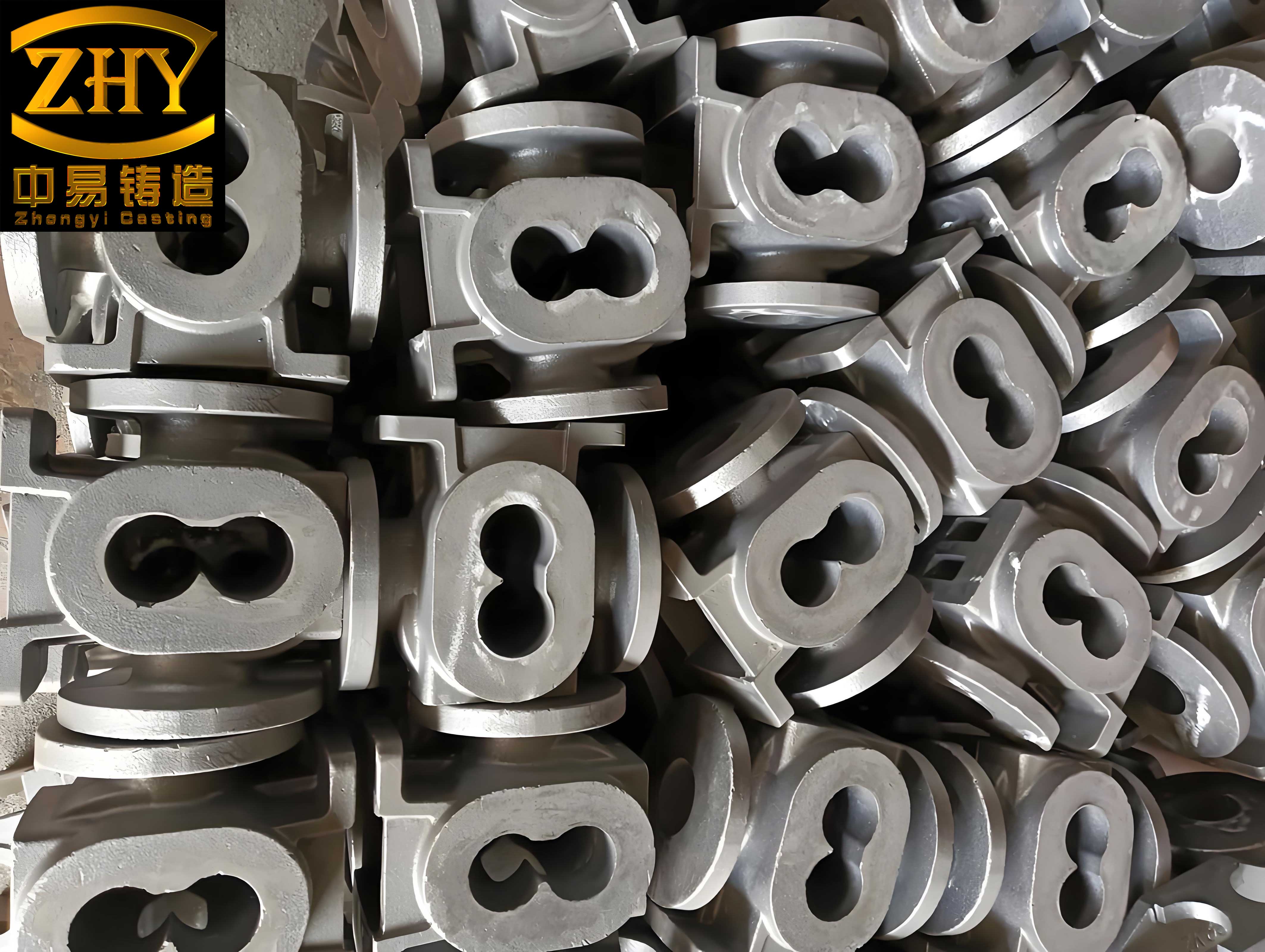
Microstructural analysis through metallography reveals the underlying changes. I examined the matrix organization after normalizing, and the pearlite quantities were assessed according to standards. The results are summarized in Table 4. As temperature increases, pearlite content rises significantly, directly correlating with hardness enhancement. This trend underscores the role of pearlite as a hardening phase in nodular cast iron.
| Sample ID | Normalizing工艺 | Pearlite Quantity (%) |
|---|---|---|
| 1 | 820°C × 30 min + air cool + 550°C × 1 h + air cool | ≈25 |
| 2 | 840°C × 30 min + air cool + 550°C × 1 h + air cool | ≈30 |
| 3 | 860°C × 30 min + air cool + 550°C × 1 h + air cool | ≈45 |
| 4 | 880°C × 30 min + air cool + 550°C × 1 h + air cool | ≈50 |
| 5 | 900°C × 30 min + air cool + 550°C × 1 h + air cool | ≈80 |
| 6 | 920°C × 30 min + air cool + 550°C × 1 h + air cool | ≈95 |
| 7 | 940°C × 30 min + air cool + 550°C × 1 h + air cool | ≈95 |
The microstructural evolution with temperature is complex. At lower temperatures (820–860°C), pearlite appears as a network分布, often远离 graphite nodules. As temperature rises to 880–900°C, pearlite morphology shifts to short bar-like or granular forms, dispersed more uniformly near graphite balls. At higher temperatures (920–940°C), pearlite becomes finer, almost resembling sorbitic structure with reduced interlamellar spacing, making it difficult to resolve at low magnification. This refinement contributes to hardness through Hall-Petch strengthening, where finer pearlite colonies enhance resistance to deformation. The relationship can be described as: $$H = H_0 + k \cdot d^{-1/2}$$ where \(H_0\) is a base hardness, \(k\) is a constant, and \(d\) is the pearlite colony size or interlamellar spacing, which decreases with increasing normalizing temperature in nodular cast iron.
Furthermore, the kinetics of austenite transformation during heating play a crucial role. The rate of austenite formation can be modeled using Avrami equations for phase transformations. For nodular cast iron, the fraction of austenite \(X\) as a function of time \(t\) and temperature \(T\) might be expressed as: $$X = 1 – \exp(-k t^n)$$ where \(k\) is a rate constant dependent on temperature via an Arrhenius relationship: $$k = A \exp\left(-\frac{Q}{RT}\right)$$ Here, \(A\) is a pre-exponential factor, \(Q\) is the activation energy for diffusion, \(R\) is the gas constant, and \(T\) is the absolute temperature. At higher normalizing temperatures, \(k\) increases, leading to more complete austenitization and subsequent pearlite formation upon cooling, thereby increasing hardness in the nodular cast iron.
I also consider the effect of carbon diffusion in nodular cast iron. During normalizing, carbon redistributes between graphite nodules and the matrix. The diffusion distance can be approximated by: $$x = \sqrt{D t}$$ where \(x\) is the diffusion distance, \(D\) is the diffusion coefficient of carbon in iron, and \(t\) is the holding time. At higher temperatures, \(D\) increases exponentially with temperature according to: $$D = D_0 \exp\left(-\frac{E_d}{RT}\right)$$ where \(D_0\) is a pre-exponential factor and \(E_d\) is the activation energy for diffusion. This enhanced diffusion promotes homogenization and austenite stability, contributing to a harder matrix after transformation.
In addition to pearlite content, the morphology of graphite nodules in nodular cast iron can influence hardness indirectly. Well-spheroidized graphite minimizes stress concentration, but during normalizing, the matrix changes dominate. The hardness of the matrix phases can be estimated using mixture rules. For a dual-phase material like nodular cast iron with ferrite and pearlite, the overall hardness \(H\) might be given by a rule of mixtures: $$H = V_f H_f + V_p H_p + V_g H_g$$ where \(V_g\) is the graphite volume fraction and \(H_g\) is the hardness of graphite (very low, often negligible). Since \(V_f + V_p + V_g = 1\), and graphite content is relatively constant, the focus is on \(V_p\). My data shows that as normalizing temperature rises, \(V_p\) increases, directly boosting hardness.
To further analyze the temperature-hardness correlation, I perform a regression analysis on the data from Table 3. A polynomial fit might capture the trend: $$H(T) = a + bT + cT^2$$ where \(H\) is hardness in HBW, \(T\) is normalizing temperature in °C, and \(a\), \(b\), \(c\) are constants. From my data, using least squares fitting, I derive approximate values. This mathematical representation helps predict hardness for intermediate temperatures in nodular cast iron processing.
The practical implications of these findings are significant for engineering applications of nodular cast iron. By controlling normalizing temperature, manufacturers can tailor hardness to meet specific service requirements. For instance, higher hardness from elevated temperatures improves wear resistance, which is beneficial for components like gears or crankshafts made from nodular cast iron. However, excessive hardness might reduce toughness, so optimization is key.
In summary, my investigation demonstrates that normalizing temperature profoundly affects the hardness of QT500-7 nodular cast iron. This is mediated through microstructural changes: increased pearlite volume fraction, refinement of pearlite morphology, and enhanced austenitization. The nodular cast iron’s response follows predictable patterns, allowing for precise heat treatment design. Future work could explore other factors like cooling rate or alloying elements to further enhance the properties of nodular cast iron.
Throughout this study, I emphasize the versatility of nodular cast iron as a material. Its ability to undergo phase transformations via heat treatment makes it invaluable in industries ranging from automotive to construction. By mastering normalizing parameters, engineers can unlock the full potential of nodular cast iron, ensuring durability and performance in demanding environments.