
In the automotive industry, the push for lightweighting and emission reduction has become a dominant trend, driven by environmental regulations and economic pressures. Among various materials, high-performance nodular cast iron stands out due to its exceptional combination of strength, ductility, wear resistance, and vibration damping properties. This article, from my perspective as an industry observer, delves into the application of 800–1000 MPa grade high-performance nodular cast iron in heavy-duty truck chassis, exploring its technical requirements, production processes, real-world implementations, and associated challenges. The focus is on how this material contributes to lightweighting efforts while maintaining structural integrity and performance.
High-performance nodular cast iron, often referred to as ductile iron, is a type of cast iron where graphite is present in spherical nodules, which imparts superior mechanical properties compared to traditional gray cast iron. The key grades used in heavy-duty truck chassis range from 800 to 1000 MPa in tensile strength, offering a balance between high strength and adequate elongation. These materials are typically classified into two categories: as-cast supplied nodular cast iron and austempered ductile iron (ADI). The former is produced through controlled melting, spheroidization, and inoculation processes to achieve desired properties in the cast state, while the latter involves a heat treatment process known as austempering to develop an ausferritic microstructure.
The as-cast high-performance nodular cast iron, such as QT800-5, has a density of approximately 7.3 kg/m³, with tensile strength (Rm) of 800 MPa, yield strength (Rp0.2) of 480 MPa, elongation (A) of 5%, and hardness ranging from 245 to 335 HBW. This grade is preferred for its cost-effectiveness and simplified production流程, as it eliminates the need for additional heat treatment. The chemical composition is critical; for instance, a typical formulation includes carbon (C) at 3.3–3.5%, silicon (Si) at 2.3–2.5%, manganese (Mn) at 0.8–1.0%, and copper (Cu) at 0.7–0.9% by mass. The microstructure should have a pearlite content of over 85% and a spheroidization grade of 2 or better. The production relies on high-purity raw materials to minimize trace elements that interfere with graphite spheroidization, and advanced techniques like pure magnesium treatment are employed to enhance efficiency and reduce inclusions.
On the other hand, austempered ductile iron (ADI) is produced by subjecting nodular cast iron to an austenitizing treatment followed by rapid quenching into a salt bath or oil at temperatures around 250–400°C for isothermal transformation. This results in a unique ausferritic structure consisting of high-carbon austenite and acicular ferrite, which provides exceptional toughness and strength. The mechanical properties of ADI, as per standards like GB/T 24733-2009, include tensile strengths from 800 to 1050 MPa, with elongations up to 10%, as summarized in Table 1. The elastic modulus is around 170 GPa, Poisson’s ratio is 0.28, and thermal properties are favorable for automotive applications. ADI is often used to replace forged steel or low-alloy cast steel components, offering weight savings of up to 40% in some cases.
| Grade | Tensile Strength Rm (MPa) | Yield Strength Rp0.2 (MPa) | Elongation A (%) |
|---|---|---|---|
| QTD800-10 | 800 | 500 | 10 |
| QTD900-8 | 900 | 600 | 8 |
| QTD1050-6 | 1050 | 700 | 6 |
The production of high-performance nodular cast iron involves meticulous process control. For as-cast grades, the melting process typically follows a sequence of scrap steel, pig iron, and returns, with temperatures kept below 1370°C to prevent excessive oxidation. Carbon raisers are added in stages to achieve the desired carbon equivalent. The spheroidization treatment is crucial; methods like the sandwich process using FeSiMg6Re2 inoculant or pure magnesium treatment are common. In pure magnesium treatment, magnesium blocks are placed in a reaction chamber, and when molten iron is introduced, magnesium vaporizes and reacts with the iron, achieving high absorption rates of around 60%. This method reduces silicon intake and allows for better control of composition. Inoculation is performed multiple times using barium-containing ferrosilicon to promote graphite nucleation and improve mechanical properties.
For ADI, the heat treatment process can be modeled using kinetics equations. The austenitizing temperature (T_γ) and time (t_γ) depend on the composition, but generally, it follows:
$$ T_{\gamma} = A_{c3} + \Delta T $$
where \( A_{c3} \) is the temperature at which austenite transformation completes, and \( \Delta T \) is an overheat factor. The isothermal transformation time (t_i) at temperature T_i affects the volume fraction of ausferrite, approximated by:
$$ V_f = 1 – e^{-k t_i} $$
where \( k \) is a rate constant dependent on alloying elements. This treatment enhances the toughness of nodular cast iron by avoiding brittle carbide formation.
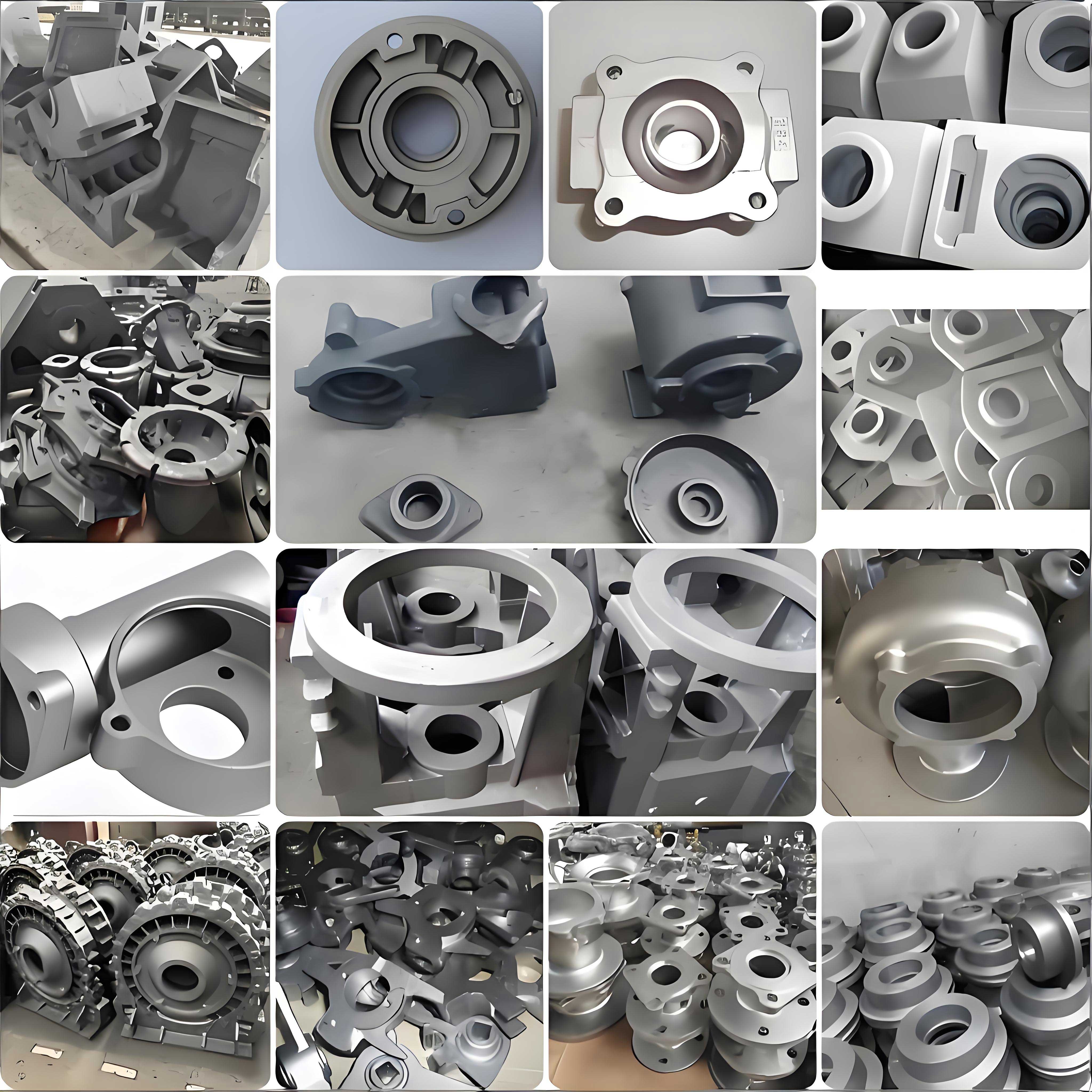
The application of high-performance nodular cast iron in heavy-duty truck chassis is widespread across Chinese manufacturers. Components such as balance shaft brackets, spring hangers, tow hooks, and steering knuckles are commonly made from these materials. Table 2 provides an overview of typical applications, highlighting the shift from traditional materials to nodular cast iron for lightweighting. For instance, in balance shaft brackets, the use of QT800-5代替 QT500-7 can reduce mass by up to 29% while meeting strength requirements through structural optimization.
| Component | Typical Grade | Weight Reduction | Replaced Material |
|---|---|---|---|
| Balance Shaft Bracket | QT800-5 | 15 kg (29%) | QT500-7 |
| Front Extension Beam Bracket | ADI QTD900-8 | ~20% | Low-alloy Steel |
| Leaf Spring Bracket | As-cast QT800-5 | 10–15% | Cast Steel |
| Tow Hook | ADI QTD1050-6 | 25–30% | Forged Steel |
| Steering Knuckle | ADI QTD900-8 | ~40% | 40Cr Steel |
A detailed case study involves the redesign of a balance shaft bracket for a heavy-duty truck. The original bracket, made from QT500-7, weighed 51 kg. By switching to QT800-5 and optimizing the geometry through finite element analysis (FEA), the wall thickness was reduced from 14–16 mm to 12 mm, resulting in a final weight of 36 kg—a 15 kg reduction. The design constraints included vertical loads of 220 kN and braking loads of 90 kN vertically and 120 kN longitudinally. FEA simulations confirmed that the maximum stress concentrations at the fillet roots remained within allowable limits, with safety factors exceeding requirements. The casting process was simulated to ensure soundness, and prototype testing validated the performance.
The casting simulation for the balance shaft bracket revealed potential shrinkage porosity in certain areas, but actual cut-up tests showed only minor defects acceptable per standards. This highlights the importance of process simulation in high-performance nodular cast iron production. The melting and treatment involved using scrap steel with low impurities, carbon raisers with fixed carbon over 98%, and a sandwich spheroidization process with FeSiMg6Re2 and barium ferrosilicon inoculants. Mechanical tests on samples from the casting本体 showed tensile strengths above 800 MPa and elongations over 5%, with spheroidization grade 3 and graphite size 6, meeting specifications.
The microstructure of high-performance nodular cast iron is key to its properties. For as-cast grades, the graphite nodule count and matrix structure can be described by parameters like nodularity (N) and pearlite fraction (P). Nodularity is defined as:
$$ N = \frac{\sum A_{\text{spherical}}}{\sum A_{\text{total}}} \times 100\% $$
where \( A_{\text{spherical}} \) is the area of spherical graphite, and \( A_{\text{total}} \) is the total graphite area. A higher nodularity, typically above 80%, ensures better mechanical properties. The pearlite fraction influences strength and hardness, often optimized through alloying with copper, manganese, or tin.
Despite the advantages, the application of high-performance nodular cast iron faces several challenges. Cost is a significant issue; the rising prices of raw materials, such as high-purity pig iron and alloying elements, increase production costs. While lightweighting offers fuel savings and payload benefits, the economic balance must be carefully evaluated. Technical challenges include consistency in mechanical properties across batches, as variations in melting, treatment, or cooling can lead to defects or performance deviations. For example, the sensitivity of nodular cast iron to section thickness requires uniform design to avoid stress concentrations. Collaboration between OEMs and suppliers is another hurdle; often, design optimization and process simulation are done separately, leading to suboptimal outcomes. A more integrated approach, using digital tools for concurrent engineering, could enhance material utilization and reduce development time.
To address these challenges, advancements in technology are essential. For instance, the use of artificial intelligence (AI) in melting control can optimize composition in real-time, reducing variability. Additive manufacturing techniques are also being explored for producing complex nodular cast iron components with reduced weight and improved performance. Furthermore, lifecycle assessment (LCA) studies can quantify the environmental benefits of using high-performance nodular cast iron over alternative materials, supporting its adoption in sustainable automotive design.
In conclusion, high-performance nodular cast iron, particularly in the 800–1000 MPa range, plays a crucial role in the lightweighting of heavy-duty truck chassis. Its superior strength-to-weight ratio, combined with good ductility and fatigue resistance, makes it an attractive alternative to traditional steels and cast irons. Through case studies like the balance shaft bracket, it is evident that significant weight reductions of up to 30% are achievable without compromising safety or performance. However, challenges related to cost, technical consistency, and supply chain collaboration must be overcome to fully realize its potential. As the automotive industry continues to evolve towards electrification and autonomy, the demand for lightweight and durable materials like nodular cast iron is expected to grow, driving further innovation in production processes and applications.
The future of high-performance nodular cast iron lies in the development of new grades with enhanced properties, such as higher toughness at low temperatures or improved wear resistance for specific components. Research into eco-friendly production methods, such as using recycled materials and energy-efficient heat treatments, will also contribute to its sustainability. By leveraging digital tools and fostering closer industry partnerships, the automotive sector can harness the full benefits of this versatile material, paving the way for next-generation heavy-duty vehicles that are lighter, stronger, and more efficient.