
In the realm of wind energy, the demand for larger and more powerful turbines has driven the need for robust and reliable components. Among these, castings such as hubs, bedplates, and frames are critical, and nodular cast iron has emerged as a preferred material due to its excellent wear resistance, damping capacity, insensitivity to notches, superior castability, and cost-effectiveness. However, as wind turbine components grow in size, with section thicknesses often exceeding 200 mm, significant challenges arise in maintaining the material integrity of nodular cast iron. Thick-section castings cool slowly during solidification, leading to issues like poor graphite spheroidization, reduced graphite nodule count, and the formation of chunky graphite. Additionally, severe compositional segregation in the matrix can result in carbides that are difficult to eliminate even with prolonged heat treatment, along with coarse grains, black spots, and shrinkage porosity.
Traditionally, improvements have relied on strict chemical control, advanced casting processes, post-heat treatments, and forced cooling techniques. While these methods have shown some efficacy, enhancing the quality of wind power nodular cast iron castings without escalating costs has proven nearly impossible through process and equipment adjustments alone. Currently, the predominant material used domestically for wind power castings is QT400-18AL, which offers tensile strength ≥ 360 MPa, yield strength ≥ 220 MPa, elongation ≥ 12.5%, and impact energy at -30°C of 10 J (average) and 7 J (individual). In contrast, international standards like EN-GJS-500-14 and EN-GJS-600-10 provide higher strength but lack low-temperature impact requirements, posing risks in wind energy applications. Therefore, developing a high-strength, high-toughness, low-temperature-grade nodular cast iron is imperative.
This work explores the alloying approach to enhance the strength and toughness of nodular cast iron for wind power castings, aiming to reduce section thicknesses in heavy parts and mitigate quality issues stemming from slow cooling. By incorporating specific alloying elements into the QT400-18AL base, we seek to achieve a material that meets stringent mechanical and low-temperature performance criteria. The focus is on nickel (Ni), niobium (Nb), and zirconium (Zr), selected for their beneficial effects: Ni lowers the brittle transition temperature and improves low-temperature properties; Nb enhances mechanical performance without compromising low-temperature toughness; and Zr acts as a deoxidizer, purifier, and grain refiner, further supporting low-temperature behavior. The detailed alloy composition is presented in Table 1.
| Element | C | Si | Mn | P | S | Mg | RE | Ni | Nb | Zr |
|---|---|---|---|---|---|---|---|---|---|---|
| Content | 3.5–3.7 | 2.0–2.3 | < 0.2 | < 0.02 | < 0.015 | < 0.04 | < 0.03 | 0.3–0.5 | 0.1–0.3 | 0.01–0.03 |
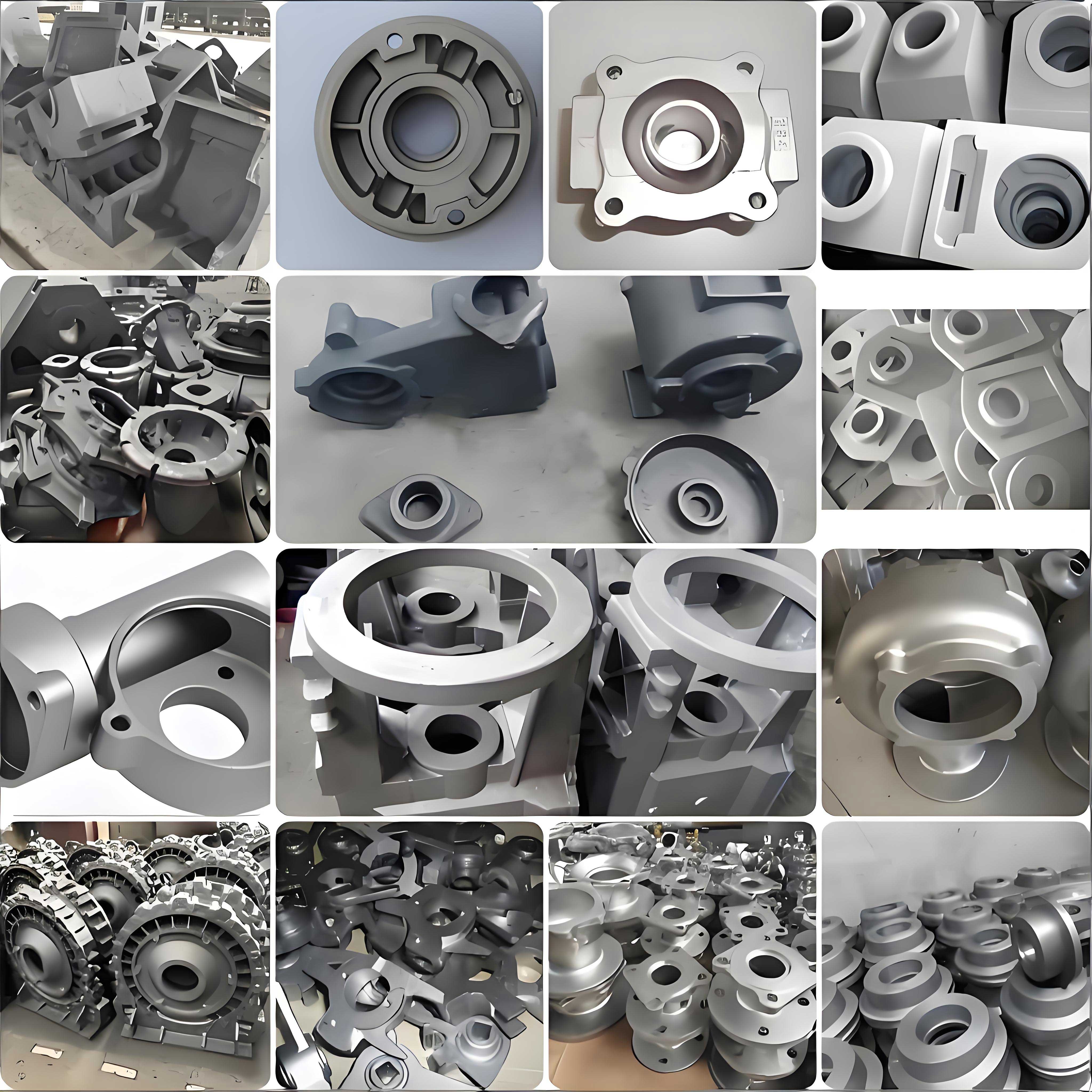
The development of this advanced nodular cast iron involved a meticulous process of material preparation, sample casting, and comprehensive testing. Initially, raw materials including pig iron, returns, and scrap steel were melted in a furnace to produce molten iron. Carbon content was adjusted through carburization to meet the specifications in Table 1. Subsequently, the melt underwent spheroidization, inoculation, and alloying treatments: Nb and Ni were added according to the mass percentages, while Zr was introduced via a silicon-zirconium inoculant. The treated molten iron was then poured to fabricate the high-strength, high-toughness nodular cast iron material. For testing purposes, cast blocks with dimensions of 300 mm × 300 mm × 300 mm were produced, accompanied by attached test blocks of 70 mm thickness to simulate thick-section conditions. The casting and mold opening processes are illustrated below, showcasing the practical aspects of producing nodular cast iron components.
To evaluate the performance of the alloyed nodular cast iron, a series of tests were conducted on the cast samples. Mechanical properties at room temperature were assessed according to GB/T 228-2002 (equivalent to ISO 6892-1), with results summarized in Table 2. The data reveal a significant improvement over conventional QT400-18AL, demonstrating the efficacy of Ni and Nb addition in enhancing strength and ductility simultaneously. The tensile strength, yield strength, and elongation all meet or exceed the targets for high-performance wind power castings, underscoring the potential of this nodular cast iron variant.
| Sample No. | Tensile Strength (MPa) | Yield Strength (MPa) | Elongation (%) |
|---|---|---|---|
| 1 | 402.9 | 276.9 | 21.3 |
| 2 | 401.5 | 272.2 | 21.7 |
| 3 | 408.1 | 271.0 | 21.6 |
Microstructural analysis was performed following GB/T 9441-2021 (similar to ISO 945-1), with key findings presented in Table 3 and accompanying descriptions. The graphite morphology showed a spheroidization grade of 2, with a nodularity exceeding 90% and graphite size rated at 6. The matrix consisted of over 90% ferrite, with carbides and phosphide eutectic kept below 1% and 0.5%, respectively. This refined microstructure is crucial for achieving high toughness in nodular cast iron, particularly in thick sections where slow cooling can degrade graphite quality. The addition of Zr likely contributed to grain refinement, while Ni and Nb promoted ferrite stability and inhibited carbide formation.
| Sample No. | Spheroidization Grade | Nodularity (%) | Graphite Size | Ferrite (%) | Carbide (%) | Phosphide Eutectic (%) |
|---|---|---|---|---|---|---|
| 1 | 2 | > 90 | 6 | > 90 | ≤ 1 | ≤ 0.5 |
| 2 | 2 | > 90 | 6 | > 90 | ≤ 1 | ≤ 0.5 |
Low-temperature impact toughness is a critical parameter for wind power nodular cast iron components operating in cold climates. Charpy impact tests were conducted at -20°C and -30°C per GB/T 229-2020 (aligned with ISO 148-1), with results shown in Table 4. The average impact energy at -30°C was 10.8 J, satisfying the typical requirement of 10 J (average) for wind turbine castings. This indicates that the alloyed nodular cast iron maintains adequate toughness at sub-zero temperatures, a key advantage over higher-strength international grades that lack low-temperature specifications. The role of Ni in reducing the ductile-to-brittle transition temperature is evident here, making this material suitable for harsh environmental conditions.
| Test Temperature (°C) | Impact Energy KV (J) – Individual Values | Average Impact Energy KV (J) |
|---|---|---|
| -20 | 12.9, 13.2, 13.1 | 13.1 |
| -30 | 10.7, 11.3, 10.4 | 10.8 |
Fatigue performance is another vital aspect for wind power nodular cast iron components subjected to cyclic loading. Axial force-controlled fatigue tests were carried out according to GB/T 3075-2021 (equivalent to ISO 1099), with data analysis following GB/T 24176-2009 (similar to ISO 12107). The stress ratio was set at -1 (fully reversed tension-compression), and the run-out cycle limit was 1×10⁷. The fatigue limit was determined using the staircase method (up-and-down technique) with a stress step of 10 MPa, involving 15 specimens. The test data are listed in Table 5, and the corresponding staircase diagram is conceptualized to illustrate the failure and survival points. From this, the average fatigue limit at 50% failure probability was calculated as 196 MPa. This value represents the endurance strength of the alloyed nodular cast iron under alternating stresses, which is essential for designing durable wind turbine castings.
| Specimen No. | Maximum Stress (MPa) | Cycles to Failure or Run-out | Result |
|---|---|---|---|
| 001 | 200 | 1.30×10⁶ | Failure |
| 002 | 190 | 1.00×10⁷ | Run-out |
| 003 | 200 | 1.00×10⁷ | Run-out |
| 004 | 210 | 6.59×10⁵ | Failure |
| 005 | 200 | 7.73×10⁵ | Failure |
| 006 | 190 | 1.00×10⁷ | Run-out |
| 007 | 200 | 1.81×10⁶ | Failure |
| 008 | 190 | 3.66×10⁶ | Failure |
| 009 | 180 | 1.00×10⁷ | Run-out |
| 010 | 190 | 1.00×10⁷ | Run-out |
| 011 | 200 | 1.00×10⁷ | Run-out |
| 012 | 210 | 5.21×10⁶ | Failure |
| 013 | 200 | 1.36×10⁶ | Failure |
| 014 | 190 | 1.00×10⁷ | Run-out |
| 015 | 200 | 1.00×10⁷ | Run-out |
To further characterize the fatigue behavior, additional specimens were tested at various stress levels to construct an S-N curve (stress-life curve) for the alloyed nodular cast iron. The results, combined with the fatigue limit, are summarized in Table 6 and plotted to show the relationship between stress amplitude and cycles to failure. The S-N curve can be modeled using the Basquin equation: $$ S = S_f’ (2N_f)^b $$ where \( S \) is the stress amplitude, \( S_f’ \) is the fatigue strength coefficient, \( N_f \) is the number of cycles to failure, and \( b \) is the fatigue strength exponent. For this nodular cast iron, fitting the data yields parameters that reflect its high-cycle fatigue resistance, which is superior to conventional grades due to the alloying effects. This mathematical representation aids in predicting the service life of wind power castings under cyclic loads.
| Specimen No. | Maximum Stress (MPa) | Cycles to Failure | Result |
|---|---|---|---|
| 016 | 200 | 5.31×10⁶ | Failure |
| 017 | 200 | 1.50×10⁶ | Failure |
| 018 | 200 | 6.84×10⁵ | Failure |
| 019 | 220 | 6.43×10⁵ | Failure |
| 020 | 220 | 8.04×10⁵ | Failure |
| 021 | 220 | 9.35×10⁵ | Failure |
| 022 | 260 | 3.46×10⁵ | Failure |
| 023 | 260 | 4.63×10⁵ | Failure |
| 024 | 260 | 3.66×10⁵ | Failure |
| 025 | 290 | 6.31×10⁴ | Failure |
| 026 | 290 | 1.68×10⁵ | Failure |
| 027 | 290 | 1.14×10⁵ | Failure |
| 028 | 320 | 6.57×10⁴ | Failure |
| 029 | 320 | 5.20×10⁴ | Failure |
| 030 | 320 | 1.89×10⁴ | Failure |
The application of this advanced nodular cast iron in wind power castings offers substantial benefits. During melting, since Nb has a higher melting point than iron, it is essential to crush ferroniobium into fine pieces to ensure proper dissolution in the molten iron. This practical step guarantees homogeneous alloy distribution, which is critical for consistent properties in thick-section nodular cast iron components. Compared to QT400-18AL, the alloyed material exhibits markedly improved mechanical performance while meeting low-temperature impact requirements, making it a viable replacement. When used in castings like hubs, bedplates, and frames, weight reduction of up to 15% can be achieved due to the higher strength, allowing for thinner sections without compromising safety. This lightweighting not only addresses quality issues from slow cooling but also reduces transportation costs, eases assembly, and optimizes overall turbine loads, contributing to more efficient wind energy systems.
In conclusion, the alloying of QT400-18AL nodular cast iron with Ni and Nb has successfully yielded a high-strength, high-toughness material suitable for wind power applications. The enhanced mechanical properties, coupled with satisfactory low-temperature impact energy and fatigue resistance, fulfill the stringent demands of modern wind turbine castings. This development enables the production of lighter and more reliable nodular cast iron components, effectively mitigating problems associated with thick sections and slow cooling. The widespread adoption of this alloyed nodular cast iron could drive advancements in wind energy technology, supporting the trend towards larger and more efficient turbines. Future work may explore further optimization of alloy ratios or the addition of other elements to push the boundaries of nodular cast iron performance in renewable energy sectors.