
In the field of advanced materials for high-temperature applications, the development and optimization of high nickel austenitic nodular cast iron have garnered significant attention due to its exceptional properties. This material, often designated as D2B, exhibits a unique microstructure consisting of spherical graphite distributed within an austenitic matrix with minimal carbides. The combination of high room-temperature mechanical strength, excellent thermal shock resistance, elevated temperature creep resistance, corrosion resistance, and oxidation resistance, along with low thermal expansion at high temperatures, makes it ideal for critical components such as top and bottom bushings in automotive exhaust systems. In this study, I delve into the comprehensive production process of high nickel austenitic nodular cast iron, focusing on compositional design, manufacturing techniques, and quality control measures to meet stringent client specifications. The goal is to provide a detailed account that leverages tables and formulas to summarize key aspects, ensuring the content exceeds 8000 tokens while adhering to the requirements of this technical exploration.
The fundamental requirements for high nickel austenitic nodular cast iron are outlined in terms of chemical composition, mechanical properties, and microstructure. These specifications serve as the baseline for the production trials. The chemical composition, as per client demands, is critical to achieving the desired performance. Table 1 summarizes the mass fraction percentages of key elements.
| Element | Range |
|---|---|
| Carbon (C) | 2.5–3.0 |
| Silicon (Si) | 1.5–3.0 |
| Manganese (Mn) | 0.7–1.25 |
| Chromium (Cr) | 2.75–4.0 |
| Nickel (Ni) | 18–22 |
| Copper (Cu) | ≤ 0.5 |
The mechanical properties are equally vital, as they determine the component’s functionality under stress. Table 2 presents the target values for tensile strength, yield strength, elongation, and hardness, which are derived from standard testing protocols.
| Property | Range |
|---|---|
| Tensile Strength | 395–500 MPa |
| Yield Strength | 210–260 MPa |
| Elongation | 7–15% |
| Hardness | 150–255 HBW |
Microstructurally, the nodular cast iron must exhibit a specific organization to ensure optimal performance. The requirements include a graphite spheroidization level of no more than grade 4, graphite size between 5 and 7, and a matrix composed of austenite with minor grain boundary carbides and spherical graphite. This microstructure is pivotal for the material’s ductility and high-temperature stability. To quantify graphite characteristics, one can use formulas such as the nodularity index, defined as: $$ \text{Nodularity} = \frac{N_{\text{nodular}}}{N_{\text{total}}} \times 100\% $$ where \( N_{\text{nodular}} \) is the number of nodular graphite particles and \( N_{\text{total}} \) is the total graphite count per unit area. For high-quality nodular cast iron, this index should exceed 80%, aligning with the client’s specifications.
In the production trial, the selection of chemical elements was meticulously planned to balance performance and cost. Carbon content was set at the upper limit of 2.5–3.0% to enhance fluidity, reduce shrinkage porosity, and promote graphite nucleation. The relationship between carbon content and graphite formation can be expressed as: $$ G_n = k \cdot (C_{\%} – C_{\text{eutectic}}) $$ where \( G_n \) is the graphite nodule count, \( k \) is a constant dependent on cooling rate and inoculation, and \( C_{\text{eutectic}} \) is the eutectic carbon content. Silicon was maintained at 2.5–3.0% to foster graphitization and improve inoculating effects, thereby increasing nodularity. Manganese was controlled at 0.75–0.90% to minimize segregation and avoid hardenability issues that could impair machinability. Nickel, the key austenite stabilizer, was set at 18–20% to ensure adequate high-temperature properties without excessive cost. Chromium was limited to 2.75–3.15% to balance carbide formation and maintain ductility, while copper was kept below 0.5% to neutralize chromium’s effects. These choices were guided by empirical models for nodular cast iron, such as the carbon equivalent formula adjusted for high nickel: $$ CE = C + \frac{Si}{3} + \frac{Ni}{10} – \frac{Cr}{5} $$ where a higher CE promotes graphite formation, crucial for this nodular cast iron variant.
Raw materials were carefully selected to avoid detrimental trace elements like lead, titanium, and arsenic, which can degrade graphite morphology in nodular cast iron due to the absence of rare earth elements like cerium. High-quality Q10 pig iron and low-impurity scrap steel were used, with compositions verified through spectrometry. For alloying, 75% ferrosilicon, high-carbon ferromanganese, and high-carbon ferrochromium were employed. The nodularizing agent chosen was a silicon-magnesium type (Elmag5542), free from rare earths, while Superseed75 and Superseed Extra were used for inoculation and stream inoculation, respectively, to enhance graphite nodule count in the nodular cast iron.
The charge calculation for a 500 kg melt is detailed in Table 3, ensuring precise control over the final composition.
| Material | Amount |
|---|---|
| Pig Iron | 280 |
| Scrap Steel | 90 |
| Carbon Raiser | 1 |
| Ferrochromium | 22 |
| Ferromanganese | 5.5 |
| Nickel Plate | 93 |
| Ferrosilicon | 9 |
Additionally, the additions for nodularizing and inoculation are summarized in Table 4, critical for achieving the desired graphite structure in nodular cast iron.
| Agent | Amount |
|---|---|
| Nodularizing Agent | 9 |
| Inoculant | 2.1 |
| Stream Inoculant | 0.5 |
The casting process utilized a shell molding technique with stacked molds to accommodate the small part size (30 mm diameter, 53 mm length, 0.28 kg mass). Each mold stack consisted of 6 layers with 16 cavities per layer, producing 96 castings per pattern. This approach optimized production efficiency for batch manufacturing of nodular cast iron components.
Melting was conducted in a 500 kg medium-frequency induction furnace. The charge sequence involved adding pig iron, scrap steel, carbon raiser, ferrosilicon, ferrochromium, ferromanganese, and nickel plate. After complete melting at 1460–1480°C, a white iron test piece was analyzed via optical emission spectrometry, and adjustments were made to meet the target composition. At 1550°C, the ladles were preheated to ensure thermal stability. For nodularizing, 9 kg of nodularizing agent, 1.8 kg of inoculant, and 6.5 kg of covering agent were added to the treatment ladle and compacted. When the molten metal reached 1640 ± 10°C, it was tapped for treatment, with a reaction time of 40–60 seconds. After slag removal, pouring occurred at 1470–1540°C, accompanied by stream inoculation using 0.2–0.7 mm grain size inoculant. The final mold included tensile test bars and spectrometric samples for quality assessment.
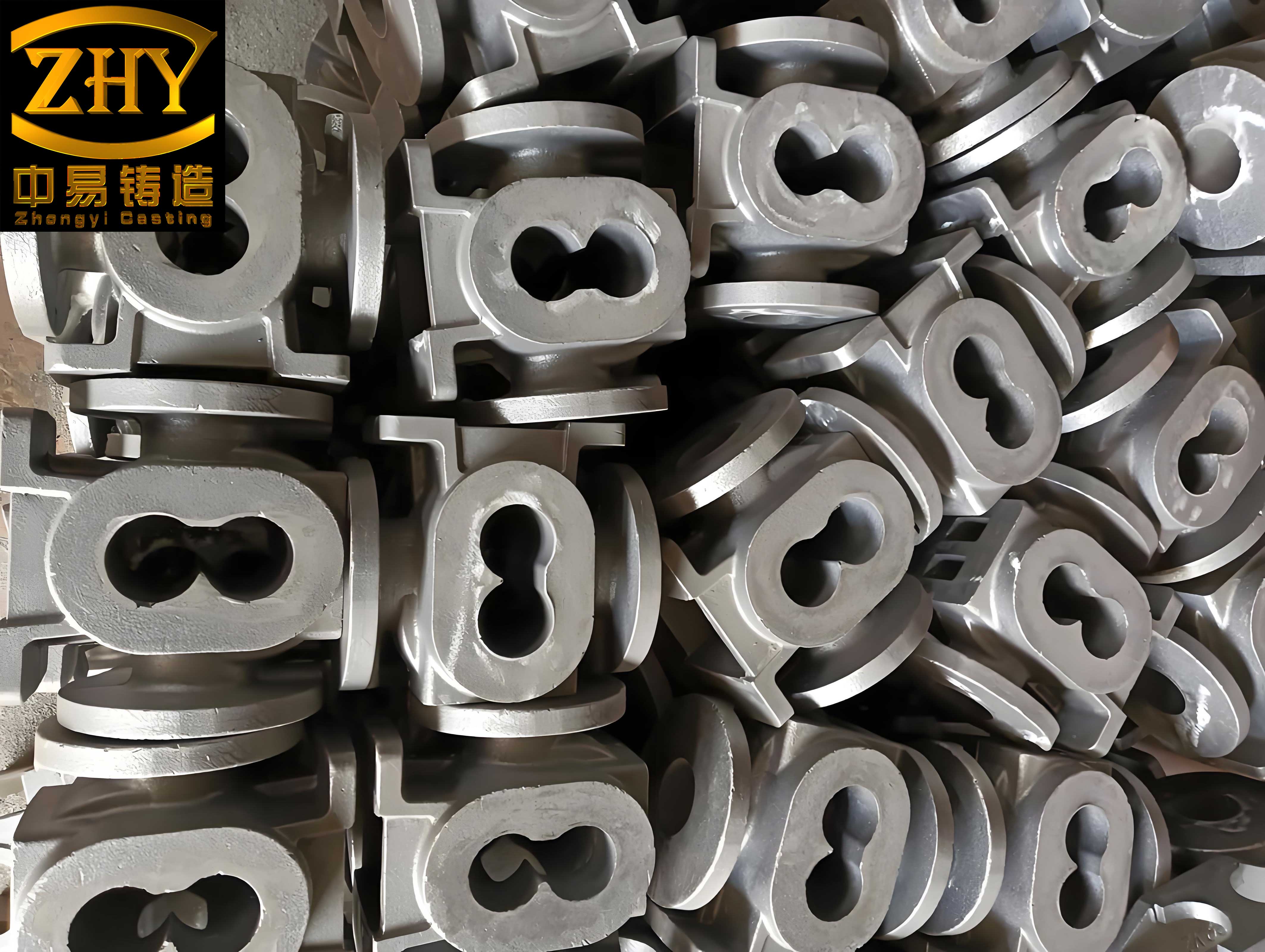
The trial results demonstrated successful production of high nickel austenitic nodular cast iron. The chemical composition of the castings, as shown in Table 5, aligned closely with the specified ranges.
| Element | Value |
|---|---|
| C | 2.89 |
| Si | 2.92 |
| Mn | 0.822 |
| Cr | 2.88 |
| Ni | 19.32 |
| Cu | 0.038 |
Microstructurally, the nodular cast iron exhibited a nodularity of 91.5% and a graphite nodule count of 408 per mm², meeting the client’s requirements. The matrix consisted of austenite with minimal carbides, as observed in metallographic analysis. The mechanical properties, summarized in Table 6, confirmed the material’s suitability for high-temperature applications.
| Property | Value |
|---|---|
| Tensile Strength | 465 MPa |
| Yield Strength | 255 MPa |
| Elongation | 13.5% |
| Hardness | 163 HBW |
These results validate the initial production parameters for high nickel austenitic nodular cast iron. However, during batch production, issues arose regarding consistency in nodularity and mechanical performance. Analysis of 6,855 castings produced over several days revealed a defect rate of 0.44%, including sand inclusions and cold shuts, but more critically, fluctuations in nodularity from 80% to 90% impacted elongation values. For instance, when nodularity dropped to 75%, elongation decreased to 8%, barely meeting the lower limit. This underscores the sensitivity of nodular cast iron properties to processing variables.
To address nodularity instability, I investigated the pouring process and identified prolonged pouring times and intermittent stream inoculation as key factors. By restricting pouring time to under 8 minutes and ensuring continuous stream inoculation with a 6 mm diameter feeder tube, nodularity stabilized at 90%, leading to consistent elongation above 11%. The relationship between nodularity and elongation can be modeled as: $$ \delta = \delta_0 + \alpha \cdot (\text{Nodularity} – \text{Nodularity}_{\text{min}}) $$ where \( \delta \) is elongation, \( \delta_0 \) is baseline elongation at minimum nodularity, and \( \alpha \) is a material constant. For this nodular cast iron, \( \alpha \) was empirically determined to be approximately 0.15% per percentage point of nodularity increase.
Furthermore, mechanical performance variability was linked to graphite characteristics. The graphite nodule count influences tensile strength through the Hall-Petch type relationship: $$ \sigma_t = \sigma_0 + k_y \cdot (G_n)^{-1/2} $$ where \( \sigma_t \) is tensile strength, \( \sigma_0 \) is friction stress, \( k_y \) is a strengthening coefficient, and \( G_n \) is graphite nodule density. In high nickel austenitic nodular cast iron, maintaining \( G_n \) above 400 mm⁻² ensured tensile strength within the desired range. This was achieved through optimized inoculation practices.
To enhance cost-effectiveness, I explored the use of returns and machining chips from high nickel austenitic nodular cast iron production. Returns, accounting for up to 40% of the charge (200 kg per 500 kg melt), were incorporated without compromising properties, provided silicon content in the base iron was controlled at 1.1–1.2% to accommodate increases from returns and inoculation. The silicon balance equation is: $$ \text{Si}_{\text{final}} = \text{Si}_{\text{base}} + \Delta \text{Si}_{\text{returns}} + \Delta \text{Si}_{\text{inoculation}} $$ where \( \Delta \text{Si}_{\text{inoculation}} \) is about 1.3%. This approach saved material costs significantly.
Machining chips, rich in nickel (18–22%), were added at 20% of the charge (100 kg per melt), yielding a cost reduction of approximately 3,100 units per batch. However, chips exhibited magnetism due to oxidation during machining, potentially affecting melt quality. To mitigate this, chips were added incrementally under a layer of pig iron to prevent excessive oxidation. Mechanical tests on castings produced with chip additions showed compliance with specifications, as seen in Table 7, though a minor increase in slag-related defects (5% in a sample of 20) was noted, warranting further study.
| Property | Value |
|---|---|
| Tensile Strength | 430 MPa |
| Yield Strength | 258 MPa |
| Elongation | 8.8% |
| Hardness | 164 HBW |
The integration of returns and chips into the production of nodular cast iron aligns with sustainable manufacturing principles. The overall material balance for a 500 kg melt can be expressed as: $$ M_{\text{total}} = M_{\text{new}} + M_{\text{returns}} + M_{\text{chips}} $$ where \( M_{\text{new}} \) includes pig iron, scrap steel, and alloys. This strategy reduces reliance on virgin nickel, lowering the environmental footprint while maintaining the integrity of high nickel austenitic nodular cast iron.
In conclusion, this study successfully demonstrates the production of high nickel austenitic nodular cast iron meeting rigorous client requirements. Key findings include the importance of compositional control, with carbon and silicon at upper limits to enhance graphitization and reduce shrinkage in nodular cast iron. The melting and pouring processes were optimized, particularly by limiting pouring time to under 8 minutes and ensuring continuous stream inoculation, which stabilized nodularity at 90% and improved mechanical consistency. The use of returns and machining chips proved feasible for cost reduction, with returns up to 200 kg and chips up to 100 kg per 500 kg melt, without adverse effects on properties when managed carefully. These insights contribute to the broader knowledge base on nodular cast iron, especially for high-temperature applications. Future work could focus on refining chip recycling to eliminate oxidation issues and expanding the application of this nodular cast iron to other industrial sectors. The formulas and tables presented herein provide a framework for quality assurance and process optimization in the production of high-performance nodular cast iron components.