
In the pursuit of automotive lightweighting and enhanced performance, the adoption of advanced materials has become paramount. As an engineer deeply involved in casting process design and melting operations, I have witnessed the transformative potential of austempered ductile iron (ADI), a form of nodular cast iron, in revolutionizing component design. This article details the comprehensive development journey of three critical bracket castings for commercial vehicles, where traditional QT450-10 nodular cast iron was successfully replaced by a superior austempered grade. This material substitution, coupled with innovative structural optimization, resulted in significant weight reductions—18.32%, 15.22%, and 19.94% respectively—while meeting and exceeding performance requirements. The following narrative, from design conception to road validation, encapsulates the technical rigor and practical outcomes of this project.
The drive for lighter, stronger, and more durable automotive components is relentless. Nodular cast iron, with its unique spherical graphite morphology, has long been a workhorse material. However, its properties can be dramatically enhanced through austempering, a heat treatment that produces a matrix of acicular ferrite and high-carbon austenite. This austempered nodular cast iron offers an exceptional combination of high strength, ductility, toughness, and wear resistance. A key metric for lightweighting is the density-to-strength ratio. For nodular cast iron, this can be expressed as:
$$ \text{Lightweighting Merit Index} = \frac{\rho}{R_m} $$
where $\rho$ is the material density (approximately 7.1–7.3 g/cm³ for nodular cast iron) and $R_m$ is the tensile strength. Lower values indicate a more favorable material for weight-sensitive applications. Austempered grades achieve a significantly lower ratio compared to conventional ferritic-pearlitic nodular cast irons like QT450-10.
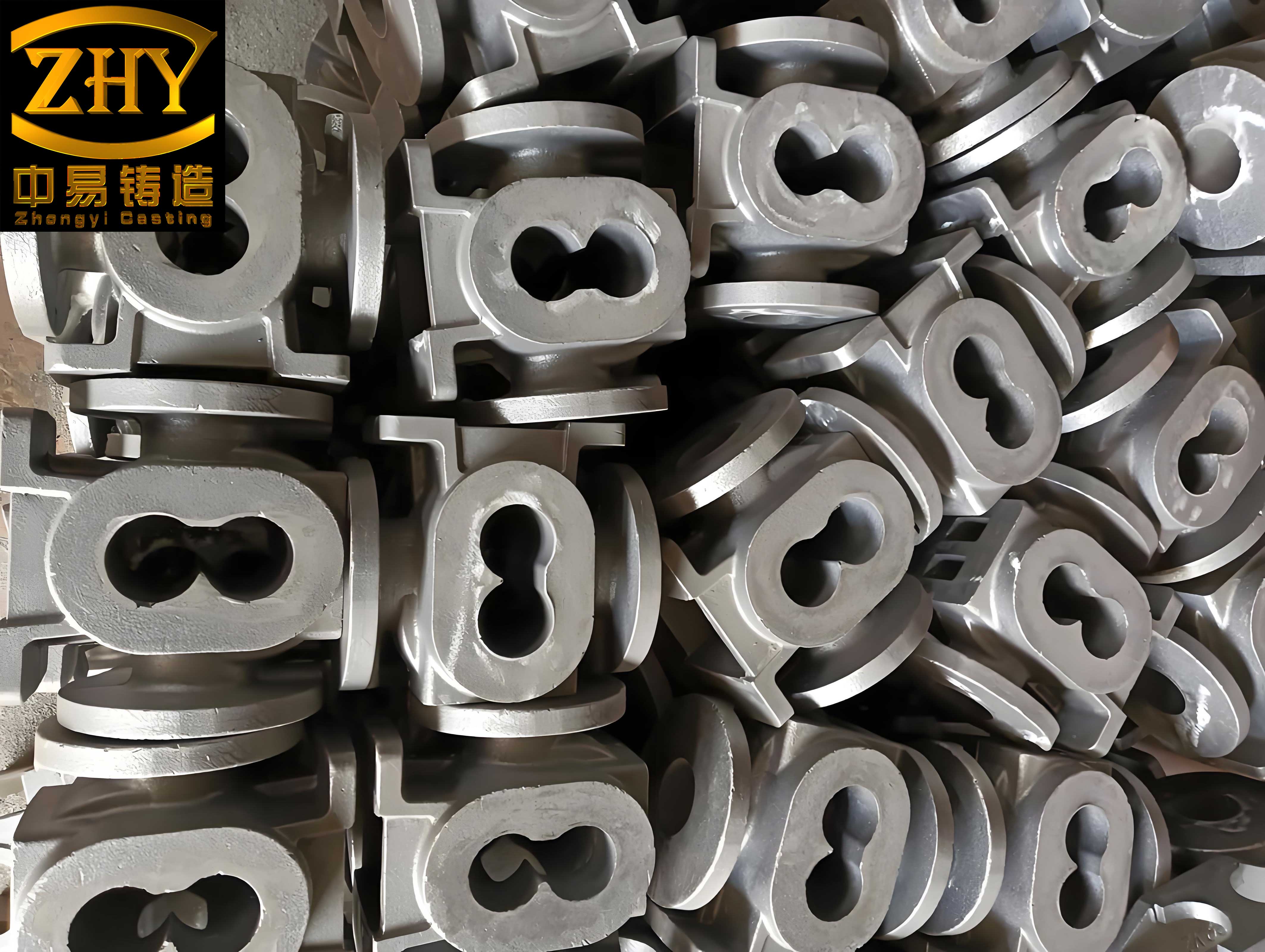
The initial phase of this project involved a thorough analysis of three existing chassis bracket components designed in QT450-10. Their original masses were 5.95 kg, 7.95 kg, and 6.87 kg. The goal was to redesign these parts for austempered nodular cast iron, leveraging its higher allowable stresses to reduce wall thicknesses and overall mass. Finite Element Analysis (FEA) was the cornerstone of this optimization. The mechanical constraints for one representative bracket, the rear support for the second axle leaf spring, are illustrated in the following schematic concept: fixed constraints were applied at the four mounting bolt holes, while radial, vertical, and axial loads simulating extreme service conditions were applied at the leaf spring shackle pin locations. The loading cases included a vertical force of -50,000 N, a lateral force of -30,000 N, and a braking force of -60,000 N per bracket.
Structural optimization was an iterative process. The original designs were analyzed under these loads to establish baseline stress and displacement fields. The key was to redesign the components with more uniform wall thickness to mitigate the section sensitivity inherent in nodular cast iron and to remove redundant material. After several iterations, the optimized geometries were arrived at. A comparative FEA summary is presented below:
| Bracket Identification | Original Mass (kg) | Optimized Mass (kg) | Weight Reduction (%) | Original Max. Stress (MPa) | Optimized Max. Stress (MPa) | Stress Reduction (%) | Calculated Safety Factor (Optimized) |
|---|---|---|---|---|---|---|---|
| Rear Bracket – 2nd Axle Spring | 5.95 | 4.86 | 18.32 | 917 | 753 | 17.88 | ~3.2 |
| Rear Bracket Assembly – Front Spring | 7.95 | 6.70 | 15.72 | 833 | 765 | 8.16 | ~3.1 |
| Front Bracket – 2nd Front Spring | 6.87 | 5.50 | 19.94 | 703 | 691 | 1.71 | ~3.3 |
The results clearly demonstrate that the redesign for austempered nodular cast iron not only achieved substantial mass savings but also, counterintuitively, reduced the maximum stress concentrations and increased the structural safety factor from an initial design target of about 2.5 to over 3.0. This is a direct benefit of the superior mechanical properties of austempered nodular cast iron and the more efficient load path enabled by the optimized geometry.
With the designs finalized, the focus shifted to the material science and processing required to achieve the target properties. The desired material grade was QTD 800-10, corresponding to a minimum tensile strength of 800 MPa and a minimum elongation of 10%. The development of this specific austempered nodular cast iron involved meticulous control over every stage: melting, chemistry, nodularization, inoculation, and heat treatment.
The melting was conducted in a medium-frequency induction furnace with a 500 kg capacity. The charge composition was carefully controlled to ensure a clean, low-residual iron base suitable for producing high-quality nodular cast iron. The typical charge makeup is summarized below:
| Charge Material | Percentage (%) | Key Characteristics |
|---|---|---|
| Pig Iron (Q12 Grade) | 20 | Low in trace elements like Ti, Sb, Pb |
| Packaged Steel Scrap | 50 | Low residual, controlled chemistry |
| Returns (Gating System, etc.) | 30 | Internal recirculation |
The chemical composition is fundamental to the behavior of nodular cast iron during solidification and subsequent heat treatment. For thin-walled castings aiming for high toughness after austempering, strict control over certain elements is crucial. The target composition range for our austempered nodular cast iron was established as follows:
| Element | Target Range (wt.%) | Rationale |
|---|---|---|
| Carbon (C) | 3.7 – 3.9 | Ensures graphitization potential and castability. |
| Silicon (Si) | 2.6 – 2.8 | Promotes ferrite, increases hardenability, and influences austenite carbon content during austempering. |
| Manganese (Mn) | ≤ 0.30 | Kept low to prevent segregation and the formation of brittle carbides at cell boundaries. |
| Phosphorus (P) | ≤ 0.04 | Minimized to reduce the formation of brittle phosphide eutectic. |
| Sulfur (S) | ≤ 0.02 | Low level is essential prior to magnesium treatment for effective nodularization. |
| Magnesium (Mg) (Residual) |
0.03 – 0.05 | Critical for graphite spheroidization. |
The kinetics of nodule formation in nodular cast iron can be conceptually related to undercooling and interfacial energy. The growth of a spherical graphite nodule in a Fe-C-Si melt treated with Mg can be described by a simplified diffusion-controlled model:
$$ \frac{dr}{dt} = \frac{D}{r} \cdot \frac{C_m – C_i}{C_g – C_i} $$
where $r$ is the nodule radius, $t$ is time, $D$ is the diffusion coefficient of carbon in the melt, $C_m$ is the carbon concentration in the melt, $C_i$ is the concentration at the graphite/liquid interface, and $C_g$ is the carbon concentration in graphite. Effective treatment ensures a high nucleation rate and spherical growth.
Nodularization was achieved using the sandwich method in a treatment ladle. A rare-earth magnesium ferrosilicon alloy (1.5% of the iron weight) was placed in a pocket at the bottom of the ladle, covered with steel punchings. The treatment temperature started between 1520–1550°C. Inoculation was performed in two stages: a primary inoculation with 0.2% FeSi75 added atop the nodularizer in the ladle, and a post-inoculation with 0.5% FeSi75 powder added during the final ladle filling. This dual inoculation is vital for countering fading effects and promoting a fine, uniformly distributed graphite structure in the final nodular cast iron, which is a prerequisite for consistent austempering response.
The heart of creating austempered nodular cast iron lies in the precise thermal cycle. The process involves two main stages: austenitization and isothermal transformation. The objective is to transform the as-cast ferritic-pearlitic matrix of the nodular cast iron into ausferrite. The selected heat treatment parameters were:
- Austenitization: 900 ± 5°C for 60 minutes. This temperature is high enough to dissolve carbides and homogenize carbon in austenite but not so high as to cause excessive grain growth. The carbon content in austenite, $C_\gamma$, at this temperature can be estimated using empirical relationships based on the bulk composition of the nodular cast iron.
- Isothermal Quenching: Rapid transfer to a salt bath maintained at 385 ± 5°C, holding for 60 minutes. At this temperature, the supercooled austenite decomposes via a bainitic transformation into the desired acicular ferrite and high-carbon retained austenite structure.
The transformation kinetics during the isothermal hold can be modeled using the Johnson-Mehl-Avrami-Kolmogorov (JMAK) equation for phase transformation volume fraction $X$:
$$ X(t) = 1 – \exp(-k t^n) $$
where $k$ is a rate constant dependent on temperature and material, and $n$ is the Avrami exponent. For the bainitic transformation in nodular cast iron, $n$ typically falls within a specific range, and the hold time must be sufficient for near-completion of the reaction to avoid untransformed austenite that could later transform into brittle martensite.
The success of the material processing was verified through the testing of separately cast keel blocks that underwent identical heat treatment alongside the production brackets. The mechanical properties obtained met the target specification convincingly.
| Sample ID | Tensile Strength, $R_m$ (MPa) | Elongation, $A$ (%) | Hardness (HBW) |
|---|---|---|---|
| Heat 1 | 1061 | 10.0 | 331 |
| Heat 2 | 1061 | 13.0 | 336 |
Metallographic examination confirmed the expected microstructure: a matrix of fine, acicular ferrite (bainite) intertwined with stable, high-carbon retained austenite, with well-spheroidized graphite nodules uniformly embedded within. This unique microstructure is the source of the outstanding properties of austempered nodular cast iron. The retained austenite content, $V_\gamma$, contributes significantly to ductility and toughness through the Transformation Induced Plasticity (TRIP) effect, where it can transform to martensite under strain, absorbing energy. The relationship between stability of austenite, its carbon content $C_\gamma$, and the Ms (martensite start) temperature is critical:
$$ M_s (^\circ C) \approx 539 – 423C_\gamma – 30.4Mn – 7.5Si + 30Al $$
For a successful austempered nodular cast iron, the $M_s$ must be below room temperature to ensure austenite stability during handling and initial loading.
The production trial of the three brackets utilized two different molding processes suitable for the complex geometries and required dimensional accuracy: investment casting for one bracket and resin sand molding for the other two. Both processes yielded sound castings with good surface finish and dimensional conformity, ready for the austempering heat treatment. After heat treatment and confirming the mechanical properties via test bars, the brackets were assembled onto prototype commercial vehicles for rigorous road testing.
The field testing encompassed a comprehensive schedule designed to simulate and exceed normal service conditions, including high-load operations, rough terrain, and extended mileage. Upon completion of all test protocols, the brackets were inspected. No cracks, permanent deformations, or signs of failure were observed. The austempered nodular cast iron components performed flawlessly, validating the design, material selection, and manufacturing process. The successful integration of these lightweight brackets contributes directly to reduced vehicle mass, leading to improved fuel efficiency, lower emissions, and enhanced payload capacity without compromising durability or safety.
The transition from conventional QT450-10 to austempered nodular cast iron for these structural brackets represents a significant advancement. The project conclusively demonstrates that austempered nodular cast iron is not merely a substitute but a performance-enabling material. The weight savings averaging around 18% per component, coupled with an increase in the component safety factor, underscore its value. The broader implications are substantial. Widespread adoption of austempered nodular cast iron for chassis, suspension, and powertrain components can lead to considerable reductions in vehicle weight across fleets. The material’s excellent wear resistance and fatigue strength also promise longer service life and reduced maintenance. From a manufacturing perspective, the higher yield strength of austempered nodular cast iron often allows for more efficient gating and risering systems, improving yield, as was observed in this project. The continued development and optimization of austempering processes for nodular cast iron will undoubtedly unlock further potential, enabling even more aggressive lightweighting and performance targets in the future of commercial and passenger vehicle engineering. The journey of these three brackets from drawing board to road proves that innovative material science, embodied here by austempered nodular cast iron, is a key driver in the evolution of sustainable and high-performance automotive technology.