
In hydraulic systems, axial piston pumps serve as core components due to their high efficiency, stable performance, and low environmental impact. Among these, the piston-cylinder pair, a fundamental friction couple, often faces severe wear under heavy-load conditions, leading to reduced service life and increased power consumption. To address this, surface modification techniques are crucial. In this study, we explore the application of salt bath nitriding—a cost-effective and efficient process—to enhance the tribological properties of nodular cast iron, specifically grades QT450, QT500, and QT550, when paired with 38CrMoAl alloy steel. Through experimental analysis, we investigate the hardness, friction coefficients, wear loss, and wear mechanisms under lubricated conditions, aiming to provide insights for improving the durability of piston pumps in high-pressure applications.
We begin by detailing the materials and methods. The nodular cast iron samples—QT450, QT500, and QT550—were cut from actual cylinder blocks and subjected to a normalizing treatment at 900°C. Their chemical compositions are summarized in Table 1. After polishing to a mirror finish, the samples underwent salt bath nitriding. The salt mixture, composed of 40% KCNO, 12.5% K2CO3, 10% NaCNO, 12.5% KCl, 12.5% NaCl, and 10% Na2CO3 by mass, was melted in a crucible at 560°C. The samples were immersed for 4 hours, followed by quenching in liquid nitrogen and cleaning to remove residual salts. This process aimed to form a hardened surface layer on the nodular cast iron.
| Grade | C | Si | Mn | Fe |
|---|---|---|---|---|
| QT450 | 3.4 | 2.0 | 0.45 | Balance |
| QT500 | 3.4 | 2.0 | 0.5 | Balance |
| QT550 | 3.4 | 2.2 | 0.55 | Balance |
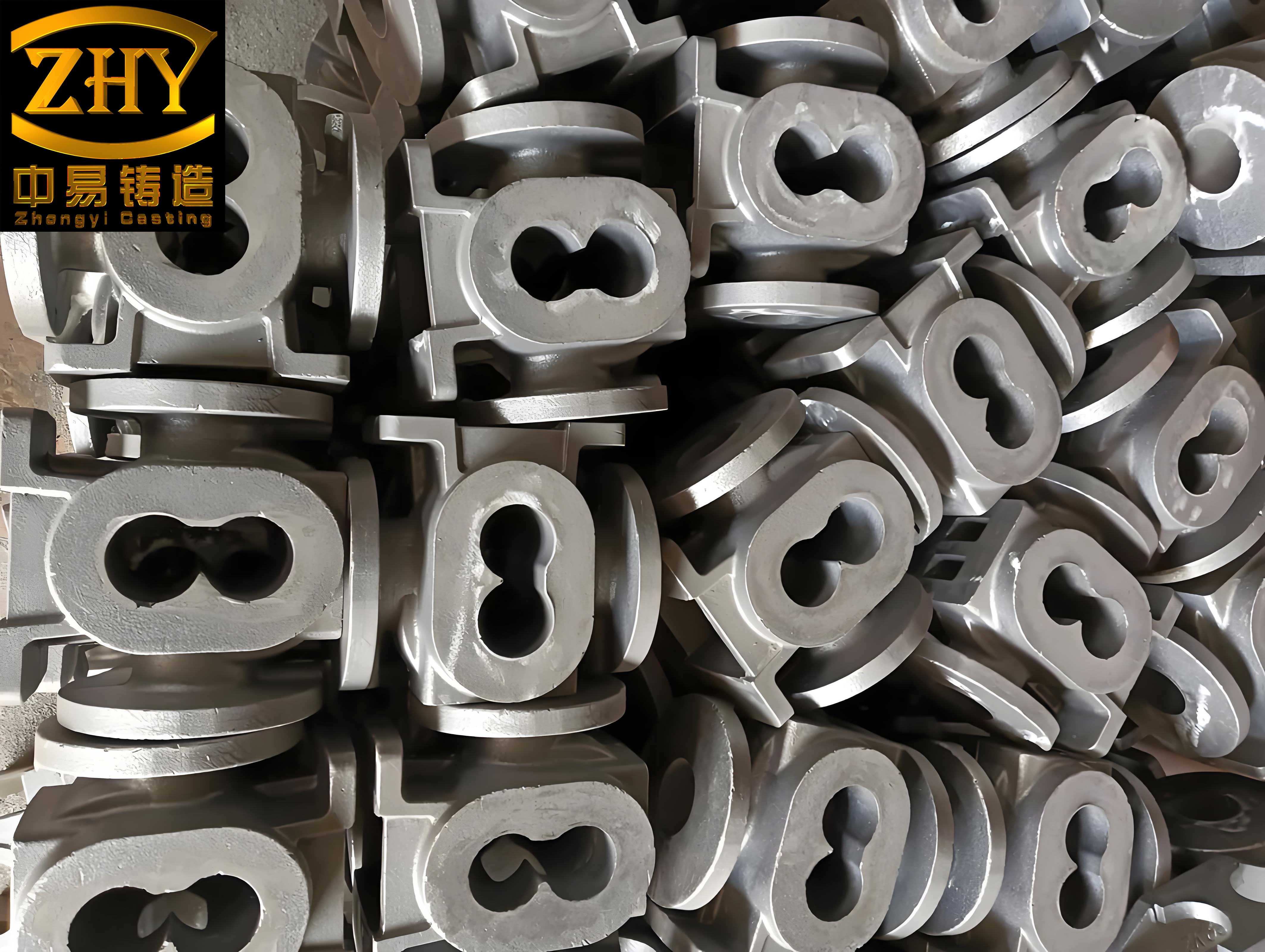
The microstructure of nodular cast iron, characterized by spherical graphite nodules in a ferritic or pearlitic matrix, plays a key role in its mechanical properties. To visualize this, we include an image below that highlights the typical structure of nodular cast iron, which is essential for understanding its behavior after surface treatment.
After nitriding, we evaluated the surface hardness using a microhardness tester with a load of 2.942 N. Twenty random measurements were taken for each sample, and the average values are reported. Tribological tests were conducted on a CFT-I reciprocating friction wear tester under conditions simulating actual piston pair operation: a normal load of 40 N, test duration of 30 minutes, speed of 600 rpm, stroke length of 8 mm, and lubrication with 0.5 mL of L-HM32 hydraulic oil. Friction coefficients were recorded, and wear loss was determined by mass difference before and after testing. Wear surfaces were examined using scanning electron microscopy (SEM) and energy-dispersive spectroscopy (EDS) to analyze morphology and chemical composition.
The results reveal significant improvements in hardness after salt bath nitriding. The base hardness of nodular cast iron grades ranged from 300 to 350 Hv0.3. Post-nitriding, the hardness increased substantially: QT450 achieved an average of 951.3 Hv0.3, QT500 reached 1035.0 Hv0.3, and QT550 attained 1097.2 Hv0.3. This enhancement can be attributed to the formation of nitrides like Si3N4 and the development of γ’ and ε phases, which induce lattice distortion and dispersion strengthening. The hardness increase follows a trend that can be modeled with a power-law equation, where hardness H relates to nitriding time t and material constants:
$$ H = H_0 + k \cdot t^n $$
Here, \( H_0 \) is the base hardness, \( k \) is a rate constant dependent on the nodular cast iron grade, and \( n \) is an exponent typically between 0.5 and 1 for diffusion-controlled processes. For our samples, with t fixed at 4 hours, the higher hardness in QT550 suggests a greater k value, possibly due to its higher Si content promoting nitride formation.
Friction coefficients under lubricated conditions are presented in Table 2. All samples exhibited coefficients below 0.20, but the nitrided nodular cast iron grades showed lower and more stable values compared to the base QT500. The base QT500 had a rising friction coefficient over time, indicating poor lubrication retention, whereas nitrided samples maintained lower friction due to their hardened surfaces and better oil film stability.
| Sample | Average Friction Coefficient | Wear Loss (mg) | Wear Mechanism |
|---|---|---|---|
| Base QT500 | 0.15 (increasing trend) | 1.4 | Delamination, plastic flow, oxidation |
| Nitrided QT450 | 0.12 | 0.4 | Abrasive wear, fatigue wear, oxidation |
| Nitrided QT500 | 0.10 | 0.3 | Fatigue wear, oxidation |
| Nitrided QT550 | 0.10 | 0.3 | Fatigue wear, oxidation |
Wear loss was markedly reduced in nitrided nodular cast iron. The base QT500 suffered 1.4 mg loss, while nitrided samples lost only 0.3–0.4 mg, demonstrating the efficacy of salt bath nitriding in enhancing wear resistance. This reduction correlates with hardness, as shown in Figure 1 (conceptual), where wear rate W can be expressed as:
$$ W = \frac{K \cdot L}{H} $$
In this equation, \( W \) is wear rate (proportional to mass loss), \( K \) is a wear coefficient, \( L \) is load, and \( H \) is hardness. For nodular cast iron, increasing H through nitriding directly decreases W, explaining the lower wear loss. The wear mechanisms varied: base QT500 experienced delamination and plastic flow due to surface softening and crack propagation, while nitrided samples primarily showed fatigue wear and oxidation, with minor abrasive wear in QT450. EDS analysis confirmed the presence of oxygen on all wear surfaces, indicating oxidation wear, but no adhesive wear was detected as Cr, Mo, or Al from the counter ball were absent.
Further discussion on the tribological behavior involves the role of surface roughness and lubrication. After nitriding, the surface roughness of nodular cast iron increases slightly, but this is offset by the hardened layer’s ability to support load and reduce direct contact. The friction coefficient μ can be described by the Stribeck curve, where in the mixed lubrication regime:
$$ \mu = a \cdot \left( \frac{\eta v}{P} \right)^b + c $$
Here, \( \eta \) is oil viscosity, \( v \) is sliding speed, \( P \) is pressure, and a, b, c are constants. For nitrided nodular cast iron, the higher hardness increases P tolerance, shifting the curve to lower μ values. Additionally, the formation of a stable oxide layer during wear contributes to friction reduction. We observed that nitrided QT500 and QT550 performed best, with minimal wear and stable friction, making them suitable for high-pressure piston pumps.
The wear mechanisms are elaborated through SEM observations. Base QT500 showed continuous grooves and plastic deformation, indicative of abrasive and adhesive-like wear. In contrast, nitrided nodular cast iron exhibited pitting and micro-cracks, characteristic of fatigue wear caused by cyclic stress. The absence of material transfer confirms that salt bath nitriding prevents adhesive wear, a common issue in steel-nodular cast iron pairs. Oxidation wear was prevalent in all cases due to frictional heating, but its extent was limited in nitrided samples due to their protective nitride layers.
To quantify the benefits, we propose a performance index PI for nodular cast iron in piston pairs:
$$ PI = \frac{H \cdot \sigma_f}{\mu \cdot W} $$
Where \( \sigma_f \) is fatigue strength, approximated from hardness data. For nitrided nodular cast iron, PI values are higher, indicating improved durability. This aligns with our findings that salt bath nitriding enhances both hardness and wear resistance, key for extending pump life.
In conclusion, salt bath nitriding significantly improves the tribological properties of nodular cast iron. The hardness increase, reduction in friction coefficient, and lower wear loss make nitrided QT500 and QT550 ideal for axial piston pump applications. The wear mechanisms shift from severe delamination in base material to mild fatigue and oxidation in nitrided samples. Future work could explore optimizing nitriding parameters for different grades of nodular cast iron or combining it with other surface treatments. Overall, this study underscores the potential of salt bath nitriding to enhance the performance and longevity of hydraulic components made from nodular cast iron.
We also note that the process is scalable and cost-effective, suitable for industrial applications. The repeated emphasis on nodular cast iron in this research highlights its versatility as a material, and salt bath nitriding offers a viable route to overcome its limitations in tribological scenarios. Further investigations might include long-term fatigue tests or field trials in actual pumps to validate these laboratory findings.