
In the production of nodular cast iron, slag inclusion defects are a persistent challenge that can compromise the integrity and performance of cast components. As a metallurgical engineer specializing in foundry processes, I have extensively studied these defects, particularly in critical safety parts such as bearing housings for railway applications. This article delves into the root causes of slag inclusions in nodular cast iron, presenting a detailed analysis and effective improvement strategies based on industrial case studies. The focus is on both primary and secondary slag inclusions, their formation mechanisms, and how optimized gating systems and pretreatment methods can mitigate these issues. Throughout this discussion, the term “nodular cast iron” will be frequently emphasized to underscore its relevance in modern casting practices.
Slag inclusions in nodular cast iron are classified into two main types: primary slag and secondary slag. Primary slag inclusions typically originate during melting and nodularization processes, where oxides, sulfides, and other non-metallic compounds form and are not adequately removed before pouring. These inclusions often appear near the surface of castings and are relatively large. Secondary slag inclusions, on the other hand, arise during mold filling due to turbulent flow, leading to reoxidation of the molten iron and the entrapment of endogenous slag particles within the casting. These are usually finer and distributed internally. Understanding the distinction is crucial for implementing targeted countermeasures. The formation of slag inclusions can be modeled using kinetic equations for oxidation and fluid dynamics principles. For instance, the rate of oxide formation during melting can be expressed as:
$$ \frac{d[O]}{dt} = k \cdot A \cdot (C_s – C_b) $$
where \( \frac{d[O]}{dt} \) is the rate of oxygen uptake, \( k \) is the rate constant, \( A \) is the interfacial area, \( C_s \) is the oxygen concentration at the surface, and \( C_b \) is the bulk oxygen concentration. In nodular cast iron, the presence of magnesium and silicon enhances oxidation tendencies, making slag control vital.
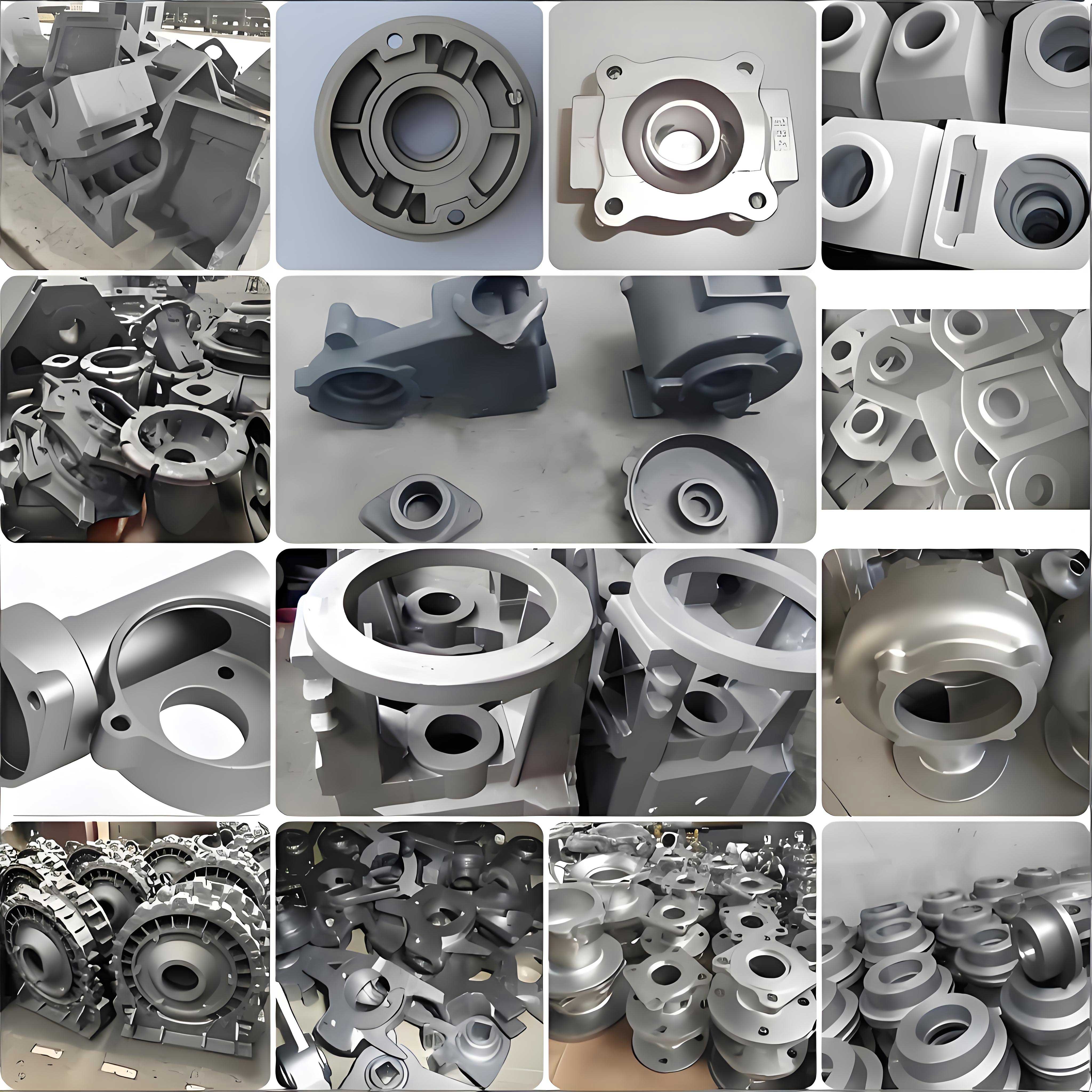
To illustrate the practical implications, consider a bearing housing casting for railway safety components. This nodular cast iron part, with a weight of approximately 245 kg and wall thickness of 30 mm, requires high internal soundness, meeting UT2 level per EN12680-3 standards, along with full ferritic matrix and graphite spheroidization above 90%. The initial production process involved furan resin sand molding with a top gating system, but this led to a high scrap rate due to black spot defects on machined surfaces, identified as slag inclusions. Chemical composition design for such nodular cast iron typically aims for a carbon equivalent (CE) of 4.5–4.6%, with precise control of elements like silicon and magnesium. Table 1 summarizes the standard compositional ranges for QT400-18 grade nodular cast iron.
| Element | Range (%) |
|---|---|
| Carbon (C) | 3.7–3.8 |
| Silicon (Si) | 2.4–2.5 |
| Manganese (Mn) | < 0.3 |
| Sulfur (S) | < 0.02 |
| Phosphorus (P) | < 0.03 |
| Magnesium (Mg) | 0.03–0.05 |
| Cerium (Ce) Residual | 0.01–0.03 |
The melting and pouring practices initially employed a 1.5-ton medium-frequency induction furnace, with charge materials consisting of 40% pig iron, 40% steel scrap, and 20% returns. The molten nodular cast iron was superheated to 1,500–1,520°C, held for 3–5 minutes, and then subjected to nodularization using a lanthanum-based inoculant in a covered ladle process. Pretreatment with silicon carbide (SiC) was applied at 0.2% addition, and inoculation was performed with calcium-barium-silicon and sulfur-oxygen inoculants. Pouring temperature was maintained at 1,350–1,380°C with a pouring time of 15–20 seconds. However, this setup resulted in slag inclusion defects, prompting a thorough investigation.
Defect analysis involved sampling from affected areas and conducting energy-dispersive spectroscopy (EDS). The results indicated high concentrations of silicon, magnesium, aluminum, chlorine, sodium, and potassium, pointing to silicate-based inclusions. The presence of Cl, Na, and K suggested contamination from slag removers or undissolved SiC particles. The gating system was also scrutinized: the original design used a top gating with four ingates and two ceramic pipes of 25 mm diameter, which likely induced turbulent flow during filling. Turbulence can be quantified using the Reynolds number (\(Re\)), defined as:
$$ Re = \frac{\rho v D}{\mu} $$
where \( \rho \) is the density of molten nodular cast iron (approximately 7,000 kg/m³), \( v \) is the flow velocity, \( D \) is the hydraulic diameter of the gating system, and \( \mu \) is the dynamic viscosity (around 0.005 Pa·s for iron at pouring temperatures). For \( Re \) above 2,000, flow becomes turbulent, promoting reoxidation and slag entrainment. In the initial setup, calculations indicated \( Re \) values exceeding 4,000, confirming excessive turbulence.
To address these issues, two major improvements were implemented. First, the gating system was redesigned to ensure laminar flow. The new system incorporated four bottom-pouring ceramic pipes of 25 mm diameter each, arranged symmetrically to facilitate steady upward filling of the mold cavity. Additionally, the filters in the runner were placed horizontally instead of vertically, and slag traps were added at the runner ends to capture inclusions before the metal entered the mold. An overflow riser was also included to divert the first metal stream, which often carries slag. The modified gating layout reduced the Reynolds number to below 1,500, as per the following calculation for the new pipe configuration:
$$ v = \frac{Q}{A} = \frac{0.245 \, \text{m}^3 / 15 \, \text{s}}{4 \times \pi \times (0.0125 \, \text{m})^2} \approx 0.83 \, \text{m/s} $$
$$ Re = \frac{7000 \times 0.83 \times 0.025}{0.005} \approx 1,450 $$
where \( Q \) is the volumetric flow rate and \( A \) is the cross-sectional area of one pipe. This adjustment significantly minimized turbulence, but preliminary trials showed a scrap rate still around 30%, indicating that gating alone was insufficient.
The second improvement focused on SiC pretreatment. Originally, SiC with a grain size of 2–9 mm was added at 0.2%, which often led to incomplete dissolution and residual slag. To optimize this, the SiC particle size was reduced to 1–3 mm, and the addition rate was lowered to 0.1–0.15%. The dissolution kinetics of SiC in molten nodular cast iron can be described by the shrinking core model:
$$ t = \frac{\rho r_0^2}{2b D C_s} $$
where \( t \) is the dissolution time, \( \rho \) is the density of SiC, \( r_0 \) is the initial particle radius, \( b \) is the stoichiometric coefficient, \( D \) is the diffusion coefficient, and \( C_s \) is the saturation concentration. Reducing particle size decreases \( r_0 \), thereby shortening dissolution time and ensuring complete assimilation. Table 2 compares the old and new pretreatment parameters for nodular cast iron.
| Parameter | Original Process | Optimized Process |
|---|---|---|
| SiC Grain Size (mm) | 2–9 | 1–3 |
| Addition Rate (%) | 0.2 | 0.1–0.15 |
| Dissolution Time (s) | ~60 | ~30 |
| Estimated Slag Residual | High | Negligible |
After implementing both changes, a batch of 20 castings was produced and inspected. Machining revealed no slag inclusion defects, and subsequent larger batches confirmed the effectiveness. The nodular cast iron components met all quality standards, including ultrasonic testing, radiographic inspection, and microstructural requirements. The graphite spheroidization exceeded 90%, with graphite size grades of 5–8, tensile strength above 400 MPa, elongation over 18%, and hardness within 140–200 HBW. The full ferritic matrix was achieved through controlled cooling and inoculation.
Further analysis involved statistical process control to validate the improvements. The defect rate before and after optimization is summarized in Table 3, highlighting the impact on nodular cast iron quality.
| Production Phase | Number of Castings | Slag Inclusion Defects | Scrap Rate (%) |
|---|---|---|---|
| Initial Process | 50 | 25 | 50 |
| After Gating Optimization | 25 | 8 | 32 |
| After SiC Optimization | 100 | 0 | 0 |
The mechanism of slag inclusion formation in nodular cast iron is complex, involving thermodynamic and fluid dynamic factors. The free energy change for oxide formation, such as SiO₂ or MgO, can be calculated using the Ellingham equation:
$$ \Delta G = \Delta H – T \Delta S $$
where \( \Delta G \) is the Gibbs free energy change, \( \Delta H \) is the enthalpy change, \( T \) is the temperature in Kelvin, and \( \Delta S \) is the entropy change. For typical nodular cast iron compositions, the affinity for oxygen is high, especially during pouring. Therefore, minimizing exposure to air and controlling flow dynamics are paramount. The improved bottom-pouring system reduces velocity and pressure fluctuations, which can be modeled using the Bernoulli equation for incompressible flow:
$$ P + \frac{1}{2} \rho v^2 + \rho gh = \text{constant} $$
where \( P \) is pressure, \( v \) is velocity, \( g \) is gravitational acceleration, and \( h \) is height. By maintaining a constant head pressure and reducing \( v \), the risk of air entrainment and slag formation is lowered.
In addition to gating and pretreatment, other factors influence slag inclusions in nodular cast iron. For instance, mold materials and coatings can react with molten metal, generating secondary slag. The use of refractory coatings based on zirconia or alumina is recommended to minimize interactions. Moreover, pouring temperature plays a critical role; too low a temperature increases viscosity, hindering slag floatation, while too high a temperature accelerates oxidation. An optimal range of 1,350–1,380°C was maintained, supported by the following empirical relation for slag floatation velocity in nodular cast iron:
$$ v_f = \frac{2 g r^2 (\rho_m – \rho_s)}{9 \mu} $$
where \( v_f \) is the floatation velocity, \( r \) is the slag particle radius, \( \rho_m \) is the density of molten nodular cast iron, \( \rho_s \) is the slag density, and \( \mu \) is the viscosity. This equation underscores the importance of temperature control, as \( \mu \) decreases with temperature, enhancing slag removal.
The inoculation process also affects slag formation in nodular cast iron. Over-inoculation can introduce excess oxides, while under-inoculation leads to poor graphite nodularity. The optimized process used a combination of primary and late inoculation, with precise amounts calibrated to the ladle size. The effectiveness of inoculation can be expressed in terms of nodule count per unit area (\(N\)), which correlates with mechanical properties:
$$ N = k_I \cdot [\text{Inoculant}] \cdot e^{-E_a / RT} $$
where \( k_I \) is a constant, \( [\text{Inoculant}] \) is the inoculant concentration, \( E_a \) is the activation energy, \( R \) is the gas constant, and \( T \) is the temperature. Proper inoculation ensures a high nodule count, which improves ductility and reduces stress concentrations that might exacerbate slag-related failures.
Long-term production data for nodular cast iron components show that consistent quality requires ongoing monitoring. Spectroscopy analysis of molten metal before pouring helps detect excess oxygen or sulfur, which are precursors to slag. The dissolved oxygen content should be below 10 ppm for premium nodular cast iron grades. Additionally, non-destructive testing methods like ultrasonic imaging and X-ray tomography are invaluable for detecting internal slag inclusions without destroying the casting.
In conclusion, the successful elimination of slag inclusion defects in nodular cast iron hinges on a holistic approach combining fluid dynamics optimization and metallurgical pretreatment. The case study demonstrates that bottom-pouring gating systems with multiple ceramic pipes and controlled SiC pretreatment are effective solutions. These measures ensure that nodular cast iron castings meet stringent industry standards for safety-critical applications. Future work may explore advanced simulation tools, such as computational fluid dynamics (CFD), to further refine gating designs and predict slag formation in nodular cast iron. The continuous advancement in nodular cast iron technology will undoubtedly enhance the reliability and performance of cast components across various sectors.
To summarize the key parameters, Table 4 provides a comprehensive overview of the optimized process for producing high-quality nodular cast iron free from slag inclusions.
| Process Aspect | Parameter | Value or Range |
|---|---|---|
| Melting | Furnace Type | Medium-Frequency Induction |
| Superheating Temperature | 1,500–1,520°C | |
| Holding Time | 3–5 minutes | |
| Charge Composition | 40% Pig Iron, 40% Steel Scrap, 20% Returns | |
| Nodularization | Nodularizer Type | Lanthanum-Based |
| Addition Rate | 1.0% | |
| Method | Covered Ladle Process | |
| Pretreatment | SiC Grain Size | 1–3 mm |
| SiC Addition Rate | 0.1–0.15% | |
| Purpose | Deoxidation and Nucleation Enhancement | |
| Inoculation | Primary Inoculant | Calcium-Barium-Silicon |
| Primary Addition Rate | 0.4% | |
| Secondary Inoculant | Sulfur-Oxygen | |
| Secondary Addition Rate | 0.05–0.1% (Stream Inoculation) | |
| Pouring | Gating System | 4 × 25 mm Ceramic Pipes, Bottom-Pouring |
| Pouring Temperature | 1,350–1,380°C | |
| Pouring Time | 15–20 seconds | |
| Quality Control | Non-Destructive Testing | Ultrasonic Testing (UT2), X-Ray Radiography |
| Microstructural Target | Graphite Nodularity ≥90%, Full Ferritic Matrix |
The integration of these parameters ensures robust production of nodular cast iron. The mathematical models and empirical data presented herein serve as a guideline for foundries aiming to minimize slag inclusions. As nodular cast iron continues to evolve, ongoing research into innovative additives and real-time process control will further elevate its quality and applicability in demanding engineering fields.