
The production of high-integrity nodular cast iron components is frequently compromised by the occurrence of slag inclusion defects. These non-metallic inclusions, entrapped within the casting matrix or concentrated on upper surfaces and re-entrant sections, manifest as dark, discontinuous spots or areas lacking metallic luster upon fracture. Such defects directly lead to the rejection of castings due to failures in dimensional checks, ultrasonic testing (UT), and magnetic particle inspection (MT), imposing significant detrimental impacts on production efficiency and economic viability. This article provides a first-person, in-depth examination of the multifaceted origins of slag inclusion formation in nodular cast iron and systematically outlines a suite of proven corrective measures, supported by thermodynamic principles, process data, and empirical findings.
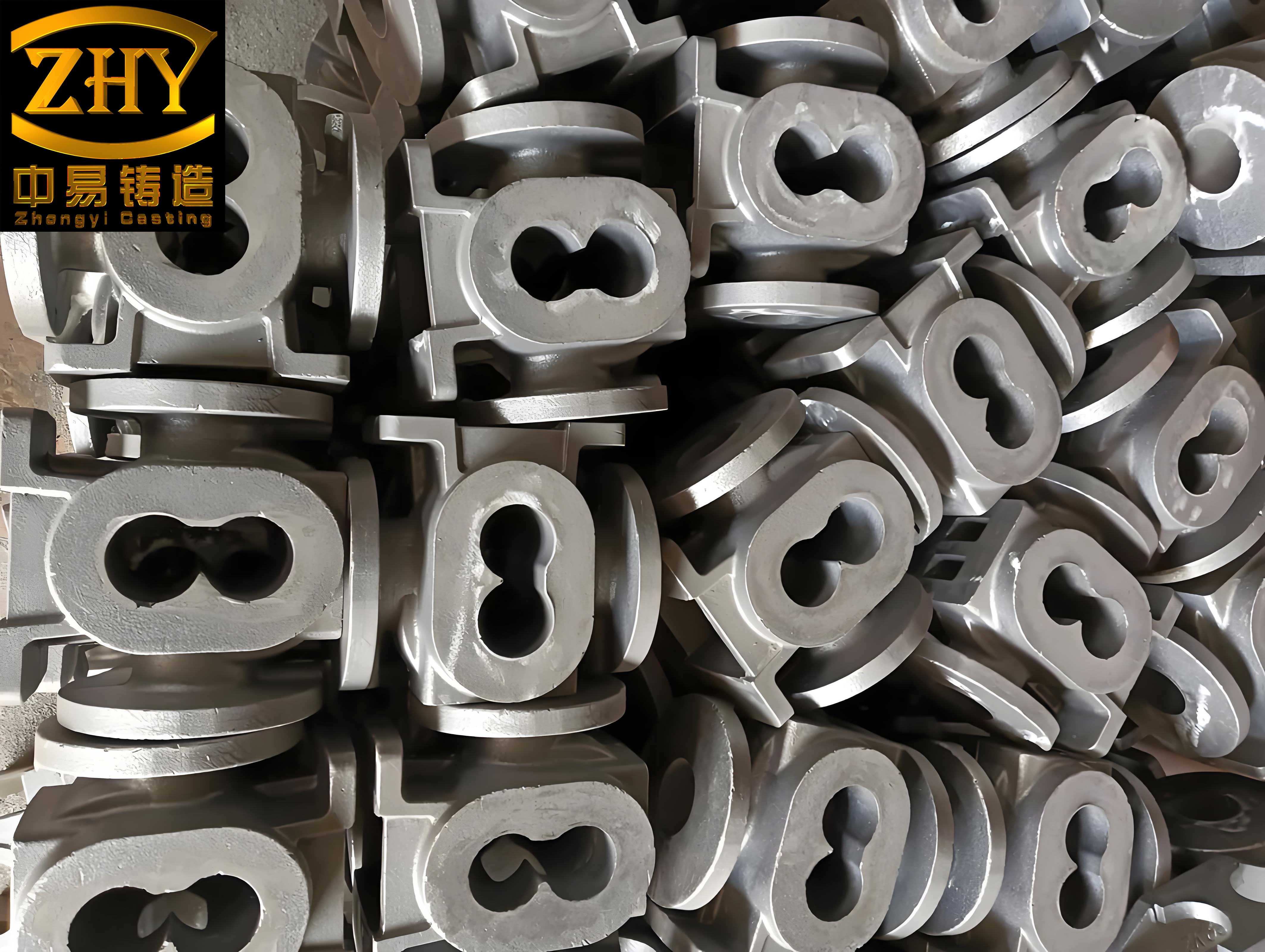
The fundamental nature of slag inclusions in nodular cast iron is that of complex oxides, sulfides, silicates, and their mixtures. Energy Dispersive Spectroscopy (EDS) analyses of defect sites consistently reveal elevated peaks of oxygen (O), silicon (Si), magnesium (Mg), calcium (Ca), barium (Ba), and sulfur (S). The presence of these elements points directly to sources within the melting, treatment, and pouring processes. A critical comparative analysis between sound and defective areas highlights the stark contrast in interstitial element content, as shown in the generalized data below, which aligns with common industrial findings.
| Analysis Region | Nitrogen (N), wt.% | Hydrogen (H), wt.% | Oxygen (O), wt.% |
|---|---|---|---|
| Sound Matrix | 0.003 – 0.006 | 0.0001 – 0.0003 | 0.002 – 0.005 |
| Slag Inclusion Zone | 0.02 – 0.06 | 0.0003 – 0.0006 | 0.3 – 0.6 |
The drastic increase in oxygen and nitrogen within the defect zone underscores their primary role. The formation of these inclusions is governed by thermodynamic driving forces. The free energy change $\Delta G$ for the formation of an oxide, for instance, determines its stability. For a generic reaction of a metal M with oxygen:
$$ mM + nO \rightarrow M_mO_n $$
The standard Gibbs free energy change is given by:
$$ \Delta G^\circ = \Delta H^\circ – T\Delta S^\circ $$
Where $\Delta H^\circ$ is the standard enthalpy change, $\Delta S^\circ$ is the standard entropy change, and $T$ is the temperature. In the complex melt of nodular cast iron, elements like magnesium, calcium, aluminum, and barium have highly negative $\Delta G^\circ$ values for oxide formation, making them potent slag formers. The practical activity of oxygen in the melt, $a_O$, is the critical parameter influencing these reactions.
Root Cause Analysis of Slag Formation
1. Influence of Raw Material Quality
The economic necessity of using steel scrap, returns (gates and risers), and purchased cast iron introduces significant variability. These materials often carry surface contaminants: rust (hydrated iron oxides), sand, paint, and oil. Rust is particularly pernicious as it introduces both oxygen and hydrogen directly into the bath. The dissolution of rust proceeds as:
$$ 2FeO(OH) \rightarrow Fe_2O_3 + H_2O_{(g)} $$
The released water vapor dissociates at high temperature, increasing the melt’s hydrogen and oxygen potential. A survey of various pig iron sources reveals the inherent inconsistency in interstitial content, establishing the first major variable in the process.
| Pig Iron Source Sample | Oxygen (O), wt.% | Nitrogen (N), wt.% | Hydrogen (H), wt.% |
|---|---|---|---|
| Source A – High Purity | 0.008 – 0.012 | 0.003 – 0.004 | 0.0002 – 0.0004 |
| Source B – Standard | 0.011 – 0.015 | 0.004 – 0.005 | 0.0003 – 0.0006 |
| Source C – Variable Quality | 0.015 – 0.022 | 0.005 – 0.008 | 0.0005 – 0.0010 |
Uncontrolled use of high-oxygen materials directly elevates the initial $a_O$ in the melt, providing the reactant for subsequent slag-forming reactions during treatment and solidification.
2. The Dual Role of Inoculation
Inoculation is indispensable for achieving the desired nodule count and matrix structure in nodular cast iron. However, most inoculants (FeSi-based) are potent sources of non-metallic inclusions. They contain active elements (Ca, Al, Ba, Sr, Zr) with high affinity for oxygen, nitrogen, and sulfur. During the exothermic dissolution of the inoculant, localized micro-reactions create clusters of oxides/nitrides that can agglomerate into macroscopic slag if not properly managed. The composition of the inoculant dictates its slag-forming potential.
| Inoculant Type | Typical Composition | Oxygen (O), wt.% | Nitrogen (N), wt.% | Primary Slag-Forming Tendency |
|---|---|---|---|---|
| Standard FeSi (75% Si) | Fe, Si, 0.5-1.5% Al, 0.2-1.0% Ca | 0.1 – 0.3 | 0.005 – 0.015 | Al2O3, CaO·Al2O3, SiO2 |
| Barium-Inoculant | Fe, Si, Ba, Ca, Al | 0.5 – 1.2 | 0.02 – 0.04 | BaO, BaO·SiO2, Complex Ba-Al-Ca silicates |
| Low-O/N FeSi | Fe, Si, Low Al/Ca, Special Processing | < 0.05 | < 0.005 | Minimal |
The dissolution efficiency and reaction kinetics can be modeled. The rate of inoculant dissolution and reaction $R$ can be approximated by:
$$ R = k \cdot A \cdot (C_s – C_b) $$
where $k$ is a rate constant, $A$ is the surface area of the inoculant, $C_s$ is the concentration of the reactive element at the particle surface, and $C_b$ is its concentration in the bulk melt. Poor practice (e.g., coarse granules, late addition, low temperature) leads to incomplete dissolution and increased local supersaturation, favoring large inclusion formation.
3. Melting Practice and Charge Order
The sequence in which materials are charged into the furnace profoundly affects the oxidation dynamics and the opportunity for impurity removal. Charging scrap steel first, which often has the highest surface-area-to-volume ratio and rust content, subjects it to the longest exposure at high temperature in an oxidizing environment, maximizing oxide scale formation. This scale can become entrapped or serve as nucleation sites for other inclusions. Reversing the order so that lower-oxygen materials like pig iron melt first creates a protective carbon-saturated bath that can reduce the oxidation of subsequently added scrap. Experimental data comparing the two sequences shows a clear difference in inclusion load, as assessed by metallographic analysis of separately cast keel blocks.
| Charging Sequence | Observed Macro-Inclusion Density (per cm²) | Average Inclusion Size (µm) | Bath Oxygen Activity (aO) at Tap (relative units) |
|---|---|---|---|
| Scrap → Returns → Pig Iron | 15 – 25 | 40 – 80 | High (1.0) |
| Pig Iron → Returns → Scrap | 5 – 10 | 20 – 40 | Low (0.6) |
4. Superheating and Holding Time Dynamics
Superheating the molten nodular cast iron above its liquidus temperature and holding it for a sufficient duration is a critical but often overlooked purification step. The principles of Stokes’ law govern the flotation of non-metallic particles:
$$ v = \frac{2}{9} \cdot \frac{(\rho_m – \rho_i) \cdot g \cdot r^2}{\eta} $$
where $v$ is the terminal rising velocity, $\rho_m$ and $\rho_i$ are the densities of the metal and inclusion respectively, $g$ is gravitational acceleration, $r$ is the radius of the inclusion, and $\eta$ is the dynamic viscosity of the metal. The relationship is quadratic with respect to particle radius. Larger inclusions rise quickly, but sub-micron particles may never separate. Superheating reduces viscosity $\eta$, increasing $v$. More importantly, it provides the thermal energy needed for small inclusions to coalesce (Ostwald ripening) into larger, more buoyant aggregates. The effect of holding time at an adequate superheat temperature (e.g., 1520°C – 1550°C) is dramatic.
| Superheating & Holding Practice | Total Oxygen [O] after Hold (ppm) | Visual Slag Skimming Yield (kg/ton) | Inclusion Rating in Test Bar (0-5 scale, lower is better) |
|---|---|---|---|
| Minimal Superheat, 3 min hold | 25 – 35 | 0.5 – 1.0 | 4 |
| Adequate Superheat, 10 min hold | 12 – 18 | 1.5 – 2.5 | 2 |
| Extended Superheat, 20 min hold + slag conditioning | 8 – 12 | 2.0 – 3.0 | 1 |
The reduction in total oxygen content is a direct indicator of de-oxidation and inclusion removal. The relationship between holding time $t$ and inclusion concentration $C$ can be described by a first-order decay model in a well-stirred reactor: $$ C(t) = C_0 \cdot e^{-Kt} $$ where $C_0$ is the initial concentration and $K$ is a rate constant dependent on temperature and inclusion characteristics.
5. Gating System and Pouring Hydrodynamics
Even with a clean melt, slag can be regenerated through turbulence and re-oxidation during pouring. The gating system design must ensure laminar flow to prevent aspiration of air and erosion of the mold wall. The critical velocity $v_{crit}$ to avoid mold erosion can be approximated based on the density of the metal and the sand mold’s strength. More critically, the system must incorporate effective slag traps. A properly designed whirl gate or skim bob achieves this by exploiting centrifugal force or buoyancy. The efficiency $\eta_{trap}$ of a buoyancy-based trap can be related to the dwell time $t_{dwell}$ and the particle’s rise velocity $v$: $$ \eta_{trap} \propto \frac{v \cdot t_{dwell}}{D} $$ where $D$ is a characteristic depth of the trap chamber. Pouring temperature also plays a key role; too low a temperature increases viscosity, hampering slag separation in the gating system and the mold itself.
Integrated Mitigation Strategy for Slag Inclusion Defects
Based on the preceding analysis, a successful strategy for producing clean nodular cast iron must be holistic, addressing every stage from charge to casting.
1. Rigorous Raw Material Specification and Pre-treatment:
* Implement spectroscopic and combustion analysis for interstitial elements (O, N, H) on incoming pig iron batches.
* Establish acceptance limits (e.g., O < 0.015%, N < 0.008%).
* Mandate pre-cleaning of scrap: shot blasting to remove rust and sand, and thermal de-coating for painted or oiled scrap.
* Store charge materials under cover to prevent moisture pickup.
2. Optimized Melting and Metallurgical Practice:
* Adopt the charge sequence: **Pig Iron → Returns/Cast Iron Scrap → Steel Scrap**. This uses the carbon-saturated melt from the pig iron to protect subsequent charges.
* Employ a vigorous superheating practice. Aim for a temperature of 1520-1550°C with a minimum holding time of 10-15 minutes after the final alloy addition. This is the single most effective melt purification step.
* Perform thorough slag-off operations before tapping for treatment. A clean, bare metal surface should be visible.
* Consider the use of reactive slag conditioners (e.g., fluxes containing CaC2) during melting to actively capture and remove oxides, described by reactions like:
$$ 3CaO + 2Al \rightarrow 3Ca + Al_2O_3 $$ (in slag)
The resulting Ca can then desulfurize the melt.
3. Advanced Inoculation Technology:
* Select low-oxygen, low-nitrogen inoculants specifically designed for high-quality nodular cast iron. The premium cost is offset by reduced defect rates.
* Optimize addition methods. Replace late stream inoculation with advanced systems like in-mold inoculation or controlled-length immersed bell techniques for ladle treatment, which improve recovery and reduce oxide generation.
* Pre-warm inoculant additions to prevent steam generation and thermal shock upon contact with the metal.
* Precisely calculate the minimum effective inoculant dose based on cooling curve analysis to avoid excess reactive elements.
4. Optimized Treatment and Pouring Technology:
* Use tundish cover or ladle covers during transfer to minimize atmospheric re-oxidation.
* Design gating systems with a focus on minimizing turbulent entry into the sprue. Use tapered sprues, ensure full systems, and incorporate effective slag traps (e.g., whirl gates, skim bobs) with calculated dimensions based on flow rates and particle size targets.
* Maintain a consistent, optimal pouring temperature. The target range depends on section thickness but should be high enough to ensure fluidity for slag flotation in the mold, yet not so high as to promote mold erosion and burn-in defects.
5. Process Monitoring and Feedback Control:
* Implement regular bath analysis for oxygen activity using electrochemical sensors (e.g., Celox® probes) to gain real-time process control.
* Perform systematic micro-cleanness assessment on separately cast coupons using standards like ASTM E45 or digital image analysis to quantify inclusion levels.
* Correlate process parameters (charge sequence, superheat time, inoculant type) with cleanness ratings and final casting quality to continuously refine the practice.
Conclusion
The mitigation of slag inclusion defects in nodular cast iron is not a matter of applying a single remedy but requires a systematic, science-based approach across the entire production chain. The defect originates from the complex interplay of raw material impurities, the thermodynamics of reactive elements, and the kinetics of inclusion formation, growth, and removal. Key to success is the recognition that the molten metal must be actively purified through proper superheating and holding, protected from re-oxidation, and handled with hydro-dynamic care during pouring. By adopting a disciplined strategy encompassing the specification of low-interstitial raw materials and inoculants, optimization of the melting charge sequence, enforcement of adequate superheating duration, and implementation of laminar flow gating design, foundries can dramatically reduce the incidence of slag-related scrap. The resultant improvement in the reliability and mechanical properties of nodular cast iron castings delivers substantial gains in productivity, cost efficiency, and customer satisfaction, securing a critical competitive advantage in demanding industrial markets.