
In the production of high-integrity castings, particularly those made from nodular cast iron, encountering graphite degeneration in thick sections is a formidable challenge. This issue directly compromises the mechanical properties that define the grade, such as ductility and impact resistance. I recently confronted this exact problem with a critical bearing housing component. The casting, with a mass of 210 kg, featured a complex geometry with a substantial central section measuring approximately 189 mm x 126.5 mm, flanked by thinner walls. The specified material was a ferritic nodular cast iron equivalent to QT400-15, demanding high elongation (≥15%) and a microstructure free from carbides and excessive pearlite, with graphite predominantly in a spherical form.
The initial production campaign yielded disappointing results. While thin sections met specifications, the core heavy section exhibited severe graphite deformation. Instead of the desired well-formed spheroids, the microstructure was dominated by compacted, irregular, and often fragmented graphite aggregates. Consequently, the mechanical properties sampled from this problematic zone fell short: a tensile strength of 367 MPa, yield strength of 280 MPa, and an elongation of only 8%, against requirements of ≥400 MPa, ≥250 MPa, and ≥15%, respectively. This failure prompted a comprehensive investigation into the root causes and the development of a targeted solution strategy.
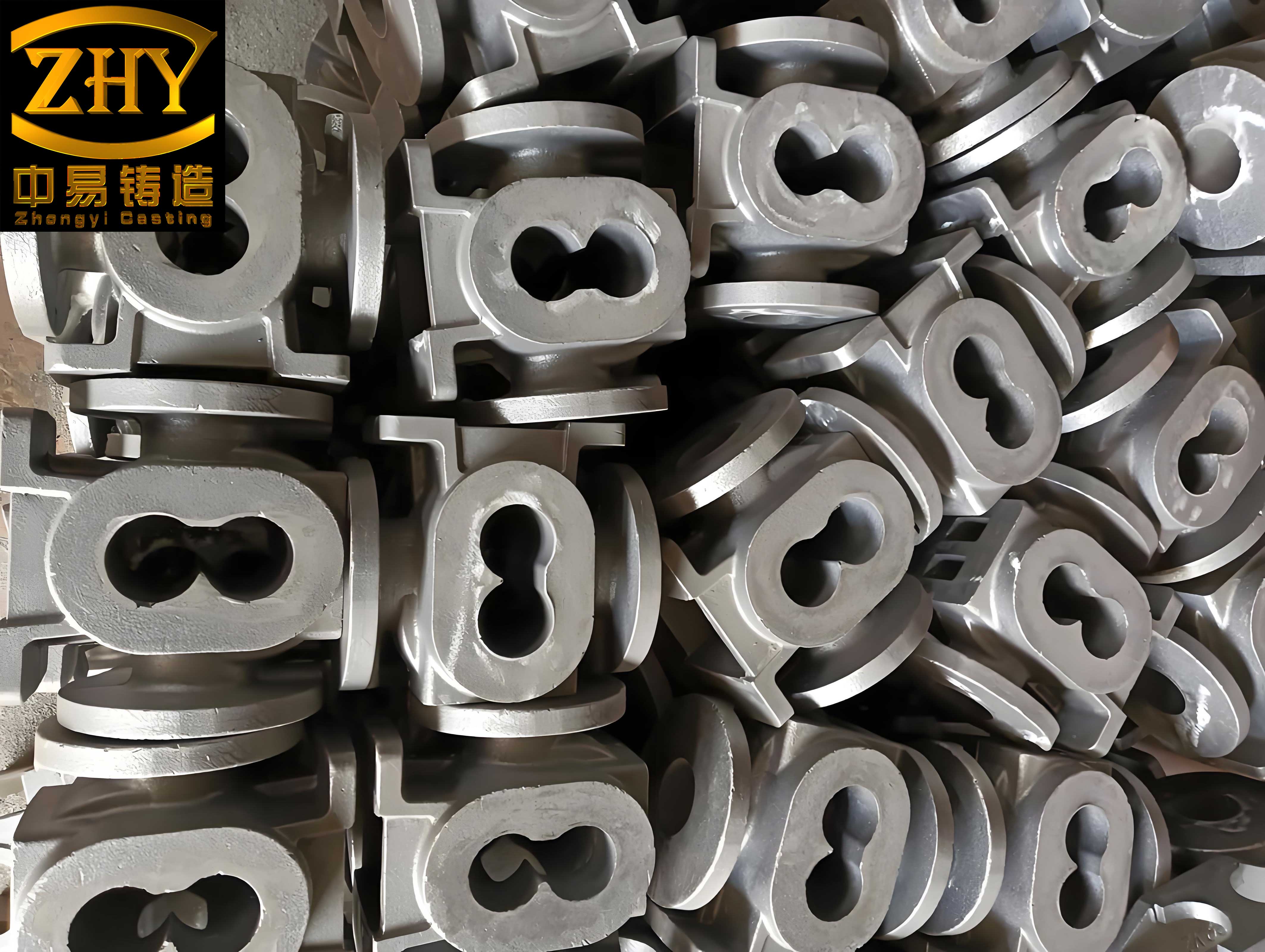
Root Cause Analysis of Graphite Degeneration
The formation of degenerate graphite in heavy sections of nodular cast iron, often termed “chunky graphite” or “exploded graphite,” is a well-documented phenomenon linked to prolonged solidification times and specific metallurgical conditions. My analysis focused on several interdependent factors from our initial process.
Metallurgical and Chemical Factors
The stability of graphite spheroids is highly sensitive to the local chemical environment during the lengthy eutectic solidification of a heavy section. Key elements play conflicting roles:
- Residual Elements: Trace elements like Lead (Pb), Antimony (Sb), Titanium (Ti), and even excess Cerium (Ce) can promote graphite distortion. Their effect is often synergistic.
- Sulfur (S) Content: A high sulfur level in the base iron consumes magnesium (Mg) during treatment to form MgS slag, reducing the effective Mg available for graphite shaping and increasing the risk of late-stage fading.
- Rare Earth (RE) Content: While beneficial for counteracting certain anti-nodularizing elements, an excessive amount of rare earths, particularly cerium, is a primary promoter of chunky graphite formation in slow-cooling conditions. The initial process used a standard nodulizer with significant RE content.
The local concentration of these elements can be described by a concept of “nodularizing potential” (NP), which deteriorates with time and temperature:
$$ NP(t) = [Mg]_{eff} – k_1[S] – k_2[O] – \sum(k_i[CET_i]) $$
where $[Mg]_{eff}$ is the effective magnesium accounting for fading, $[S]$ and $[O]$ are sulfur and oxygen contents, $CET_i$ represents concentrations of trace interfering elements, and $k$ are rate constants. In a heavy section, solidification time $t_s$ is large, leading to a significant decrease in $NP(t_s)$.
Process-Related Factors
The original casting and melting process exacerbated the metallurgical challenges:
| Process Parameter | Initial State | Impact on Heavy Section |
|---|---|---|
| Gating Design | Gates attached to the thick section | Created severe local superheating, extending local solidification time. |
| Pouring Temperature | 1360-1420°C | High superheat increased total solidification time $t_s$, promoting element segregation and graphite degeneration. |
| Solidification Time | Very long in the core | Governed by Chvorinov’s Rule: $t_s = k (V/A)^2$, where the modulus (V/A) was large. This allowed ample time for graphite shape deterioration. |
| Inoculation Practice | Single late stream inoculation | Insufficient to maintain a high graphite nodule count throughout the long solidification, increasing inter-nodular spacing and facilitating degenerate growth. |
Implemented Solutions and Process Optimization
The corrective strategy was multifocal, aiming to control the chemical environment, enhance graphite nucleation, and modify the thermal history of the critical section.
1. Metallurgical Adjustments
The chemical foundation was crucial. We tightened control over the base iron and treatment alloys.
| Element/Parameter | Target | Rationale |
|---|---|---|
| Base Iron Sulfur [S] | ≤ 0.020% | Minimize Mg consumption, improve treatment efficiency and fade resistance. |
| Nodulizer Type | Low-Ce, Mg-FeSi Alloy | Reduce the primary promoter (Ce) of chunky graphite in heavy sections. Composition: ~0.5% La, ~6.0% Mg. |
| Nodulizer Addition Rate | Increased to 1.2-1.3% | Ensure sufficient and sustained Mg activity to counteract fading over the extended solidification period. |
| Antimony (Sb) Addition | Controlled trace addition (~0.002%) | To neutralize the harmful effects of trace Pb, Bi, and potentially balance high Ce. The reaction can be simplified as: $Sb + Pb \rightarrow (Sb,Pb)$ compound, reducing free Pb activity. |
| Inoculation Strategy | Two-Stage: Ladle + Late Stream | Enhance nucleation. Ladle inoculation provides baseline nuclei. A powerful, sulfur/oxygen-bearing inoculant (0.12%) added during pouring creates fresh, potent nucleation sites just before solidification. The nodule count $N$ is critical: $N \propto f(I_{eff}, T_{pour})$. Higher $N$ reduces diffusion distances, stabilizing spherical growth. |
2. Casting Process Redesign
Altering the thermal history of the thick section was paramount.
- Gating Relocation: The ingates were moved from the thick central hub to a bottom-gating system through thinner sections. This eliminated the severe local superheating caused by hot metal streaming directly into the thermal center.
- Reduced Pouring Temperature: The range was lowered to 1340-1380°C. This directly reduces the total heat content and shortens the solidification time $t_s$, limiting the time available for graphite degeneration. The relationship is direct: $\Delta t_s \propto \Delta T_{pour}$.
- Risering: Adequate feeding using exothermic sleeves was maintained to prevent shrinkage, but their placement was reviewed to not add excessive heat to the problematic zone.
The new thermal gradient forced the thick section to solidify under a more favorable temperature profile, moving it from a last-to-freeze hot spot to a more uniformly cooling region.
Results and Verification
The implementation of this integrated approach yielded a dramatic improvement. Microstructural evaluation of the heavy section confirmed the complete elimination of the gross graphite deformation. The graphite was now predominantly spheroidal (80-90% nodularity) with a size consistent with ASTM 5-7. No carbides were present, and the pearlite content was well below the 10% limit.
| Property | Initial Result (from thick section) | Result After Optimization | Specification (QT400-15) |
|---|---|---|---|
| Tensile Strength (MPa) | 367 | 432 | ≥ 400 |
| Yield Strength (MPa) | 280 | 291 | ≥ 250 |
| Elongation (%) | 8 | 16 | ≥ 15 |
| Hardness (HB) | 187 | 167 | 130 – 185 |
The properties not only met but exceeded the requirements, demonstrating the full recovery of the material’s ductile potential. The hardness also moved into the ideal center of the specified range.
Generalized Learnings for Heavy-Section Nodular Cast Iron
This case reinforces fundamental principles for producing sound heavy-section nodular cast iron castings. The problem is never single-faceted; it is the intersection of chemistry and thermal history. A successful strategy must address both.
- Chemistry is Paramount: Control base S, use low-RE nodulizers specifically designed for heavy sections, and consider strategic use of balancing elements like Sb. The goal is to maintain a stable, non-degenerative environment around growing graphite nodules for an extended time.
- Thermal Management is Critical: Avoid direct gating into thick sections. Minimize pouring temperature to the lowest level consistent with mold filling. The governing equation is always Chvorinov’s, and every reduction in superheat or improvement in cooling rate (by reducing the effective modulus) shortens the window for defect formation.
- Robust Inoculation is Non-Negotiable: A high and persistent graphite nodule count is the best defense. Multiple inoculation stages, including a potent late addition, are essential to counteract fading during long solidification. The nodule count $N_v$ should be maximized: $N_v = N_0 \cdot e^{-Q/RT} \cdot I_{eff}$, where $I_{eff}$ is the effectiveness of inoculation practice.
- Interactions Rule: The effects of Ce, Mg, S, and trace elements are not independent. For instance, the detrimental effect of Ce is amplified by slow cooling. Process control must therefore be holistic and consistent.
In conclusion, resolving graphite deformation in demanding nodular cast iron castings requires a systems-engineering approach. By rigorously analyzing the synergy between alloy chemistry, treatment methods, and casting design, it is possible to robustly produce heavy-section components that reliably achieve their required microstructure and superior mechanical properties. This case stands as a testament to the fact that even in challenging geometries, the inherent benefits of nodular cast iron can be fully realized through precise and knowledgeable process control.