
The development of a robust and cost-effective production methodology for a series of complex, heavy-section grey iron castings presents significant metallurgical and engineering challenges. In my experience, these challenges are compounded when the product family is characterized by high mix, low volume, and stringent quality requirements mandating a defect-free machined surface. This article details a comprehensive, first-person investigation and process optimization undertaken to resolve persistent issues of shrinkage porosity and slag inclusions in a series of spiral components. The successful strategy hinged on a synergistic approach combining optimized chilling and feeding practices with a bottom-gating system, all tailored for the unique demands of producing high-integrity grey iron castings.
Introduction and Casting Challenges
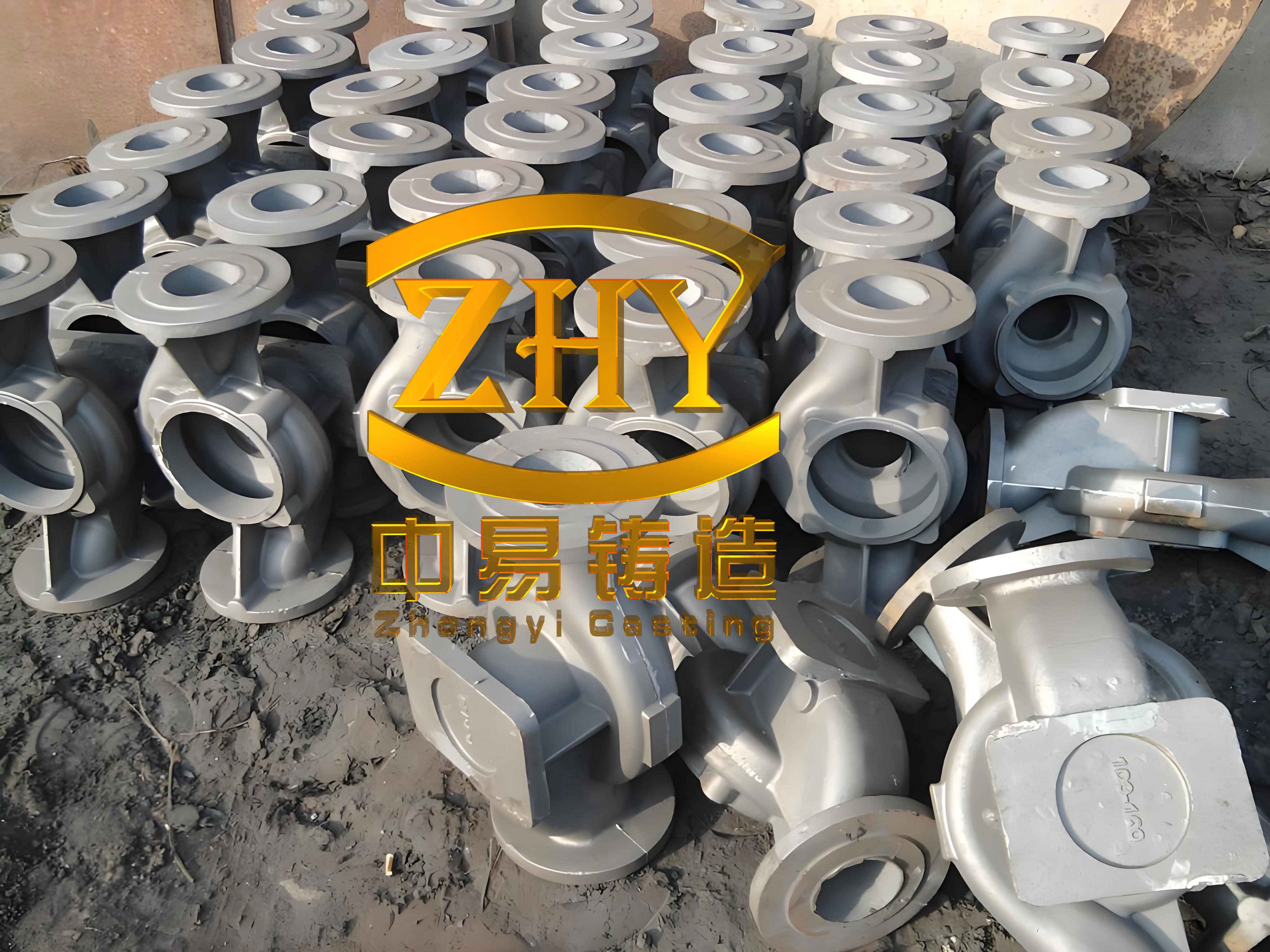
The subject components, generically termed “spiral series” grey iron castings, represent a family of parts with weights ranging from 500 kg to 2000 kg. These are quintessential examples of thick-section grey iron castings with non-uniform wall thickness distribution. The nominal wall is approximately 20 mm, but localized sections can reach up to 100 mm, creating complex thermal profiles and numerous isolated hot spots. The structural geometry inherently leads to challenging solidification dynamics. The primary technical hurdle was achieving a sound casting, post-machining, completely free from visually detectable defects and meeting stringent nondestructive testing (NDT) standards including Ultrasonic Testing (UT) and Magnetic Particle Inspection (MT). This requirement for perfection in such heavy grey iron castings sets a high bar for process control and design.
Defect Analysis and Root Causes for Grey Iron Castings
Initial production trials revealed two dominant failure modes: macro-shrinkage porosity and non-metallic slag inclusions. For thick-section grey iron castings, these defects are often interlinked with the solidification characteristics and metal handling practices.
Shrinkage Porosity: In grey iron, graphite precipitation during solidification leads to an expansion that can counter the shrinkage of the austenitic matrix. However, in heavy sections, the extended solidification time and the presence of isolated hot spots can disrupt this natural compensation. The long freezing range allows interdendritic channels to remain open while liquid feed metal is depleted, leading to dispersed microporosity or localized macro-shrinkage. The risk is modeled by considering the thermal gradient (G) and the solidification rate (R). Shrinkage tendency increases with a lower G/R ratio, which is prevalent in thick sections of grey iron castings.
The Niyama criterion, often adapted for cast irons, provides a useful indicator for shrinkage prediction:
$$ \frac{G}{\sqrt{\dot{T}}} \geq C $$
where \(G\) is the temperature gradient, \(\dot{T}\) is the cooling rate, and \(C\) is a material-specific constant. Areas where this value falls below the critical threshold are prone to shrinkage porosity in grey iron castings.
Slag Inclusions: These are primarily oxide-based films or particles entrapped within the casting. Sources include:
1. Primary slag from furnace melting and ladle transfer.
2. Secondary oxidation due to turbulent metal flow during mold filling.
3. Mold erosion (sand particles) washed into the cavity.
For large grey iron castings with lengthy filling times, the risk of oxide film formation and entrainment is significantly heightened, especially with top-gating systems.
| Defect Type | Primary Root Causes in Grey Iron Castings | Typical Location in Spiral Castings |
|---|---|---|
| Dispersed Shrinkage Porosity | Inadequate thermal control (gradient); Insufficient feeding pressure; Extended local solidification time. | Junction of thick ribs, flange hubs, and isolated heavy sections. |
| Slag Inclusions (Oxide Films/Sand) | Turbulent mold filling; High pouring temperature; Ineffective slag trapping; Poor mold surface integrity. | Upper surfaces, near ingates, and slow-filling areas of the cavity. |
Comprehensive Casting Process Optimization
The developed strategy was built on four interconnected pillars: process unification and cost reduction, tooling optimization, inclusion control, and shrinkage mitigation, all specifically designed for the series production of grey iron castings.
1. Process Standardization and Cost Management
For a multi-variant product line like the spiral series, standardization is key to economic viability. A single, universal gating system design was adopted for the entire weight range (200-1500 kg) of grey iron castings. This drastically reduced pattern costs and simplified foundry floor operations. Furthermore, the molding methodology was innovated to maximize flexibility with existing flask equipment. The pattern itself was designed as a modular “tooling-less” system comprising a core body and exchangeable “expansion blocks.” This allowed the same base pattern to be adapted for different casting sizes by swapping blocks, eliminating the need for costly full-pattern plates and reducing overall tooling investment by an estimated 50% for these grey iron castings. The molding sequence utilized a master plate for parting line definition, enabling efficient production of both cope and drag molds without permanent metal patterns.
2. Metal Quality and Inclusion Control for Grey Iron Castings
Controlling the source and transport of inclusions is paramount. The measures implemented formed a defense-in-depth strategy:
- Metal Source Control: The time from furnace tap to pour was strictly capped at 10 minutes to minimize oxidation and slag formation in the ladle.
- Ladle Treatment: A ceramic fiber board was placed on the ladle surface before pouring to absorb floating oxides, preventing their transfer into the downsprue.
- In-Mold Filtration: Ceramic foam filters (150x150x20 mm) were placed in the running system, specifically at the entrance to the ingates. These filters provide a tortuous path for the metal, effectively trapping macro-inclusions and promoting laminar flow into the cavity for grey iron castings.
- Mold Integrity: Rigorous pre-closing inspection ensured a clean cavity. All loose sand in corners or from fragile mold sections was removed.
- Gating System Design: The cornerstone of inclusion control was the adoption of a bottom-filling gating system. Coupled with the use of refractory ceramic tubes for ingates (to prevent erosion), this design ensures metal enters the mold cavity at the bottom with minimal velocity and turbulence. Any remaining oxides or eroded sand particles have a long, quiescent path to float upward and be trapped in the upper mold regions or slag pockets, away from critical casting areas. The upward movement of these inclusions in grey iron castings can be described by Stokes’ law, guiding riser and overflow placement:
$$ v_t = \frac{2}{9} \frac{(\rho_p – \rho_f)}{\mu} g R^2 $$
where \(v_t\) is the terminal velocity, \(\rho_p\) and \(\rho_f\) are the particle and fluid densities, \(\mu\) is the dynamic viscosity of iron, \(g\) is gravity, and \(R\) is the particle radius.
3. Thermal Management and Shrinkage Elimination
To address the dispersed shrinkage in these thick-section grey iron castings, a targeted combination of chills and risers was deployed to control solidification sequencing and ensure directional feeding.
- Strategic Chilling: High-conductivity iron chills were placed adjacent to identified hot spots and critical machining areas on the core side (drag). These chills act as heat sinks, rapidly extracting heat to create a steeper thermal gradient (increase \(G\)) and promote faster solidification at the casting surface, effectively eliminating local hot spots. This initiates a stable solidification front towards the risers.
- Optimized Feeding with Insulating Risers: Insulating sleeve risers were positioned on the cope side over the major thermal masses. Their function is to remain liquid significantly longer than the surrounding casting, providing a reservoir of molten metal to compensate for the volumetric shrinkage of the solidifying grey iron castings. The riser neck design is critical; it must freeze after the casting section but before the riser itself to ensure effective feeding pressure. The required riser volume can be estimated based on the casting section modulus and the shrinkage behavior of grey iron.
$$ V_{riser} \geq \frac{V_{casting} \cdot \beta}{\eta} $$
where \(V_{casting}\) is the volume of the section fed, \(\beta\) is the volumetric shrinkage of the liquid-to-solid transformation (accounting for graphite expansion), and \(\eta\) is the feeding efficiency of the riser (typically 10-20% for grey iron castings with insulating risers). - Low-Temperature Pouring: The process specified a relatively low pouring temperature of 1330 ±10°C. While this increases the risk of mistruns in thin sections, for these heavy grey iron castings it reduces the total heat content that must be removed, decreases metal oxidation, and minimizes the volume contraction during cooling, thereby reducing the demand on the feeding system.
| Process Aspect | Original/General Practice | Optimized Practice for Grey Iron Castings | Rationale |
|---|---|---|---|
| Gating System | Top or side gating, varied per model. | Standardized bottom-gating with ceramic filters and tubes. | Minimizes turbulence, promotes inclusion float-out, standardizes operation. |
| Feeding | Generic riser placement, limited chilling. | Combined insulating risers (cope) + active chills (drag) at hot spots. | Creates directional solidification, feeds isolated thermal centers effectively. |
| Pouring Temperature | ~1360-1380°C | 1330 ±10°C | Reduces total heat load, shrinkage volume, and oxide formation. |
| Pattern Tooling | Dedicated metal pattern plates per model. | Modular wooden pattern with exchangeable blocks; tooling-less design. | Drastically reduces cost and lead time for low-volume series of grey iron castings. |
| Mold Filling Time | Not explicitly controlled. | Designed for slow, laminar fill via large choke area in filters/bottom gate. | Ensures calm fill to prevent mold erosion and air entrainment. |
Results, Verification, and Production Performance
The efficacy of the optimized process was rigorously validated through both simulation and physical casting trials. Solidification modeling using commercial software (e.g., ProCAST) was employed to predict shrinkage risk. The simulation output for the final design showed a significant reduction in predicted shrinkage volume, with the majority of the porosity index concentrated safely within the riser necks and isolated to non-critical areas, achieving a predicted shrinkage percentage of approximately 1% in the casting body. This confirmed the effectiveness of the chill and riser synergy for these grey iron castings.
Three separate production trials (“1+2+4” batch sequence) were conducted. All resultant grey iron castings were subjected to full NDT. The results were consistent: both MT and UT inspections met the stringent Grade 1 / Grade SM 3 requirements. Most importantly, post-machining visual inspection confirmed the complete absence of shrinkage cavities and slag defects on critical surfaces.
The process has been fully implemented for series production. To date, this methodology has been successfully applied to produce over 150 castings across 35 different variants within the spiral family. The consistency in quality and the absence of defect-related scrap or rework demonstrate the robustness and scalability of the optimized process for manufacturing heavy-section, high-quality grey iron castings.
Conclusion and Future Directions
The successful resolution of shrinkage and slag defects in the spiral series underscores a fundamental principle in casting engineering: a holistic, integrated approach is necessary for complex grey iron castings. The key findings and contributions of this work are:
- The bottom-gating system, when combined with in-mold filtration and ceramic tubes, is exceptionally effective in controlling slag inclusions in large grey iron castings by ensuring a quiescent fill and providing a mechanism for inclusion floatation and capture.
- The synergistic use of chills and insulating risers is critical for managing the solidification of uneven sections. Chills eliminate local hot spots and establish solidification direction, while risers provide the necessary feed metal volume. This combination is highly effective for mitigating shrinkage porosity in thick-section grey iron castings.
- Process standardization and modular tooling design are viable and economically essential strategies for managing high-mix, low-volume production environments without compromising the quality of grey iron castings.
- Control over metal purity and mold cleanliness forms the foundational defense against non-metallic inclusions, and this must be supported by the gating system design.
The underlying principles can be encapsulated in a conceptual process quality index (PQI) for such castings, considering major factors:
$$ \text{PQI} \propto \frac{(G/\sqrt{\dot{T}})_{\text{min}} \cdot F_e \cdot t_f}{T_{\text{pour}} \cdot V_{\text{riser}}} $$
where \((G/\sqrt{\dot{T}})_{\text{min}}\) is the minimum Niyama value in critical sections, \(F_e\) is the filtration efficiency factor, \(t_f\) is the fill time (optimized for laminar flow), \(T_{\text{pour}}\) is the pouring temperature, and \(V_{\text{riser}}\) is the riser volume (optimized for feeding). Maximizing this index correlates with higher soundness in grey iron castings.
Future work will focus on further digitizing this process. This includes the development of a digital twin for the casting process, integrating real-time sensor data (pour temperature, cooling curves) with the initial simulation model to enable predictive corrections. Furthermore, exploring advanced genetic algorithm-based optimization of riser and chill placement could automate the design process for new variants of grey iron castings, reducing lead time and pushing the boundaries of achievable quality in ever-more complex geometries. The knowledge gained reinforces that the production of flawless, heavy-section grey iron castings is an achievable standard through meticulous, physics-based process design and control.