
In my experience working on gray iron castings, particularly for medium-speed engine components, I have encountered a persistent and costly defect known as shrinkage depression. This issue manifests as surface cavities or pits on the upper planes of castings, often leading to scrap rates that impact production schedules and economic viability. The defect is characterized by localized volume deficits that occur during solidification, sometimes accompanied by small metal droplets or “iron beans” expelled during the final stages of graphite expansion. Addressing this problem requires a holistic understanding of metallurgical, process, and mold design factors. In this comprehensive discussion, I will delve into the root causes of shrinkage depression in gray iron castings, drawing from a specific case study of a flywheel casting, and present detailed analytical and practical solutions that have proven effective. Throughout, I will emphasize the importance of controlled parameters and simulation tools in enhancing the quality of gray iron castings.
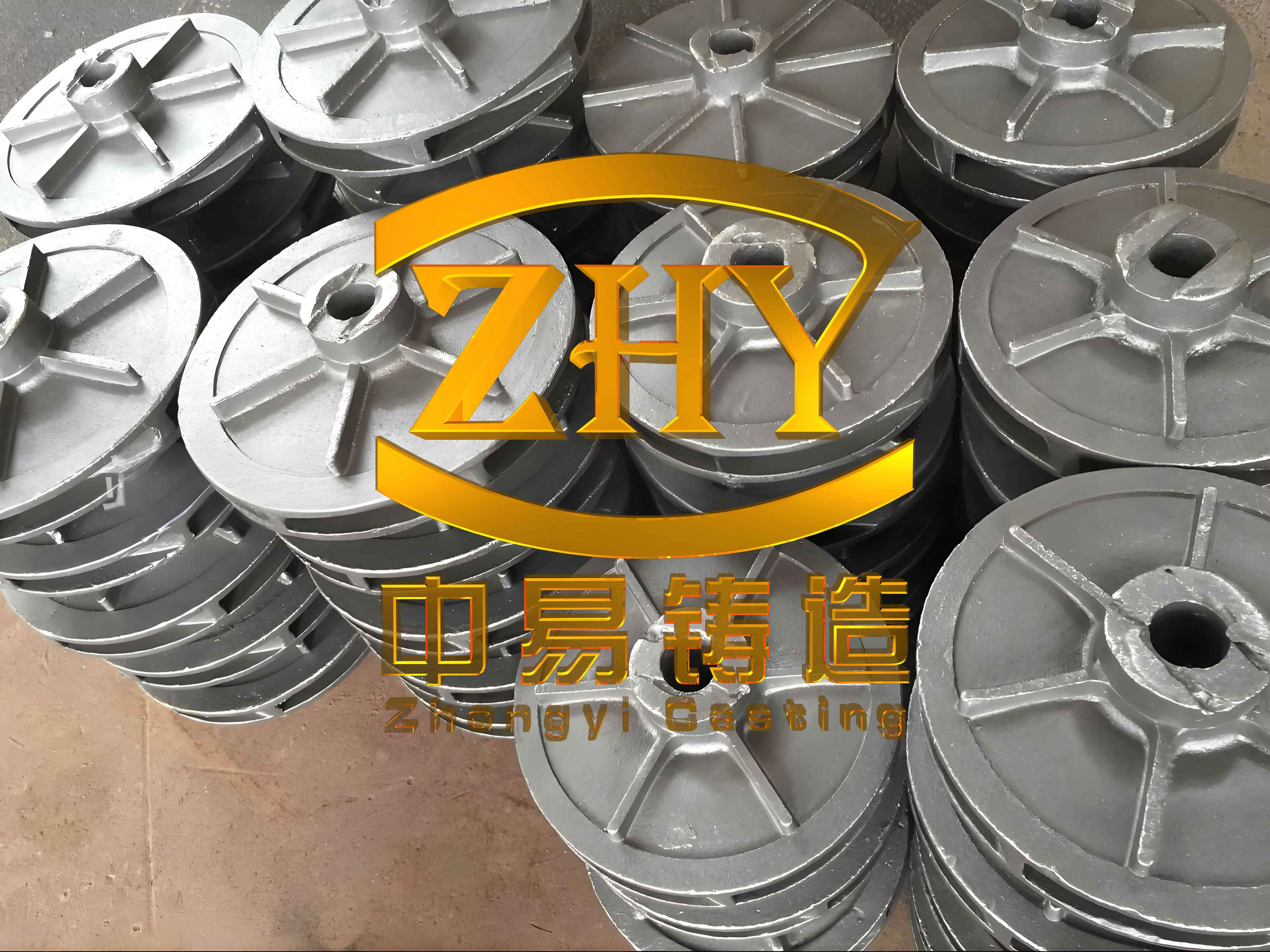
Gray iron castings, such as the flywheel in focus, are widely used in industrial applications due to their excellent castability, damping capacity, and machinability. However, their susceptibility to shrinkage defects, especially in sections with varying thicknesses, poses significant challenges. The flywheel casting under discussion has a轮廓尺寸 of approximately 702 mm in diameter and 133 mm in height, with a minimum wall thickness of 46 mm. The casting weight is around 245 kg, and the material specification is HT250 gray iron, requiring a hardness range of 190–240 HBW. The microstructure must predominantly consist of Type A graphite, with minor允许ance for Type B, and a pearlite content exceeding 98%. Such specifications are typical for high-duty gray iron castings used in engine systems, where mechanical integrity is paramount.
The production of these gray iron castings initially followed a standardized process on a high-volume流水线. The molding utilized alkaline phenolic resin自硬砂, with two castings arranged in a single mold box. The gating system was of a封闭式 design, with a截面 ratio set as ΣAsprue : ΣArunner : ΣAgate = 1.64 : 2.05 : 1, where the gates served as the choke points. The molten iron composition, as shown in Table 1, was maintained within specified ranges, but subtle imbalances contributed to the defect. The pouring temperature was initially set at 1350–1360°C, with two molds poured from a single ladle.
| Element | C | Si | Mn | P | S | Cu | Cr |
|---|---|---|---|---|---|---|---|
| Content | 3.3 | 1.9 | 0.95 | 0.04 | 0.09 | 0.4 | 0.28 |
Upon inspection, the shrinkage depression defects on the flywheel’s upper surface were severe, with depths often exceeding 3 mm and in some cases reaching over 5 mm, leading to rejection. This prompted a detailed investigation into the underlying causes. Shrinkage depression in gray iron castings is fundamentally a result of volumetric contraction during solidification, which can be exacerbated by several factors. In metallurgical terms, the behavior of gray iron during cooling involves liquid contraction,凝固收缩, and graphite expansion. The net volume change determines whether defects like shrinkage cavities or depression occur. The carbon equivalent (CE) plays a crucial role, as it influences the solidification range and the amount of graphite precipitation. For gray iron castings, the carbon equivalent is commonly calculated as:
$$ CE = C + \frac{1}{3}(Si + P) $$
In the initial composition, with C at 3.3% and Si at 1.9%, the CE is approximately 3.97%, which places the iron in the亚共晶 region. This results in a wider freezing range, leading to increased液态收缩 and a higher tendency for shrinkage defects. The liquid contraction can be estimated using the formula:
$$ \Delta V_l = \alpha_l \cdot (T_{pour} – T_{liquidus}) $$
where $\Delta V_l$ is the liquid contraction volume, $\alpha_l$ is the coefficient of liquid expansion for iron (typically around $1.0 \times 10^{-4} \, \text{°C}^{-1}$), $T_{pour}$ is the pouring temperature, and $T_{liquidus}$ is the liquidus temperature. For gray iron castings with a CE of 3.97%, $T_{liquidus}$ is roughly 1150°C. With a pouring temperature of 1360°C, the temperature drop is 210°C, leading to significant liquid contraction. Additionally, the solidification shrinkage for gray iron, influenced by graphite expansion, can be modeled as:
$$ \Delta V_s = \beta_s \cdot (T_{liquidus} – T_{solidus}) – \gamma_g $$
Here, $\Delta V_s$ is the solidification shrinkage, $\beta_s$ is the solidification shrinkage coefficient (approximately 0.03 for gray iron), and $\gamma_g$ represents the volume expansion due to graphite precipitation (which can offset shrinkage). In hypoeutectic gray iron castings, the graphite expansion may be insufficient to compensate for contraction, especially if the CE is low or the cooling rate is high.
Beyond metallurgy, process parameters were scrutinized. The high pouring temperature of 1360°C exacerbated liquid contraction, as outlined above. Moreover, the gating system design was identified as a critical factor. The封闭式 system with gates as chokes caused turbulent flow, with gate velocities estimated at around 200 cm/s. This turbulence led to air entrainment and pressure fluctuations, resulting in an unstable meniscus during pouring. After pouring stopped, the liquid level in the gating system dropped sharply, reducing its ability to feed liquid metal during the critical液态收缩 phase. The gate height was only 5 mm, which caused premature solidification, further hindering feeding. Additionally, the mold strength was inadequate due to insufficient compaction during molding, with a震实 time of only 15 seconds. This allowed mold wall movement under metallostatic pressure, contributing to dimensional inaccuracies and volume deficits in the gray iron castings.
To address these issues, a multi-faceted改进 strategy was implemented, leveraging both empirical adjustments and simulation tools like Magma software. First, the carbon equivalent was increased by raising the carbon content from 3.25% to 3.3%, aiming to shift the iron closer to the eutectic point and enhance graphite expansion. The revised composition is summarized in Table 2, along with the calculated CE. This adjustment reduces the freezing range and promotes a more favorable solidification pattern for gray iron castings.
| Element | C | Si | Mn | P | S | Cu | Cr | CE |
|---|---|---|---|---|---|---|---|---|
| Content | 3.3 | 1.9 | 0.95 | 0.04 | 0.09 | 0.4 | 0.28 | 3.97 |
Second, the pouring temperature was strictly controlled at 1350°C, with the implementation of camera monitoring in the pouring area to ensure compliance. By reducing $T_{pour}$, the liquid contraction volume $\Delta V_l$ is minimized, as per the earlier formula. For instance, with $T_{pour} = 1350°C$ and $T_{liquidus} = 1150°C$, the temperature drop is 200°C, yielding a 5% reduction in liquid contraction compared to the initial 210°C drop. This subtle change can significantly impact defect formation in gray iron castings. Furthermore, production scheduling was adjusted to concentrate flywheel castings, avoiding prolonged holding times that could elevate铁水 temperature unnecessarily.
Third, the mold strength was enhanced by increasing the震实 time from 15 seconds to 25 seconds, ensuring better compaction of the resin sand. This improves the mold’s rigidity, reducing wall movement and maintaining dimensional stability during solidification. The effective mold stiffness can be approximated by the砂型强度 factor, which influences the pressure transmission during graphite expansion. A stiffer mold better contains the expansion, promoting self-feeding within the gray iron castings.
Fourth, the gating system was radically redesigned using Magma simulation software. The initial system was replaced with a封闭开放式 design, incorporating a choke between the sprue and runner to regulate flow. This modification transformed the system into an open configuration beyond the choke, significantly calming the metal flow. Simulation results, as illustrated in Table 3, show that the gate velocity decreased from approximately 200 cm/s to 80 cm/s, reducing turbulence and promoting laminar filling. The runner was redesigned from a full circle to a 3/4 circle with a slag trap at the end, further stabilizing the flow. Additionally, the gate height was increased from 5 mm to 8 mm, while the width was proportionally reduced to maintain the same cross-sectional area. This change延长ed the gate solidification time, allowing it to remain open longer and provide liquid feeding during the critical收缩 phase. The new截面 ratio was optimized to ΣAsprue : ΣArunner : ΣAgate = 1.5 : 1.8 : 1, with the choke serving as the flow control point.
| Parameter | Initial Design | Optimized Design |
|---|---|---|
| Gating System Type | Closed (Choke at Gate) | Closed-Open (Choke at Sprue-Runner Junction) |
| Gate Velocity (cm/s) | ~200 | ~80 |
| Gate Height (mm) | 5 | 8 |
| Runner Design | Full Circle | 3/4 Circle with Slag Trap |
| Simulated Flow Stability | Unstable, Turbulent | Stable, Laminar |
The Magma simulations also provided insights into the solidification sequencing and feeding efficiency. By analyzing temperature gradients and liquid fraction maps, it was confirmed that the optimized gating system promoted directional solidification toward the feeders, reducing isolated hot spots that lead to shrinkage in gray iron castings. The software allowed for virtual testing of different scenarios, such as varying pouring temperatures and gate designs, without physical trials, saving time and resources. The final design ensured that the gates remained液态 longer than the adjacent casting sections, acting as effective feeders. This is critical for gray iron castings, where the balance between contraction and expansion must be managed precisely.
Fifth, the pouring practice was adjusted to include a slight overflow volume in the gating system. This compensates for any meniscus fluctuations caused by initial turbulence, ensuring that the liquid level remains high enough to exert sufficient metallostatic pressure for feeding. The overflow volume can be calculated based on the gating system dimensions and the expected contraction volume. For the flywheel casting, an additional 5% of the total poured volume was allocated to overflow, which proved effective in maintaining feeding pressure.
After implementing these measures, approximately 100 flywheel castings were produced and inspected. The results were markedly improved: the upper surfaces were smooth and free from shrinkage depression defects, with no pits exceeding acceptable limits. This success underscores the importance of a systematic approach in solving defects in gray iron castings. The combination of metallurgical adjustments, process controls, and advanced simulation tools provided a robust solution that can be adapted to similar challenges in other gray iron castings.
To generalize the findings, I have developed a set of guidelines for preventing shrinkage depression in gray iron castings, summarized in Table 4. These guidelines integrate the key factors discussed and can serve as a checklist for process engineers.
| Factor | Optimal Range | Rationale |
|---|---|---|
| Carbon Equivalent (CE) | 4.0–4.2% for HT250 | Promotes eutectic solidification, enhances graphite expansion to offset shrinkage. |
| Pouring Temperature | 1330–1350°C | Minimizes liquid contraction; too low may cause mistruns, too high increases contraction. |
| Gating System Design | Closed-Open with Choke, Gate Velocity < 100 cm/s | Ensures calm filling, prolongs gate liquid time for feeding. |
| Gate Height | ≥ 8 mm for medium sections | Delays solidification, acts as effective feeder. |
| Mold Strength | High compaction,震实 time ≥ 20 s | Prevents mold wall movement, maintains dimensional stability. |
| Simulation Usage | Employ tools like Magma for optimization | Predicts flow and solidification, identifies hot spots, reduces trial runs. |
From a theoretical perspective, the behavior of gray iron castings during solidification can be modeled using the following integrated volume change equation, which accounts for both contraction and expansion:
$$ \Delta V_{total} = V_0 \left[ \alpha_l (T_{pour} – T_{liquidus}) + \beta_s (T_{liquidus} – T_{solidus}) – \gamma_g \right] $$
where $V_0$ is the initial volume of the casting, $\alpha_l$ is the liquid contraction coefficient, $\beta_s$ is the solidification shrinkage coefficient, and $\gamma_g$ is the graphite expansion factor. For gray iron castings with high CE, $\gamma_g$ can be significant, often around 0.02–0.03, which can fully compensate for solidification shrinkage. However, in hypoeutectic irons, $\gamma_g$ is reduced, making the net $\Delta V_{total}$ positive (i.e., shrinkage occurs). By optimizing CE and pouring temperature, we aim to achieve $\Delta V_{total} \leq 0$, indicating no net shrinkage. This principle is fundamental to producing sound gray iron castings.
In practice, the interaction between mold stiffness and internal pressures is also crucial. During graphite expansion, the pressure generated within the casting can be expressed as:
$$ P_g = \frac{E_m \cdot \gamma_g}{1 – \nu_m} $$
where $E_m$ is the Young’s modulus of the mold material, and $\nu_m$ is its Poisson’s ratio. A stiffer mold (higher $E_m$) results in higher $P_g$, which helps push liquid metal into shrinking regions. Therefore, enhancing mold strength through proper compaction is vital for gray iron castings.
The success of this case study highlights the value of a data-driven approach. By collecting and analyzing process data, such as composition logs, temperature records, and defect maps, patterns can be identified to preempt issues in gray iron castings. For instance, statistical process control (SPC) charts can be used to monitor CE and pouring temperature trends, ensuring they remain within optimal limits. Additionally, the use of simulation software like Magma allows for predictive modeling, reducing the need for costly physical prototypes. These tools are especially beneficial for complex gray iron castings with varying section thicknesses, where shrinkage risks are heightened.
Looking beyond the flywheel example, the lessons learned are applicable to a wide range of gray iron castings, such as engine blocks, cylinder heads, and gearboxes. In all these components, managing solidification behavior is key to avoiding defects. For instance, in thick-walled gray iron castings, chills or cooling fins can be used to promote directional solidification, while in thin-walled ones, gating design becomes more critical to ensure adequate feeding. The principles of carbon equivalent control, temperature management, and mold rigidity remain universal.
In conclusion, shrinkage depression in gray iron castings is a multifaceted problem that requires a comprehensive solution strategy. Through the detailed analysis and改进措施 described, I have demonstrated how combining metallurgical adjustments, process optimizations, and advanced simulation can effectively eliminate this defect. The key takeaways include: increasing carbon equivalent to enhance graphite expansion, lowering pouring temperature to reduce liquid contraction, redesigning gating systems for平稳 flow, increasing mold strength to resist deformation, and leveraging simulation tools for predictive insights. These measures not only resolved the immediate issue with the flywheel castings but also provided a framework for improving quality across other gray iron castings. As foundries continue to advance, embracing such integrated approaches will be essential for achieving high yields and consistent performance in gray iron castings.